New PSA screening updates (ACS 2026):
🔹 Now a recommendation, not just a talk about it
🔹 Average risk: PSA every 2 yrs, age 50–69
🔹 Black men or strong family history: yearly from 45
🔹 High PSA (≥3; ≥6.5 at 70–74): repeat, then MRI/biomarker before biopsy
🔹 No DRE. Stop at 75
💡 Screen on schedule, but let MRI pick the biopsy.
https://t.co/JOhz0JOXlQ
#ProstateCancer #PSA #Urology
JUST IN: @AmericanCancer (ACS) updates their guidance about routine PSA screening for #prostatecancer, moving off "shared decision-making".
This is a major shift since the last ACS recommendations in 2010:
1) High risk (Black men; first-degree relative dx <65 or multiple at any age): annual PSA, ages 45-69
2) Average risk: PSA every 2 years, ages 50–69. American Cancer Society
3) Non-Black men with 1 first-degree relative diagnosed ≥65: PSA every 2 years, ages 45–69.
4) Age 70–74: individualized decision; if screening continues, every 2 years.
5) Age ≥75: generally no screening; very healthy men 75–79 may discuss continued screening.
6) No screening ≥80 and no screening at any age with life expectancy <10 years.
@CACancerJournal@DanaFarber_GU@harvardmed@OpenMedInsights
Link: https://t.co/iIavJuqoGu
HER2+ THERAPY IS BECOMING RESPONSE-ADAPTED
A simple algorithm proposed by Tarantino et al. (JCO 2026):
▪️ Stage IIA → THP → Surgery → HP
▪️ Stage IIB → THP → Response assessment → Continue THP or escalate to T-DXd
▪️ Stage III → TCHP or THP → T-DXd → Surgery
▪️ pCR → Complete planned HER2-directed therapy
▪️ Residual disease → T-DXd or T-DM1
The concept is simple:
✓ Stage
✓ Biology
✓ Treatment response
Together determine treatment intensity.
We are moving beyond a one-size-fits-all approach toward more personalized HER2-directed therapy.
Adapted from Tarantino et al., JCO 2026.
#BreastCancer #HER2 #HER2Positive #Oncology #JCO #ASCO #TDXd
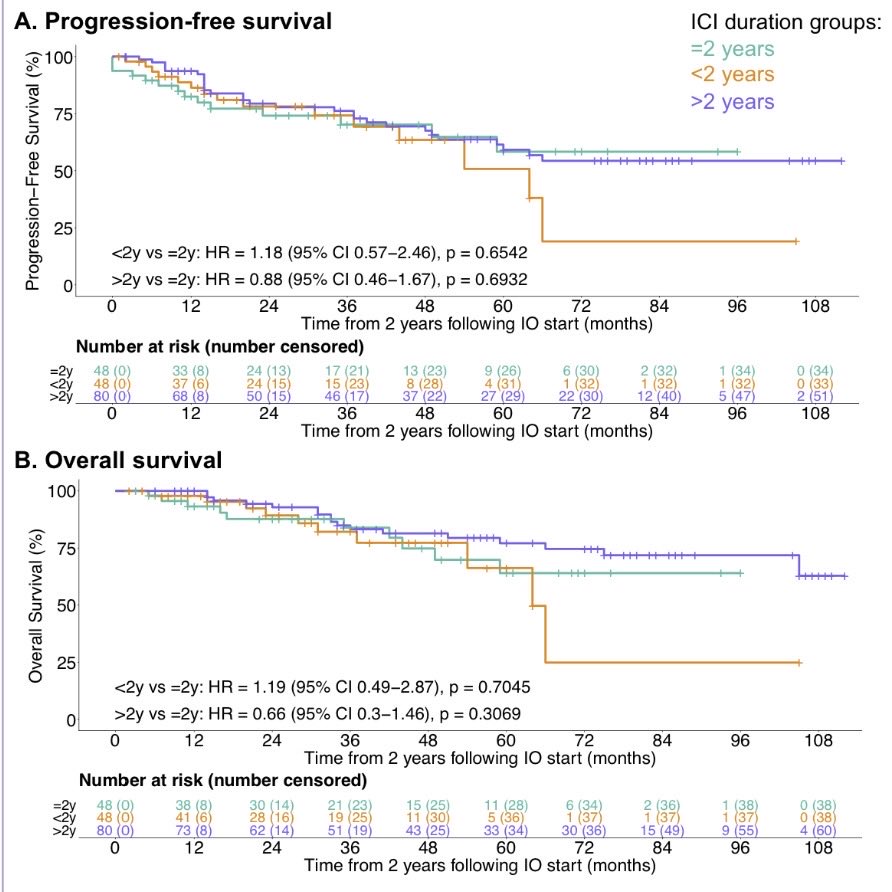
Here the 🇧🇪 🇧🇪 Belgium team (Jeremy Blanc & Christof Vulsteke) compare patients stopping or continuing PD(L)1 therapy at 2 yrs in responders (large global retrospective series). The Data suggests it is safe (KM curve green line= stops at 2 yrs; purple line = continues beyond 2 yrs). The recent MIOI randomized trial suggested earlier IO cessation may not be safe, especially in bladder cancer patients. @OncoAlert@DrChoueiri@montypal@PGrivasMDPhD
#ESMO26 Management of mCRPC: Personalized treatment selection and sequencing @dmukherji@urotoday
Spectrum of PARPi sensitivity in mCRPC by HRR gene alteration
Evidence from PROfound, MAGNITUDE, TALAPRO-2, PROpel, and FDA pooled analysis
“How do you pick your front line treatment option”? This question was asked by multiple different community colleagues.
@montypal: “There is no wrong answer…” and here is the data for IO/IO or IO-TKI in 1L metastatic #KidneyCancer#GUSM#OncTwitter
1/2
🫁🫁 Efficacy of ADCs following EGFR-TKI therapy 🫁🫁
💥💥 At #ESMO26, there was a series of presentations on ADCs for patients whose disease had progressed after EGFR-TKI therapy, and promising results were reported.
While treatment options have increased, the landscape has become increasingly crowded.
💥💥 Sac-TMT - OptiTROP-Lung04
💥💥 Iza-Bren - PANKU-Lung01
💥💥 Ruzaltatug rezatecan - HERON-Lung01
#LCSM
#Lung
#EGFR
#ESMO26
@myESMO
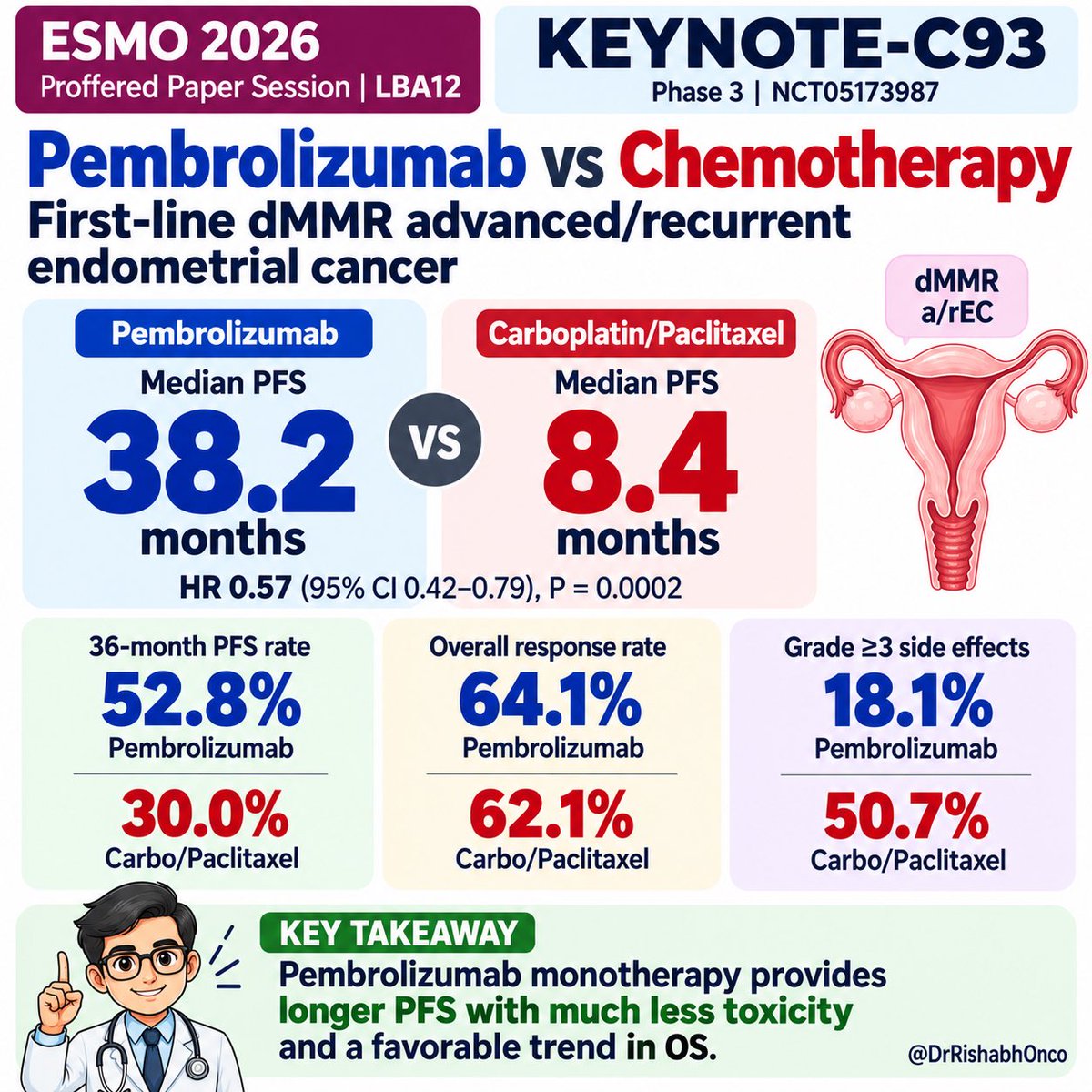
KEYNOTE-C93: pembrolizumab alone vs carboplatin/paclitaxel, first line, dMMR }#endometrialcancer, stage III to IV or recurrent, including carcinosarcoma. N=299.
PFS: median 38.2 vs 8.4 months, HR 0.57. At 3 years, 53% vs 30% progression-free. OS: HR 0.77 (0.52 to 1.15), not significant.
The OS result is explained by subsequent lines as most patients on chemo alone would get immunotherapy at progression. So survival may depend less on whether IO comes first, and more on whether the patient gets it at all.
That turns this into a different question: what does the patient gain by skipping chemo? No alopecia, no neuropathy, no 6 cycles of carboplatin/paclitaxel. For many dMMR patients, that's worth a lot.
The catch: about 20% progress by the first scan on pembro alone. Those are the patients chemo-IO would have held.
How I'll use it: pembro alone for the patient who wants to avoid chemo, or is frail, with low-volume disease. Chemo-IO for bulky, symptomatic disease where I can't afford early progression.
One detail to check: resected stage IVB with no visible disease was allowed. I want PFS split by measurable disease at baseline.
What we need now: a way to identify the early progressors before we start, and results by MMR mechanism, MLH1 hypermethylation vs MMR gene mutation. #gyncsm #ESMO26
@myESMO
🧬 ESMO 2026 | 12 PRESIDENTIAL ABSTRACTS
12 trials. 12 take-home messages. One glance.
From personalised mRNA vaccines and ADCs to targeted therapy, immunotherapy combinations and treatment de-escalation.
✅ What improved: RFS, PFS, EFS, MFS or OS?
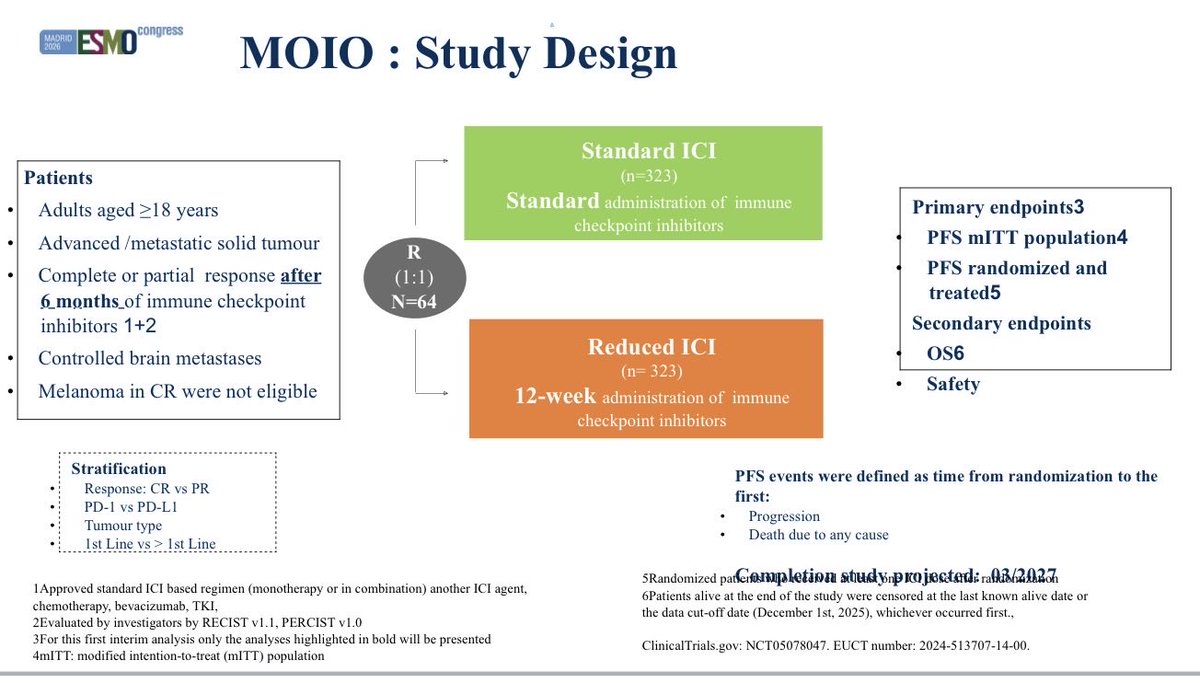
⚠️ MOIO reminds us: Less frequent treatment is not automatically equivalent.
The evidence in one line. The implications for practice.
@myESMO@OncoAlert@larvol
#ESMO26 #Oncology #ClinicalTrials #MVOnco
The MOIO randomised phase 3 non-inferiority trial (n=340) explored early discontinuation of ICI therapy be SOC in advanced patients responding to therapy. It had many flaws (mixed tumors and treatments, small size, early discontinuation etc). Also, due to the statistics, it’s not possible to say whether non-inferiority was achieved (OS HR 1.89 [95%Cl: 1.03,3.48]). Despite these problems it highlights a concern around early discontinuation, which should be taken seriously. Tumour specific trials are needed, but I’m not sure it will be easy to randomize patients . #ESMO26 @OncoAlert@myESMO@Annals_Oncology
🚨 38.2 vs 8.4 MONTHS!
Can we eliminate chemotherapy in first-line dMMR endometrial cancer?
#ESMO26 LBA12 | KEYNOTE-C93
Pembrolizumab vs Carbo/Paclitaxel:
🔥 PFS: 38.2 vs 8.4 months (HR 0.57)
🔥 Grade ≥3 TRAEs: 18.1% vs 50.7%
🔥 Median response duration: NR vs 10.2 months
A major step toward chemotherapy-free treatment!
OS remains immature.
@myesmo@ESMO_open@ASCO@oncoalert