A new study from Brown and Mass General Brigham Neuroscience Institute shows how an implantable brain-computer interface enables rapid, accurate typing for people with ALS and spinal cord injuries — helping restore communication after paralysis. https://t.co/ye3yJfUKJX
A recently published Brown study allows paralyzed patients to “type” at up to 22 words per minute. The work uses electrode arrays to track the neural signals associated with attempted finger movements for typing on a keyboard.
https://t.co/84brnA74uF
"This is an important technical advance that brings brain-computer typing much closer to practical communication speeds for people with paralysis." https://t.co/jdrHAJsqK4
A device capable of translating activity in the brain during attempted keyboard typing into typed text is presented in @NatureNeuro. This approach could offer a more familiar and easier-to-learn alternative to communication systems: https://t.co/41bCo4ITtV
New study in the world of #iBCI from the team at @MassGenBrigham 🚨
The @BrainGateTeam's new innovative method enables rapid communication for two people with paralysis, the fastest yet in the world of iBCI.
Read more: https://t.co/ZUV7NNFjJo https://t.co/VkvNhyleCi
Two people with paralysis were able to type using a brain-computer interface that decodes attempted finger movement, a new study showed. https://t.co/pSR1D8yVWL
Unos electrodos conectados al cerebro permiten a dos personas con parálisis teclear con la mente. Uno de los pacientes, con tetraplejía, logró velocidades similares a las de la media y casi sin errores https://t.co/Vjvc0oTJ48
Another brain-computer interface record set in the published record: fastest communication based on hand movements (typing in this case): https://t.co/foO2VGFTmD
Congrats Justin and the rest of the @BrainGateTeam!
Decoding intended speech with an intracortical brain-computer interface in a person with longstanding anarthria and locked-in syndrome https://t.co/WOOHrwFylC #biorxiv_neursci
Our new preprint describes a multimodal intracortical brain-computer interface that a man with ALS has used at home, independently, almost every day for >19 months. It decodes both speech and cursor control to enable him to communicate and use his computer. Here’s a quick tour👇
We're excited to announce the Brain-to-Text '25 competition, with a new intracortical speech neuroscience dataset and $9,000 in prizes generously provided by @BlackrockNeuro_!. Can you do better than us at decoding speech-related neural activity into text?
https://t.co/MKz7WuHjTh
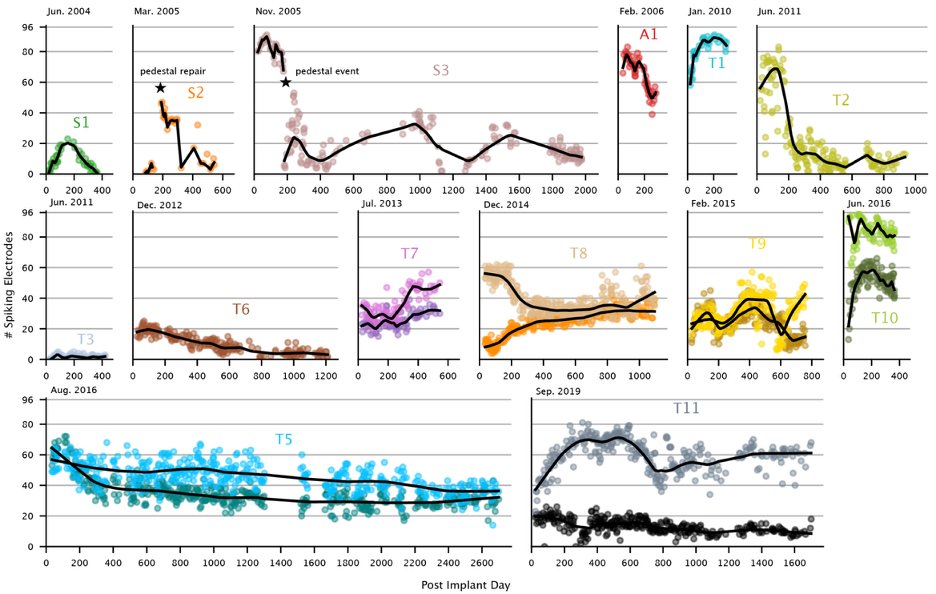
20 years and 14 BrainGate participants - our latest preprint delivers the first systematic look at Utah array longevity, stability & decoding accuracy in people! 1/7 https://t.co/IRB1ZnVHOu
Our brain-to-voice synthesis brain-computer interface paper was published in @Nature today! This neuroprosthesis synthesized the voice of a man with ALS instantaneously, enabling him to ‘speak’ flexibly and modulate the prosody of his BCI-voice. 1/7
Paper: https://t.co/STKtfgypAW
I’m excited to present our new preprint!
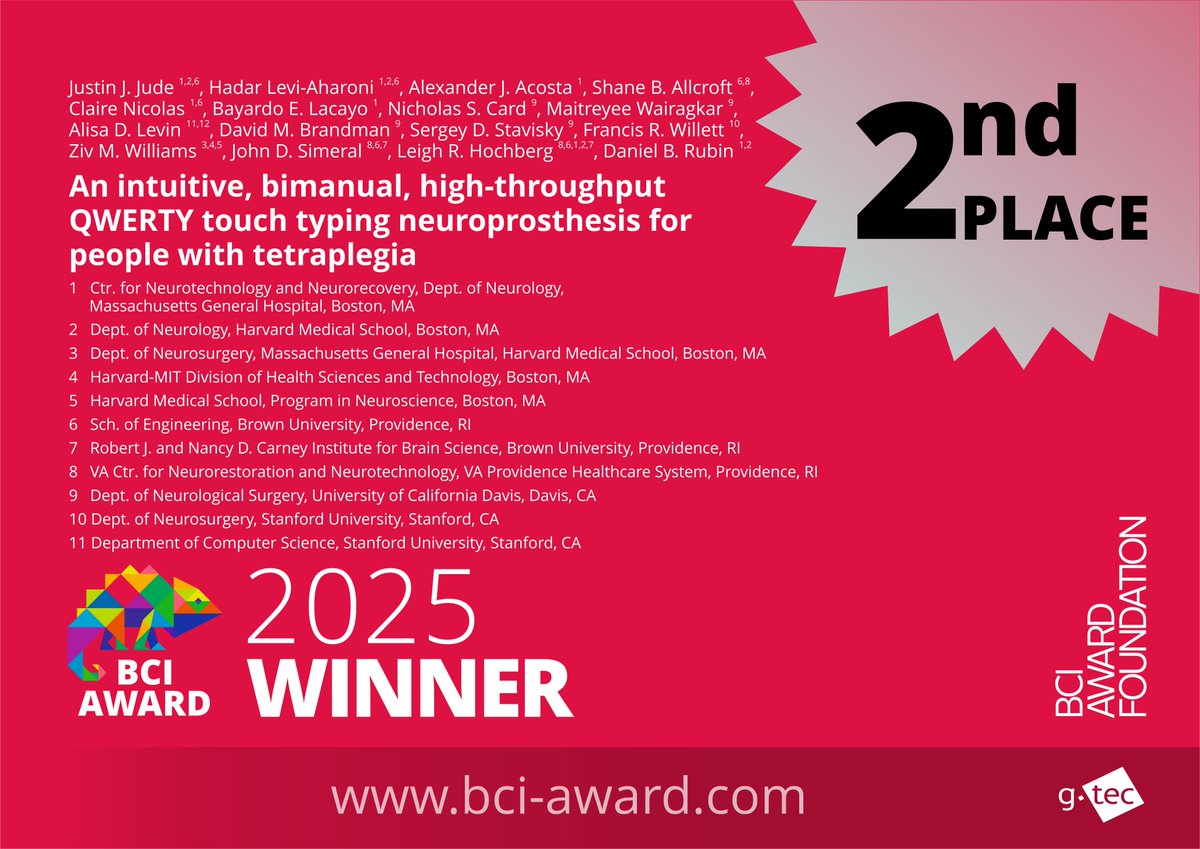
An intuitive, bimanual, high-throughput QWERTY touch typing neuroprosthesis for people with tetraplegia.
https://t.co/mSJbbV5cS4
Excited to share our NEW preprint: a "brain-to-voice" neuroprosthesis that directly synthesizes voice from neural activity with closed-loop audio feedback. It allowed a man with ALS to speak expressively by modulating intonation & sing melodies via BCI! https://t.co/CxNBxTqqYr 1/
Our new study is out today in the New England Journal of Medicine! We demonstrate a speech neuroprosthesis that decodes the attempted speech of a man with ALS into text with 97.5% accuracy, enabling him to communicate with his family, friends, and colleagues in his own home. 1/9