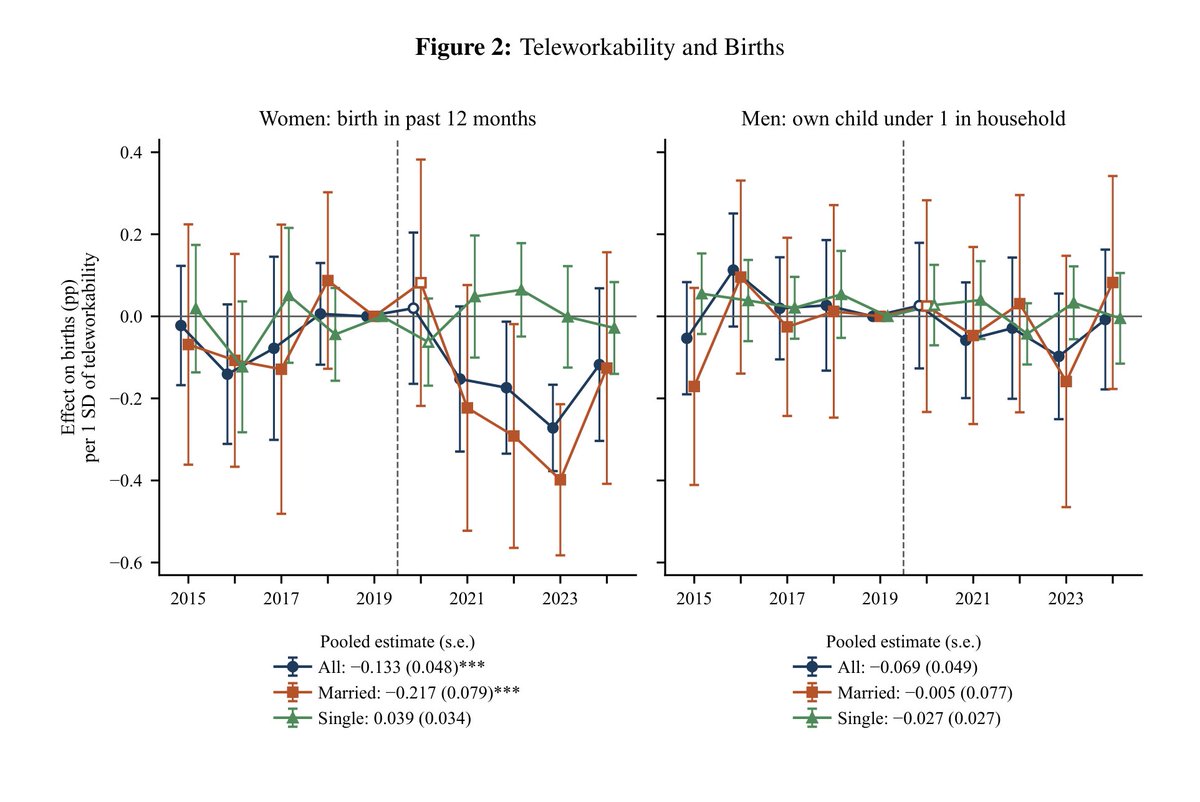
Many people hope remote work will raise birth rates. No commute, more flexibility, a chance to live near family.
I test the idea in a new paper. Among married women, the 2020 expansion of remote work reduced births. 🧵
Claude Opus 5.5 writes a fugue in the style of Bach. I called Astra’s fugue the most impressive musical feat I’d ever seen from an LLM, and this is just as good. The circle-of-fifths sequence beginning at 1:13 is beautiful. The interplay of voices is natural and satisfying. LLMs are getting to the point where their music is good enough to listen to for pure enjoyment.
The Pangram Saga Continues: Charles Dickens' "A Tale of Two Cities" is 65% AI. And yes, I know it is the opening, and it is a short text, and that the confidence is low, but still...
https://t.co/RG6F6TC0OG
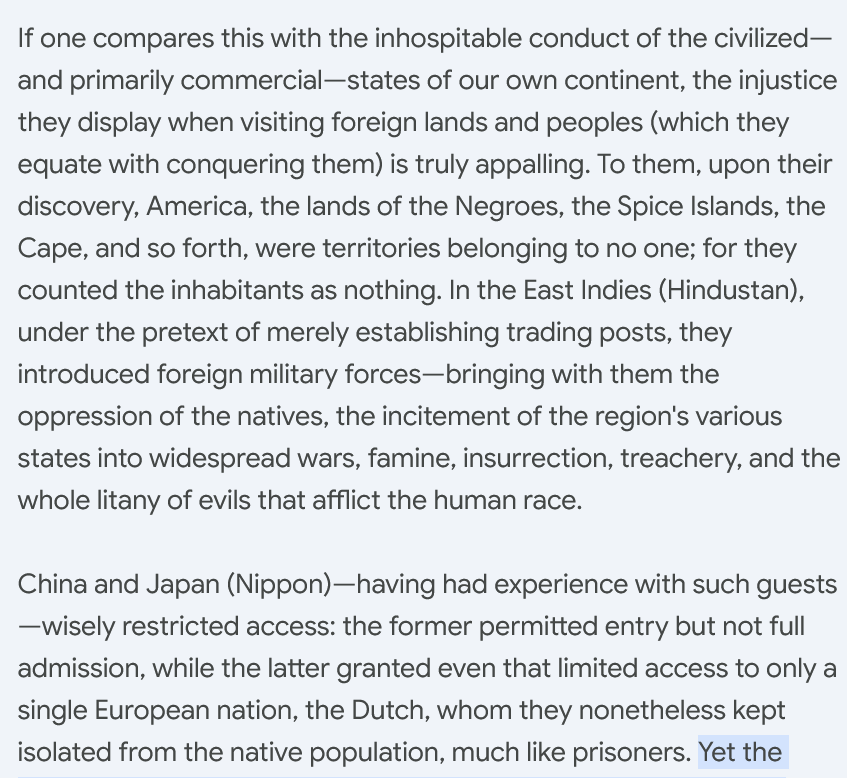
Historians rightly say people's actions must be judged by the standards of their time. What often gets lost is that those standards often weren't what we think. Many 18thc Europeans hated colonialism--as an e.g., here's Immanuel Kant in 1795 castigating it as "truly appalling."
Yesterday, I led a workshop on AI strategy to the leadership of Southern Denmark University (SDU), a public university with over 25k students.
SDU wanted my help to think about how to integrate AI into their overall strategy.
Here's what I told them:
1. Based on a survey I conducted, few of the leadership had used AI past Copilot. I emphasized how disastrous top-down AI strategy decisions can be from leadership with little understanding of AI, and pointed out that in the economics profession, most "AI diffusion" was bottom-up.
Typical pattern - a prominent economist (e.g. @cblatts, @pedrohcgs, @causalinf ) tries AI, has a great experience, writes about it, and then others - through their trust in them, decide to try it themselves. IMO most university's strategies should be focused on facilitating bottom-up diffusion.
2. What does facilitating bottom-up diffusion concretely mean? Here are some thoughts:
> University faculty NEED to be able to make their own decisions with their own research funds on Claude/ChatGPT subscriptions. It's critical to chip away at any obstacles which prevent this from being frictionless.
> Don't bother spending one penny on a university wide Gemini or Copilot subscription. It wastes everyone's time by misdirecting attention at vastly inferior products ("why do you want Codex? You already have OpenAI models through Copilot 🤮)
> It likely makes sense to give a university's most AI-pilled researchers an option to replace some service responsibilities with some low effort "AI office hours" or similar mechanism to facilitate the spread of their knowledge throughout the university.
3. There are no risk-free decisions. Many universities' AI policies get stalled at floundering about data security risks and questionably relevant regulations (eg GDPR), without considering the risk of *not* acting to prepare your students and faculty.
I asked the faculty to work through a short "AI 2031"-like scenario of what bad outcomes look like for their department (e.g. difficulty attracting researchers, bad labor market outcomes for graduates unsmoothed by American AI tech riches) from not acting.
FWIW, I'm sympathetic to the difficulty of deciphering through personal/team/enterprise plans on the privacy implications of different frontier model subscriptions. It's far from transparent - I plan to make some sort of guide for this.
4. I gave a few final practical recommendations:
> For senior faculty/administrators no longer in the weeds with research, I recommend checking the option in Codex/CC to not train on your data, and hook up your tool to your email + AI notetaker. So much of the value I get from these tools comes just from doing this.
> It's important to do cost/benefit calculations with your political acts. Okay, you don't want to use ChatGPT/X b/c of Altman/Musk, but you're losing a lot of your own potential efficacy by cutting off those options. I pointed out in particular the importance of X for both keeping up to date and understanding the spread of AI in academia, and pointed the faculty at my list of economists to follow in this space.
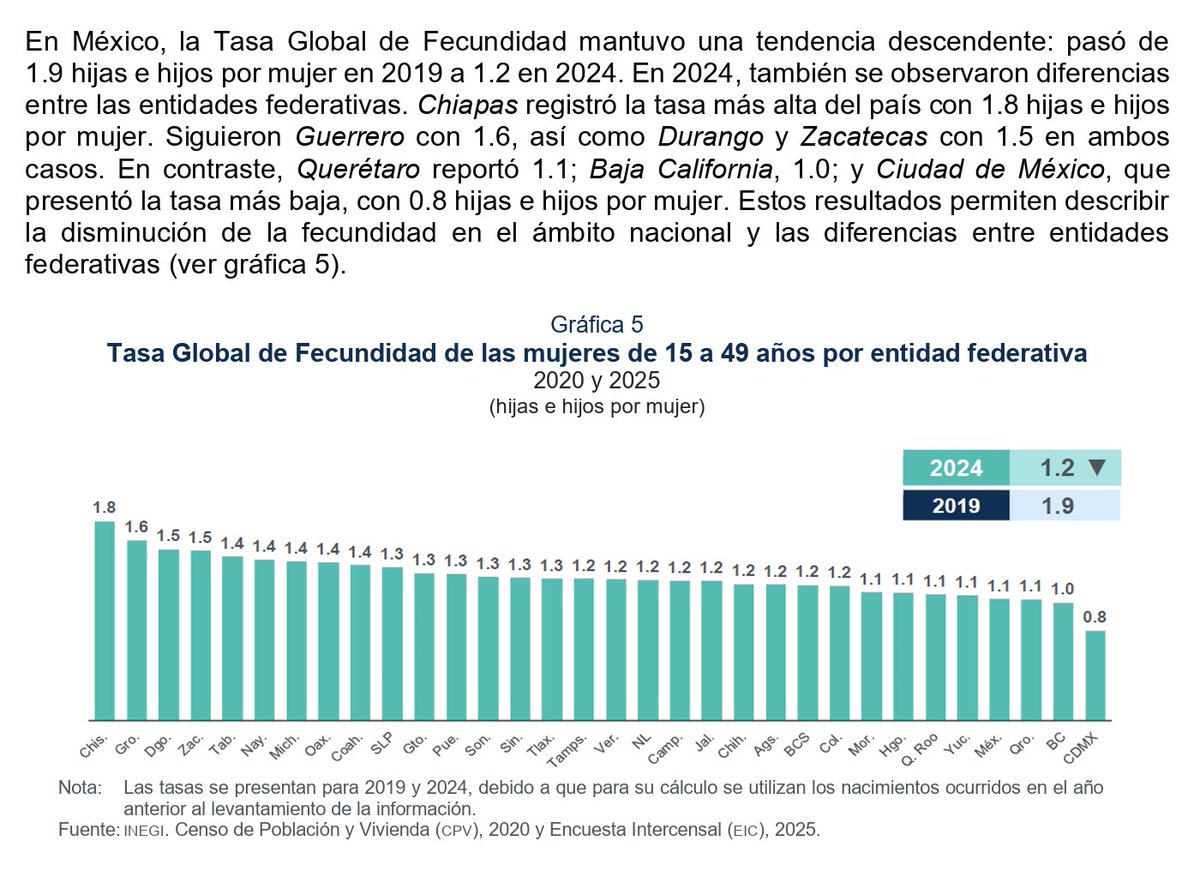
A few hours ago, INEGI, the Mexican National Institute of Statistics and Geography, a government agency, published its Encuesta Intercensal (EIC) 2025 (intercensal survey 2025).
Here is the press release:
https://t.co/o08abDMiUW
Page 9 reports the total fertility rate (TFR). INEGI estimates Mexico’s TFR for 2024 at 1.2 (screenshot in Spanish below). Yes, 1.2, only slightly above Japan’s level in the same year (1.15). By 2026, Mexico’s TFR could fall below Japan’s.
I don’t find words to describe this.
One of the nice things living in Europe has taught me about academia is the love that goes into local institution building. Hear me out. 👇
In much of the world, academic life involves jumping from one position to the next. The goal is to get to the most prestigious institution you can. And that’s a valid career path. But in some places people are playing a very different game: they have a lifelong commitment to their home institutions and cannot think of working anywhere else.
Visiting Pécs reminded me again of the value of institution builders. These are often scholars who could operate elsewhere based on merit but choose not to. The net effect is people who not only contribute a level of teaching and research that would be hard to attract from abroad, but who are active in building their institution, by applying for grants, building programs, and connecting with others.
This sits in stark contrast with an experience I still remember from my time at MIT. I remember talking with a famous computational biologist at a party who insisted that there was no point in paying any attention to anyone who had never visited the institute before the age of 35, because if they hadn’t been invited, that was proof they didn’t matter. I disagreed, but I was not at all convincing.
But I still stand by my disagreement. Institution builders matter enormously, and I would argue matter more than many of those obsessed with the pyramid scheme of prestige that can emerge from institutional climbing.
Great institutions exist because some people choose to stay and build them. Prestige is easy to admire. Institutions are harder to build.
ExtremeScan now appears to be the most accurate Russian pollster.
They got the real (non-falsified) vote about exactly right.
Incidentally, this also explains why kremlins removed Yabloko. Otherwise an explicitly anti-war party would have claimed second place.
People sometimes ask why I mostly say stuff being proposed is terrible.
The reason is that most stuff proposed by tax lobbyists is terrible.
For more grumpy responses you can subscribe to our free newsletter: https://t.co/9UsadvEjKc
One other detail: Hackett claims there has been a 'flight to quality' in recent years, with 'high-tariff institutions' seeing more applicants. This is a fantastic euphemism: Russell Group unis have been lowering entry requirements like mad to scoop up more students.
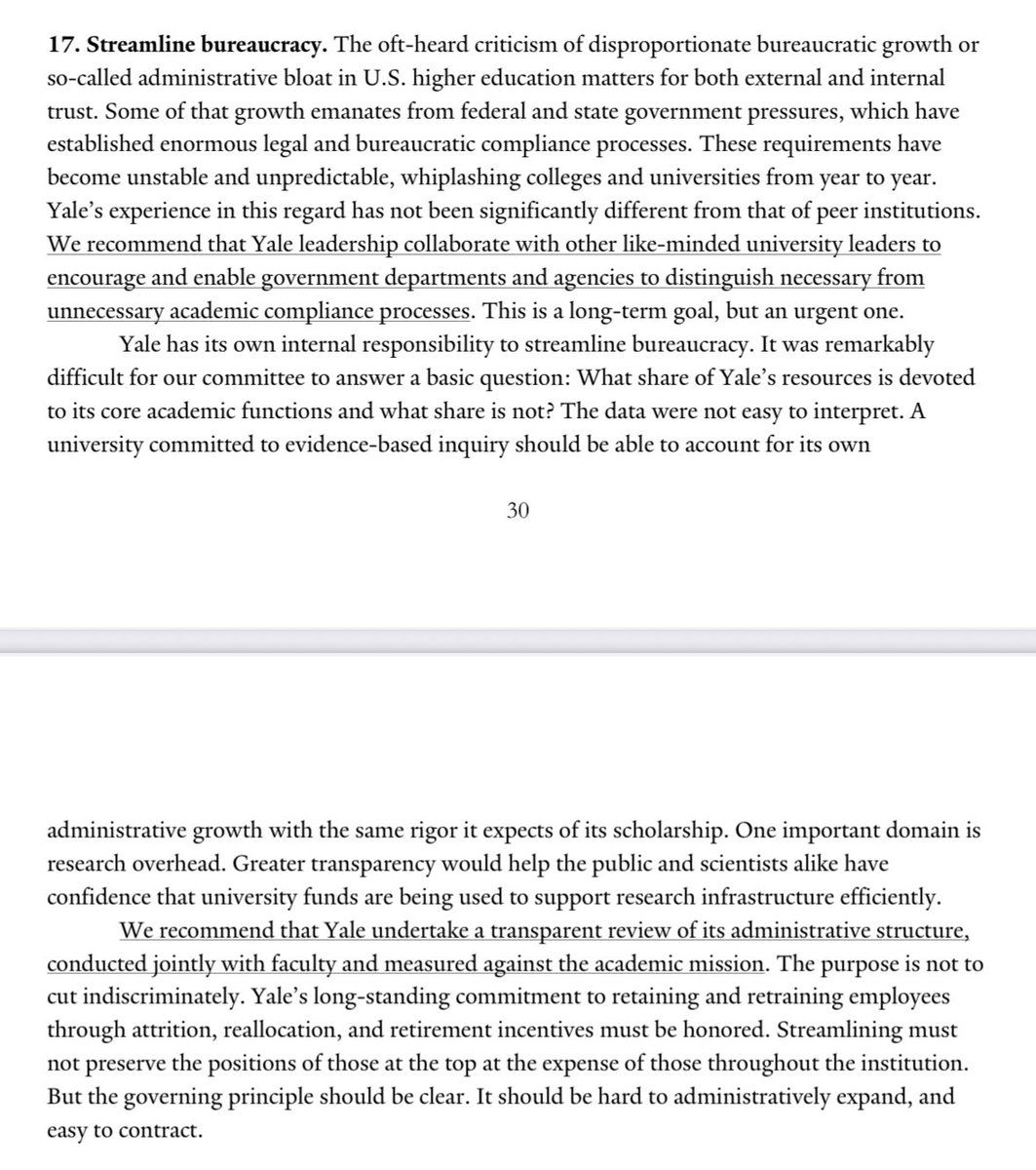
The Yale Report on Trust in Higher Ed:
“It was remarkably difficult for our committee to answer a basic question: What share of Yale's resources is devoted to its core academic functions and what share is not?”
“We recommend that Yale undertake a transparent review of its administrative structure.”
If I were American, I would probably feel embarrassed (and slightly concerned) that my arch-enemy's politicians come across as so much more educated, intelligent and informed about economics, than my own president.
As an academic I feel like that I'm living in that scene in The Big Short where they see all the empty houses and know it's a bubble, but for me it's hearing about all the innovation and growth in higher education, then teaching a class where only 8/250 students show up weekly
The publishing rat race has gotten out of control and AI is making it worse.
I am officially putting a pause on publishing my papers in the Quarterly Journal of Economics and I call on all leading economists to do the same.
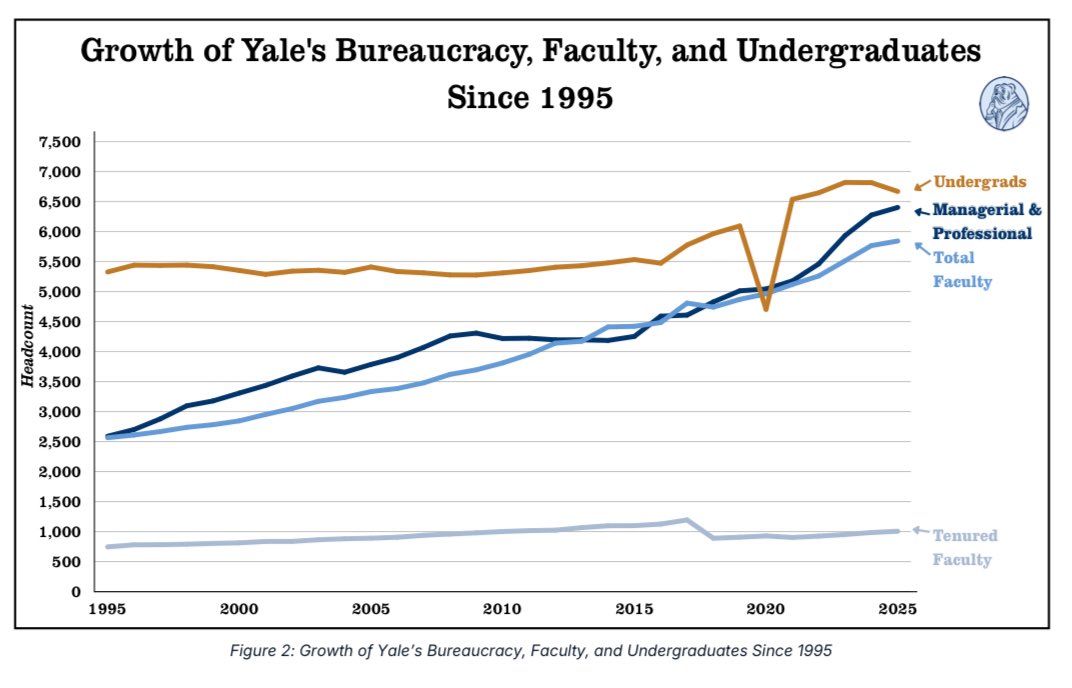
Yale has nearly one bureaucrat for every undergraduate student — 6,401 management and professional staff and 6,667 undergraduates.
Since 1995, Yale’s bureaucracy has increased 147% while the student population has increased only 43% (and the undergrad population only 25%).
You cannot script this.
The University of Alberta, after slashing 100% of funding to their daycares, just sent an email to the entire university announcing "gender equality week."
Literally YESTERDAY a student mother went on CBC to discuss how she may have to drop out.
Call for expression of interest: 10 PhD Scholarships, DIViNE-Democratic Institutions and Violence Network in Europe.
DIViNE doctoral network brings together leading research environments: Uva Amsterdam, UESSEX , Unimi (Milan), UC3M (Madrid) and Uppsala: https://t.co/Hi4ilf5cAU