1/ Most traders know delta.
Some know gamma. Very few understand vanna.
Yet when markets make moves that seem disconnected from price action, vanna is often part of the explanation.
Coffeezilla just debated Jeff Walton for an hour about bitcoin and Michael Saylor’s digital credit business.
If you don’t know him, @Coffeebreak_YT has become the most popular YouTuber focused on exposing crypto scams and is skeptical of the strategy.
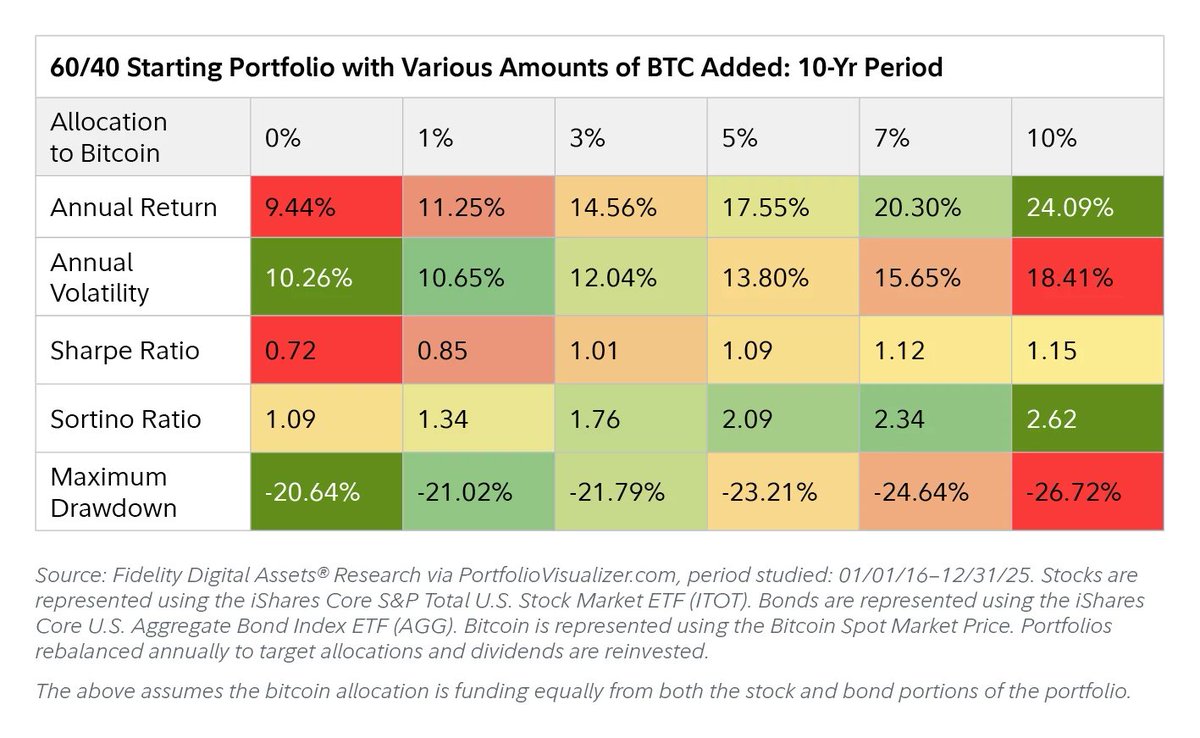
Fidelity Digital Assets says the most important portfolio decision isn't how much bitcoin to buy. It's going from zero to any.
Their data shows that adding just 1% bitcoin to a traditional 60/40 portfolio produced 30% more compounded value over the study period, increased risk-adjusted returns by 20%, and only increased maximum drawdown by 0.27%.
The first 50 to 100 basis points of bitcoin allocation delivered the most efficient improvement in portfolio performance. After that, returns scale but so does volatility. The initial move off zero is where the math is most lopsided.
The corporate treasury findings are even more striking. A 1% bitcoin allocation to a standard corporate bond portfolio more than doubled returns, actually reduced overall drawdown, and increased the Sharpe ratio by over 40%.
For companies sitting on cash reserves earning next to nothing in a negative real rate environment, Fidelity is saying the risk of holding zero bitcoin is greater than the risk of holding some.
The report also found that where you source the allocation from barely matters. The difference between funding it from stocks versus bonds was 0.11% in returns and 0.13% in volatility for a 1% position. The decision that moves the needle is binary: zero or not zero.
Fidelity manages over $5 trillion in assets. This isn't a bitcoin company talking its book. It's one of the largest asset managers in the world telling institutional clients that the data favors allocation, and that the biggest risk in a portfolio may be having none at all.
My guest today is Paul Tudor Jones (@ptj_official), one of the greatest macro traders of all time.
He correctly predicted the 1987 stock market crash and shorted the Japanese bubble in 1990. For over 40 years, his flagship fund has had a negative correlation to the S&P 500. 100% of his returns are alpha.
He says today's market has so many similarities to 2000, "the easiest bear market I've ever seen in my whole life."
He makes the case for going long dollar-yen, why Bitcoin beats gold as an inflation hedge, and why he was wrong about Warren Buffett.
But what I'll remember most from this conversation is Paul's zest for life. He's 71 and still wakes at 2:30 every morning to trade the London open. He works out for two hours a day. He walks with his wife every evening. He travels the country chasing peak spring and peak fall. He's so excited about the songs picked for his funeral that he wishes he could be there to hear them.
Paul has lived five lifetimes in one. He's one of the most entertaining and interesting people I've met, and the conversation will leave you searching to be as passionate about what you do as he is about what he does.
Enjoy!
Timestamps:
0:00 Intro
1:00 The Kindest Thing
13:19 Trading vs. Investing
17:33 Lessons from Warren Buffet
22:24 The Existential Risks of AI
29:54 The Nature of Trading
31:46 Bitcoin
35:55 Bubbles
42:08 A Day in the Life of PTJ
46:00 Information Overload
47:07 Passion for Markets
50:49 The Robin Hood Foundation
54:18 The Workless World
56:03 Journalism
1:00:00 Principal Components of a Great Life
1:05:06 Kill Them With Kindness
BREAKING: ADM Paparo, 4-star Admiral and Commander of U.S. Indo-Pacific Command, just testified before the Senate that “Bitcoin shows incredible potential” as a tool for U.S. national security. Watch the full exchange:
Insane.
So a 4 star admiral testifying to Congress now sounds like @adam3us.
Boys and girls-btc is becoming embedded within US power infrastructure.
Game over.
Valued only at $1.5T.
65% less than @Apple.
I'm not leaving. I'm not pivoting away from this space. It's early.
1/ I’ve spent most of the last few weeks since the Google, Caltech papers to think about tradable implications around quantum computing and crypto
specifically what happens to the market around q-day
@TheSamsPodcast asked for my quick overview of STRC, Bitcoin, and the comparison to LUNA, so here you go.
TLDR -- It is not an infinite flywheel, but is NOT like Luna, a ponzi or any other nonsense term used by critics.
TACTICAL DELAY: Why The "Failed" Breakout is Actually a More Compressed and Bullish Spring and the Path to a Year-End ~$219K
On December 26th, the market expected a massive volatility release as ~60% ($327M) of gamma expired. Instead, price remained flat. This was not a "failure" of the bull market; it was a mechanical re-pressurization event.
Here is the mathematical reason of why the market didn't break, why it is currently coiling, and why it leads to Year-End ~$219K.
1. Why the "Release Valve" Jammed (The Great December Roll)
The volatility explosion failed to materialize for one specific reason: Traders didn't leave the table; they just bought more time.
Instead of letting positions expire (which unpins the price), the market executed a massive, coordinated Roll:
The Action: Institutional players sold the expiring December contracts and aggressively bought January contracts.
The Result: The Dealer "Short Gamma" exposure didn't vanish; it was simply transferred 35 days into the future.
THE NUMBERS:
Old Trap (Dec 27): Gamma has withered to $17M (only 6.8% of total). The pin is gone here.
New Trap (Jan 30): Gamma has swelled to $93M (37.3% concentration).
The Diagnosis: The "can" was kicked down the road. The suppression wall that held Bitcoin at $87k in December has been rebuilt at the exact same level for January.
2. Why This is Bullish (Paying Rent to Wait)
If the market were bearish or exhausted, traders would have taken the liquidity event on Dec 25th to cash out. They didn't.
Paying the Premium: The Term Structure is in Contango (Dec IV 28.3% < Jan IV 39.3%). Rolling these positions is expensive.
The Signal: Smart money is effectively paying "rent" to keep their bullish exposure alive. You do not pay a premium to roll a position unless you mathematically expect the eventual breakout to exceed the cost of the roll.
Conclusion: This wasn't a "failed breakout." It was a kinetic loading phase. The market is compressing the spring tighter rather than letting it release prematurely.
3. Why This Cannot Happen Forever (The Physics of the Pin)
You asked: "What will keep this from happening every month?"
The market cannot perpetually roll this position. Maintaining a price pin against fundamental inflows requires energy (capital) and willing counterparties. The physics of the options market guarantees this suppression mechanism will eventually break.
A. The Cost of Carry (The "Charm" Bleed)
Data: The dashboard shows Charm Exposure at $-18M.
Meaning: This is the daily cost of time decay. The holders of these calls are bleeding millions in value every day the price stays flat. Eventually, they are mathematically forced to either exercise (buy spot) or capitulate (close). Both actions shatter the pin.
B. Gamma Steepening (The Wall Gets Harder to Hold)
The Physics: As we get closer to the Jan 30 expiration, the "Gamma Curve" becomes vertical.
The Consequence: Today, a $500 move requires moderate Dealer hedging. By mid-January, that same $500 move will force Dealers to buy/sell massive amounts of Bitcoin to stay neutral. The "Pin" becomes unstable and eventually unmanageable.
4. The Path to $226K (The Beach Ball Effect)
The market feels dead because Implied Volatility (28%) is crushed while Open Interest ($276B) is at record highs. This is the definition of a Mechanical Coil.
Think of Bitcoin right now as a beach ball being held underwater by a mechanical arm (the Dealer Pin).
The Submersion (Current State):
Force Down: The Call Wall at $90,000 caps the upside.
Force Up: ETF Inflows (IBIT/FBTC) are buying the underlying asset.
Result: Potential energy accumulates. The longer price stays flat while inflows continue, the more violent the eventual snap-back.
The Failure Point (Jan 30 or Sooner):
When the "Charm" bleed forces the Longs to act, or the "Gamma Steepening" makes the pin impossible to hold, the mechanical arm breaks.
The Release ($90k → $226K):
Stage 1 (The Squeeze): Breaking $90k forces Dealers (who are short calls) to panic-buy Bitcoin to hedge. This drives price to $100k-$110k in days.
Stage 2 (The Vacuum): Above $110k, there is almost no sell-side liquidity (the "Air Pocket").
Stage 3 (Price Discovery): With the suppression removed, Bitcoin reprices to match the accumulated ETF inflows. The target of $219K aligns with the Power Law projections for late 2026, accelerated by the "catch-up" from this suppression period.
Final Verdict: The December Roll bought the bears 35 days of survival, but it guaranteed that the eventual move will be vertical. The spring is now more compressed.