Fourth question on AI.
One of the great promises of AI is the discovery of new drugs and cures, so that we can live longer and healthier lives. If and when this becomes a reality, it would indeed be a big achievement.
These potential health benefits are often invoked to justify current investments (and lack of regulations). Some even argue that slowing down AI would harm humanity by delaying these benefits. (See https://t.co/3D0lTFCwmA).
This raises another uncomfortable question: can we justify rapid and large AI investments based on health benefits?
Here is why I think this is an uncomfortable question.
First, despite significant effort, AI has so far produced few gains in drug discovery or new cures. A fascinating new paper by Ryan Hill and Carolyn Stein documents significant (downstream) scientific work on proteins whose structures AlphaFold predicted. But the authors conclude “we find no evidence so far that more applied, early-stage drug development is targeting these proteins.” (See their paper here https://t.co/yWHpDCNgOF).
This thought-provoking post by Daphne Koller explains the difficulties that AI is currently facing in drug discovery. Koller emphasizes that AI-based research is focused on the last layer of drug development (creating new molecular entities for already well-understood therapeutic modalities), rather than targeting new disease mechanisms (see https://t.co/uQMWlQ02Ul). Understanding disease mechanisms is harder because there is much less data on it, and this endeavor requires more innovative approaches. It remains an open question whether current AI models are capable of doing this.
Second and more importantly, if you want to improve life expectancy and health in the United States, there is plenty of low hanging fruit and diverting some of the huge investments going to AI for this purpose would likely do much more for health outcomes.
The United States has the lowest life expectancy at birth among large rich economies. Americans live about five years less, in expectation, than the citizens of Switzerland, Sweden, Japan, Italy, South Korea and several other industrialized countries, and most of the gap comes from deaths before age of 70 due to chronic diseases, overdoses and other preventable causes (see, for example, https://t.co/LndeZHpj60).
These largely reflect failures in US public health: preventable problems, unhealthy diets, insufficient immunization rates, poor access to primary care; and poor information about health. The country spends much more than other peer economies on healthcare, but too little and too ineffectively on public health (here is a reference to my own work on this: https://t.co/VZI2JbO4Gf).
Could we, and should we, divert some of the massive investments in AI towards public health if what we want is better health and longer lives for Americans? (And yes, new drugs will benefit citizens of other countries as well, but they can also invest more in public health and the bulk of global AI spending is currently in the United States).
A really nice paper about something that I spend a lot of time thinking about: how changes in technology can increase the scope of "who can do what task", but in doing so flattens out gains from tenure, specialization, longer hours, etc.
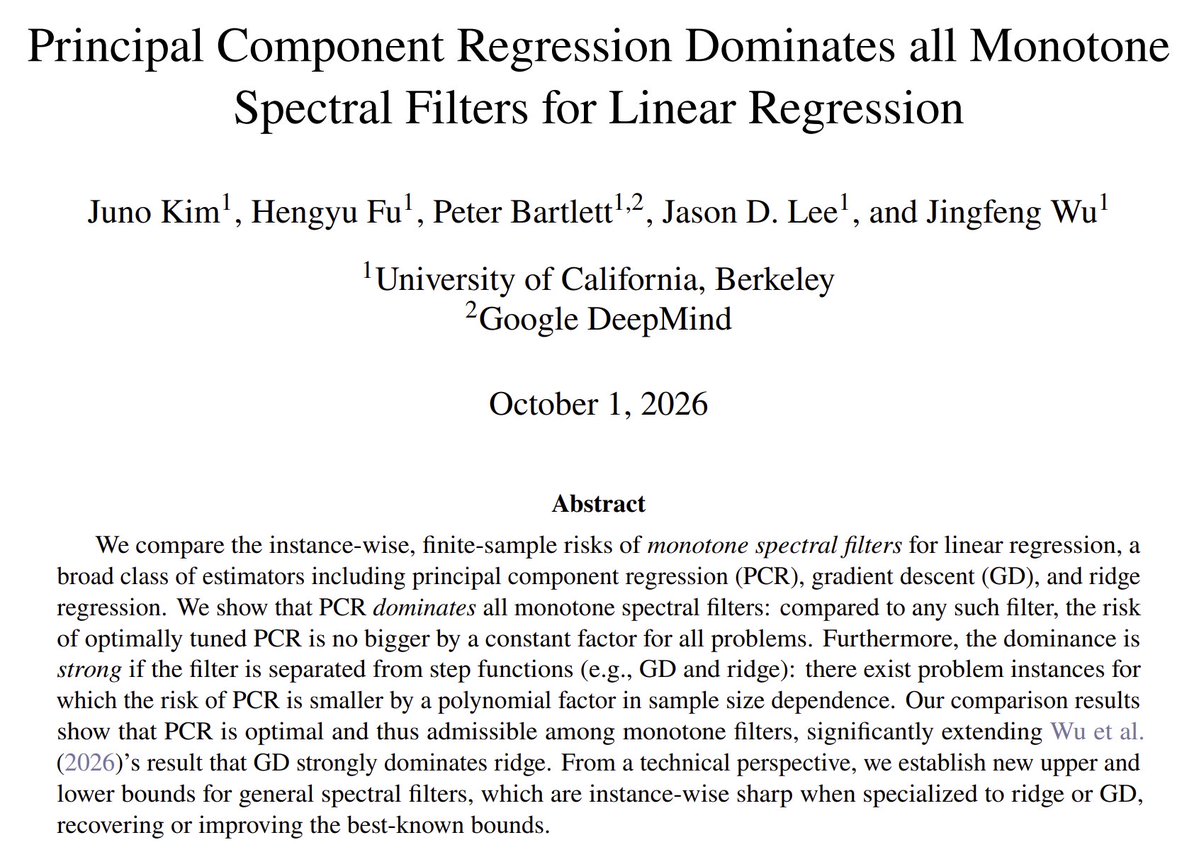
What's the best way to solve linear regression? (No, it’s not least squares.)
In our new paper, we show that principal component regression (PCR) beats, up to constants, every monotone spectral filter (incl. gradient descent & ridge regression) on every problem instance! (1/8)
Excited to announce that Northwestern Economics now has a seminar series on the economics of AI!
Organized jointly with the Kellogg Math Center and the Ryan Institute, it kicks off Oct 6 with a talk by Jon Kleinberg.
Full lineup below.
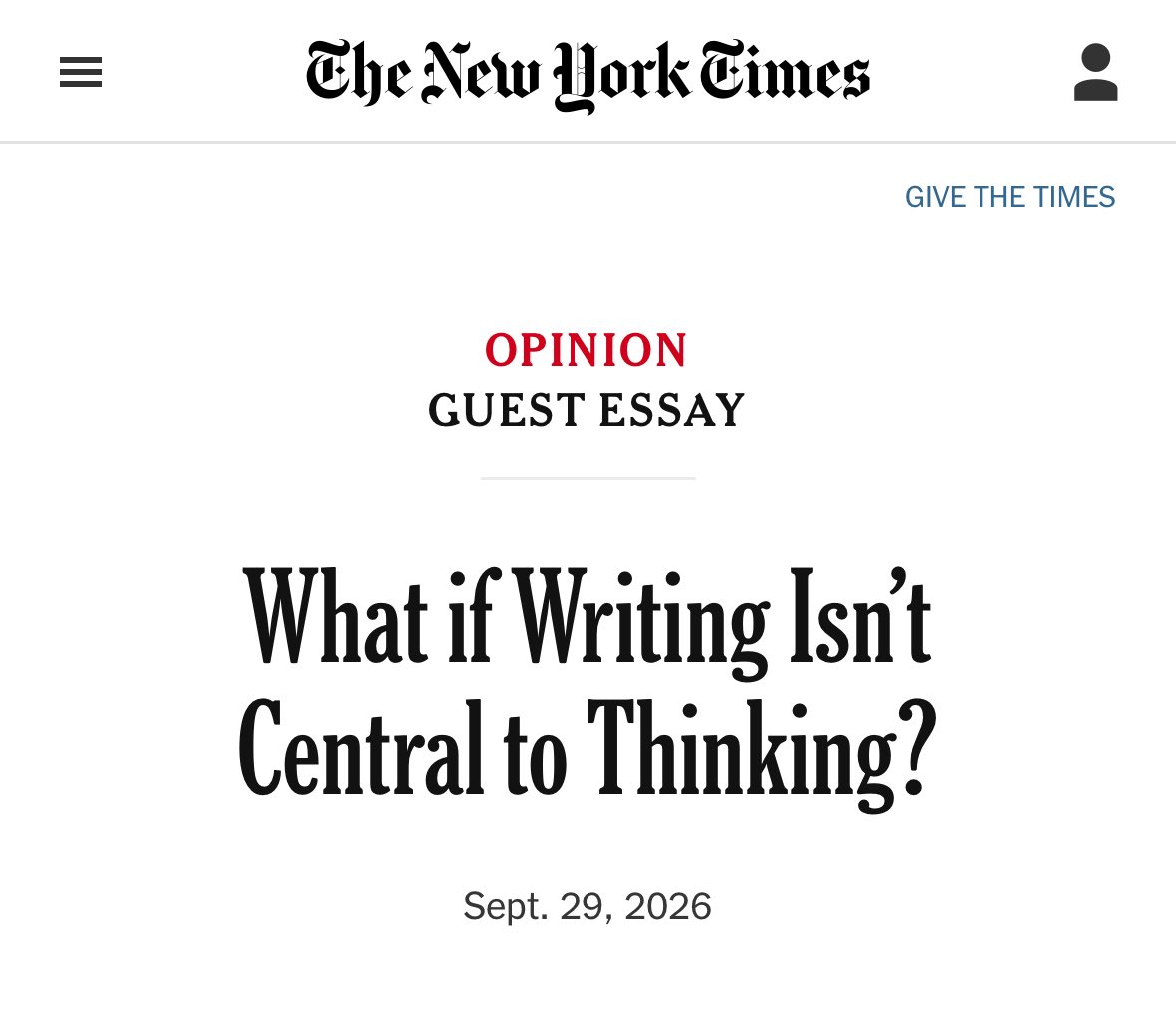
The head of the philosophy department at Williams College downplays the pedagogical value of writing:
“What if we are mistaken in treating writing as the highest cultivation of thought? The evidence that supports this belief is thin at best. Writing can be useful cognitive scaffolding for memory and self-regulated learning, but the notion that it is the best process for developing thinking skills is a fairly recent idea, traceable to the 1970s writing-across-the-curriculum movement.”
Students sometimes ask me if it still makes sense, in this accelerating age, to pursue a PhD in AI.
Perhaps counterintuitively, I think it's a great time to do so.
I wrote up some thoughts on this here: https://t.co/RRqGR0qi1R
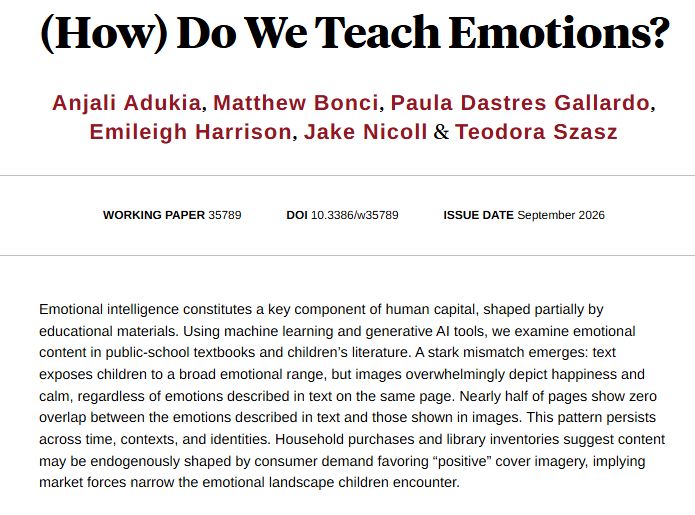
The text of children's books convey a broad emotional range but images overwhelmingly show happiness/calm—a mismatch that consumer demand for "positive" imagery may reinforce, narrowing the emotions children encounter, from @aadukia, Matthew Bonci, Paula Dastres Gallardo, @emileigharrison, Jake Nicoll, and @TeodoraSzasz https://t.co/Pk982C10Wu
24 senior mathematicians met at Harvard and agreed on something big:
A PhD should no longer be awarded mainly on the dissertation text. Their reason is that AI can now help write it. They want in-person, written, and oral exams instead.
Personally, as someone with a PhD, I think the defense should have been the real test all along. Anyone can polish a document.
https://t.co/zoUeNVefz0
👩🏫 UNA PROFESORA DE STANFORD EXPLICA CÓMO DOMINAR LOS PROCESOS DE DECISIÓN DE MARKOV
Una clase de 83 minutos, gratuita y directamente desde Stanford.
🧠 En la lección aprenderás:
• Diferencias entre problemas de búsqueda y entornos estocásticos.
• Evaluación de políticas y recurrencias de valores Q.
• Cómo funciona la iteración de valores.
• Límites de convergencia en grafos cíclicos.
Todo explicado desde los fundamentos de los Markov Decision Processes (MDP).
🔥 Si estás aprendiendo inteligencia artificial, aprendizaje por refuerzo o toma de decisiones algorítmica, es una clase para guardar.
📌 Guárdala y mírala cuando tengas tiempo.
Una joya gratuita de Stanford.
The 2026 NBER Economics of AI conference is available on YouTube. The theme was the economics of AI in China. Here are some of my takeaways.
Day 1: https://t.co/BAKzyKf1tS
Day 2: https://t.co/kcaIMa1vRv
Aşağıdaki “R ile Ekonometriye Giriş” kitabı Stock ve Watson tarafından yazılan “Ekonometriye Giriş” kitabının uygulamalı yardımcı kitabı niteliğinde.
PDF
🔗 https://t.co/m9AI3ipEFj
Today we launched "Living CPI Data" project, from the IEM Lab at Harvard Business School.
https://t.co/qpnQQAOZY0
It is an AI-driven global database of consumer price indices. AI agents continuously collect, expand and quality-check the data every day, so it never stops growing.
It also has real depth. Getting detailed CPI data usually means digging through statistical-office websites, tables and PDFs. The agents have already done that. You get official classifications, disaggregated sectoral indices, basket weights and even average prices of individual goods, when available.
In 2006, He was selected for a Fields Medal. He declined it.
In 2010, the Clay Mathematics Institute awarded him the $1 million Millennium Prize for resolving the Poincaré conjecture. He declined that too.
https://t.co/SPTtcWmFb5