According to some bimbo in CJP, “economy shambles mein hain.”
Since we love to quote Grok:
Fact: Real GDP growth for FY26 (ended March 2026) came in around 7.6–7.7% (with quarterly figures near 7.8% in Q4), accelerating from the prior year and driven by domestic demand, services, manufacturing, consumption, and public investment. India is still the fastest-growing large economy even amid global trade tensions and other pressures.
Inflation: Was notably low for much of 2025 (averaging ~1.7% for stretches). It has risen with food/fuel pressures and geopolitics;
RBI projects ~5% CPI for FY27 (within/near its target band, with risks balanced).
• Fiscal position: Central government deficit around 4.4% of GDP in FY26 (meeting targets via revenue efforts and spending control); consolidation continues.
• External buffers: Foreign exchange reserves have hovered in the $680–700+ billion range (comfortable import cover).
The current account has been manageable. The rupee has depreciated amid global factors and outflows.
• Labor market: Official unemployment rates generally reported in the ~5% range (PLFS data), with participation and formal job trends showing stability or improvement in some metrics.
• Other: Banking sector healthier (low NPAs, strong profits in many cases); high-frequency indicators (PMI, GST collections, power, auto, etc.) have often pointed to resilience; corporate balance sheets relatively strong.
NEW: Spain is now deploying its military after thousands of military-aged men stormed over the border into Ceuta, Spain.
Ceuta authorities are calling on Madrid to declare a national emergency after the border "totally collapsed."
"The situation is absolute chaos. It’s not possible to give precise numbers, but there are thousands of migrants crossing," said head of the association that represents Spain’s Civil Guard officers in Ceuta, Rachid Sbihi, to AP.
The Trump White House is now ripping Europe for its far-left policies.
"President Trump has long warned Europe what would happen if they continue to implement far-left, globalist policies, including enabling mass migration," said WH principal deputy press secretary Anna Kelly to Fox.
"Spain and other countries who have adopted this destructive philosophy should immediately reverse course or risk their own demise."
I just spoke to a friend of mine.
Told him that tens of thousands of military-aged Muslim migrant men from Morocco were CURRENTLY invading Spain and have been all day long.
He didn't believe me, had ZERO CLUE it was happening and said that he hadn’t read about it anywhere.
I sent him all the videos on X that we have all seen today.
Dude was absolutely stunned, still couldn’t believe it.
One of the most insane betrayals by a government of it’s people I have ever seen and it’s not even on the front page of most major news sites right now.
That's not an accident, by the way, it's a deliberate choice of the media to hide the truth.
The best thing you can do for your friends right now is get them on X.
As fast as possible,
They're being lied to by silence... and they don't even know it's happening.
@JaidevJamwal I have been trying for the last couple of years exactly the same.
Its incredible the vice-like grip that they have created in the entire ecosystem. Impossible to get out clean. Unless of course you want to become a hermit. Real scary stuff.
@DrRajeshPatil20 Funny thing! Delhi State level competition would not count. As per their own rules in St. Stephens (you can check) only if you have competed in Nationals & won 1sr, 2nd or 3rd prize, can you apply for sports quota. I know, I did.
There being the son of Rajiv read Nepo-kid worked.
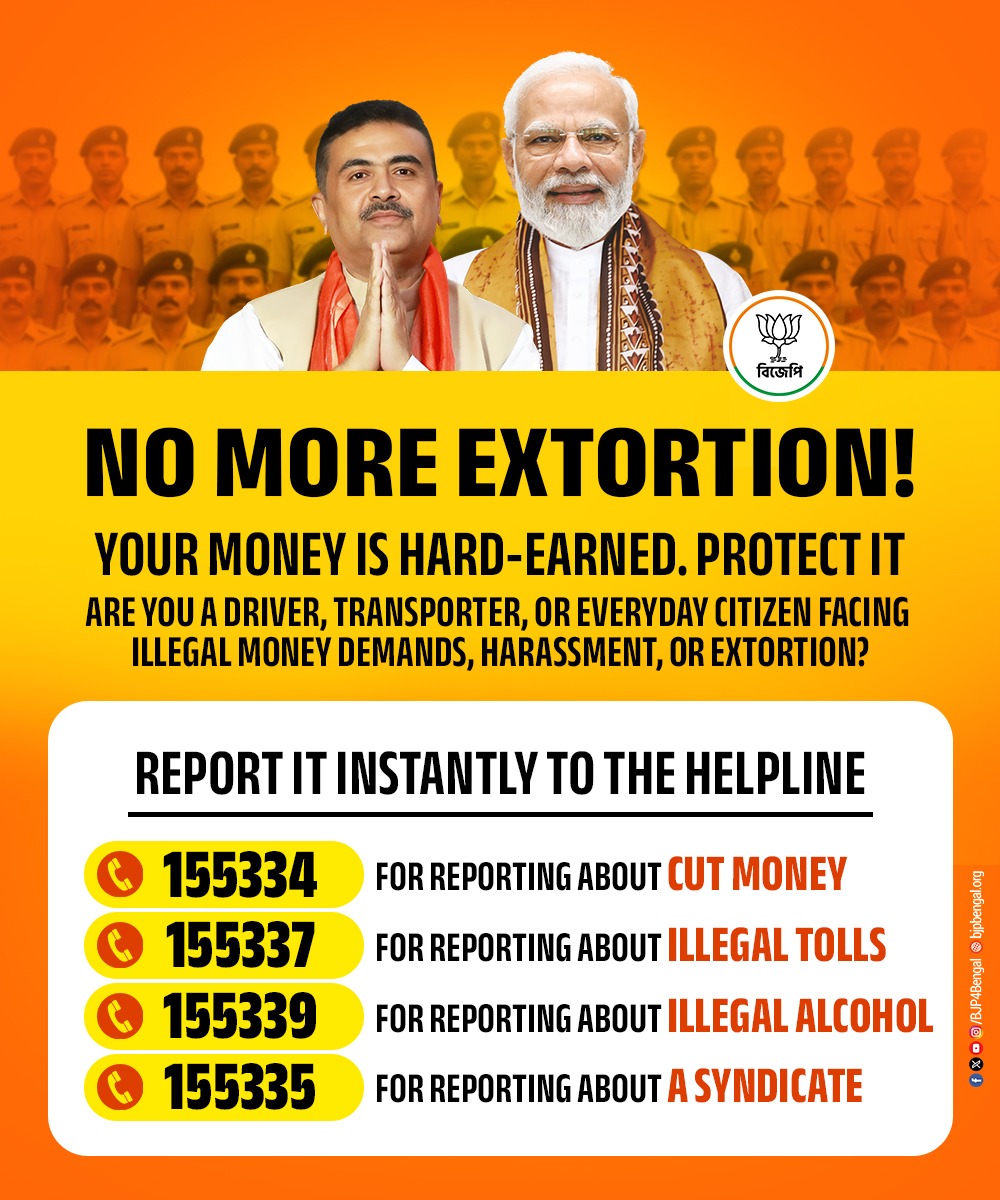
It is time to put an end to extortion. Protect your hard-earned income by reporting illegal activities instantly using the dedicated helpline numbers below:
-155334 | Cut Money
-155337 | Illegal Tolls
-155339 | Illegal Alcohol
-155335 | Syndicate
Spot on!! 🎯😎😆
I can’t wait for the comments!!
Nicklas Nilsson explains the difference between right-wing and left-wing people in spot-on text on Facebook:
"If a right-wing person is gay, then he is, and he doesn't care what others think.
If a left-winger is gay, then he demands legal changes, protests against everything and everyone, and turns it into a political struggle.
If a right-winger is vegan, then he simply doesn't eat meat.
If a left-winger is vegan, then he wants to ban meat, halt food production, and protest outside farms and chicken farms.
If a right-winger doesn't like guns, then he just doesn't buy any.
If a left-winger doesn't like guns, then he tries to ban them, prevent everyone else from owning one, and hates those who do.
If a right-winger is worried about the climate, then he flies less, drives an electric car if it suits him, and sorts his waste.
If a left-winger is worried about the climate, then he wants to ban fossil fuel cars, air travel, and meat for everyone else, protest outside factories, and demand that the state forces the change.
If a right-winger wants to give his children a good education, then he moves to an area with good schools, or chooses a private school, or gets involved himself.
If a left-winger wants to give his children a good education, then he demands more tax money from everyone, equal results for all, a ban on charter schools, and protests against every inequality.
If a right-winger complains about his job or workplace.. he doesn't. He changes jobs or starts his own business.
If a left-winger complains about his job – then it's the boss, the company, or the colleagues who are at fault. He demands collective agreements, strikes, changes for the whole community, and protests against the company so that it suits him.
If a right-winger is dissatisfied with his housing or rent, then he moves, renovates, or buys something else.
If a left-winger is dissatisfied with his housing or rent, then he demands rent freezes, more subsidies, regulations for everyone, and protests against landlords and politicians.
If a right-winger fails with a business or an investment that goes wrong, then he gets up, dusts himself off, and tries again tomorrow.
If a left-winger runs out of money on the 24th, then he blames the rich for having too much and needing to contribute more, blames the lottery win that didn't come home last week, and mutters that he has such damn bad luck.
If a right-winger sees this – then he sends it to a few friends for a good laugh.
If a left-winger sees this – then he tries to argue against it, get it removed, and delete me from Facebook."
India was the cradle of civilisation. Not one of several.
Several people have replied to my recent essay by saying there is no single cradle of civilisation. Civilisation developed independently in Mesopotamia, Egypt, India, China and South America. Why make it a competition?
This sounds like humility, but it is the same evasive move that propped up the Aryan invasion theory for a century: when the evidence becomes inconvenient, redraw the question so no evidence can ever settle it.
Consider what would have to be true for independent emergence to hold. Indus-Sarasvati merchant seals would not appear across Sumerian cities. An Akkadian cylinder seal would not name its owner as an interpreter of the Meluhhan language. Bead necklaces manufactured at Lothal would not turn up in Queen Puabi's tomb at Ur around 2450 BC. Pre-dynastic Egyptian graves at Nakada would not contain mud brick-lined pits in Sumerian and Indus-Sarasvati style, alongside cylinder seals and lapis lazuli from the northernmost Indus-Sarasvati settlement. The Sumerian scribes would not record ships arriving from Meluhha carrying timber, copper, carnelian and cotton.
All of those things happened, and they are in the archaeological record. They have been for decades.
The "independent emergence" position has a convenient feature. No evidence can ever dislodge it. Merchant seals from one civilisation found inside another become "evidence of trade, not dependency." Identical brick ratios become "convergent development." A professional interpreter role for a foreign language becomes "contact, but not influence." At every point the conclusion is decided in advance, and the evidence is arranged around it.
Others have argued that even if the civilisations were connected, Mesopotamia was still earlier. Earliest attested writing. Earliest cities. Earliest legal codes. The crucial word is "attested," which means found and recorded by archaeologists. Mesopotamia was excavated intensively from the 1840s. Mohenjo-daro was not discovered until 1922. The site at Bhirrana, dated to 7570-6200 BC, with planned streets, drainage, standardised weights and bronze metallurgy millennia before it appears elsewhere, was identified only recently. Mehrgarh, around 7000 BC, supported 20,000 people growing wheat, barley and cotton, and trading lapis lazuli and copper beads. "Earliest attested" tells you where archaeologists chose to dig, but it does not tell you what existed first.
So at what point does evidence of connection actually count? When one civilisation's merchants are living in another's cities, boring beads with their own technology and maintaining a permanent enclave at Lagash? When the Sumerian texts record ships from Meluhha bringing wealth but never once mention Sumerian ships sailing east? When Indus-Sarasvati seals are found throughout Mesopotamia but no Mesopotamian seal has ever been found in Indus-Sarasvati lands?
And that is before the underwater evidence from the Gulf of Cambay and the Tamil coast, where sonar readings suggest ports thousands of years older than anything in Mesopotamia. If those dates hold, the question of independent emergence becomes redundant.
Treating every civilisation as equally primary, whichever direction the evidence actually points, is a kind of participation trophy for entire fields of study, not open-mindedness.
Independent emergence is where one lands once you’ve already decided not to look at what moved between the geographical boxes, or in which direction. It kept the Aryan invasion theory standing for a hundred years, and it's propping up the same evasion today.
Which of these common painkillers is the most dangerous for your kidneys if taken frequently?
A) Paracetamol
B) Ibuprofen
C) Tramadol
D) Aspirin
Bonus: Why do some of these destroy the kidneys while others bypass them completely?
Mesopotamia was never the cradle of civilisation. India was.
I spent forty years in international shipping, not academia. When I began researching the history of maritime trade, I had no orthodoxy to defend. I followed the evidence, and it kept arriving in the same place: the Indian subcontinent.
Nineteenth century archaeologists dug in Mesopotamia because the climate preserved artefacts, the biblical sources pointed them there, and the Ottomans allowed the excavations. That is the entire basis for the myth of Mesopotamia as "the cradle of civilisation."
Nobody applied the same rigour to India. Mohenjo-daro was not discovered until 1922. By then the narrative had already hardened.
What was actually there was the largest civilisation of the ancient world. Three hundred cities. Fifty thousand people in each, by 2600 BC. Two thirds of them stood on the banks of the Sarasvati, the central and greatest of the seven rivers described in the Rig Veda, flowing down from the Himalayas before the river vanished entirely by 1900 BC. The Vedic kings claimed territory stretching "sea to sea," from Afghanistan to Maharashtra, some 1.5 million square miles, against Egypt's 13,000. A dock at Lothal built to handle thirty ships of sixty tons, unmatched in Europe for four thousand years. When it was first excavated, it was recorded as a bathing pool.
When the scale became impossible to dismiss, the theory was not corrected. It was replaced with a story of pale-skinned nomads from the steppe who supposedly arrived around 1500 BC and brought civilisation with them. There is no evidence. The chronology doesn't work. The Vedas describe no invasion.
In 2019 a Harvard-led genetic study revived the claim, and the press reported it as confirmation. It was not. The same study found the builders of these cities were indigenous. The Sarasvati river that the Rig Veda described had already dried up before these newcomers arrived. What the study also found is that a small group of men, arriving after the Sarasvati had already dried up, interbred with the existing population and left a genetic signature. That is all.
So, where they chose to dig was mostly an accident of climate and access. The Aryan invasion theory was constructed because an Indian civilisation that owed nothing to Caucasians was a fact the late nineteenth century could not accommodate.
Link to full Substack essay with sources in the comments below.
@Fintech03 Interesting!
I was sent away at 11 years to live my life on my own till 12th class. Then went to College & from there direct entered the work life leaving for work abroad.
That train to Delhi & from there to Jodhpur, Rajasthan & that pain/hollow feeling, i can feel even today.
1918: they sold radioactive water as a health tonic. It was radium, and it dissolved men's jaws.
1898: they sold heroin as a children's cough syrup. It was heroin.
1863: they sold cocaine wine as a daily pick-me-up. Popes and presidents put their names to it.
1946: they sold cigarettes on a doctor's recommendation. Whole campaigns ran on which brand physicians preferred.
1960s: they sold margarine as the heart-healthy fat. It was loaded with the trans fat that actually stops hearts.
Every one of these came with an expert's blessing and total confidence.
The people telling you today which fat to fear are the institutional descendants of the ones who put radium in your water and a doctor's face on a cigarette packet.
"The experts recommend it" has a body count going back a century.
Holy shit...
The bacterial flagellar motor is a reversible, nanoscale rotary engine that powers bacterial motility. Driven by an electrochemical ion gradient, it converts chemical energy into mechanical rotation.
Are these Indian temple pillars... is this... 🤯
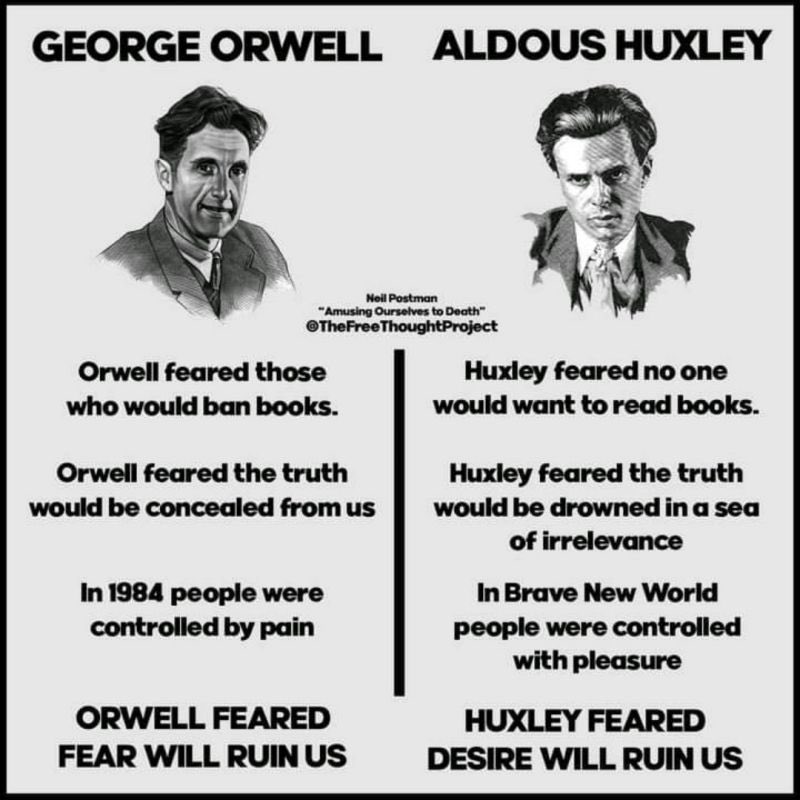
One of my longest-standing arguments is that we are not living in Orwell’s 1984, where truth is centrally suppressed and censored by force (that’s former communist societies, modern-day China, Russia, North Korea).
We are living in something much closer to Huxley’s Brave New World.
The truth is not hidden - it is almost always readily available. But it is buried beneath an industrial quantity of noise: propaganda, outrage, half-truths, conspiracy theories, influencer theatre, algorithmic rage bait and an endless stream of content designed not to inform us, but to keep us emotionally stimulated.
The modern information system does not need to censor the truth when it can simply drown it in noise.
A fact no longer has to be disproven - it only has to be surrounded by a hundred competing claims, stripped of context and nuance, turned into partisan ammunition and pushed into the same feed as celebrity gossip, memes and 15 second videos engineered to deliver the fastest possible dopamine hit. By the time the truth reaches us, it appears as just another piece of content competing for our attention.
That is the more sophisticated form of control: not preventing people from knowing, but exhausting their capacity to care.
Orwell feared a world in which people would be deprived of information. Huxley feared a world in which they would be given so much distraction, stimulation and triviality that they would lose the desire to seek it.
The defining struggle of our age is therefore not simply between truth and censorship, but between truth and indifference.
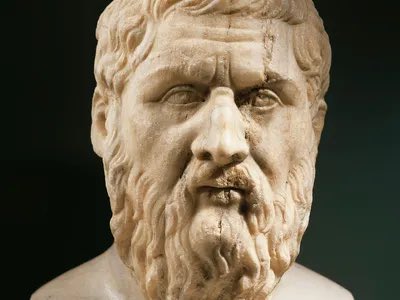
Now Plato – the most dangerous philosopher who ever lived.
Aristotle was his student, his corrector, and in the end his antidote. The argument between them is not ancient history. It is the argument the West is currently losing.
1. Plato distrusts the world. Everything visible, tangible, particular — the market, the body, the individual — is mere shadow to him. Reality is the Form, the Ideal, the perfect abstraction accessible only to the philosopher. This is not just a metaphysics. It is a politics. If the real is abstract and only the philosopher can access it, then only the philosopher should rule. The Republic follows necessarily from the theory of Forms. Plato built the first blueprint for technocratic tyranny and called it philosophy.
2. His perfect state is governed by philosopher-kings – selected, trained, and self-perpetuating. They know what is good for you better than you do, because they have access to the Forms and you do not. This is every credentialist institution, every expert class, every central planning committee that ever existed, dressed in a toga and speaking Greek. The technocrat ruling by divine right of competitive examination is a Platonic philosopher-king who has forgotten the philosophy but kept the power.
3. Idealism and absolutism are the intellectual disease of humanity. By avoiding collision with reality, they produce arrogant delusion – and arrogant delusion combined with power produces totalitarianism. This is the precise opposite of what built Western strength: individual freedom, competition, and meritocracy – a system that encourages everyone to create maximum value and gives the greatest room to those who do it best. Instead of a system of obedience to intellectual and physical bullies.
4. It started seriously with Plato, reached its apex with Hegel, and today’s Marxisms and deconstructionisms are merely the dishwater left behind. What they all share is the same social profile of origin: blasé, bored boys from wealthy homes, untouched by the pressure of real survival, inventing their idealisms in comfortable detachment from consequences. Unfortunately, detachment from reality impresses many simple minds with intellectual pretensions. They listened. The results were fatal. Millions of corpses.
5. Plato invented the "Noble Lie" – the idea that the ruling class should deceive the population for its own good. He considered it governance. Every ideology that has ever lied systematically to its population was, consciously or not, working from Plato’s manual. Every ministry of propaganda, every content moderation policy removing unauthorized narratives is Plato’s Republic with updated technology.
6. Aristotle walked into Plato’s Academy, studied there for twenty years, and then systematically dismantled everything. Where Plato saw Forms, Aristotle saw particulars. Where Plato trusted the philosopher, Aristotle trusted the middle class. One tradition produces science, common law, and the free market. The other produces utopias – and the violence required to build them. And in the process, two and a half thousand years of sophisticated abstraction buried the most obvious truth available to any living organism: that our purpose is to pass life forward, to create the most flourishing possible next generation. Simple. Obvious. Covered over by millennia of sophisticated raving of Platonists.
7. Every great man-made catastrophe of the modern era has Platonic DNA – the French Revolution’s Republic of Reason, Marxism’s scientific laws of history, Mao’s New Man. Each one began with a Form and required that the imperfect world be forced to conform to it. The pile of bodies is not an accident of implementation. It is what happens when you take Plato seriously enough to act on him. Aristotle’s answer sounds less glamorous: look at what actually exists, work with what human beings actually are, build institutions that survive contact with reality. Sounds less beautiful. It is why we are still here.
"Conquered, not stolen."
This distinction.
This very important distinction.
Because if it was conquered, if there was resistance, if there was a fight, if the losers had their moment, then it was fair. It was a competition. The best team won.
This is the logic of the person who breaks into your house, and when you pick up a kitchen knife to defend yourself, says:
"See? You resisted. You accepted the terms of contest. I won the contest. This is my house now."
The resistance of the colonized does not retroactively legitimize the colonization.
The fact that indigenous peoples fought back does not convert their dispossession into a sporting result.
The fact that Vietnam resisted does not mean America had a legitimate claim to determine its political future.
Resistance is not consent to the terms of the contest.
Resistance is the refusal of those terms.
The person who converts resistance into consent is not making a legal argument.
They are revealing that they believe superior violence is self-justifying.
Which is true as a description of how power often works.
It is not a moral philosophy.
It is the confession that they don't have one.