The worst part of a crypto crash is not the fall. It is everything the fall knocks over.
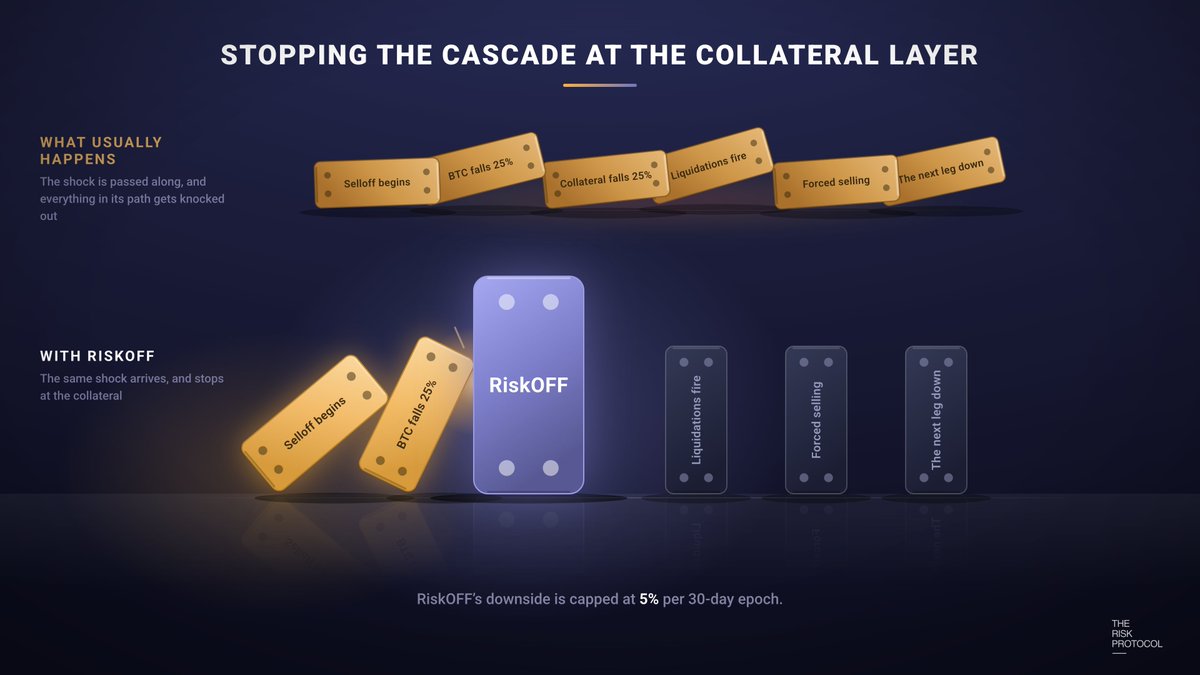
A crash spreads through collateral. Price drops, so collateral is worth less. Collateral is worth less, so liquidation engines start selling it. That forced selling pushes the price down further, which weakens the next tier of collateral, which triggers the next round of selling. Each one knocks over the one after it. March 2020, May 2021, the LUNA week: different triggers, same chain.
DeFi's answer so far has been better machinery downstream: faster oracles, smarter liquidation engines, deeper liquidity to sell into. All of it useful. All of it engaged only after the collateral has already gone over and taken the next one with it.
We went at the upstream question instead. What if the collateral did not fall over?
That is what RiskOFF is.
Deposit BTC or ETH into The Risk Protocol and it splits into two tokens that always sum back to the underlying. RiskOFF is the defensive half: every 30 days it takes a floor 5% below the current price, and in exchange it gives up everything above a cap roughly 6% higher. RiskON is the other half, and it inherits precisely what RiskOFF gives up: the upside past the cap and the downside past the floor. That inheritance is what makes RiskON roughly 2X leveraged outside the strikes, with none of the funding payments or forced top-ups that leveraged perp positions normally carry.
Notice what is missing. Nobody sold RiskOFF that floor. It is financed by the upside handed to RiskON, inside the same pot of collateral. In options language, it is a costless collar, re-struck at the market price every 30 days. The two sides exactly offset, so there is no counterparty to trust and no recurring fee bleeding the protection away.
Now the number that matters. RiskOFF's daily beta to its own underlying is 0.20 on BTC and 0.16 on ETH. When BTC falls 10% in a day, RiskOFF BTC moves about −2%. The other −8% is never transmitted to RiskOFF, because it belongs to RiskON, whose holders took that side deliberately in exchange for leveraged upside.
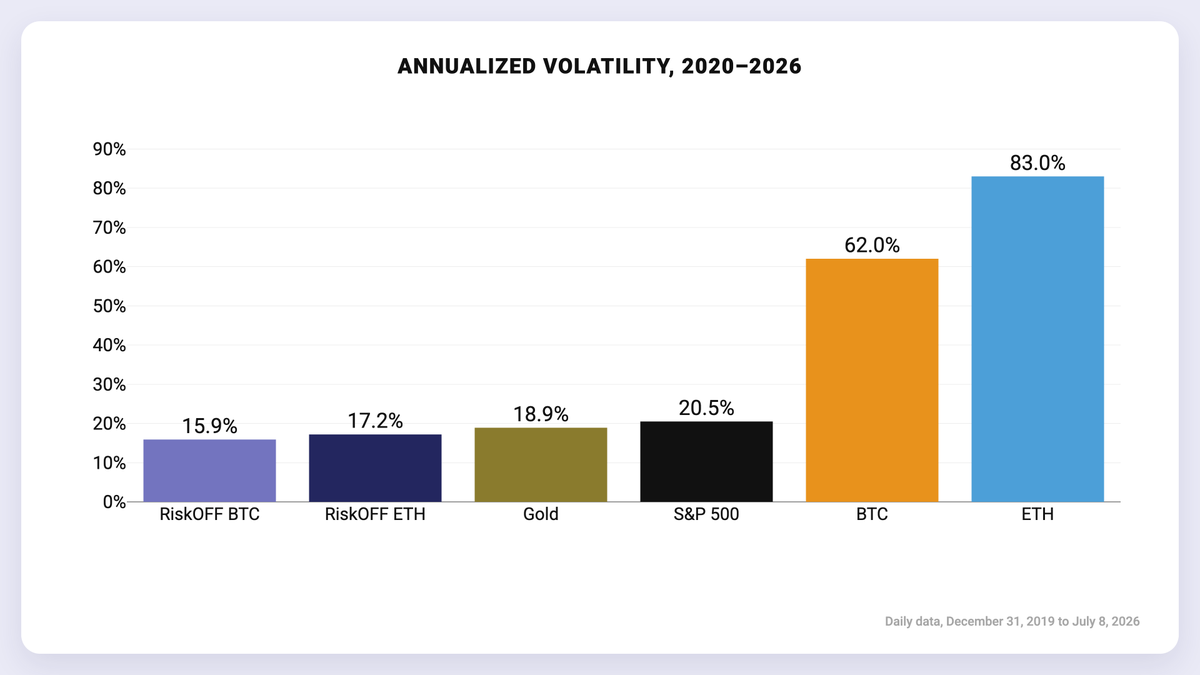
Six years of daily data, crashes included: BTC and ETH together logged 289 days worse than −5%. RiskOFF BTC and ETH together logged four, and not a single day worse than −10%.
Collateral like that does something no liquidation engine can. It holds. The shock still arrives, and it stops there instead of becoming the next round of selling.
And the floor needs no desk to answer at 3 am. It is written into the token's structure, priced fresh every epoch, and that is why it would have needed nobody to save it through COVID, LUNA, or FTX.
Crypto runs on two reserve assets, BTC and ETH, and both have halved more than once since 2020. Lenders haircut them, stablecoin issuers fear them, and treasuries survive them. The volatility is priced into everything, because it has to be.
So we took six years of daily data, crashes included, and measured what happens when the volatility is removed at the token layer itself. The result is RiskOFF, a token built with BTC and ETH as underlying, that ran calmer than gold and the S&P 500.
Stability has a new home 🧵
Finance did not begin with chasing returns. It began with trading risk.
London, 1686. Merchants in a coffee house paid underwriters to carry the risk of losing a ship at sea. One side paid to shed a risk it could not afford. The other side was paid to hold it. That trade predates the Bank of England by eight years.
Chicago, 1848. Grain merchants opened an exchange, and within a few years a farmer could sell a crop he had not yet harvested and lock in the price today.
Chicago again, 1973. An options exchange opened, and Black and Scholes published the formula to price optionality itself. Risk now had a market price of its own.
The 1990s. Credit risk was cut away from the bonds that carried it and traded on its own.
Three centuries, one direction: risk went from something you carried to something you could trade. As our manifesto puts it, every financial system that scales eventually becomes a system for managing risk rather than chasing returns.
Crypto compressed most of that history into less than two decades. Spot markets, lending, derivatives—each rebuilt on-chain at astonishing speed. But the final layer, the one TradFi spent the longest building, got skipped. And even TradFi never finished the job: risk there is explicit in language but implicit in implementation, locked inside bilateral contracts, fund wrappers, and gatekeepers. Risk, in TradFi, is a prisoner of its own packaging.
That is the opening. Crypto doesn't need to evolve over three centuries; we can go straight to the end state: risk as a first-class, on-chain primitive that can be isolated, priced, transferred, and composed. If tokenization freed the asset from its wrapper, RiskFi frees the risk from the asset.
This is what we are building. Not the next product category. The next layer of finance.
The RiskFi Manifesto: https://t.co/6gb2SyLoHy
We came to Arbitrum Founder House London with a bold vision to build crypto's missing risk layer, a new primitive. The strength of our execution to date, as well as our potential to shape the next generation of onchain finance, was evident to the judges, mentors, and peers.
We left as one of the winners, placing second in the General Track.
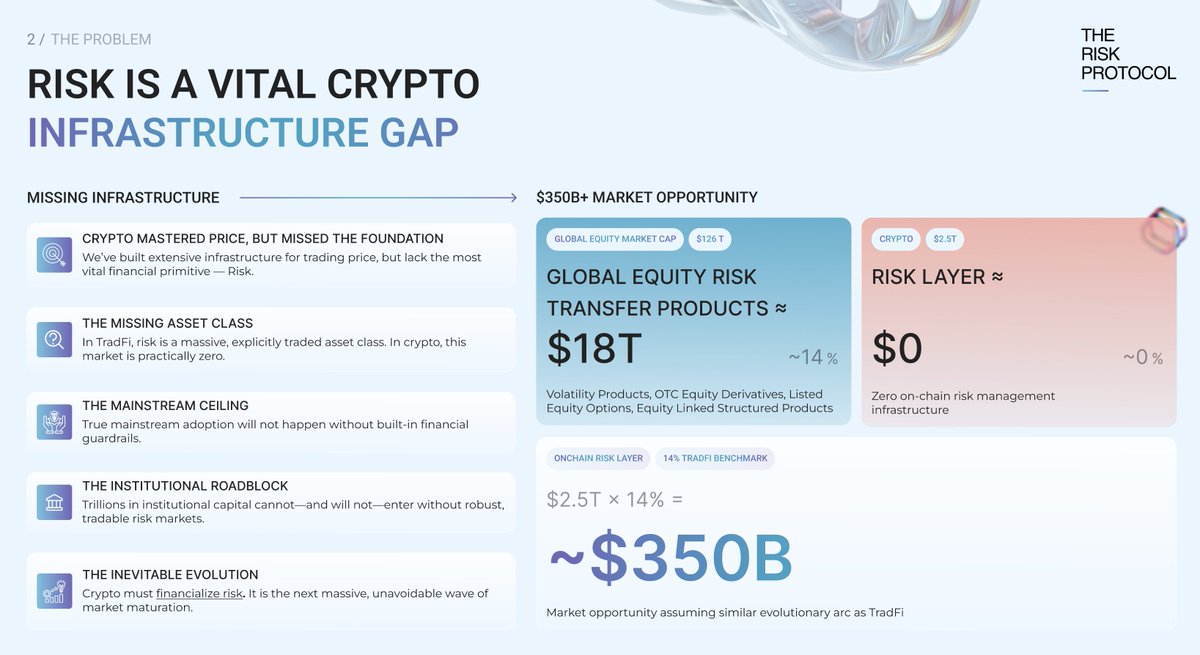
In TradFi, risk itself is a traded asset class: equity risk-transfer products alone are roughly 18T dollars. In crypto, one of the riskiest major asset classes in history, that market barely exists. We believe it is a 350B+ dollar market, and we are building the layer that unlocks it. We call it RiskFi: risk made tokenizable, programmable, and tradeable, on one risk engine—SMART Tokens first, and then Risk Prediction Markets.
Our first product is RiskON and RiskOFF, the first pair in a series of SMART Tokens: a BTC or ETH deposit split into two sides—leverage on one, protection on the other—through options-based risk transfer, without debt or intermediaries. No funding, no margin calls, no liquidations. It is the same architecture @VitalikButerin's recent research arrived at independently: options instead of debt: https://t.co/uh7l1mJdeG
From more than 490 registrations, 140 builders were selected to join Founder House London for three days of building alongside mentors from across the Arbitrum ecosystem—thank you @arbitrum, @Offchain, and @EntropyAdvisors for the opportunity, mentorship, and insightful talks.
The Risk Layer is coming.
2nd place 🥈 and a weekend well spent. Thank you @arbitrum 🙏
We came to ship the missing risk layer for crypto — split any asset into RiskON / RiskOFF. No margin calls. No liquidations.
RiskFi has no incumbent, and Arbitrum is where we build it. Meet us on testnet--mainnet coming soon.
gg @xLiquida 👏
RiskON is built to deliver ~2X on BTC or ETH. So we asked the obvious question: how does it compare against the way most traders actually hold 2X—a leveraged perpetual?
As per our backtests, in every BTC and ETH bull market since 2020, 13 of 13, the perpetual finished behind RiskON.
Here is the full study 🧵
The Risk Roundtable kicks off this coming Tuesday 🎙️
A walkthrough of our Risk Dashboards—live risk data, the trends playing out this week, and how RiskON and RiskOFF are doing.
TRP Founder and CEO @Karamvir_Gosal will go through the dashboards himself.
Bring your questions. Be the trading wiz the rest of CT cannot be ✨
🗓️Tuesday, June 16, 1:00 PM UTC
Set a reminder 👇
https://t.co/fEIboY1QUC
In the last 30 days, BTC is down about 21%, and ETH about 28%.
If you had read the risk regime right and moved into RiskOFF instead of holding spot, your downside would have been capped at −5%.
The Risk Protocol splits BTC and ETH into two tokens you hold by direction. When you are bullish, RiskON gives you ~2X leverage. When you are bearish, RiskOFF puts a hard floor under your downside, while retaining meaningful upside. You pick the side that matches your view. The last 30 days were the ones to hold RiskOFF.
Thirty days ago, on 9th May, BTC was at $80,200 and ETH at $2,310. Today they are near $63,200 and $1,670. Anyone who simply HODLed felt every point of that drop.
Now, imagine if you had read the risk regime correctly. You wouldn't have had to call the exact top or open a short. You needed just one move: step out of the line of fire without selling everything for stablecoins and walking away from your position.
That is what RiskOFF is built for: capping the downside while also having an exposure if there is a bounce-back. You trade away the far tail of the upside for a hard floor under the losses. When the market is falling, that floor is the entire point.
Here is how BTC vs RiskOFF BTC played out:
A $100,000 BTC position from 9th May is worth about $78,800 today. The same $100,000 in RiskOFF BTC is worth $95,000. The floor capped the loss at −5% and held it there while the spot kept sliding to −21%. That gap, about $16,200, is a drawdown you simply never took.
Here is how ETH vs RiskOFF ETH played out:
ETH was worse. A $100,000 ETH position is worth about $72,500 today. In RiskOFF ETH, it is $95,000. Same floor, while HODLers sat through a 28% fall. That is about $22,500 protected on a single $100,000 position.
RiskOFF turned a brutal month into a scrape. You saved between $16,200 and $22,500 on $100,000.
RiskOFF is not a stablecoin. It is a stabler coin. It lets you stay in BTC and ETH, keep some, and avoid eating the full crash when the risk regime turns negative.
Start trying RiskOFF and RiskON on our Incentivized Testnet and get used to them as we gear up towards our mainnet launch: https://t.co/Q5bt70v9Ka.
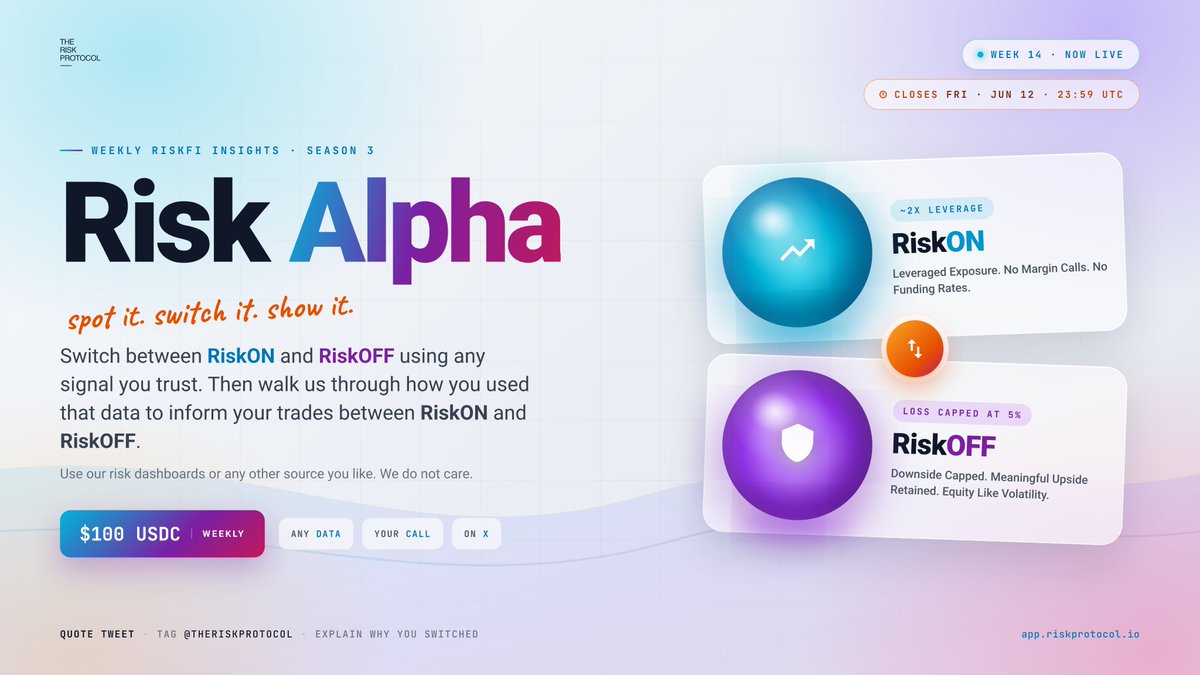
Week 14 of Weekly RiskFi Insights is Live 🤺
But first, last week. Congratulations to @gen2glitter, our Week 13 winner.
He pulled the volatility heatmap, VaR, and drawdowns from our risk dashboards and reached a genuinely differentiated call: BTC fully into RiskOFF, ETH into a 52/48 split rather than a binary flip. That is someone reading BTC and ETH as two different risk regimes, not one. His full entry is linked below.
Now, here is the idea. On The Risk Protocol, BTC and ETH each split into two SMART Tokens with opposite risk profiles. RiskON gives you about 2x leveraged upside without forced liquidations, margin calls, or funding rates. RiskOFF caps your loss at 5% while still retaining meaningful upside. Hold RiskON when you expect strength, rotate into RiskOFF when you sense trouble, and that switching becomes the edge.
Our research shows the bar is lower than you might think: get the call right about 55% of the time, and you already beat buy-and-hold. Push that to 66%, and the gap widens quickly: a median +306% versus +132% for buy-and-hold. That is Risk Alpha.
So here is the challenge:
1. Find your edge anywhere. The charts you already stare at all day, the on-chain dashboards everyone screenshots, our own risk dashboards (https://t.co/twPWrAms17), or your own models. We do not care where it comes from.
2. Use the data to switch between RiskON and RiskOFF at https://t.co/Q5bt70v9Ka.
3. Show your trades on X. Post screenshots of the data you read and the trades you made, then walk us through why you switched.
The sharpest reasoning, backed by real trades, wins.
💰 $100 USDC
⏰ Closes Friday, June 12, 23:59 UTC
📲 Quote tweet this and tag @TheRiskProtocol
Round 1 of The Risk Protocol Trading Competition just got over.
Round 2 just kicked off.
Here is what the competition is about and why you should care.
The instruments: RiskON and RiskOFF
The Risk Protocol splits a single asset (BTC or ETH) into two SMART Tokens:
➡️ RiskON: captures leveraged upside (~2× on moves beyond the strikes). Hold this when you are bullish.
➡️ RiskOFF: caps your downside to 5% per epoch. Hold this when you are bearish.
Every dollar of risk that RiskOFF sheds, RiskON absorbs—and every dollar of upside that RiskON captures comes from what RiskOFF gave up. They are built as counterparties to each other, so at any point in time, the price of RiskON + the price of RiskOFF equals the price of the underlying asset.
The game is knowing when to swap between them.
You do not need to be right every time.
Our research shows that at just 55% accuracy, dynamic switching between RiskON and RiskOFF as market dynamics change begins to beat buy-and-hold. At 66% accuracy over 3 years, BTC traders see +306% median returns versus +132% from just holding.
Full research: https://t.co/U3PxgW4oJy
How you are scored:
Final Score = 60% P&L Score + 40% Risk Awareness Score
Your P&L Score measures how much your portfolio grew. Your Risk Awareness Score measures your Maximum Drawdown—the largest peak-to-trough drop in your portfolio. Lower drawdown means better risk management.
A trader earning 30% returns with only 5% drawdown can outrank someone earning 25% with a 20% drawdown. It is not just about making money; it's also about how well you limit downside risk.
Our Risk Dashboards give you an edge.
Making good swaps starts with reading the market well. Our Risk Dashboards track historic volatility across the top 20 cryptocurrencies—decomposed into upside and downside—so you can see where risk is concentrated. Forecast models predict where volatility is heading. Sortino Ratios across the top 100 cryptocurrencies, broken down by sector and market cap, show you which corners of the market are delivering returns relative to their downside risk. And our Tail Risk dashboard quantifies the probability and severity of extreme losses, so you know when to stay aggressive and when to pull back.
Use them to time your RiskON ↔ RiskOFF swaps with conviction, not guesswork: https://t.co/twPWrAms17
To qualify for Round 2
➡️ $10,000 net volume per round. You can claim free $10,000 of Test BTC and ETH each round to get started
➡️ Active on at least 3 separate days during the round
➡️ Each round runs for 30 days
Two leaderboards. Two ways to win.
Trading Leaderboard: Top 100 traders per round earn RISK Points based on their ranking. Rank 1 earns the most, and points decrease as you move down the leaderboard.
Risk Championship: Tracks cumulative performance across all rounds. One great round is not enough. Consistency is key. Top 10 earn additional RISK Points.
Missed Round 1? Jump in now and start earning.
Did well in Round 1? Do not stop. The Risk Championship rewards consistency across rounds.
May the best trader win Round 2.
https://t.co/Q5bt70v9Ka
The Start In Block 2026 startup competition concluded last week, and it exceeded all expectations.
From over 1,000 applications across every corner of the digital asset ecosystem, 12 finalists made it to the stage at the Carrousel du Louvre. Two days of pitching in front of the leading investors, institutional leaders, and the most demanding jury in European digital assets. The energy in that room during the competition was unlike anything we have seen in previous editions.
Every finalist brought something real. But three companies stood above the rest:
🥇 First Place: @Manakoai, also the winner of the Bittensor track by @YumaGroup
🥈 Second Place: @TheRiskProtocol, also the winner of the DeFAI track by Spectrum Nodes
🥉 Third Place: @SundialProtocol, also the winner of the Institutional Adoption track by @Cardano_CF
A special recognition to the other finalists: @404gen_, Synth, @Bitcast_network, @Neuron_World, Deploi, @CoinbaxHQ, @MasumiNetwork, @zettacapital00, and @libertum_token, each of whom brought a standard that made this one of the strongest cohorts in Start In Block history.
None of this happens without the people who gave their time and expertise to make the competition credible. Thank you to our jury, Mykolas Majauskas - @Bybit_Official, Tomasz Kajetan Stańczak (@tkstanczak) -@Nethermind, Jessi Brooks - @RibbitCapital, Greg Schvey (@GSchvey) -@YumaGroup, Siam Kidd (@SiamKidd) - @dsvfund, Brett Sun (@sohkai) - @preludexyz, Matthew Felice Pace (@mfelicepace) - @SpectrumNodes, Pablo Campos - @Bit2Me, David Bchiri - @xrpl_commons, Samiz Bayan (@samizb) - @DraperDragon, Brian Wong (@brian_wong) - ASCII Ventures, and Ethan Pierce (@EthanPierse) - @BorderlessVC.
Thanks to our sponsors, @Cardano_CF, @SpectrumNodes, @YUMAGroup, @Bit2Me, and @AdevarLabs, for making the $10M+ prize pool possible.
To every founder who applied, built, and took the stage this week, we see you, and we look forward to seeing you at Signal Week 2027.
We’re hosting a Space with @TheRiskProtocol team on April 13, 13:00 UTC.
We’ll focus on their upcoming incentivized testnet going live April 17, and how it works in practice.
$50 reward pool for participants. Set a reminder👇
https://t.co/ctJQij31Ui
Every financial system that scales eventually stops being about chasing returns and starts being about managing and exploiting risk.
Crypto is hitting that inflection point right now.
DAOs are professionalizing treasury management. Institutional allocators are entering with explicit mandate constraints. Sophisticated traders want exposure profiles that perps and spot markets simply can't deliver.
The demand is here. The infrastructure isn't.
Perps lets you trade price outcomes—directional bets on up or down. Protocols like Pendle let you PT/YT Yield, but the underlying risk stays untouched. Nothing in DeFi today lets you isolate, price, and transfer the risk of the asset itself.
That's the gap RiskFi fills. Not packaging risk inside a wrapper. Externalizing it. Making it a programmable primitive—something you can tokenize, bound, index, reprice dynamically, and compose with AMMs, lending markets, and other primitives.
The difference matters. When risk is explicit and observable, the gap between perceived exposure and actual exposure collapses. That's how a financial system matures.
RiskFi isn't the next product category—it's the missing layer of crypto.
https://t.co/YX8hfvW7Na
Crypto built an $85 trillion-per-year market for taking risk, but nothing for managing it.
The last 5 months alone: $150B+ in liquidations. $19B wiped in a single day last October—1.6 million traders liquidated. Black Sunday in February—$2.5B liquidated in 24 hours. Fear & Greed deep in extreme fear for over a month. 38% of altcoins are at all-time lows.
Same pattern every time. Positions unwind into thin books, prices cascade, and the only move available is the same blunt instrument it's always been: sell everything.
Not because traders are reckless. Because the infrastructure literally offers no alternative. There is no on-chain way to dial down your exposure without exiting it entirely. No functional risk transfer market.
In TradFi, equity risk transfer products represent ~$18T against a $126T equity market, ~ 14% of the asset class. The on-chain equivalent of that number? Zero.
Size the gap against TradFi, and you start to see what's actually on the table ⬇️
That's not a problem statement. That's the biggest unbuilt market in DeFi.
On-chain derivatives have scaled past $12 trillion in cumulative volume. Over 97% of it solves the same problem: price direction.
Hyperliquid, dYdX, GMX—these protocols proved that decentralised derivatives can compete with and surpass centralised exchanges. But they all answer the same question: "Which direction will price go?"
On-chain options protocols explored risk management, but still represent a minuscule percentage of derivatives volume. The demand is real. The form factor hasn't landed.
No one has tried to answer a different question at scale: "How much risk do you want?"
That's what we're building.
RiskON and RiskOFF start with the underlying asset and split it into two tokens—one that takes on more volatility in search of more upside, and one that sheds most of its volatility for downside protection without giving away all the upside. You are not betting on direction. You are choosing your relationship with risk itself.
RiskON gives you amplified upside without margin requirements, liquidation risks, or funding rates that drain your position. You wanted more risk—here it is, as a token.
RiskOFF gives you dampened-volatility exposure to the same asset. You still participate in the upside. Your downside is capped at 10%. You wanted less risk—here it is, as a token.
No strikes. No expiries. No counterparty matching. No Greeks. Two ERC-20 tokens, priced by a GARCH volatility model, composable across the entire DeFi stack from day one.
An options position sits in one protocol. A SMART Token moves across the entire DeFi stack—lending, LPing, collateralisation, trading—the same way any ERC-20 does.
The closest precedent isn't in derivatives—it's Pendle. They split yield-bearing assets into two composable tokens, an innovation that created an entire category that reached a peak TVL of $13.4 billion.
We are applying the same model to risk. One asset → RiskON + RiskOFF. Each component finds its own market. But where Pendle depends on ongoing high yields to stay compelling, RiskON and RiskOFF are powered by price volatility—crypto's most permanent feature.
$12 trillion+ traded on-chain. Over 97% directional. Options proved risk demand is real, but haven't scaled. Yield tokenisation proved that asset-splitting works at billions in TVL. RiskON and RiskOFF sit at the intersection of all three insights—in a category with no incumbent at scale.
We are not competing for market share. We are building the market.
Everyone's reading the chart wrong.
The entire CT timeline is debating whether $60k is the bottom. Bulls say extreme fear = generational buy. Bears say $37k is next based on historical drawdown patterns. Both sides are screaming about the same chart.
Wrong argument.
Bitcoin just halved from its all-time high. Over $2B+ liquidated in a single day—multiple times in the same week. 9.3 million BTC sitting underwater. And the Fear & Greed Index hit 5—a new all-time low.
But here's the part nobody's talking about:
Volatility spiked massively. And yet the only tool 99% of participants had during its worst drawdown since FTX was "sell".
No way to isolate the risk. No easy way to stay exposed to upside while hedging the crash. No way to take a view on volatility itself—even as 7-day annualized vol hit levels not seen since 2022.
And when you sell? You create a new problem.
On February 5th, Bitcoin crashed to $60,062. Liquidations cascading. Extreme fear everywhere. Thousands of traders did the rational thing—they exited to stables.
By February 6th, Bitcoin had surged 19% to $71,458—its largest single-day gain in nearly three years.
The traders who sold were safe. They were also sidelined—watching a nearly 20% bounce from the stablecoin waiting room with no way back in at the right moment. And that's the trap: in crypto, the crash and the recovery often happen within the same 48-hour window. Selling protects you from the downside, but it also locks you out of the snapback.
This isn't a price problem. It's an infrastructure problem.
That's what we're building at @TheRiskProtocol.
SMART Tokens split any crypto asset into two components—RiskON and RiskOFF—powered by GARCH volatility forecasting.
GARCH—Generalized Autoregressive Conditional Heteroskedasticity—wasn't born in crypto. It was born in academia. The original ARCH model was developed by Robert Engle in 1982, later extended to GARCH by Tim Bollerslev in 1986. The insight was foundational: volatility isn't random. It clusters. Periods of high volatility tend to persist before mean-reverting—exactly the kind of regime we're seeing right now in crypto. Engle, along with Clive Granger, won the Nobel Prize in Economics in 2003 for their pioneering work. It became the backbone of how traditional finance prices risk—from proprietary Wall Street trading desks to central banks to quant hedge funds and sophisticated institutional investors.
Our Head of Research is a leading econometrician who has worked extensively with Engle and Granger and co-authored papers with them. He first conducted extensive research on the nature of crypto volatility ( see “The Nature of the Beast” and “Bitcoin and Ethereum Volatility Forecasting with GARCH Models” linked below) and then built our volatility forecasting engine from the ground up, purpose-built for crypto's unique volatility profile: fatter tails, faster regime shifts, and 24/7 markets that never close.
This is what allows SMART Tokens to dynamically price the split between upside exposure and downside protection—not based on vibes, not based on liquidation levels, but based on rigorous, academically-grounded volatility forecasting updated in real time.
RiskON amplifies the upside. RiskOFF dampens the downside without sacrificing all the upside. No liquidation. No margin calls. Perpetual in nature.
Think of it as the missing risk layer for crypto. The primitive that lets you position for exactly the outcome you believe in—without betting the entire portfolio on a single direction.
Had SMART Tokens existed during the February meltdown, you wouldn't have had to choose between getting liquidated and getting sidelined. You could have held RiskOFF through the crash and still been in the game for the recovery. No panic. No timing the re-entry. No watching the bounce from the sidelines.
The next time BTC loses almost half its value, the question shouldn't be "is this the bottom?" It should be "which side of the trade am I on?"
Incentivized testnet launching soon. Join our Discord to be the first to know: https://t.co/LqqgzCvHNm
The Nature of the Beast: https://t.co/495RIno98M
Bitcoin and Ethereum Volatility Forecasting with GARCH Models: https://t.co/uRC6NFd2i6
Leverage in crypto is a trap. And earning yield on a bearish thesis? Almost impossible without taking on unbounded risk.
Want 3x long exposure? You post margin and wait. Market wicks down 33% at 1 am when you are asleep, liquidates you, then recovers by morning. You could have recovered, but you got eliminated from the game at the bottom.
Want to earn yield by betting against a rally? You short perps and collect funding. But funding rates can flip and can be unpredictable. Short squeezes can liquidate you. And even when you are earning, you can still be exposed to near-unlimited losses if the market keeps rising and you keep posting more collateral. You have to watch, manage, and adjust. It's a full-time job with asymmetric downside.
This isn't the price of volatility. It's the price of primitive infrastructure.
So here's the question:
What if bulls could get 3x upside in a much more capital-efficient way—without margin calls, without getting wiped by wicks, without watching charts at night?
What if you could earn yield with a neutral-to-bearish view—with no liquidations, no funding rate flips, no unlimited downside, and no active management?
That's one of the major problems we are solving for.
For bulls: Synthetic leverage through SMART Token design. No margin. No liquidations. Your worst case? The token expires worthless. You lose the premium you put in—nothing more.
For yield seekers: A new primitive. Underwrite the bulls. If the market stays flat or drops, you keep everything. If it rallies hard, you lose a part of the principal—but that's it. No margin calls. No infinite liability. No watching positions at night. Deposit, hold, settle. Bounded risk from day one.
One token for amplified conviction. One token for passive yield. Mathematically opposite. A pure zero-sum derivative pairing. Fully collateralised. Defined settlement.
This is the next chapter of DeFi—the dawn of tokenized risk, of RiskFi.
Coming soon, courtesy of The Risk Protocol.