Attorney, securities & sarcasm, with an enthusiasm for cryptoassets. Alumni of 'SC, GW Law. . . .these tweets/sarcasm are neither legal nor financial advice.
.@PantherHollowV and I just moved to Bloomfield, NJ to accelerate a few things…
Join us for our inaugural Panther Hollow nerd and normie mixer!
Sign Up Here -
https://t.co/TEqXsTS3ph
Our banking advocacy organizations are going full mask off. This time is a letter, replete with both misrepresentations and outright lies, panicking about Genius once again.
The core of the panic is simple: banks erected, post-crisis, a regulatory moat to allow them to pay depositors zero and keep all the profits for themselves. Now, they are facing the existential threat of having to compete in a market to earn customers by providing value, instead of having the government lock their depositors in like pigs for the slaughter.
My friend @malekanoms has spoken about this before, but either the banks need to be honest that they are public utilities and be regulated like them (e.g. your bonuses are going way, way, way down) or they need to face actual competition and prove to people they deserve to exist.
What is their response to this? Well, letters that say things like the following, when you simplify their rhetoric:
1 - Uninsured vehicles that hold only t-bills and short dated government debt are much less safe than very lightly insured vehicles that hold illiquid commercial real estate loans at 10x leverage.
This is, obviously, insane. Why do I say that? Well, for one, government money market funds have had zero price stability problems or failures, while in the post-crisis era alone, hundreds upon hundreds of banks have failed. The data here is so striking this is like a highway traffic safety organization saying the Volvo XC-90 is an unsafe SUV so you should go with a 1980 rotted out vehicle with no airbags or seatbelts.
Secondly, you know with certainty they know they are lying. Why? There are something like $7T of government money market funds, which are the exact same structure as the mere billions of stablecoins in a framework similar to Genius, and there is zero about them coming from the bank policy folks. Nothing. If potentially billions of stablecoins being uninsured and holding t-bills is this much of a threat, where the hell were you on trillions of government money market funds! And before someone tells me "oh those are different", I can literally get a debit card and account from @Fidelity backed with their gov't mmf so I earn interest on the money I have parked in there (great product, btw).
2 - This creates a pathway for less regulation and that's unfair
Okay so guys, serious question, which of these requires more regulation:
Option 1: I take money and buy t-bills, and have all the money on hand always if people want it back
Option 2: I take money, lever up massively, lend to a bunch of people in illiquid fashion, don't have enough money to give all the money back if people ask, and pray
These guys are arguing that those financial activities are identical, or that 1 is somehow possibly riskier than two. But even more hilariously, they are lying about the requirements. Genius explicitly says that state frameworks must be substantially similar to and robust as the federal framework (note: still being implemented, so they are also complaining about theoretical futures, not actual ones). Who is writing that federal framework? The @USOCC, a small backwater regulator in charge of insignificant things, like oh I don't know, all of the largest banks in the entire world. Yes, literally the main regulator of JP Morgan, BofA, etc. is the one tasked with this, and yet they are having a collective meltdown.
It would take a heart of stone not to laugh at all of this.
But the reason I write it out is so that everyone can see how profoundly, deeply, hilariously dishonest and anti-consumer letters are like this.
So here is some advice for everyone who is a customer of a bank or who works in Congress (staff and members):
If someone is pleading with you to lock all their customers in and let you exploit them horribly rather than compete, you should remember this is how they want to treat people in every single interaction going forward.
And if you are an American citizen, write to your member of the House or Senator and tell them how odious this is.
https://t.co/KGg5bjZPF2
Our banking advocacy organizations are going full mask off. This time is a letter, replete with both misrepresentations and outright lies, panicking about Genius once again.
The core of the panic is simple: banks erected, post-crisis, a regulatory moat to allow them to pay depositors zero and keep all the profits for themselves. Now, they are facing the existential threat of having to compete in a market to earn customers by providing value, instead of having the government lock their depositors in like pigs for the slaughter.
My friend @malekanoms has spoken about this before, but either the banks need to be honest that they are public utilities and be regulated like them (e.g. your bonuses are going way, way, way down) or they need to face actual competition and prove to people they deserve to exist.
What is their response to this? Well, letters that say things like the following, when you simplify their rhetoric:
1 - Uninsured vehicles that hold only t-bills and short dated government debt are much less safe than very lightly insured vehicles that hold illiquid commercial real estate loans at 10x leverage.
This is, obviously, insane. Why do I say that? Well, for one, government money market funds have had zero price stability problems or failures, while in the post-crisis era alone, hundreds upon hundreds of banks have failed. The data here is so striking this is like a highway traffic safety organization saying the Volvo XC-90 is an unsafe SUV so you should go with a 1980 rotted out vehicle with no airbags or seatbelts.
Secondly, you know with certainty they know they are lying. Why? There are something like $7T of government money market funds, which are the exact same structure as the mere billions of stablecoins in a framework similar to Genius, and there is zero about them coming from the bank policy folks. Nothing. If potentially billions of stablecoins being uninsured and holding t-bills is this much of a threat, where the hell were you on trillions of government money market funds! And before someone tells me "oh those are different", I can literally get a debit card and account from @Fidelity backed with their gov't mmf so I earn interest on the money I have parked in there (great product, btw).
2 - This creates a pathway for less regulation and that's unfair
Okay so guys, serious question, which of these requires more regulation:
Option 1: I take money and buy t-bills, and have all the money on hand always if people want it back
Option 2: I take money, lever up massively, lend to a bunch of people in illiquid fashion, don't have enough money to give all the money back if people ask, and pray
These guys are arguing that those financial activities are identical, or that 1 is somehow possibly riskier than two. But even more hilariously, they are lying about the requirements. Genius explicitly says that state frameworks must be substantially similar to and robust as the federal framework (note: still being implemented, so they are also complaining about theoretical futures, not actual ones). Who is writing that federal framework? The @USOCC, a small backwater regulator in charge of insignificant things, like oh I don't know, all of the largest banks in the entire world. Yes, literally the main regulator of JP Morgan, BofA, etc. is the one tasked with this, and yet they are having a collective meltdown.
It would take a heart of stone not to laugh at all of this.
But the reason I write it out is so that everyone can see how profoundly, deeply, hilariously dishonest and anti-consumer letters are like this.
So here is some advice for everyone who is a customer of a bank or who works in Congress (staff and members):
If someone is pleading with you to lock all their customers in and let you exploit them horribly rather than compete, you should remember this is how they want to treat people in every single interaction going forward.
And if you are an American citizen, write to your member of the House or Senator and tell them how odious this is.
https://t.co/KGg5bjZPF2
@pick_cameron I'm not sure if it's stickier that they think they already have the capability to engage but don't, OR that they do actually have the capability, but haven't anyways
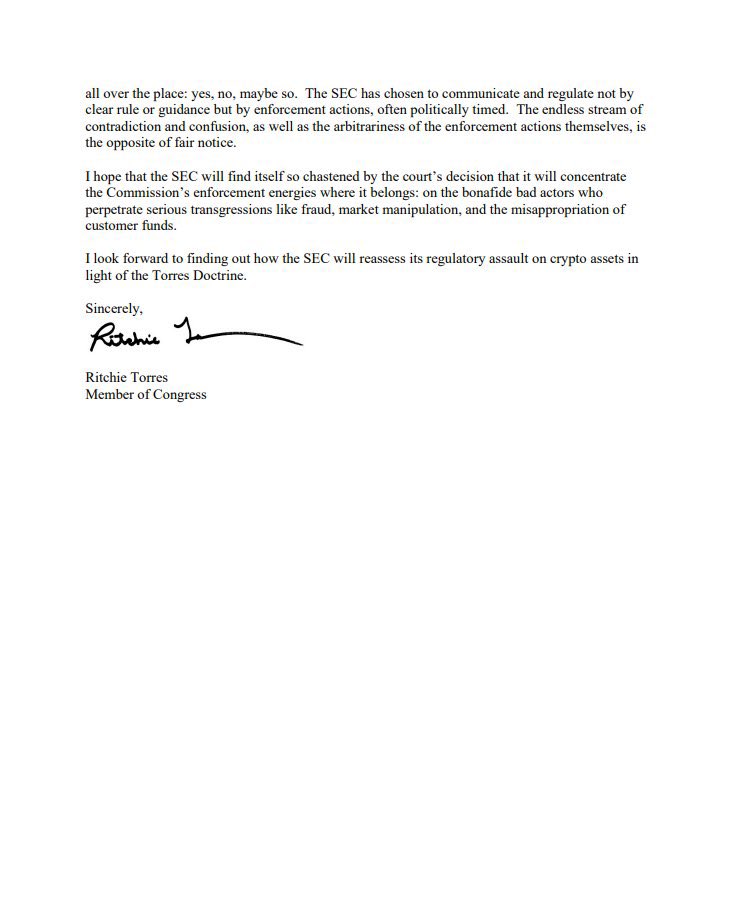
Big week for the Torres’s of New York (see also judge torres referenced) .
Same name a conflict of interest? Idc ya got my vote buddy.
[*not actually in the state of NY*]
Judge shocked by SEC objection to stop purchase of Voyager assets for requesting to prove a negative without further guidance. Fortunately, this protected 97% of customers who voted in favor so that 73% of creditor claims could be recovered—what a relief! #crypto
The proposed custody rules are more “you can’t do”, the vastly less helpful cousin of “here’s what you should do to protect investors, given the circumstances”. #investorprotection? #crypto
After spending time in a country with 99% inflation, I’ve decided people with the opinion that “crypto is useless” really just don’t get out much. Looking right at you Charlie Munger.
@Alex_LLOYLaw To say the least. I wouldn’t even say they “lost the forest amidst the trees”—it’s like they never acknowledged any foliage until it caught fire.
Many centralized exchanges are willing to register. Coinbase acquired a broker dealer/ATS in 2018 and as far as I know (based on public info), the SEC/FINRA won’t approve the license transition to digital assets
Gensler needs to stop the PR road show and resolve the issues