Who ever said free speech was boring? 😄
We are thrilled to announce Tony and Emmy-winning comedian @AlexEdelman as our gala keynote speaker at Soapbox, FIRE's free speech conference!
Secure your 🎟️ below and join us in the fun!
📅 November 4-6, 2026 📍Philadelphia, PA
RIP John Sterling. I used to resent the schtick but came to see him as a very fine baseball broadcaster. And a certified NY broadcast legend, regardless. Still think this is his best call: https://t.co/mn7K9grJjZ
This indictment is breathtakingly frivolous and makes a mockery of the First Amendment. Every attorney who participated in securing it should be ashamed of themselves, if they have that capability. A dark day for freedom of speech.
Congratulation you've just described exactly how government officials can use bogus lawsuits to stifle valid criticism in the absence of a fee shifting statute.
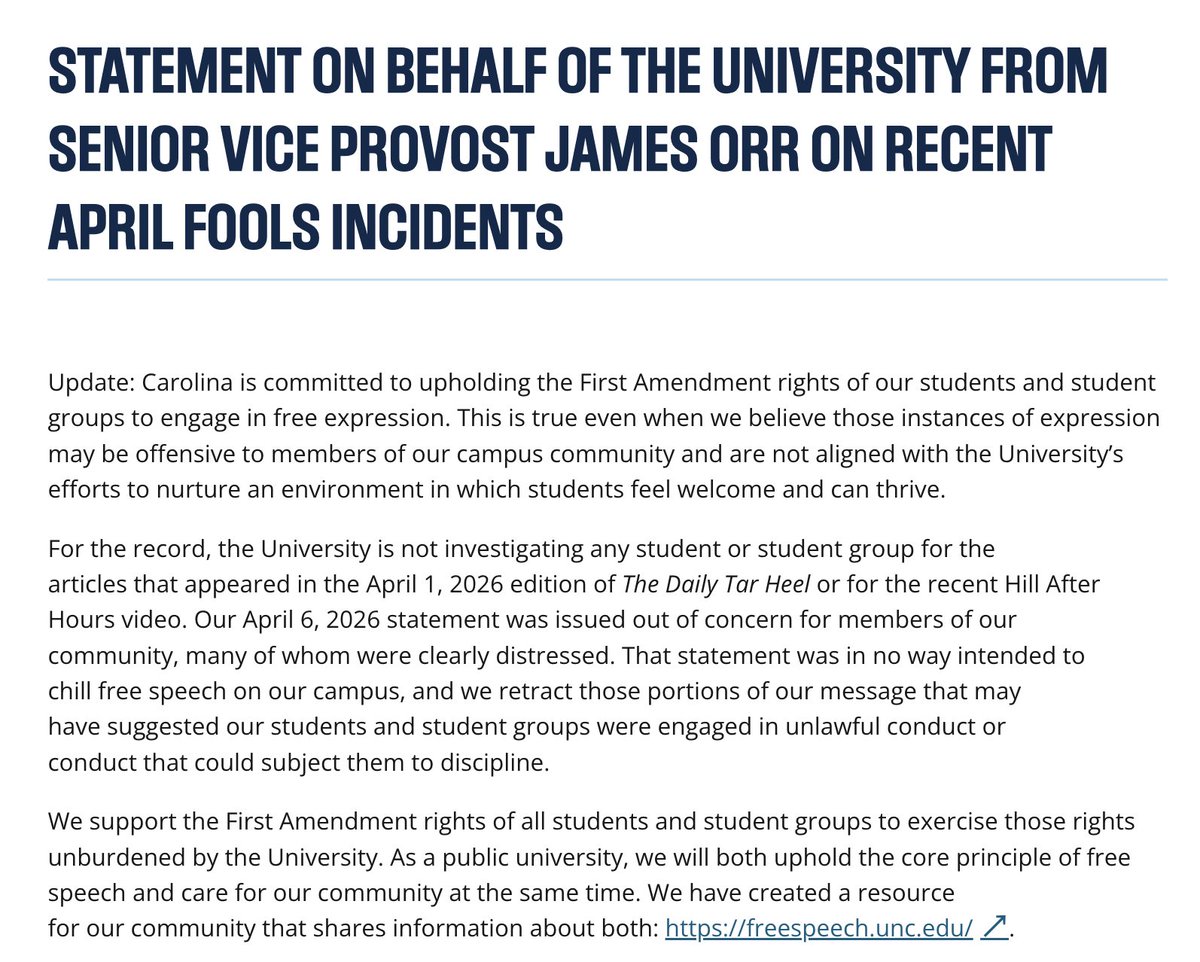
Just now, @UNC-Chapel Hill updated its problematic statement, specifically retracting its announced investigation into satirical student speech.
UNC deserves credit for addressing FIRE’s concerns and acknowledging that its initial response to the @DailyTarHeel’s April Fool’s edition and "Hill After Hours" video chilled speech on campus.
Today’s clarification and retraction is a step in the right direction. While the university’s earlier statement may have chilled speech, its follow-up begins to reverse that damage by reaffirming UNC’s obligation to protect even unpopular or provocative expression.
FIRE applauds UNC’s decision to uphold the First Amendment.
One of the many pleasures (yes, they exist) of being a #Mets fan is not only listening to @HowieRose but having the sense that he is a genuinely nice guy and local kid who Made Good. He deserves to go out on his terms, to have a fulfilling retirement, and to mark the end of his 40 years on the mic with a championship call.
Minnesota’s AI speech proposal is like saying you have free speech, except in books or on social media. The government can’t carve entire mediums of expression out of the First Amendment. https://t.co/KBK9ppsl83
Concerning. Parents, not the government, remain the best guardians of children's internet use and regulating access to information is bad for everyone.
A massive social media and AI chatbot bill, H.R. 7757, dropped on Tuesday with a mark up scheduled for today, giving the public very little time to review and weigh in. It’s a combination of several bills, including KOSA and the SCREEN Act. https://t.co/kob46Z7Zvz
Amid pressure from lawmakers, including NYC Mayor Mamdani, @Hunter_College escalated its punishment of Professor Allyson Friedman by suspending her for her hot-mic commentary about systemic racism at a local school meeting.
Dr. Friedman said her comments were taken out of context and were intended to paraphrase a famous criticism of systemic racism in education from black historian Carter G. Woodson. Regardless, the fundamental First Amendment rights of public college professors are not subject to the whims of their critics.
Faculty have the right to discuss public issues off-hours. Dr. Friedman’s commentary—about issues at a school her child attends—is precisely the kind of political speech protected by the First Amendment.
Hunter College had a chance to stand by a member of its faculty in the face of public pressure for her job. Instead, it buckled to powerful politicians and online commentators. The message to other faculty members is clear: When the rubber meets the road and scholars face backlash for their speech, leadership won’t have their backs.
Hunter must stand on principle by reinstating Dr. Friedman. The First Amendment demands nothing less.
The government can absolutely decide not to contract with a company that won’t build the product it wants. That’s normal procurement discretion, and nobody should pretend otherwise.
What’s NOT normal is escalating from “okay, we’ll take our business elsewhere” to “we’re going to brand you a supply chain risk unless you change your internal rules.” That label is supposed to be about genuine security vulnerabilities—foreign control, compromised systems, coerced access—not about an American company drawing lines around what it will and won’t build. Using it as a pressure tactic is a dangerous category mistake.
And right there is where the First Amendment problem starts to come into view—not as some abstract argument about whose viewpoint wins, but as a very concrete free-speech issue: compelled speech. If the government uses extraordinary leverage—blacklisting-style designations, emergency authorities, or other coercive tools—to force a private company to generate outputs it would not otherwise produce, that’s not ordinary contracting anymore. That’s the state coercing a private speaker to speak.
The reported threat to invoke the Defense Production Act takes it into even darker territory. The DPA is meant to prioritize or compel production for genuine national-defense needs, not to function as a “rewrite your model’s rules or else” mechanism. Using it that way would be a breathtaking precedent: the government effectively reserving the power to commandeer the policies of a leading AI company when it doesn’t like the answer “no.”
That should worry anyone who cares about free speech—and about reality-testing. Once the government normalizes coercive pressure to make AI systems behave as it prefers, you’re no longer just talking about procurement choices. You’re talking about government power shaping one of the core tools we increasingly use to understand what the world actually looks like.
Free speech has been one of America’s most revolutionary ideas. Now, we invite you to a celebration 250 years in the making.
This is Soapbox, FIRE’s free speech conference.
Tickets are now on sale.
BREAKING:
The Department of Justice is reportedly investigating elected officials for criticizing the administration’s immigration enforcement operations. If this is the basis for the investigation, it is blatantly unconstitutional and intolerable in a free society. The right to condemn government action without fear of government punishment is the foundation of the First Amendment.
This would not be the first time the administration has used boundless, imaginary definitions of “obstruction” or “incitement” that have no basis in the law and run headlong into constitutional limits. The few exceptions to the First Amendment are defined by narrow, exacting standards for a reason: to prevent the government from wielding its power to squash dissent.
If criticism of government policy can be rebranded as a crime, then constitutional protections become meaningless and the government becomes unaccountable. That is precisely the danger the First Amendment is meant to prevent, and it is a line no administration may cross.
“If your rights end where someone’s feelings begin, you don’t have free speech of any kind.” @glukianoff on Europe’s free speech crisis for The Eternally Radical Idea https://t.co/MipAKtYyOC
1/13/1969 Following the Jets’ Super Bowl victory, the Daily News publishes a Bill Gallo cartoon depicting the Jets’ championship, the future moon landing, and a potential Mets World Series title.
"'Conservative donors reached out and said, "Hey, you’re going to kill us in four, eight years," ' said one of the people familiar with the conversations between donors and officials." @gekaminsky via @TheFP https://t.co/HQ5pZWLYx7
"The freedom of individuals verbally to oppose or challenge police action without thereby risking arrest is one of the principal characteristics by which we distinguish a free nation from a police state."
City of Houston v. Hill, 482 U.S. 451, 462–63 (1987).