Telomere metabolism, innate immune signaling, cancer initiation, and proliferative boundaries
-- relocated to Blue Sky Dec 2024: @karlsederlab.bsky.social
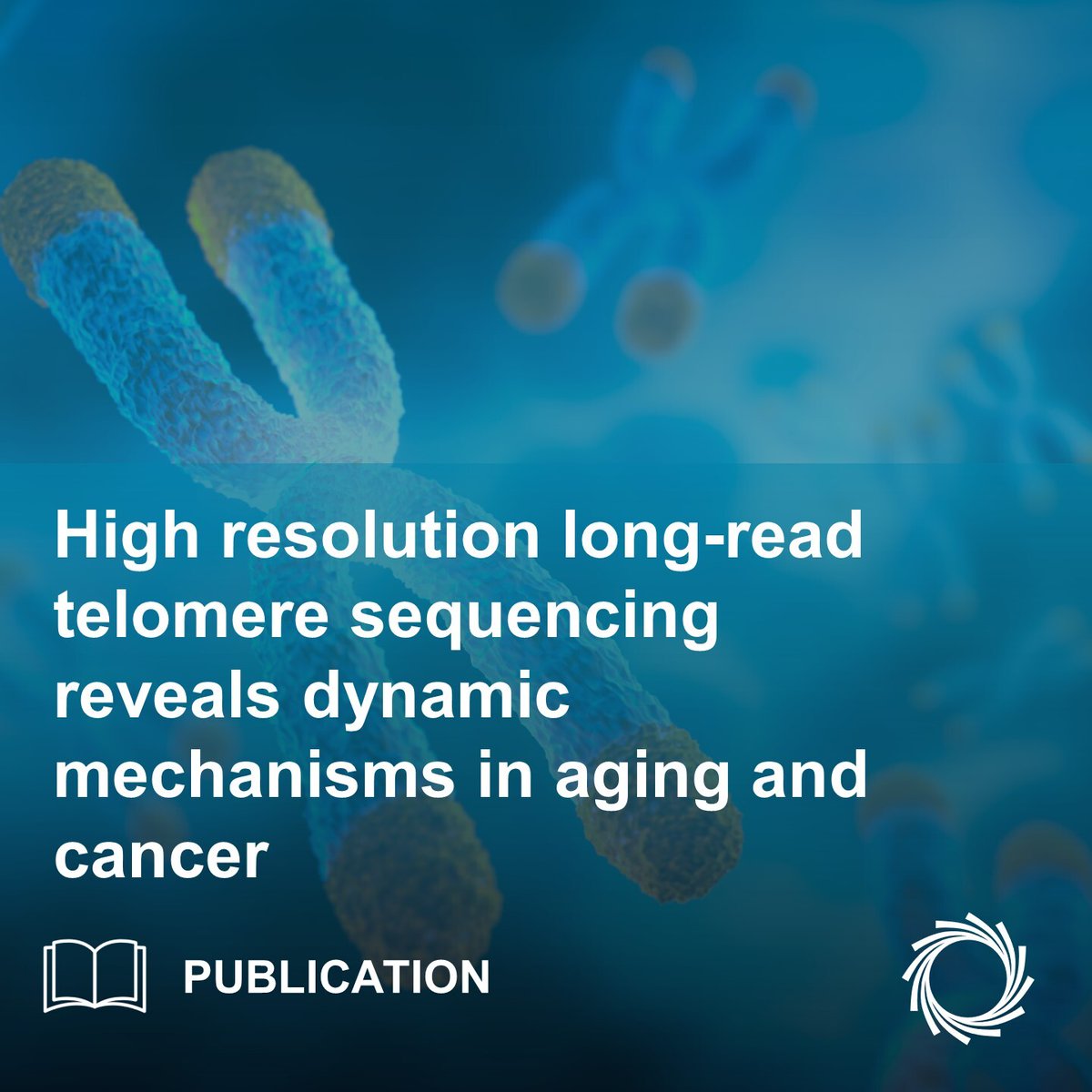
We are excited that our study on telomere sequencing in collaboration with @nanopore is published https://t.co/CZvLmrIONf We developed Telo-seq, a method to determine the length and composition of entire human telomeres in bulk, chromosome arm and in some cases allelic resolution
Introducing Telo-seq: a new tool from @SalkInstitute and Oxford @Nanopore that will revolutionize the study of aging and cancer. Scientists can now measure and sequence telomeres on individual chromosomes with unprecedented resolution. #SalkHealthyAging
https://t.co/bZkbeFDnI9
Please also check out complementary work on telomere sequencing from the Artandi lab (@SCIDirector) published in the same issue @NatureComms https://t.co/Wk6RhBoOTP. Congrats to Santiago (@santiagokique) and all collaborators!
We applied Telo-seq to resolve telomere dynamics during cellular aging and reprogramming as well as differences in TERT- and ALT-positive cancer cells. Congrats to the entire team and big thanks to all our collaborators!
@NatureComms
We are excited that our study on telomere sequencing in collaboration with @nanopore is published https://t.co/CZvLmrIONf We developed Telo-seq, a method to determine the length and composition of entire human telomeres in bulk, chromosome arm and in some cases allelic resolution
Learn how @KarlsederLab & team used nanopore technology to investigate telomere shortening during cellular aging.
Check out how they also studied how alternative lengthening of telomeres and telomerase impact iPSCs and cancer cells.
Read more: https://t.co/5yAeZW6gcE
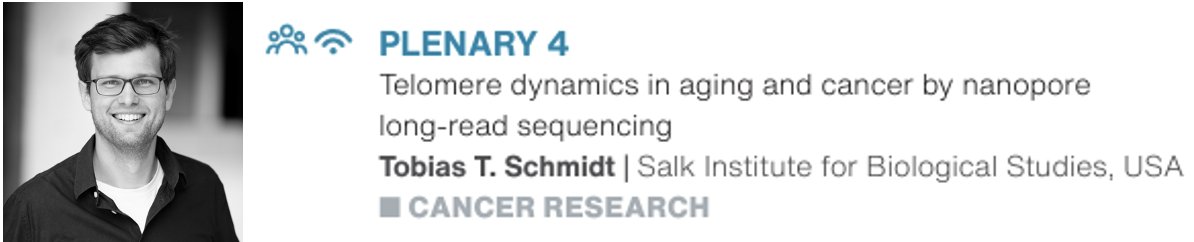
Also, be sure to catch Tobias from the @KarlsederLab's presentation on Telo-seq at the nanopore community meeting in Houston next week https://t.co/baxzG7LgQ2
In collaboration with @nanopore we developed a method to sequence entire human telomeres and determine bulk and chromosome arm-specific telomere length.
Our latest review 'Telomeres as hotspots for innate immunity and inflammation' is now live @repair_dna! Here, we describe how dysfunctional telomeres activate innate immune pathways and fuel inflammaging. Check it out @Sprzetocka@KarlsederLab
https://t.co/8tnZK4ulbn
Our lab website is now live! Explore opportunities and learn about our research on telomere-mitochondria-innate immunity crosstalk at https://t.co/ZtbPRaOejm
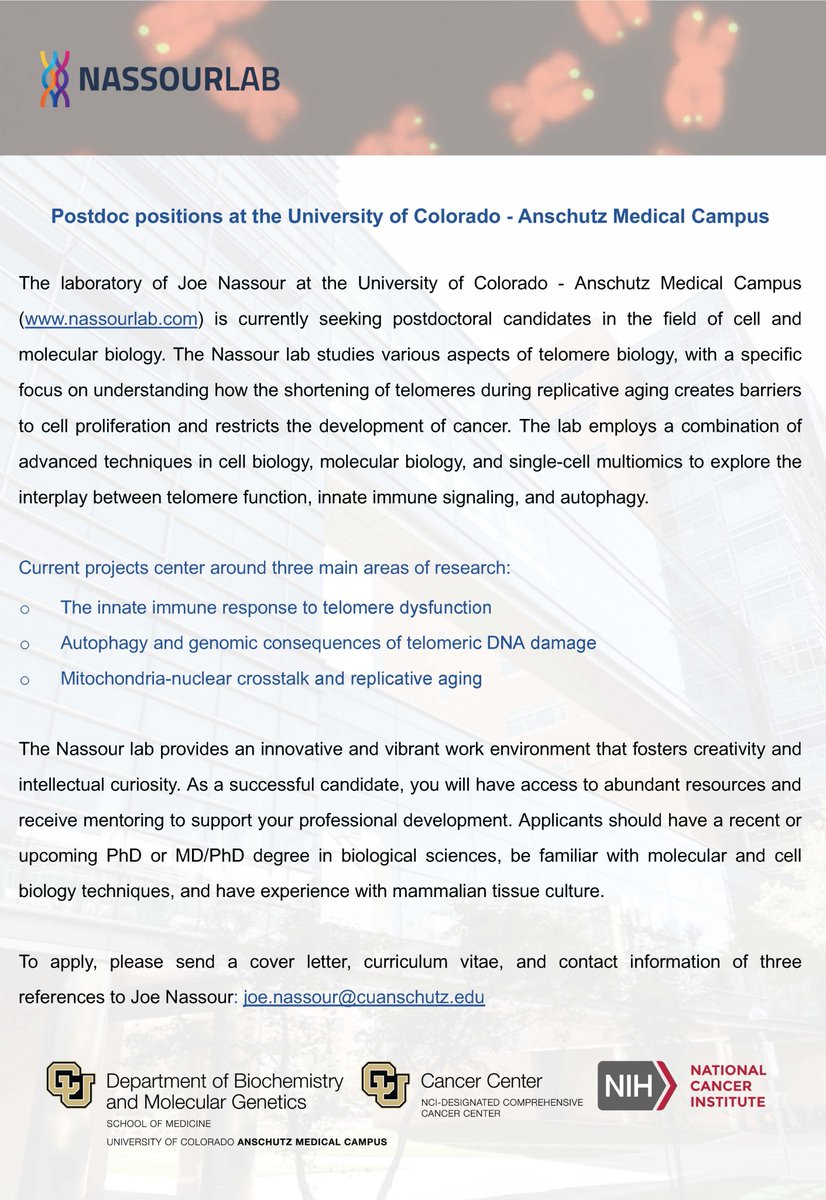
Postdoc positions are available in our group at the University of Colorado @cuanschutz to study the crosstalk between telomeres and mitochondria in innate immunity. See details below, and feel free to DM or email me for further info!
Some tumors repair their DNA via microhomology-mediated end joining (MMEJ), rather than with homologous recombination (HR). Scientists find that MMEJ relies on the APE2 nuclease, revealing a chink in the armor of HR-deficient cancers. @ArnoultLab
https://t.co/YPeVFyzMJm
Great job to the Arnoult lab for their recent publication in Molecular Cell! Their study highlights the critical role that APE2 nuclease plays in Pol Theta-mediated MMEJ. Congratulations!🥳
Excited to share this spotlight on @MolecularCell with @LiuhYow, highlighting a telomere-dependent tumor suppressive mechanism via mitochondria that acts during replicative crisis from @NassourJoe@KarlsederLab
https://t.co/SDAxJY6WQE
JOB OPPORTUNITY! 🧠🔬🧪
9 labs at Salk have joined forces to understand how aging contributes to Alzheimer’s + other age-associated conditions. The team is seeking talented postdoctoral fellows who can work across disciplines.
Please RT and share!
https://t.co/eCrd9tdosF
Our results also indicate that TZAP binding to telomeres induces telomere dysfunction and ALT-like activity, leading to the generation of t-circles and c-circles through a BTR-dependent process. Congrats to Sara (@Sara_Priego_89), Javier, and the entire team!
Our latest study, in collaboration with @ErosLazzerini, sheds light on the molecular mechanisms of the pathway triggered by the telomeric-associated zinc-finger protein (TZAP) in human cancer cells.
https://t.co/AVBXuMHSga
We found that efficient TZAP recruitment to telomeres occurs when telomeric chromatin is open due to the loss of ATRX/DAXX, independently of H3.3 deposition.