🛗 When your professor has just an elevator ride to explain their research…Hear UIC's Researchers of the Year explain their research — in a campus elevator. Learn about all #ResearcheroftheYear awardees: https://t.co/BHyFlL5y2O
#UICResearchWeek#UICResearchMatters#ThisIsUIC
Grateful to be featured by the @VanderbiltU in their 'Beyond the Postdoc' series. If you're a postdoc and looking for some perspective, keep reading until the end - I share a few reflections and pieces of advice that helped me along the way.
https://t.co/t96gbAPiF8
1. For lots of people the hardest part of the paper to write is the discussion. Here is a a very brief guide:
Paragraph 1: is a restatements of the two or three most important conclusions (starting with "here we showed", each conclusion gets 2-4 sentences).
New @SciSignal research reveals that a chemical widely used to inhibit enzymes called protein tyrosine phosphatases also activates different enzymes called protein tyrosine kinases, potentially confounding some experiments. https://t.co/EGFjhPXs8L
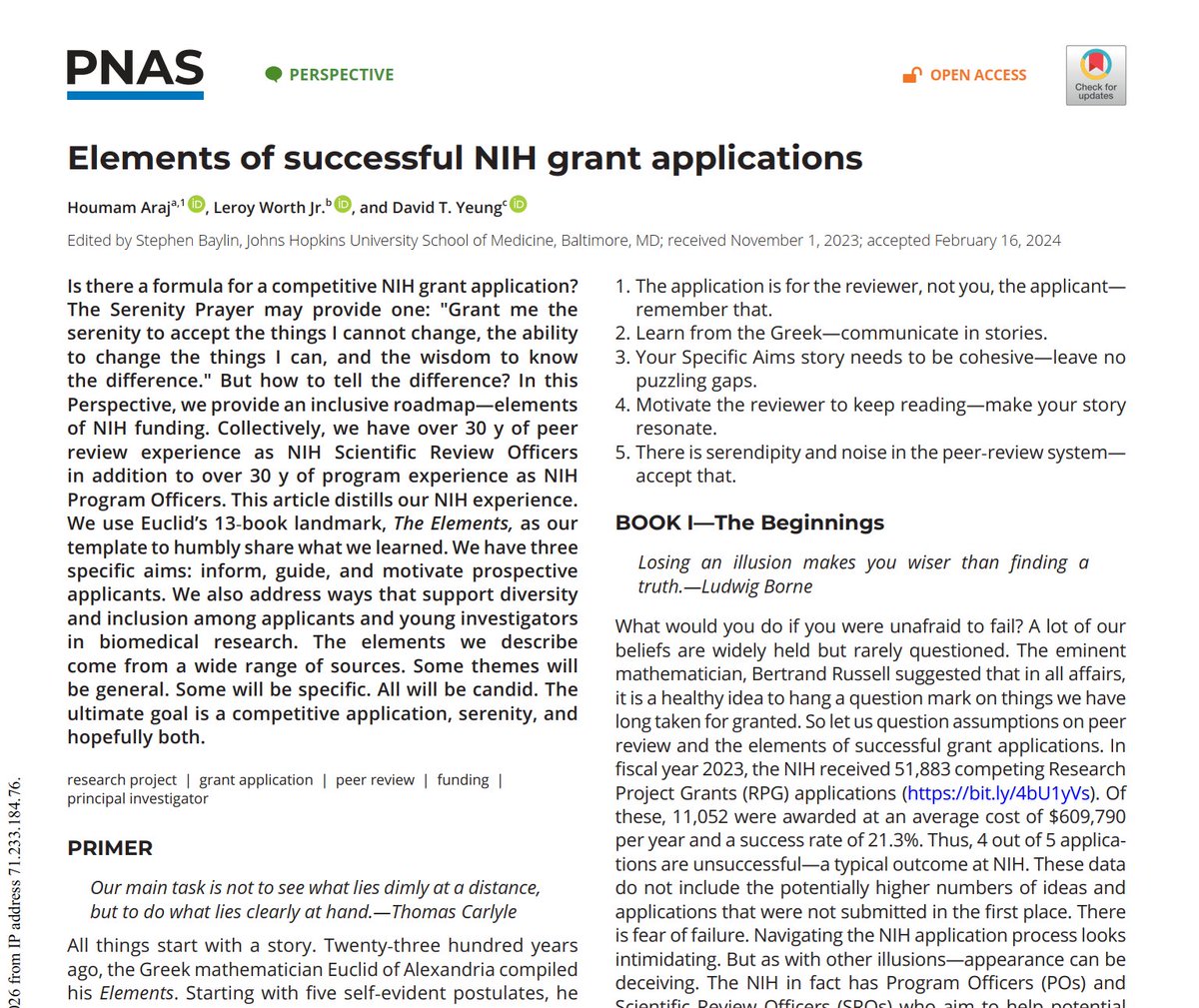
Is there a formula for a competitive NIH grant application?
This Perspective aims to provide an inclusive roadmap on the elements of NIH funding.
Elements of successful NIH grant applications
🚨 New pub alert! Check out our latest one that showcases how chemical and genetic innovations can recreate complex host–symbiont interactions in the absence of the symbiont.
https://t.co/UDFRms5VpC
🚨 Now in @ScienceMagazine: new imaging technique + single-cell sequencing reveal a new understanding of ovarian aging. Led by @DJ_Laird, with #CZBiohubSF Genomics, the study could be key to strategies for extended fertility and healthier aging.
https://t.co/dUw1ie6EdJ
Science is generally wondrous. Yet the paper (out in a few weeks) that this Preview covers is one of the biggest WOW moments of my career. Illustrious credit to @KaurTweets who dreamed it and to the team. With the evidence, we end a debate on the nature of a key symbiotic trait.
This project wouldn't have been possible w/o @Symbionticism and his unwavering support, my undergrad student Mahip Kalra for relentless troubleshooting efforts that brought the chemical experiments to life, and the incredible Lab team for their timely help every step of the way!
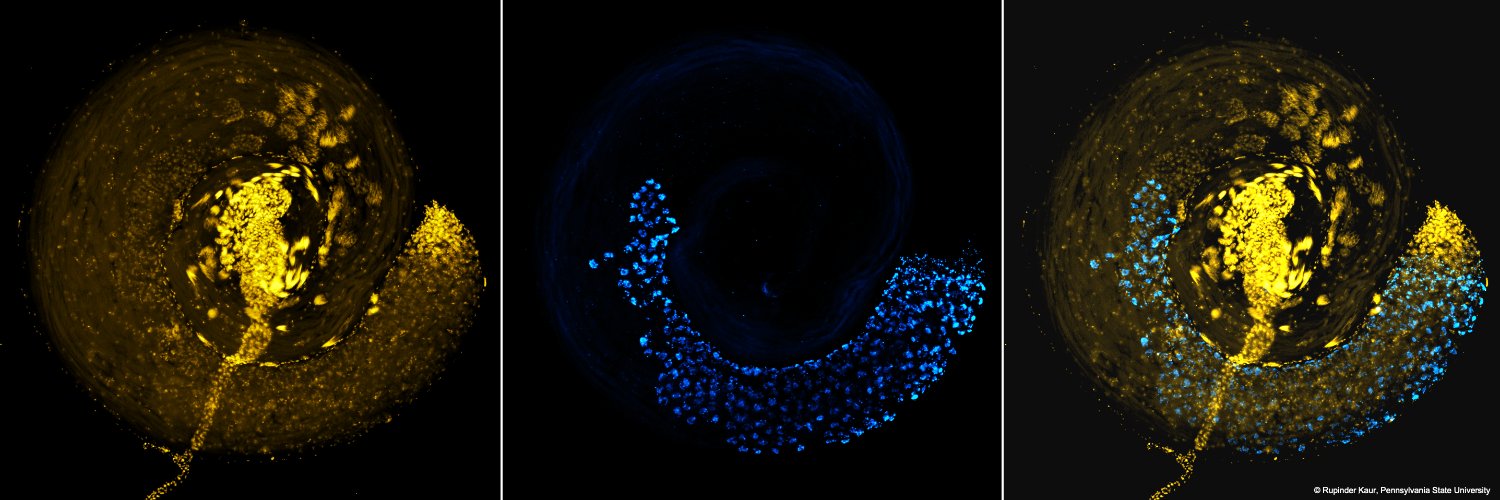
#Wolbachia has puzzled us with its power to rewire host reproduction. What if I tell you we found one of the keys Wolbachia use to rewire its host AND a small molecule can use this key to mimic what this microbe has mastered for millions of years.
https://t.co/aokRTo4YOJ
Why does it matter to mimic symbiotic trait?
👉 develops symbiont-independent toolkit for insect population control
👉 expands symbiont-based biocontrol method to species that can't be infected w the bacterium
👉 inspires ways to study how epigenetics shape host–symbiont biology
Happy to share that I’ll be joining @thisisUIC as an Asst. Prof. in Jan 2026! My lab will explore the epi/genetic principles of host–microbe interactions, symbiosis, and vector biology. We’ll be hiring postdocs and techs—details & lab website coming soon!
https://t.co/EFwRFPWKGT
Not all #mosquitoes are the same! #California is home to several species that can spread diseases like #WestNileVirus, #malaria, and even #Zika. Our latest guide highlights 5 mosquito species to watch out for and when they’re most active.
Free biotech labs, equipment, and training are all bundled into student-driven discoveries and teacher growth. Student publications? Yep. Industry partner? Yep. A must watch highlight reel of @srbordenstein digging into @WolbachiaProj@penn_state. https://t.co/PnQSLYbVOX
@owlstown Yeah, that's what I'm realizing. I see full image nicely placed on my phone screen, but on the laptop, it looks weird with an auto-adjusted view. Thought of asking, thanks though!