I didn’t have getting 👽 disclosure from Dr Phil on my bingo card😂. I’m just glad it’s finally happening. It was so obvious for decades for those paying attention. It’s time we are told the truth.
Our government has known for 79 years.
And they told us nothing.
Objects moving in ways nothing we build can...
Circling the one place on Earth we'd never want them.
This should bother you.
Every major system eventually develops a control layer.
Air traffic has one.
Global logistics has one.
Financial networks have one.
As digital assets expanded across dozens of ecosystems, transactions became increasingly interconnected, but coordination remained fragmented.
Messages move.
Assets move.
Value moves.
Yet the systems responsible for coordinating those interactions often remain disconnected from one another.
The idea behind Wire Network is crucial:
Multi-chain finance eventually needs a financial control plane.
Wire Network is that control plane.
I like saying things no one else in this industry can say. This is one of them. We are letting you own part of the network itself…not just a gas token 🤝
Wire Network is building beyond the traditional utility token model.
Founder & CEO @KenDiCross explains how the network is designed so participants can own transaction capacity instead of simply holding a utility token.
☑️ Allocate TPS to your own applications
☑️ Configure transaction costs for your platform
☑️ Generate revenue from unused transaction capacity
As AI-powered applications continue to expand, infrastructure built for scalable execution becomes even more valuable.
ft: @WireNetwork || @KenDicross
𝗪𝗵𝗮𝘁 𝗶𝘀 𝗪𝗶𝗿𝗲 𝗡𝗲𝘁𝘄𝗼𝗿𝗸?
Most blockchains were built as separate worlds.
Ethereum has its own users.
Solana has its own liquidity.
Bitcoin has its own settlement environment.
Every ecosystem grows in its own direction, with its own wallets, fees, addresses, applications, and security assumptions.
That is powerful, but it also creates a major problem.
Crypto is connected in theory, but fragmented in practice.
If a user wants to move value across ecosystems, they usually need bridges, wrapped assets, routers, or external messaging layers.
That adds friction.
It adds risk.
And it forces users to understand infrastructure they should never have to think about in the first place.
Wire Network is being built from a different starting point.
Wire is a Universal Transaction Layer.
Not a bridge.
Not a router.
Not another cross-chain messaging protocol.
A settlement layer.
The core idea is simple:
Assets stay on their native chains.
Ownership moves through Wire.
That distinction matters.
In a traditional bridge model, an asset is often locked on one chain while a wrapped version is created somewhere else.
The user is no longer just trusting the native chain.
They are also trusting the system connecting both sides.
Wire takes another path.
Instead of constantly pushing assets from one chain to another, Wire is designed to settle ownership changes on its own Layer-1 while the underlying assets remain secured on their native chains.
The asset does not need to leave home.
The ownership record changes.
That is the foundation of Wire’s Universal Transaction Layer.
And from that foundation, the rest of the system starts to make sense.
Wire Name Service handles routing and custody mapping.
UPAP, the Universal Polymorphic Address Protocol, gives users a universal address model across supported chains.
APoS separates governance from block production.
aBFT provides the finality model.
Node owners can whitelist applications, allowing specific dApps to deliver gas-free experiences for users.
Each part is designed around one larger goal:
Make blockchain feel less fragmented.
For users, Wire is about reducing cross-chain confusion.
No more asking which network an asset is on every time you want to interact.
No more manually jumping through several systems just to access liquidity somewhere else.
No more treating interoperability like an advanced skill only power users can understand.
For developers, Wire introduces the idea of Universal Deployment.
Build once.
Reach users and assets across supported chains.
Instead of rebuilding the same application across multiple ecosystems, developers can think in terms of one application layer connected to many supported environments.
That is a major shift.
But the most interesting part may be what Wire means for AI agents.
Human users can tolerate friction.
AI agents cannot.
An AI agent operating at machine speed cannot stop every few minutes to switch networks, search for gas, choose a bridge, check whether a wrapped asset is acceptable, or wait through unclear transaction states.
Agents need predictable infrastructure.
They need transactions that either complete cleanly or revert cleanly.
They need low-friction access across supported chains.
They need settlement built for speed, coordination, and scale.
That is why Wire’s architecture is especially relevant to the agentic economy.
If AI agents are going to transact with other agents, applications, marketplaces, and protocols, they will need rails that do not collapse under the weight of constant micro-transactions.
They will need infrastructure where cross-chain activity is not treated as an afterthought.
Wire is still pre-mainnet, with Testnet V2 live and mainnet timing being finalized.
So the right way to understand Wire today is not as a finished production network claiming victory over every chain.
It is better understood as a new architectural model for what cross-chain settlement could become.
A system where assets stay native.
Ownership settles through one layer.
Users get a simpler experience.
Developers get broader reach.
AI agents get infrastructure designed for machine-speed activity.
That is the introduction.
Wire Network is not trying to add another bridge to crypto.
It is building a Universal Transaction Layer for a world where value, applications, users, and AI agents need to move across supported chains without inheriting the same old cross-chain risks.
The asset stays home.
The ownership moves.
That is Wire Network.
@WireNetwork #WireNetwork
One of the biggest hidden costs in crypto isn't visible on a transaction receipt.
It's everything happening behind the scenes.
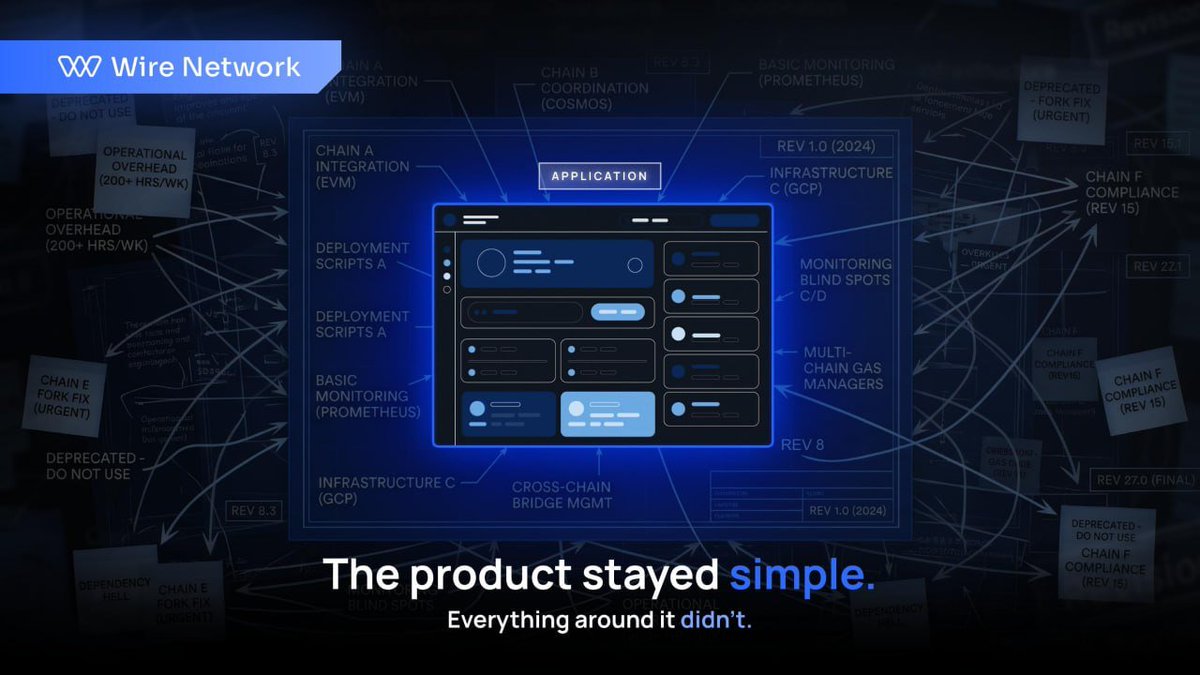
The same applications are repeatedly deployed, integrated, monitored, and coordinated across separate blockchain environments.
The application often stays the same.
The coordination requirements don't.
Shared interoperability layers exist because rebuilding the same coordination logic across every environment becomes increasingly difficult as ecosystems grow.
Applications integrate once with Wire's UTL rather than rebuilding that coordination layer chain by chain.
Complexity compounds quietly.
.@KenDicross talks about how @WireNetwork has solved one of the hardest problems on CT and how we the users would get to see it in the next couple of months.
I think the biggest mistake crypto made was assuming assets needed to move across chains.
@WireNetwork flips that idea completely.
Keep the asset where it’s most secure. Coordinate the ownership instead.
With its Universal Transaction Layer, assets stay on their native chains while ownership is coordinated trustlessly across ecosystems, that eliminates the need for bridges.
Founder of Wire Network @kendicross explains why this could redefine cross-chain infrastructure
Crypto became remarkably good at proving ownership.
It became possible to verify where an asset lives, which address controls it, and its complete transaction history.
What's becoming increasingly important now is coordination.
Assets, applications, and users no longer exist in one environment, which means ownership increasingly needs to be coordinated across connected systems.
That's the idea behind Wire's Universal Transaction Layer: ownership settles on Wire while assets remain native, creating a shared coordination layer across connected ecosystems.
Ownership laid the foundation.
Coordination is what allows digital economies to scale.
The most valuable infrastructure doesn't give users more decisions.
It removes unnecessary ones.
Most people don't want to think about which chain they should use, how value moves between environments, or what route a transaction should take.
They care about outcomes.
The same way nobody thinks about which server delivers an email, most users eventually won't care where an asset originated or how a transaction was coordinated behind the scenes.
That's part of what makes shared interoperability layers interesting.
Applications integrate once with Wire's Universal Transaction Layer and can transact against assets across connected chains without rebuilding coordination logic for every environment.
Infrastructure tends to become invisible when it works.
@seeksahib Companies that create a new mental model become the benchmark everyone else gets compared to. That’s where the real leverage comes from. OWN THE CATEGORY. Love this.
At some point, crypto stopped solving certain problems and started adapting to them.
Bridges.
Network switching.
Multiple wallets.
Wrapped assets.
Manual routing.
The industry became so familiar with these workflows that they started feeling normal.
Most of them exist because independent systems still struggle to coordinate ownership and transactions across environments.
The idea behind Wire's Universal Transaction Layer is that coordination should be shared rather than rebuilt over and over again, creating a common layer where transactions and state are standardized across connected chains while assets remain native.
The best workaround is usually the one you no longer need.
Hosting top notch builders on The Based Show has just been a complete hack to level up my knowledge, network and a front seat of innovation.
Another one tin the books with @KenDicross building @WireNetwork !
Excited to release this soon
Crypto doesn’t have a chain problem
It has a connectivity problem.
Today, billions in assets live across Ethereum, Solana, Cardano, and countless other networks but the ecosystem is still fragmented.
CEO of WireNetwork @kendicross explains why current bridging solutions are only a temporary patch, and why the future needs infrastructure that connects every chain in a trustless way.
@WireNetwork is building the missing layer for a truly interoperable blockchain world.
Ngl, this feels like the next phase of crypto. it’s a world where every chain works as one
At some point, “just bridge it” became normal advice in crypto.
That should probably concern more people.
No other financial system treats intermediary custody layers, wrapped representations, and fragmented transaction coordination as standard UX.
The industry spent years asking:
“How do we connect more chains?”
A better question might have been:
“Why do they behave like disconnected systems in the first place?”
Massive increase in usage of @MorpheusAIs this month, on track for 100%+ growth.
Seeing a surge of GLM-5.2 and DeepSeek tokens flowing yesterday through the API Gateway, also the P2P network usage has vastly increased.
Come provide inference! https://t.co/tyChSyfESl
There’s a reason “multi-chain UX” still feels unfinished.
Most systems were never designed to coordinate state natively across environments.
So the industry built layers around the problem:
Bridges, wrappers, relayers, verification systems.
Wire Network approaches interoperability at the coordination layer instead of layering more infrastructure on top of fragmentation.
.@KenDicross,founder of Wire network talks on how unification of User base and liquidity in a trusted decentralized way evolves the web3 world,which is what wire network provides.
Ft:@WireNetwork