At some point, crypto stopped solving certain problems and started adapting to them.
Bridges.
Network switching.
Multiple wallets.
Wrapped assets.
Manual routing.
The industry became so familiar with these workflows that they started feeling normal.
Most of them exist because independent systems still struggle to coordinate ownership and transactions across environments.
The idea behind Wire's Universal Transaction Layer is that coordination should be shared rather than rebuilt over and over again, creating a common layer where transactions and state are standardized across connected chains while assets remain native.
The best workaround is usually the one you no longer need.
Hosting top notch builders on The Based Show has just been a complete hack to level up my knowledge, network and a front seat of innovation.
Another one tin the books with @KenDicross building @WireNetwork !
Excited to release this soon
Crypto doesn’t have a chain problem
It has a connectivity problem.
Today, billions in assets live across Ethereum, Solana, Cardano, and countless other networks but the ecosystem is still fragmented.
CEO of WireNetwork @kendicross explains why current bridging solutions are only a temporary patch, and why the future needs infrastructure that connects every chain in a trustless way.
@WireNetwork is building the missing layer for a truly interoperable blockchain world.
Ngl, this feels like the next phase of crypto. it’s a world where every chain works as one
At some point, “just bridge it” became normal advice in crypto.
That should probably concern more people.
No other financial system treats intermediary custody layers, wrapped representations, and fragmented transaction coordination as standard UX.
The industry spent years asking:
“How do we connect more chains?”
A better question might have been:
“Why do they behave like disconnected systems in the first place?”
Massive increase in usage of @MorpheusAIs this month, on track for 100%+ growth.
Seeing a surge of GLM-5.2 and DeepSeek tokens flowing yesterday through the API Gateway, also the P2P network usage has vastly increased.
Come provide inference! https://t.co/tyChSyfESl
There’s a reason “multi-chain UX” still feels unfinished.
Most systems were never designed to coordinate state natively across environments.
So the industry built layers around the problem:
Bridges, wrappers, relayers, verification systems.
Wire Network approaches interoperability at the coordination layer instead of layering more infrastructure on top of fragmentation.
.@KenDicross,founder of Wire network talks on how unification of User base and liquidity in a trusted decentralized way evolves the web3 world,which is what wire network provides.
Ft:@WireNetwork
The Wire Network team was proud to attend the TechDollar Dinner during NY Tech Week hosted by @introductioncom.
The private event brought together leaders from frontier AI, enterprise technology, fintech, institutional finance, and global banking, including representatives from Anthropic, NVIDIA, Stripe, Palantir, Google, Amazon, JPMorgan, Robinhood, Grayscale, and more.
One theme was impossible to ignore: the lines between AI, finance, and infrastructure are disappearing.
As these industries converge, the need for systems that can coordinate value, ownership, and transactions across fragmented environments only becomes more important.
Great conversations. Great people. Excited for what's ahead.
What do you think when you see “UTC” as a web3 enthusiast?
Listen to the @KenDicross, the CEO, and founder of @WireNetwork breakdown what it is and what’s coming from Wire Network
“Today, users thinking chains, I need this wallet on this network with this gas token using this bridge before an app can be used, Wire Network is on the verge of solving all that”
Every company integrating Wire’s infrastructure is not only leveling up their capabilities & security, but also radically reducing costs as they execute their multi chain mandates. Win. Win. Win.
One of the highest hidden costs in crypto is duplicated infrastructure.
The same applications are repeatedly redeployed, re-integrated, and re-coordinated across separate blockchain environments.
That increases operational complexity, fragments liquidity, and expands trust assumptions across every additional integration.
Wire Network reduces that complexity through a shared interoperability layer where applications integrate once with the UTL instead of rebuilding coordination logic chain-by-chain.
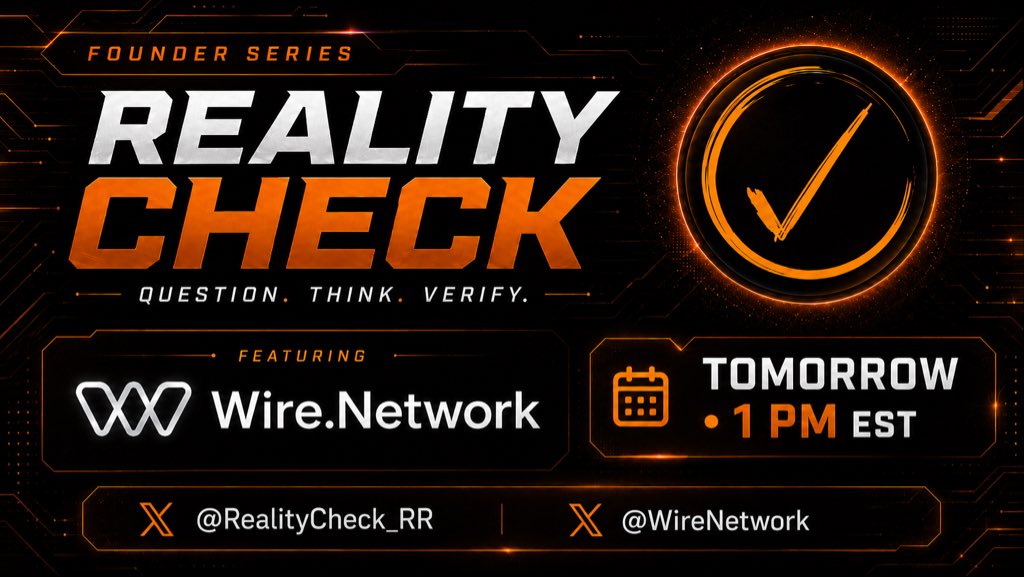
Reality Check: Founder Series goes live tomorrow with @WireNetwork
We’re talking Web3 infrastructure, the vision behind https://t.co/qFcGxPlEaj, and what they’re building next.
🗓 Tomorrow
⏰ 1 PM EST
📍 @RealityCheck_RR
Question. Think. Verify.
Ownership and interoperability are becoming increasingly important as digital assets expand across ecosystems.
Excited to discuss the future of connected chains and what comes next.
I’ve been stating for a long time that it would widen…in the other direction! As closed source models gatekeep, increase prices, etc. the open source models will push forward at the speed of innovation. This also means on the hardware side. Open source is the winner in the future.
@AskVenice is great…on the other side of the same coin…is @MorpheusAIs. @DJohnstonEC would be an amazing conversation to book.