Be ready to see a cambrian explosion of verticalized apps on web3 rails 🏗️
Asia birthed giant super apps like WeChat and Grab, but the next wave of winners will initially wedge into niches 🎯 and scale vertically through DeFi 💰 + verifiable data 📊. Let me explain why 🧵
Founders buying their own company's bonds has a poor track record and isn't a strong vote of confidence
Chairman Hui Ka Yan of Evergrande, China's second-largest property developer in 2018, collected about $1.7B in dividends in Oct-18. Shortly after, he put $1B, about 60% of payout, back into its bonds personally and through his holdco. Evergrande later defaulted in 2021
https://t.co/ChJV3o78UX
Founder Zeng Jie of Fantasia, a Chinese developer of luxury homes, received $32M in dividends through her holdco in 2019-20. Then, she bought $17.1M (53% of payout) of its bonds in 2021. Shortly after, Fantasia defaulted on these bonds in the same year and just completed a massive restructuring plan earlier this year
https://t.co/ttOHOHwbBe
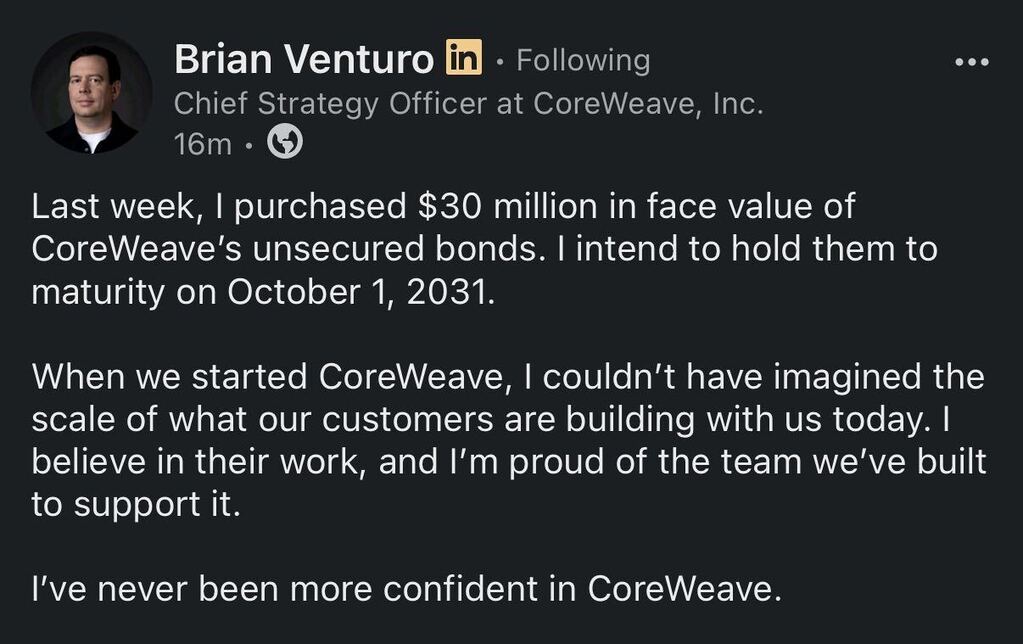
Now CoreWeave co-founder Brian Venturo has bought $30M of its bonds. His bond purchase represents 2.5% of the $1.2B+ in $CRWV stock he's sold already since IPO
CoreWeave got lucky
They were in a tight spot. Rates are elevated, capital markets are cautious on neoclouds, and their unsecured bonds are yielding mid-teens. Issuing new debt would be expensive
But strong compute demand bailed them out. According to @SemiAnalysis_, H100 rental rates rose 7% QoQ and B200 27%. With compute that tight, customers were willing to prepay on long-term contracts to lock-in capacity
Though it's a balancing act between short-term vs long-term contracts. Long-term contracts bring stability but short-term contracts bring the margin as they rent for ~2x currently
$CRWV likely gave up some price to get those customer prepayments. On yesterday's Q3 earnings call, they mentioned:
"We take an economic approach to prepayments, weighing the impact to pricing against the cost of financing."
And fortunately giving up some margin right now can cost less than issuing new mid-teens debt
They've used prepayments to solve near-term liquidity but the pressure isn't gone. It just shifts the obligations to their delivery schedule which 2/3rds of the prepayments are dependent on
The shift away from financing GPU clusters with offtake agreements to prepayments means that OCF to EBITDA is the most important metric.
Moves the diligence burden from private credit funds evaluating the creditworthiness of offtaker to the actual customer of the GPU making the prepayment.
Dock to live and historic cluster stability levels will be the most important metrics to customers who are increasingly paying nearly 100% upfront.
Also significantly improves the payback period on GPUs.
8/ Even with the risks, a v2 in this direction could gamify TCG supply and turn every collector into a source of gacha inventory 🃏
Dusty collections become productive
Normies touch web3 rails
TCG marketplaces get more supply
Who builds the drop-off + certification network?
FWA is one of the more interesting recent web3 experiments. h/t
@Rhynotic / @token_works for shipping $FWA
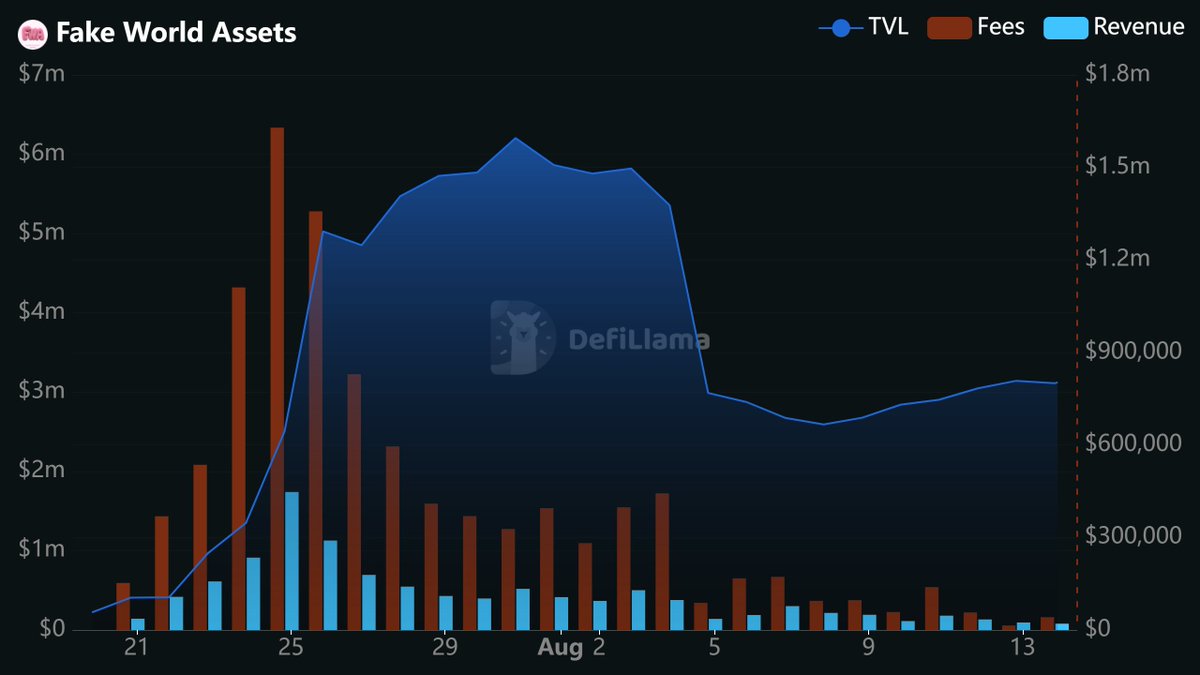
Since 7/20 launch:
6,200 NFTs
14.5K ETH (~$27M) volume
$10M fees
$2.8M revenue
Post-hype, last 7D still hit $502K fees & $260K rev
v1 proved it. v2 should expand IRL 🧵
7/ However there are some risks with the current mechanism as it may be capital inefficient with the ETH collateral requirement
And high-value cards face a russian roulette situation where they can get pulled quickly if the ETH backing is light