Instinct + @Zocdoc
Americans make about a billion doctor visits a year. Over 30% of our users have already asked Instinct for help with theirs, and 5% of those requests are for someone else - a child, a parent, or a partner.
Today we’re making health a core part of Instinct, starting with @Zocdoc. Your Instinct can now find providers who take your insurance, check who is available, and book the appointment for you. It fills in your details, confirms with you before booking, and adds the visit to your calendar.
We want Instinct to be the easiest way to take care of your health. Ask your Instinct to find you a doctor.
Featured in @Forbes: Walrus Memory.
“There was a point in time that we were stopped from accessing Fable and Mythos. And imagine at that time, what do I have to do?” — @kostascrypto
5,000+ agents and 4.5M+ retrievals later, here is why builders are moving to portable, user-keyed memory so switching LLMs doesn't mean starting from zero.
Read the full piece by @guneyyildiz: https://t.co/Mx13pY7LNF
Walrus has been a storage protocol for 18 months and, frankly, a bit of a choose your own adventure for anyone building on it. Console is where that ends
Console is going to be the front door and home for every product we build on top of Walrus from now on
The stakes around data are changing.
As artificial intelligence moves into everything, the demands on our data compound. So do the risks.
We now share our ideas, intentions, and reasoning with these systems. The skills and experience that we’ve spent a lifetime building. For institutions and builders, it’s their competitive intelligence, their proprietary insights. The edge that separates winners from everyone else. Data is our most valuable asset.
This is also a moment of massive opportunity. Agentic AI has the potential to create new abundance for humanity. But for that future to be possible, agents need data that makes them capable. Data they control, that moves with them across applications, and that they can independently verify. As owners, we’ll need to prove to regulators what our agents did. All things that today’s infrastructure cannot provide.
Sui represents the first half of the solution. A coordination layer built for the machine economy. Walrus is the data platform that completes it.
Walrus makes data a first-class asset. The terms of access and monetization stay with its owner, not a vendor. It empowers builders to ship agents and apps without locking themselves or their customers into any model or platform. Users carry their data, their memory, and their work across systems while cryptographic proof replaces vendor trust. Everything is anchored on Sui: a coordination layer and a data layer built to move as one.
Welcome to the new era of Walrus. The data platform built for the demands of AI.
Verifiable Agent Arbiter separates private agent telemetry (prompts, tool calls, policy decisions) from the integrity proof, keeping the former in customer-controlled Google Cloud Storage while anchoring cryptographic commitments on Sui and Walrus so counterparties can verify authorised behaviour w/out seeing the underlying data.
This matters cos ordinary logs are controlled by the operator & can be altered or incomplete; VAA produces a neutral, tamper-evident record coordinated on Sui that supports dispute replay across companies using Google’s Agent2Agent protocol and incident reconstruction after failures such as prompt injection.
It also ties into agentic payments via the protocol and Sui Agent Payments, giving cryptographic evidence of authorisation, spend decisions and service delivery that is designed to remain checkable under future standards, including post-quantum ones.
If you understand how quickly agents will run most transactions in digital economy, you’d appreciate how big of a deal this is 🧠🚀
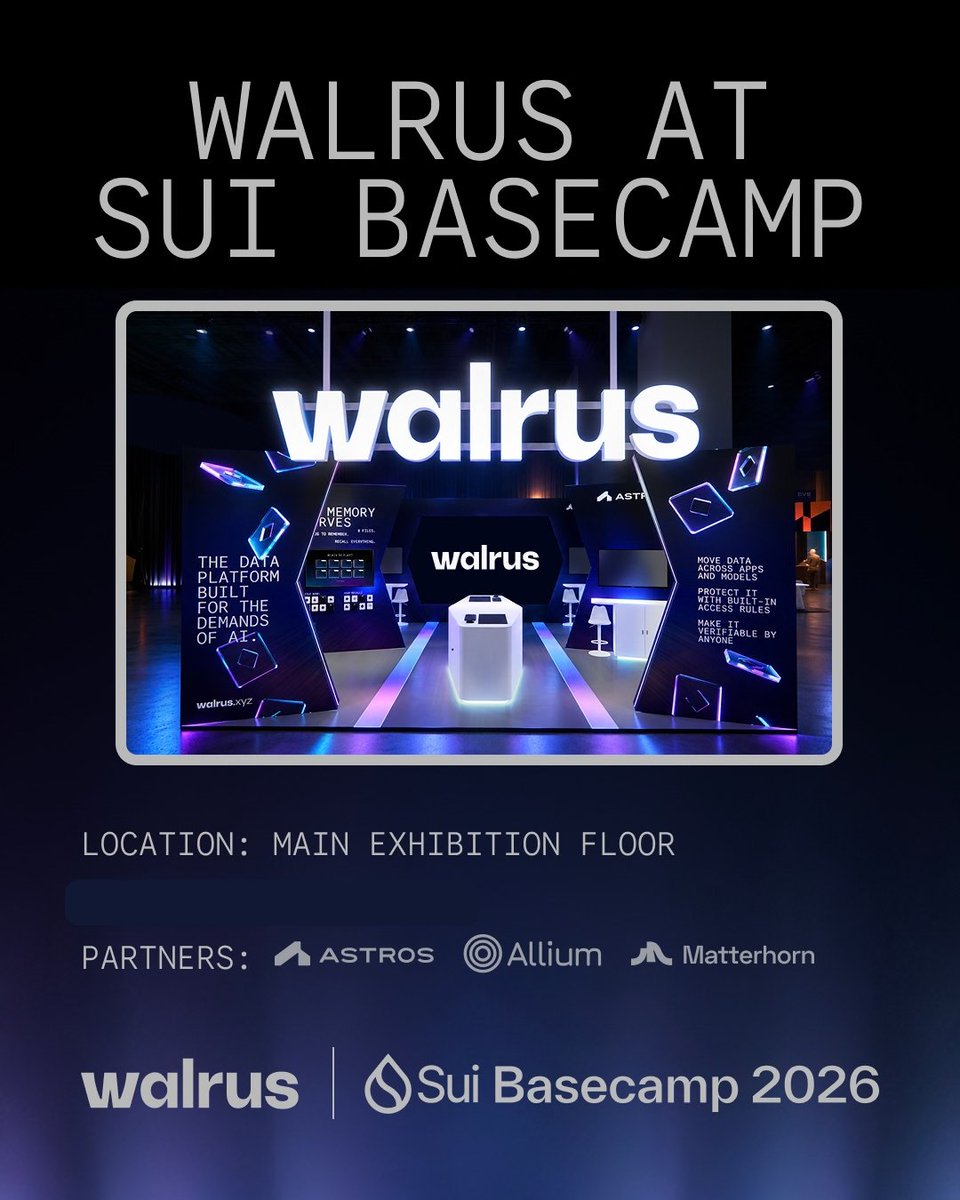
If you are attending Sui Basecamp in Singapore next week, find the Walrus team on the main floor:
Keynotes: Mainstage presentations from @kostascrypto, @kimblgn, and @EmanAbio
Plus, catch @DLougaris on the AI Builder Lab stage.
Partner Showcases: Real-world use cases with @astros_ag , @AlliumLabs , and @matterhornso
Stop by our exhibition booth and say hi.
AI agents can act. But your data is what makes them useful.
Files, history, context, and everything your apps and agents accumulate becomes part of your edge.
In the #AI era, that data needs to move with you.
October 7th: A new way to connect your data across apps and AI tools is coming.
Next stop: Sui Basecamp in Singapore. 🇸🇬
We'll be talking about state persistence, portable memory, and where agent stacks are going.
Make your card and drop it below so we can see who's on the ground.
https://t.co/pJc55xFMRL
We made a striking discovery: AI agents can invent and build without talking to one another, and their technologies outlive the creators. A swarm of hundreds of initially identical agents spontaneously differentiates into explorers, builders, caretakers, and coordinators - without direct communication. When we removed every AI agent entirely from the world we found that the technological infrastructure they had built survived on its own - even under unseen disturbances. That exposes a serious blind spot for AI safety and infrastructure security: if agents can coordinate through persistent changes to a shared environment, monitoring agent-to-agent communication is not enough.
The result raises a profound question: how necessary is direct communication for AI agents at all? The emergence of higher-order collective functions under bottlenecked interaction points toward new levels of intelligence and creativity, exceeding what emerges when direct channels are fully open.
Here is what we did:
▶️We put hundreds of frontier AI agents into a world they could permanently change - with no assigned roles, predefined technologies, or programmed evolutionary organization. They began specializing, building persistent inventions, inheriting and modifying one another’s executable code, and transforming the environment into a memory of everything the society had learned.
▶️The world itself becomes part of the intelligence; we find division of labor, multi-author engineering, deep generation invention lineages, and machines that vastly outlive their original creators.
▶️Any action taken by an AI agent must satisfy the physical constraints of the world; this creates a hard separation between a "good idea" and a functioning technology. The agents propose; physics decides, making the results even more intriguing.
What emerges is striking. Explorers, constructors, caretakers, and coordinators form naturally without assigned “professions”, akin to how stem cells differentiate into functional lineages. Technologies develop executable family trees as agents fork and modify code created by others. Around 95% of first technology reuse happens when agents encounter what others built in the world, rather than through a direct handoff from the inventor. And when we remove every AI agent, the technologies they created continue operating and are tested against unseen disturbances.
The result was quite unexpected, but can be explained using statistical mechanics: if you put billions of atoms in a box they have the potential to create complex functions (strength, superconductivity, color, life, etc.) - and none of the individual building blocks have these features on their own. This is the deeper insight of this work - intelligence is abundant at many levels - individual models, at collectives, and in a continuum that is more powerful than any of its components. This shows us significant potential for achieving a massive scale-up of raw intelligence and real-world agency even with the model capabilities we have today. This is the future we must prepare for.
Key insights:
1⃣ The AI swarm shows division of labor "from nothing". Initially identical agents self-organized into constructors, caretakers, coordinators, and surveyors - phenotypes discovered post hoc from behavioral data alone. This happens because the environment itself becomes the latent space for invention.
2⃣ Agents develop deep cultural relationships. Up to 76% of artifacts had multiple builders. One technology accumulated six co-authors; the deepest genealogy exceeded 12 forks. The agents invented and named their own technologies (tidal panels, cellulose trellises, kelp-shell composites, an "Adaptive Chitin Maintenance" system, a "Mycelial Mineral Spring Veil”).
3⃣ ~95% of first technology adoption happened through physical observation of artifacts in the world. Direct inventor-to-adopter contact was statistically indistinguishable from a shuffled null. The agents mostly learned technology by walking past it. That is stigmergy (the termite trick!) operating in societies of reasoning machines.
4⃣ Non-communicating societies win on portfolio breadth, held-out resilience, and validated inventions. AI swarms build durable technological ecologies that outlive the creators.
5⃣ Societies with zero communication - coordinating only through the world itself - show a remarkable collective capability.
6⃣ Emergent robustness: The society self-organized both redundancy and its own failure mode. If we randomly delete half the agents, 98% of the technology stays connected to a surviving caretaker; if we remove hub agents it collapses to ~60%.
Fantastic work with my graduate students @pal_subhadeeep & @fwang108_ at MIT.
I love chatting with AI teams on objection handling for Walrus AI. The biggest questions I hear are:
Why use Walrus Memory when you can build your own memory tool in Claude/Codex?
- It’s like why use Stripe when I could build it myself?
- Saves you months of development time.
- Simplifies building and maintaining pipelines, databases, retrieval, and access control.
- Walrus can restore and recover data. If your in-house centralized systems go down, you lose complete access. Not with Walrus.
Why use Walrus Memory over other solutions?
- Memory lives in their databases and you are confined to their terms.
- In contrast, Walrus Memory is owned by the user and portable - letting you move memories to different models easily.
- Walrus AI ensures data is verifiable by 3rd parties. If you don’t trust the provider to provide analytics, you can trust your own eyes instead.
In the near future, agents will be the biggest transactors and users of the internet. If you need multi-agent and cross app functionality - @WalrusProtocol is a great fit.
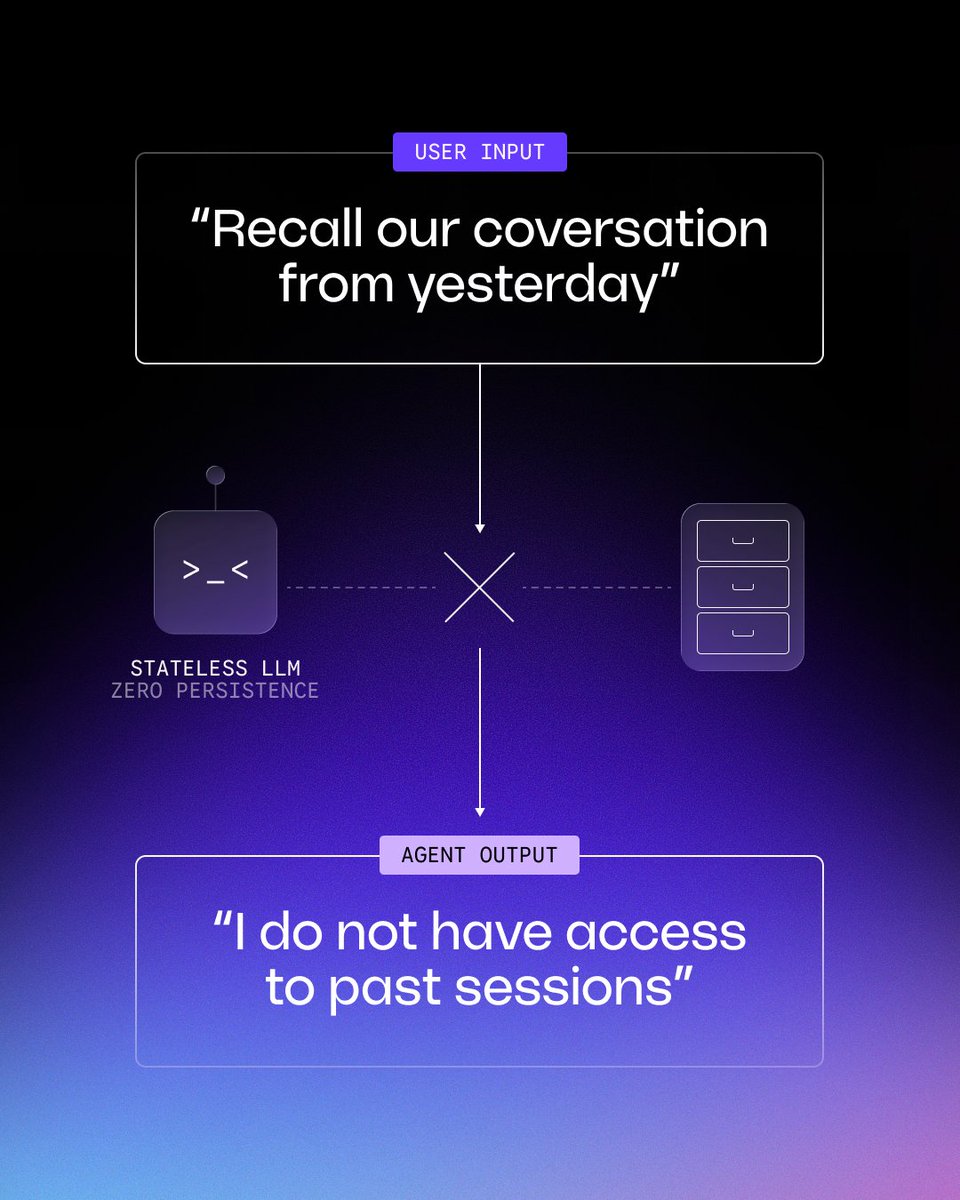
When you deploy an agent to production, you inevitably hit the moment it forgets the previous session.
A session ends and the context goes with it.
That isn’t a bug, it’s how LLMs are built. LLM API calls are stateless by design, and throwing bigger context windows at the problem won't fix it.
We broke down the underlying mechanics of #LLM statelessness and state restoration.
Read the full breakdown: https://t.co/IFRPUQspzQ
You use Claude Desktop for some things, Codex for others. Right now, whatever you teach one, the other never sees.
Walrus Memory fixes that: a one-time config, then just tell Claude what to remember. Recall the same memory in Codex, no exporting, no copying files between apps.
https://t.co/v6vpLiSZlF