▪️ Omnivorous. Monogamous. Perspicacious.
▪️ Hunting, scavenging, and messing with owls.
▪️ Unjustly tied to death, pestilence, John Crowe Ransom and racism.
Economists say that “green growth” can stop climate change, but their solutions only address carbon emissions. With this lens, electric SUVs sound great – until you factor in material extraction, land use, and other consequences born by communities in the Global South.
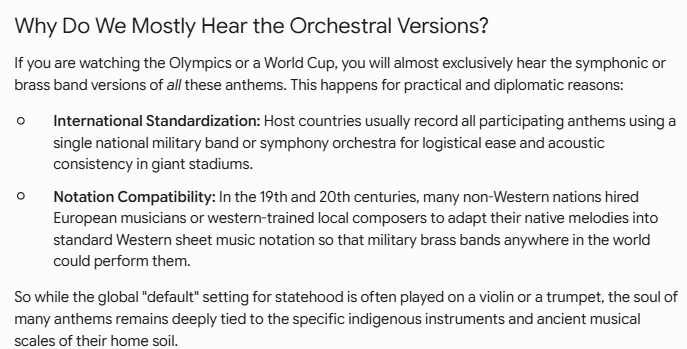
@Braden_Keith You'll hear them all played on the same/similar instruments for standardization, not necessarily because they were all composed for European instruments.
@Braden_Keith The question reporters should be asking him: "Cody, explain to the average viewer what is impressive about taking performance enhancing drugs, putting on a full rubber bodysuit, and going slower than non-enhanced records."
@mickakers The question reporters should be asking him: "Cody, explain to the average viewer what is impressive about taking performance enhancing drugs, putting on a full rubber bodysuit, and going slower than non-enhanced records."
@MattBruenig@davidshor I think they should be higher, but not end up bolstering oil company profits. Raise the price, tax the shit out of it, and accelerate the transition away from FF.
if right now it seems like the end of the world is easier to imagine than the end of capitalism… maybe it’s time to fill our imaginations with stories of the post-capitalist future we could build together.
@robintransition on the Better Future Pod:
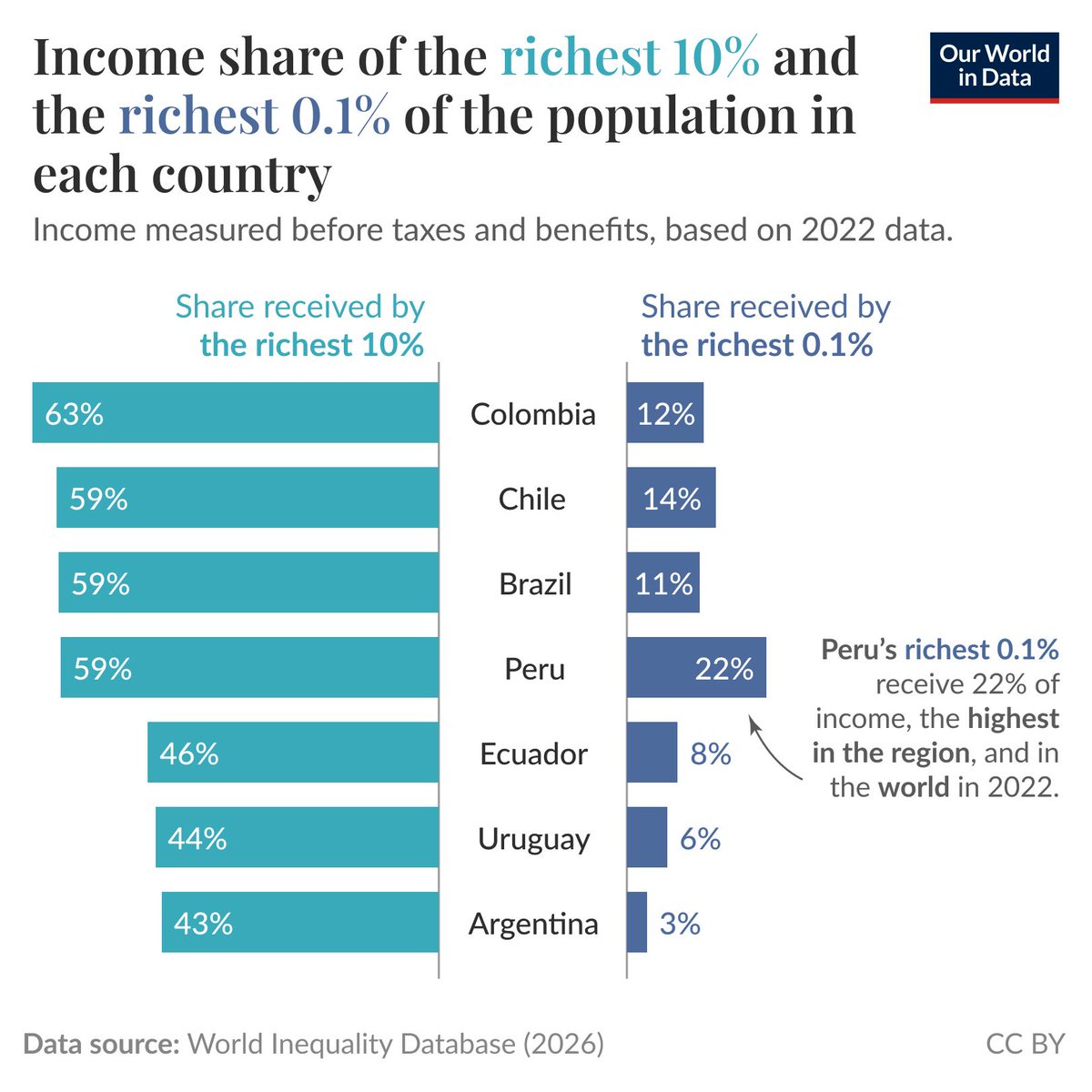
What is the most unequal country in South America? It depends on what metric you look at.
One way to measure income inequality is to look at the share of all income that goes to the top income earners.
The chart plots this for all seven South American countries with comparable 2022 pre-tax income estimates in the World Inequality Database.
The difference between the left and right bars is which earners they cover: the richest 10% on the left, the richest 0.1% on the right.
Looking at the left-hand bars, Colombia ranks top. It has the highest share going to the richest 10%, followed by Chile, Brazil, and Peru — in these four countries, the top 10% share earns more than half of all income. This is high relative to other countries around the world.
But looking at the dark blue bars on the right, the rankings change. Peru’s richest 0.1% receive about 22% of income, the highest in the region by far, and actually the highest in the world that year.
This chart shows just two metrics, but you would also get different pictures if you looked at Gini coefficients or the distribution of wealth instead.
So, what is the most unequal country in South America? It depends on what metric you look at.
This is a region with high inequalities, but different indicators will tell you different stories depending on which part of the distribution you examine, and how incomes are measured.
(This Data Insight was written by @EOrtizOspina.)
Imagine every pixel on your screen, streamed live directly from a model. No HTML, no layout engine, no code. Just exactly what you want to see.
@eddiejiao_obj, @drewocarr and I built a prototype to see how this could actually work, and set out to make it real. We're calling it Flipbook. (1/5)
Michael Phelps won 23 Olympic gold medals using a mental technique most athletes ignore:
"The biggest thing that really separated me through my career was my mental game. Everything that was in between my ears."
Michael explains how he used visualization:
"When I would visualize, I'd visualize every single thing getting up to a meet, probably a month or so in advance. What could happen. What I want to happen. And what I don't want to happen. Because when it happened, I was prepared for it."
He describes the goal:
"When I got to a swim meet, there's nothing I can control at that point except what I do. I can't control what anybody else does. So I want to know how the race could go, how I don't want the race to go, and in a perfect world, how the race should go. So I could get behind the block and not have to think about anything."
His coach Bob Bowman reveals how they trained this skill:
"When Michael was young, I gave his mom a book of progressive relaxation. Before he'd go to bed at night, she would read this progression of things: clench your fists, work through your whole body. He got so good she'd just open the book, say two things, and he'd be asleep."
Bowman explains why visualization works:
"The brain cannot distinguish between something that's vividly visualized and something that's real. By the time Michael steps up on the block at the Olympics, he's swum that race hundreds of times in his mind. All he has to do is shut everything down and it goes on autopilot."
Michael adds the key detail most miss:
"When I would visualize, it would be what you want it to be, what you don't want it to be, what it could be. So you're always ready for anything. If I have a suit rip, fine, I need another suit, put it on. Any small thing that could go wrong, I'm ready for."
Number of electric vehicle on the road:
2010
🇺🇸 USA: 3,800
🇪🇺 EU27: 2,840
🇨🇳 China: 1,940
2015
🇺🇸 USA: 400,000
🇨🇳 China: 297,000
🇪🇺 EU27: 250,000
2020
🇨🇳 China: 4.5 million
🇪🇺 EU27: 2.2 million
🇺🇸 USA: 1.7 million
2025
🇨🇳 China: 44 million
🇪🇺 EU27: 19 million
🇺🇸 USA: 8 million
Note: including BEVs and PHEVs
According to Bruegel , IEA
In 1953, the US overthrew Iran's elected leader, Mohammad Mosaddegh, so American and British oil companies could keep profiting from Iran's oil. We replaced him with a dictator. Decades later, we're at war.