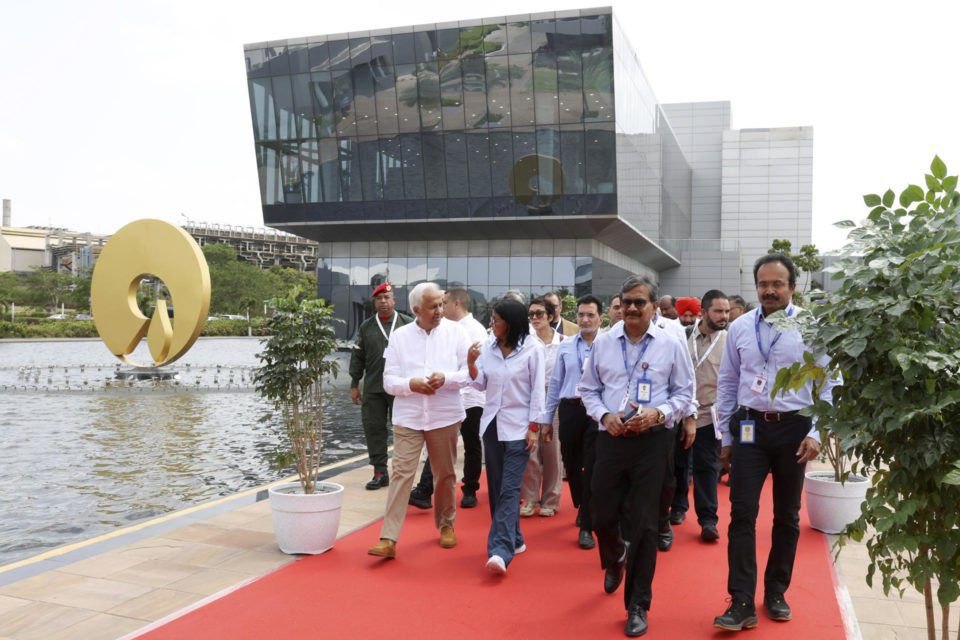
The magnitude of what just happened may take some time to sink in.
This is the first time Iran has struck Israel after Israel struck another country's territory (that is, not Iran).
This means that the battle lines have been moved.
Iran's deterrence had already been restored in the sense that Israel knew that any strike on it would be responded to.
But now, Iran has proven that it will also respond to Israeli strikes on Lebanon.
This is the first time in decades that a regional power has the means, capacity, and willingness to put hard power against Israeli military maneuvers or aggression against a third party.
Read full analysis here: https://t.co/CPawJ4TYdr
Really glad my video essay on the Five Marxist Leninist countries has helped a lot of people learn about the socialist nation of Laos. 🇱🇦
In my opinion, the most slept on ML state of them all.
Check out the video here:
https://t.co/PWPZTqDRly
This is the most common deflection used against any successful post-revolutionary state, and it fails on its own terms.
Yes, Vietnam’s Đổi Mới reforms of 1986 moved toward market mechanisms.
Yes, that represented a shift from the command economy model of the immediate postwar period.
But you have identified a policy adjustment within a continuous political order and called it a repudiation of that order.
Hồ Chí Minh died in 1969.
But the political movement he built, the organisational infrastructure he created, the cadre of leadership his movement developed, and the national unity his revolution produced were the conditions that made Đổi Mới possible.
Đổi Mới was not getting away from Hồ Chí Minh.
Đổi Mới was the Communist Party of Vietnam, the institution Hồ Chí Minh founded, deciding to adjust its economic model.
The same party.
The same political continuity.
The same leadership class.
A political tradition that can reform itself from within, without being overthrown, without foreign intervention, without a coup, is not evidence against the original leadership.
It is evidence of exactly the institutional quality the original argument was making.
No one is going back to dead-end Cold War Isolationism.
"The impediment to action advances action. What stands in the way becomes the way. - Marcus Aurelius, Meditations
Chen Weihua: ‘China🇨🇳 is the largest trading partner of 120-130 countries. China is doing trade with all sorts of countries regardless of ideological, political, and cultural differences.
China REFUSES to go back to the Cold War era where the world was divided into confrontational political blocs.’
—@chenweihua, former EU Bureau Chief of China Daily, joins us on Monday’s episode of Going Underground
Don’t miss it, follow us on X and follow our Rumble channel, link below in the replies👇
the Soviet Union had women cosmonauts and a legion of decorated antifascist war heroines the same year women in Canada were first "allowed" to open bank accounts without their husbands' written permission.
How the NY Times describes the Azov Regiment, a unit of US-armed Ukrainian fascists whose symbol is the Nazi-inspired Wolfsangel and whose torsos are emblazoned with Totenkopf tattoos:
“A well known military unit”
Much less descriptive than its account of Graham Platner’s tats
This hit piece by Jacobin uses organizing rhetoric as a cover for an obvious smear of Chris Smalls.
This has nothing to do with labor organizing for them. It’s clear in what really bothers Jacobin about Smalls is that he doesn’t suck up to imperialist pig Democrats they call “progressive” and that he stands with Cuba and Palestine as an anti-imperialist.
This marks a new low for an already discredited publication.
India tiene las instalaciones, para procesar el petróleo pesado venezolano y Venezuela tiene las reservas más grandes del mundo.
Apenas Delcy logró una rendija en las sanciones y se nos abren las puertas.
¿Ustedes creen, que India dejará de comprar crudo a Venezuela, otra vez?
🇨🇳 China: AI should be open, inclusive, people-centered, and a force for good for all.
🇺🇸 America: AI should be led by us, secured by us, and placed in the hands of “trusted defenders.”
That is the difference.
One sees AI as part of human civilization.
The other sees AI as a strategic asset of empire.
No wonder Chinese people are becoming more comfortable with AI, while Americans are taught to fear it.
You don’t love a weapon.
You fear the day it stops obeying.
Eric X. Li’s exchange with John Pilger lays it out plainly: voting in the United States is mostly political theater, a bullshit show.
Parties rotate, slogans change, new faces come and go,but the core policies stay tied to money.
Why?
Because in the US wealth runs the system.
Billionaires, lobbyists, and financial elites shape the rules, while voters are given the illusion of choice.
Real power isn’t in elections,it’s in the boardrooms.
The pattern is obvious.
Donald Trump filled his circle with billionaires, cut corporate taxes, and blurred the line between policy and business.
Meanwhile Democrats do the same thing with cleaner messaging.
Obama’s Wall Street bailout didn’t punish anyone,it protected the same financial interests that caused the whole crisis.
Different branding, same structure.
The system in the United States isn’t failing, it’s doing exactly what it was built to do: protect the top tier.
China runs a total different model.
The Communist Party doesn’t rely on campaign money or pretend elections control wealth.
Leadership stays consistent, policies shift when needed, and long-term planning actually happens.
That stability helped drive rapid industrial growth and lift massive numbers out of poverty.
And China isn’t “capitalist” in the Western sense.
Markets exist, but they don’t run the state.
Wealth is managed, not obeyed. Billionaires don’t set national direction.
So the contrast is very simple: one system claims democracy while serving wealth, the other openly prioritizes state control and focuses on outcomes.....
Jimmy Dore: "We preach democracy to China. But we don't have democracy here - the oligarchs run everything. The Princeton study proved 90% of people's wishes never become law. Only the top 10% of wealthy matter.
In China, the government sits above capital. The economy works for the people. Here, capital sits above government. The economy works for billionaires"
I recently heard a leading public figure claim that high-income countries need more GDP growth in order to increase innovation in things like renewables, EVs, and life-saving medicine.
This makes little sense:
Why do we need to increase *aggregate* production, indiscriminately, from an already very high level, in order to get these specific innovations? Why do we need continued growth in fast fashion and industrial beef in order to innovate better energy systems and medicines?
We don't. This is massively inefficient and unnecessary. Instead, we can use industrial policy and public finance to target necessary innovations directly.
And this does not require high-income countries to achieve even higher levels of GDP. It can be done right now.
Look at China. China has led major innovations in exactly these technologies - renewables, EVs and life-saving medicines, as well high-speed rail, aerospace engineering, microchips etc - with a GDP per capita that is 70% less than that of the US. How? By leveraging industrial policy and public finance.
🚨 Cuba denuncia recrudecimiento del bloqueo de EE.UU. y sus impactos devastadores.
🔴 El presidente de Cuba, Miguel Díaz Canel denunció una etapa "sumamente agresiva" de la administración Trump contra la isla caribeña, que se extendió a Venezuela con un bloqueo que incrementó la presencia militar de EE.UU.
🔴 El mandatario señaló que el bloqueo a Venezuela interrumpió la llegada de combustible a Cuba, además de otras operaciones destinadas a agredir al país suramericano.
🔴 Ante esta situación, Cuba impulsa una estrategia de soberanía alimentaria, apoyada por ley, utilizando ciencia, innovación y técnicas agroecológicas, dependiendo más de la tracción animal, afirmó el mandatario.
China built 305 wells clean groundwater wells to provide clean watere to Togo's most remote villages.
Tchador Kokouvi:
"We used to walk kilometers for muddy water, and the children were constantly sick. Now, clean well water is right here in our village!"
In 1950, China was 1 of the poorest nations in the world. Chinese per capita income was 1/3 of sub-Saharan Africa.
Mao said let's plan to surpass the US after the 15th 5-year plan.
This year China just started the 15th 5-year plan (2026-2030)