@Lifeofassyrian@Khosrowparviz77@BalaamAndDonkey Where did I advocate? I assume you know how to read then show me where did I advocate for this, all I replied with was for your genius cousin who claimed there is no relationship between Arabs and them, and I replied that they are both semites, that’s all!
We are pleased to welcome Faraj Abutalibov as Strategic Advisor – Blockchain, Web3 & Ecosystem Partnerships at Fatra.
Faraj previously served as Senior Advisor, Middle East Market Development at the Stellar Development Foundation.
Welcome to the team Faraj.
We are pleased to welcome Salman Al-Sharhan as Strategic Ecosystem Advisor at Fatra
Bringing experience in ecosystem development and strategic partnerships across the region. Welcome, Salman.
The next phase of RWA isn’t just tokenization. It’s institutional-grade credit infrastructure.
Origination, underwriting, and risk management will determine who creates lasting value on-chain.
Key takeaway from @castle_labs :
Private credit is becoming one of the most structurally important segments of the on-chain economy.
The question is no longer how assets get tokenized. It’s how credit gets originated, underwritten, and managed.
That’s where we’re building.
The next phase of tokenization isn’t just bringing existing assets on-chain.
It’s originating new, investable credit opportunities that traditional capital has historically overlooked.
That’s where the real market expansion begins.
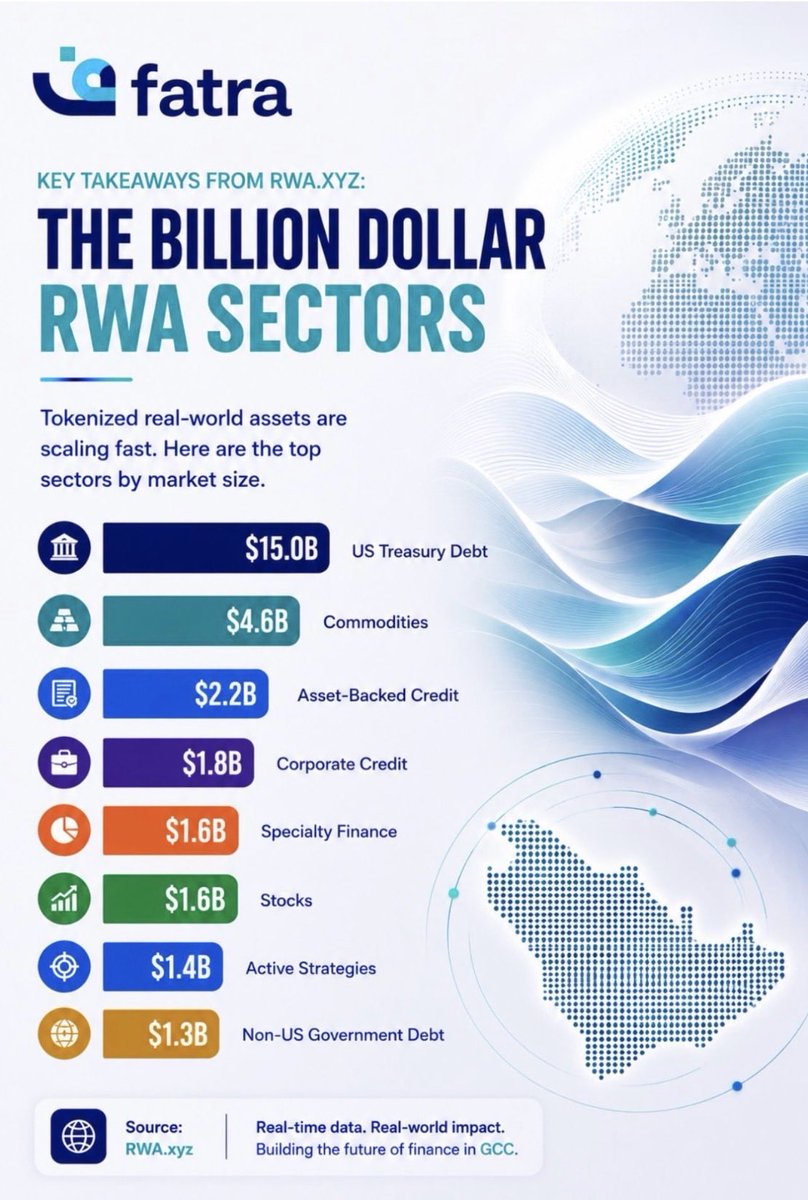
Corporate credit is now a $1.8B RWA sector and growing.
Most of the market is still tokenizing existing assets. We’re building something different: underwriting new credit for SMEs that institutional capital can’t reach today.
Source: @RWA_xyz
Key takeaway from @castle_labs :
Private credit is becoming one of the most structurally important segments of the on-chain economy.
The question is no longer how assets get tokenized. It’s how credit gets originated, underwritten, and managed.
That’s where we’re building.
Tokenized private credit is gradually moving beyond tokenization itself. The next stage of the market will be defined by the quality of the infrastructure supporting the assets after capital has been deployed. Investors will increasingly expect continuous visibility into loan performance, verified cash flows, and clearly defined liquidity frameworks alongside disciplined underwriting. Tokenization improves access and distribution, but long-term institutional adoption will depend on transparency, monitoring, and confidence in the underlying credit throughout its lifecycle.
Excellent work by @castle_labs
A comprehensive look at how real-world assets are bringing traditional financial markets on-chain, with a strong focus on infrastructure, market structure, and long-term adoption.
Real-World Assets: Bringing TradFi Onchain
Mapping the growth of RWAs and Institutional Adoption
Co-produced with @redstone_defi for @TokenizeThisNYC
Full free report here: https://t.co/ys7tgHtxX5
@FTDA_US expansion into digital assets highlights a broader trend: financial innovation is increasingly being built on digital infrastructure. @FatraLabs applies the same principle to SME financing, bringing underwriting, capital allocation, and financing workflows on-chain.
@FTDA_US expansion into digital assets highlights a broader trend: financial innovation is increasingly being built on digital infrastructure. @FatraLabs applies the same principle to SME financing, bringing underwriting, capital allocation, and financing workflows on-chain.
In credit markets, returns are often determined before capital is deployed.
The strongest portfolios aren’t built on growth speed. They’re built on disciplined underwriting, clear downside analysis, and capital preservation as a first principle.
At Fatra, every financing decision starts with repayment capacity and business fundamentals. Quality of underwriting drives long-term performance. Volume does not.
That’s the principle we’re building around.
The picks and shovels orientation at the @Bitso Stablecoin Conference was impossible to miss...
> @lightspark moving money in real time across 65 countries so neobanks do not have to build that infra themselves
> UTB clearing $10b/month in usd so crypto companies can access the banking system at all
> @Anchorage holding the regulated custody and issuance infrastructure so brands like Western Union can put their name on a stable w/o becoming a bank
> Hop Now handling FX settlement and virtual accounts so fintechs can operate globally w/o building a treasury desk
> Capa market making local currency pairs so stables issuers can maintain their pegs
Prediction markets are starting to look less like a novelty and more like financial data infrastructure.
But raw prices are not enough.
A market saying “63%” is only useful if you know whether that number deserves to be trusted.
By 2030, the GCC is expected to be home to ~2.7 million SMEs.
Most institutional capital still sits in large corporates. Few have meaningful exposure to this segment.
SME financing is becoming a real private credit opportunity. One worth watching.
#Fatra#PrivateCredit#GCC