Interaction Profiles as a Universal Language for Generative Molecular Design with ShEPhERD–2
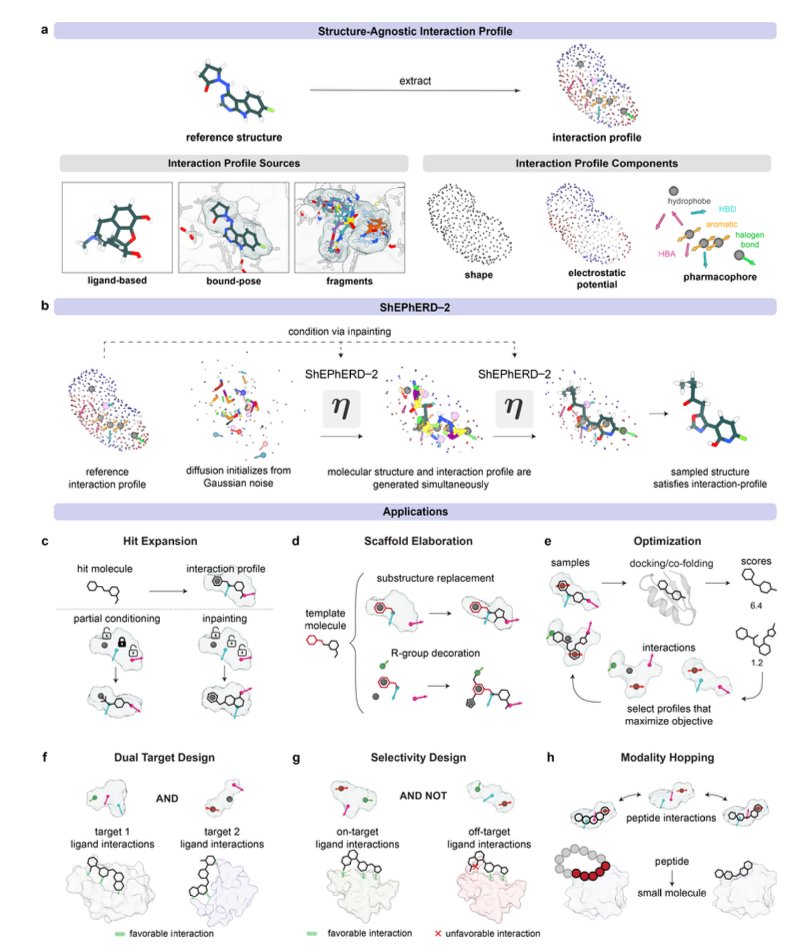
1 ShEPhERD–2 is a 3D diffusion model that treats an interaction profile—shape, electrostatic potential (ESP), and directional pharmacophores—as the explicit design specification, aiming to make molecular generation controllable and transferable across targets and tasks.
2 A key claim is that interaction profiles can act as a chemotype-agnostic interface: different molecular scaffolds can realize the same 3D interaction hypotheses, so the model is trained to generate novel structures that match interaction constraints rather than memorizing protein–ligand complex patterns.
3 The model is trained ligand-only (no protein–ligand complexes required) on 1.6M GFN2-xTB–relaxed drug-like molecules from MOSES, using interaction profiles computed from geometry (surface points for shape, Coulombic ESP on the surface from xTB charges, and SMARTS-derived pharmacophore features including directionality).
4 Method advances vs ShEPhERD include a variance-exploding diffusion formulation (EDM-style), a faster SE(3)-equivariant backbone (EquiformerV3), and “absorbing” dummy atoms/pharmacophores that let the sampler start with extra atoms and then delete superfluous ones—supporting variable-size generation without hybridization/pathology.
5 Interaction-conditioned generation is implemented via inpainting: the desired interaction profile is treated as known context, while the molecular structure is generated. On a MOSES scaffold-split test subset, ShEPhERD–2 improves validity (93.7% vs 61.3% for ShEPhERD) and better recapitulates shape/ESP/pharmacophores among graph-diverse samples, while maintaining low conformational strain after xTB relaxation.
6 Controllability features: pharmacophore prioritization lets users “fix” high-priority pharmacophores while stochastically inpainting low-priority ones, increasing recovery of critical interaction geometry without freezing the whole design; fixing all features yields the highest overall similarity but prioritization yields the best tradeoff between fidelity and flexibility.
7 Substructure/scaffold constraints are supported by fixing selected atoms (types/charges/coordinates) during denoising (rather than inpainting them). Fixing BRICS fragments or heteroatom-centered motifs preserves validity and keeps strain comparable to unconstrained generation, outperforming scaffold inpainting which can introduce clashes/strain.
8 On MolGenBench hit-to-lead (120 targets, 5 congeneric series each), ShEPhERD–2 ranks top among ligand-based methods across most metrics, balancing conformer validity, interaction recovery, docking metrics, and scaffold novelty. A notable emphasis is “interaction diversity”: diverse substructures mediating conserved interactions, not just diverse whole-molecule fingerprints.
9 Multi-target logic is done at inference-time by composing interaction profiles during diffusion: AND composition steers generation toward satisfying two profiles simultaneously (dual-target ideas), while NOT composition aims to satisfy an on-target profile while avoiding an off-target profile (selectivity engineering). Quantitatively, AND boosts similarity to both profiles over random baselines; NOT reduces similarity to the negated profile while largely preserving the primary profile when the pair has meaningful baseline overlap.
10 Case studies show a single trained model applied without task-specific retraining: (i) interaction-aware evolutionary optimization for bioisosteric fragment merging on EV-D68 3C protease using docking/Boltz-2 as surrogates, (ii) AND composition for putative PARP1/Tubulin dual inhibitors compared against catalog analogs, (iii) NOT composition to steer dabrafenib away from hPXR off-target interactions while keeping BRAF V600E interactions, and (iv) modality hopping from macrocyclic peptides to small molecules that mimic peptide interaction patterns (peptidomimicry), highlighting that maximizing interaction similarity can trade off with docking due to flexibility/entropy.
📜Paper: https://t.co/xTfS3iwQs9
#ComputationalChemistry #GenerativeModels #DiffusionModels #DrugDiscovery #MedicinalChemistry #MolecularDesign #Pharmacophores #3DML #Cheminformatics #Bioinformatics
@CuestaGFJ@NobelPrize@CuestaGFJ If immune recognition were based on sequence patterns rather than 3D structure, protein denaturation—which leaves the primary amino-acid sequence intact—shouldn’t abolish antibody recognition. But native vs denatured proteins can show very different antibody binding
New Paper in @NatureComms: Assessing how processed is your food.
"Machine learning prediction of the degree of food processing"
Available at https://t.co/lgBUAI1QZA and https://t.co/tUyYxpWGp2
With @menicgiulia @BabakRavandi @Dmozaffarian
#FoodProcessing
Not long ago a machine designed by a computer and constructed of living cells was something crazy to imagine. Now we are coexisting...
Tune in to our latest episode with @DoctorJosh & @drmichaellevin on #ComputationalDesignedOrganisms and #LivingRobots.
https://t.co/c4ftW0Bymm
Two weeks ago, doctors in Baltimore reported completing the first successful transfer of a pig heart into a living human patient. Now pig kidneys might be just around the corner. https://t.co/OcwfOjHrMt
I know every mask manufacturer and distributor is tired right now. I am tired. I have never done more interviews, answered more questions, and still I know that there is not enough info out there. My spreadsheet was meant for nerds, so will try my best to get stuff cleaned up.
Fyi, India is the furthest along but we’re also transferring our @TexasChildrens Covid vaccine technology, helping in the co development to additional countries listed here. Again, no patent or strings attached. The country vaccine producer gets to own the vaccine…
Having "high standards" is not an excuse to treat people poorly.
Some of the kindest people I know have high standards. The difference is that they encourage others to rise to their best rather than tearing them down when they fall short.
If you missed the MANA summer symposium then please find the recorded presentations here: https://t.co/qlw6wS4ZlH #metabolomics@MetabolomicsANA@ESchymanski @ErinBakerNCSU
(3) I think it's useful to think about Pareto frontiers of skills. I think it's probably easier to produce a lot of value by finding an underrated *intersection of skills* rather than being really good at a standard skill.
https://t.co/bIUiCt1jVJ
If you like to broaden your knowledge in metabolomics: Our summer course is covering all the important steps from study design to interpretation in studies in metabolomics with a lot of discussions and hands-on exercises. A couple seats are left....
https://t.co/LQpEqN1CVn
Excited to share a preprint describing a workflow to infer chromatin-mediated regulation of gene expression using single cell data, which we applied using multi-omics of resting and stimulated human blood cells! Some highlights 🧵: 1/
For those of you who aren't in the US and don't know how bad the wildfires in California get: I'm in Boston MA, on the complete opposite side of the country, it is a clear and sunny day today but you wouldn't know it because there is SMOKE FROM CALIFORNIA IN THE SKY.
NEW: #LongCovid is the silent pandemic. 2m victims & counting in the UK alone. A moving & powerful first film by @kitty_teague & @jwsal who teamed up with @Dr2NisreenAlwan to give these survivors a voice. Please watch
https://t.co/NEanaPYqRc
Animation Lab postdoc Shraddha @Na_y_ak is very excited to release "The Journey of a Metabolite," a lesson on metabolic flux for undergrads: https://t.co/DPugM6F7fo
The gif below shows a glimpse of carbon flux through glycolysis (click the link to see the rest and much more!)
The first step to mastering something is always to *have faith in your capability to learn new skills*. No matter how hard or mystifying the task seems.