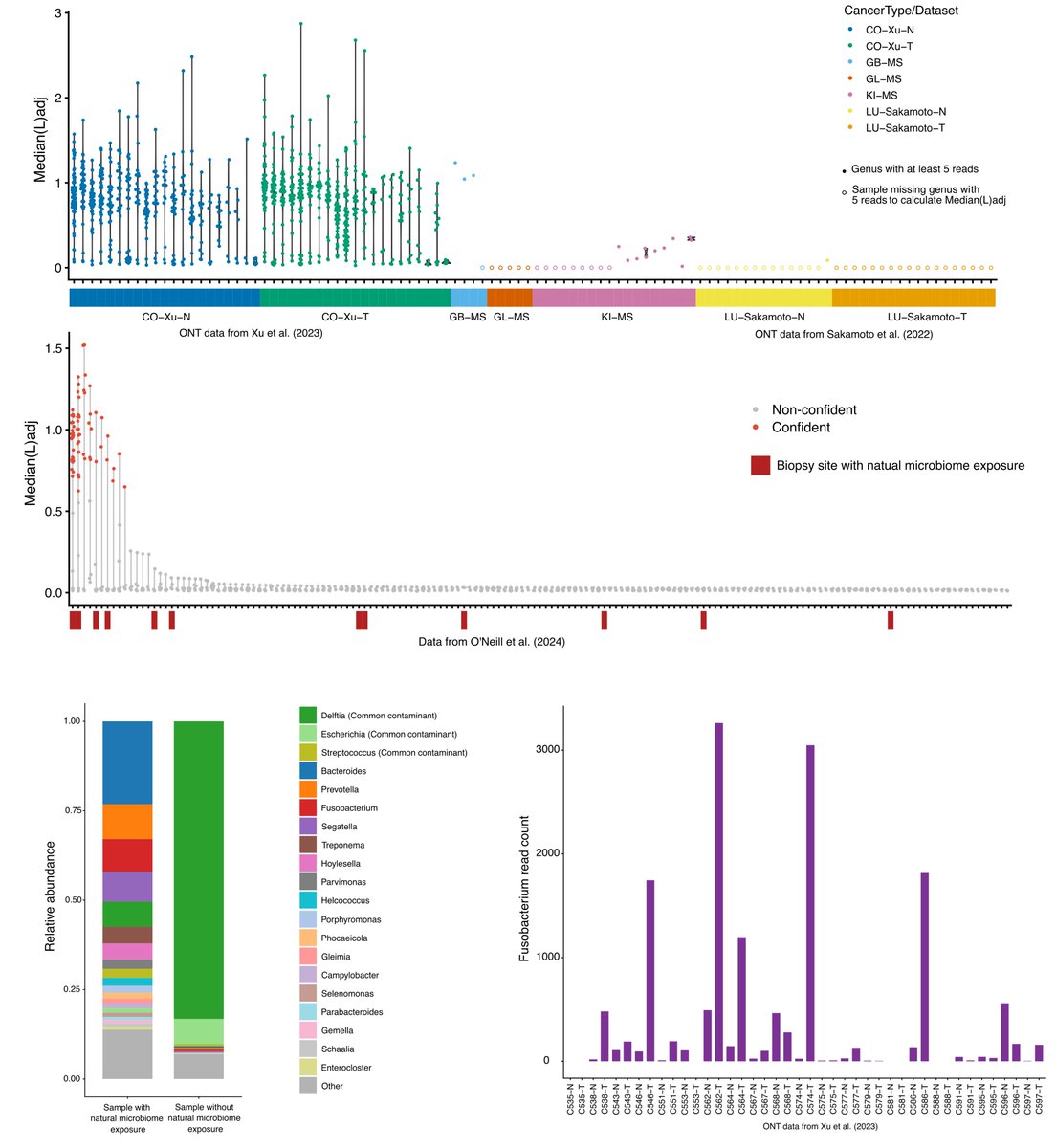
This finding is interesting and has potential utility in nanopore-based clinical metagenomics applications where contaminant differentiation matters a lot..!
New Preprint 📢 from our team 🔎 Critical assessment of #intratumor and #low#biomass#microbiome using #longread sequencing
Have you heard about #cancer microbiome or #intratumor microbiome? Some studies suggest bacteria 🦠 live inside tumors and influence cancer treatment. But there’s also been a major #debate: in these very low-microbe tissue samples, how much of the microbial signal is real ❓ and how much is background noise from the lab or the environment ❓
We tackle this with a simple idea: look at DNA fragment sizes using #longread sequencing. If microbes are truly present as intact cells, their DNA should show up as long, genome-like fragment distributions, not mostly short broken (degraded) pieces. Long-read data lets us distinguish those two cases! To make this more robust across datasets, we developed a #metric that normalizes microbial DNA fragment lengths to human DNA fragment lengths within the same sample.
Negative #controls: germ-free mice and human cell culture datasets, where true resident microbes are not expected and any microbial signal is most likely introduced during workflows (i.e. contaminations).
Positive #controls: bacteria spike-in, and importantly, GI tumors with well established bacteria: e.g. #Helicobacter #pylori in #gastric cancer, #Fusobacterium in #colorectal cancer.
Across multiple tumor types and tissues (public + new data), we find that long microbial reads are mainly seen in tissues with natural microbial exposure (such as #gut, #stomach, #skin, #vagina and #cervix, etc). Outside those settings, most microbial signals look more like fragmented, and the occasional long fragments often match well-known #contaminant organisms.
One finding that stood out to us was the #lung, which is constantly exposed to microbes we breathe in, yet in our analysis, the microbial signal appeared mostly as short, fragmented DNA, which is more consistent with transient exposure and rapid clearance than with stable resident microbes in deep lung tissue.
The new metric also helps #unify earlier debates about microbiomes reported in #placenta and #blood. When we reanalyzed long-read data from those settings using the same read length-based approach, we found no evidence for a stable resident microbiome under normal conditions, consistent with the current consensus that most signals reflect background contamination, with true positives mainly expected during active infection.
Long story short, but this was a 4+ years effort led by Yanchun Zhang and Andy Mead. Grateful to all collaborators who contributed valuable samples and feedback: Mi Ni, @MagdalenaKsi, @clannabel7, @LauraZuluagaJim, Gintaras Deikus, Robert Sebra, Rachel Brody, Raymund Yong, @NYCRoboticTeam, @Xue_Song__Zhang. @SinaiGenetics@IcahnInstitute
Link: https://t.co/MHGNCFY447
We’d love your thoughts!
#longread @PacBio@nanopore
#metagenomics #pacbio #nanopore
We are running a massive online open course on AMR databases starting end of the month. Its completely free, study at your own pace and its ~15 hours overall over the 3 weeks (although you can finish any time in a year). Please spread in your networks! https://t.co/n6LU8VDeTw
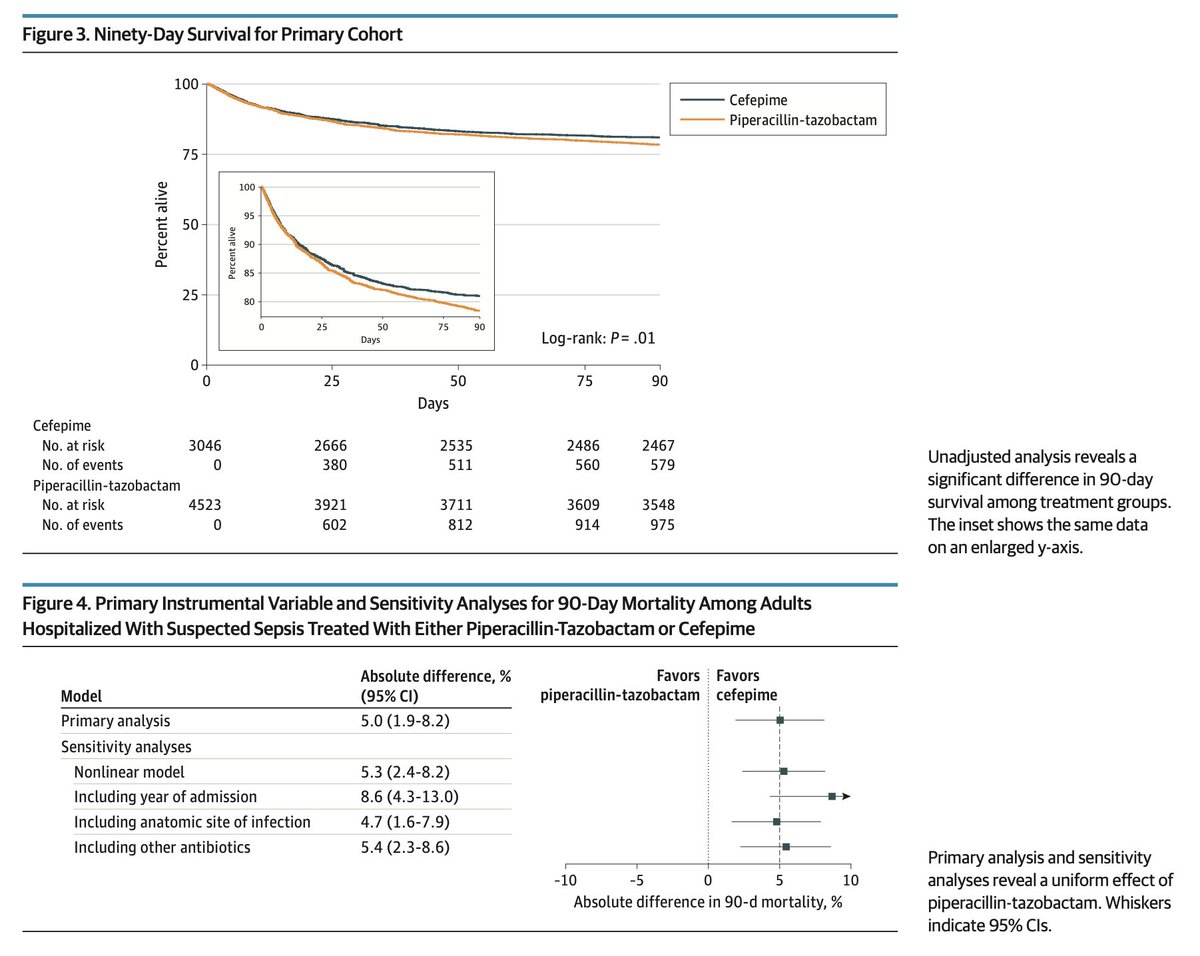
Most patients with sepsis don't need anti-anaerobic antibiotics. But most get them anyway. Why not, what's the harm?
I worry the harm is considerable.
Our new study in @JAMAInternalMed: using a 15-month pip-tazo shortage to answer this question.
1/n
https://t.co/1nOhsUaio0
First author Richard Wolff and I are delighted to share our latest preprint on “Pervasive selective sweeps across human gut microbiomes” https://t.co/ILhFFcyEj3 (1/n)
Our paper on recovering high-purity metagenome-assembled genomes (MAGs) for both prokaryotes and eukaryotes has just been published. https://t.co/RVEkkmv13G Utilizing universal core genes and iterative clustering methods, we were able to prune contaminated contigs within MAG.
"..generated machine learning models to predict AET outcomes based on pathogen genomic data."
"..incorporating population structure control was crucial for improving model interpretation and generalizability."
https://t.co/0yRA6vgVuj
We also cover a recent publication by @KihyunMicrobiol and colleagues in @NatureComms
looking into how antibiotic use at a country level can affect the gut #microbiome. Great analysis of a crazy amount of data!
Article link
https://t.co/6gLK6w3IX3
Want to start to analyze Salmonella genomes just because of this bioinfo tool's name. "bettercallsal" for predicting Salmonella serotypes from enrichment culture shotgun seq. Who's so playful with naming? US FDA.
https://t.co/kz1ckZ2yUD
having active beta lactamases of commensals are correlated with the resilience of gut microbiome functions (metabolome) when healthy volunteers went through beta lactam injection and recovery. d'Humières et al. https://t.co/6vsnW6Niur
Daniel M Maloney, Goncalo Fernandes, Rebecca Dewar, Aine O’Toole, Chenge Mphanga, Thomas C Williams, Martin McHugh, Andrew Rambaut, Kate E Templeton Preliminary Results from two novel “ARTIC-style” amplicon based sequencing approaches for RSV A and RSV B.
https://t.co/wV8iOeTK3n
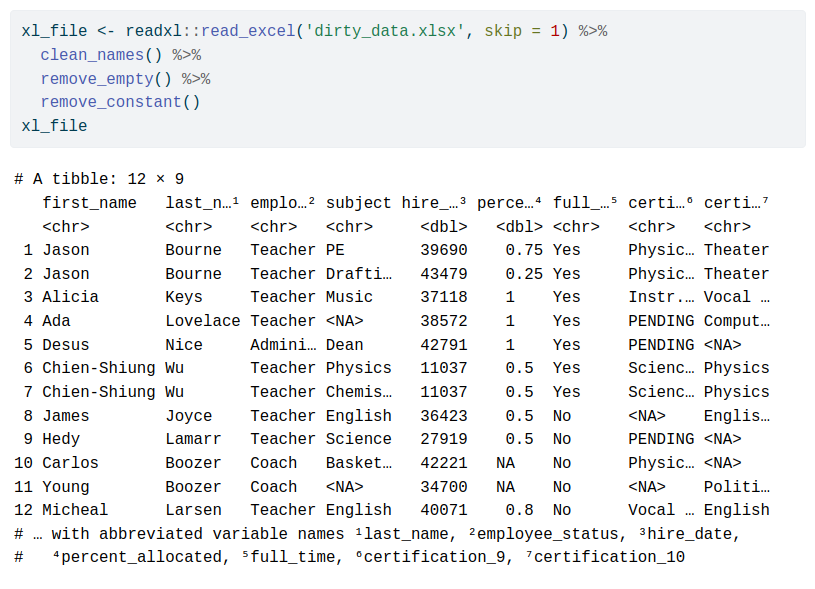
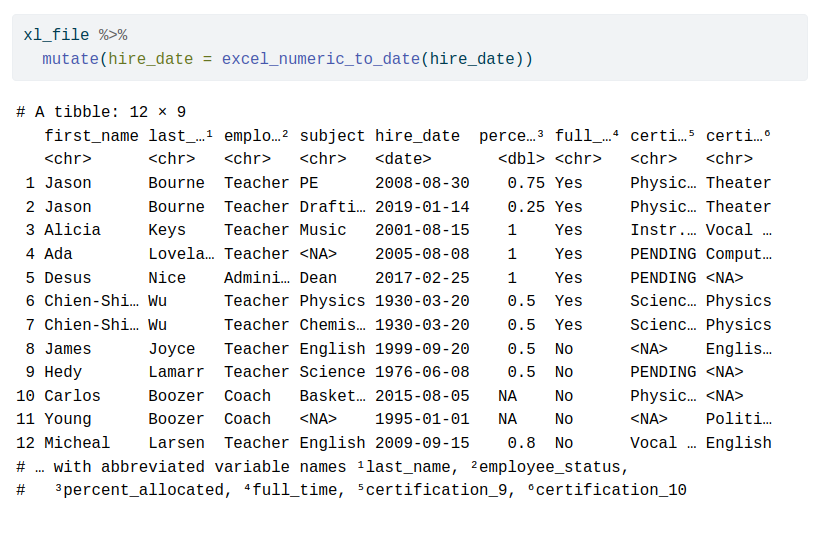
3 // Convert stupid Excel dates
Our lovely {janitor} can even convert those pesky Excel dates to something we can work with.
Check out how the hire_date column from our previous output is transformed to actual dates.
@WvSchaik Oh I see, cost problem is already big. Still hope that in one day you can do that! The paper was enjoyable and also let me realize that interpreting metagenomic *-C data is more difficult to analyze than I imagined. Congratulation for concluding a study on such a puzzling data!
Guess it will be advantageous if one can selectively enrich the library fragments whose one end anneals to defined probes (representing the resistome of interest?) before sequencing. I don't know if library yield is sufficient to do so, though, not having an experience in Hi-C.
Kienesberger, S., Cosic, A., Kitsera, M. et al. Enterotoxin tilimycin from gut-resident Klebsiella promotes mutational evolution and antibiotic resistance in mice. Nat Microbiol 7, 1834–1848 (2022). https://t.co/kKRmRrbzk3
... Bad oxytoca! Bad!
Our first paper of community-wide DNA methylome is out at @MicrobiomeJ ! Big shout out to @simroux_virus for this work. We tried to analyze genome-resolved DNA methylation profile of Ocean microbiome (https://t.co/Yxq2jHawQz) What can we expect from the next step using @PacBio ?
@sminot@conchoecia @michelebusby Miniprot indexes genomes while Diamond indexes proteins. This affects their use cases. Diamond is also highly optimized. There is probably not much room left. Nonetheless, I still wonder their relative performance. Do you have a simple test dataset I can play with?