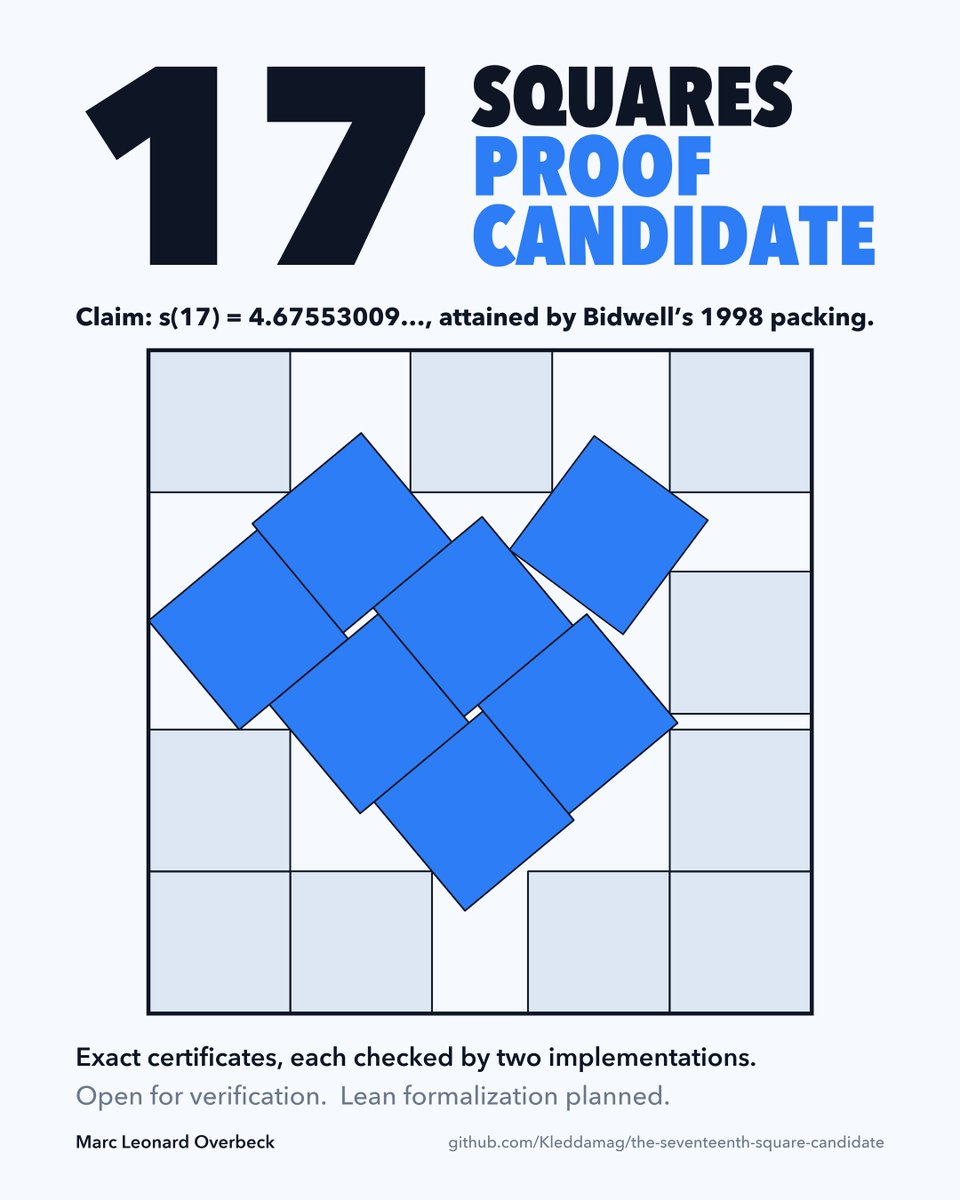
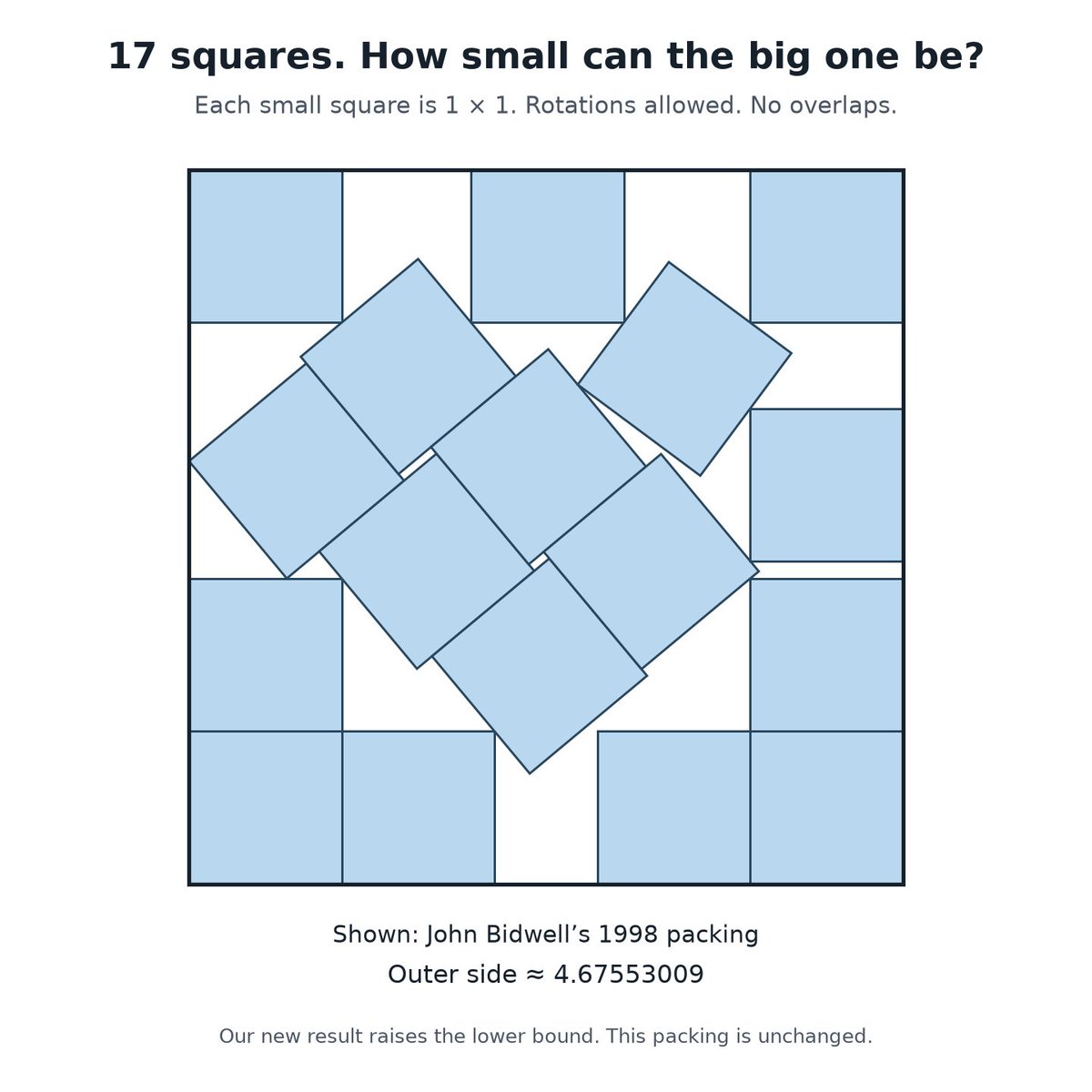
A proof candidate for 17 squares: the 1998 packing cannot be beaten. s(17) = 4.67553009…
Built with @OpenAI Codex and @AnthropicAI Claude. Thanks to @ojoshe, @_Mira___Mira_, @guzhou0806 and @ManassehA06, whose work this builds on.
Try to break it: https://t.co/vEV24IQxyc
In the repository: the proof text, every certificate, the checkers, and one command that checks all of it in a few minutes. Version 1; its known weak points are listed there. Next: a formalization in Lean, as was done for n = 11.
A proof candidate for 17 squares: the 1998 packing cannot be beaten. s(17) = 4.67553009…
Built with @OpenAI Codex and @AnthropicAI Claude. Thanks to @ojoshe, @_Mira___Mira_, @guzhou0806 and @ManassehA06, whose work this builds on.
Try to break it: https://t.co/vEV24IQxyc
It has been a delight to see our work on square packing geometry trigger such excitement and interest among millions (!!) of people over the past day.
I see many people with opinions that the solution (or perhaps the question) is “ugly.”
I look at it quite differently. I think square packing is beautiful. But it is something even better: it is unexpected.
The unexpected corners of the solution for n = 11 are hints at something far bigger, almost certainly more strange and wonderful than any of us realize.
John von Neumann famously said that in math, you don't understand things; you just get used to them. He was partly joking and partly gesturing at the deeper truth.
Things that don’t make sense are usually our own poorly tuned intuitions. A sign that we are missing something important.
This is not just about math. It is about reality.
A child delighted by a helium balloon often expects that tying a string to a balloon is what makes the balloon float.
Later, she will tie a string to an air-filled balloon and be bitterly disappointed. That doesn't mean the child is stupid (in fact I would say this is a sign she is unusually clever). Or that physics is ugly. Or that there was not beauty in her naive hope.
It does not make sense for her to wish for a world where strings make balloons float. She simply has no knowledge of helium or intuitions about buoyancy of gases.
After learning more, her understanding that something as strange and wonderful as helium exists (and that you can inhale it and talk like a chipmunk!) might bring her great joy.
If she is lucky enough to have someone explain all this to her, she might even come to realize that such feelings of disappointment are signposts we can use to navigate the incredible complexity of the universe.
That defied expectations are a sign that an insight into something more strange and more wonderful than you have ever imagined is around the corner.
Exciting to see a resolution of the long-standing geometry problem of packing 11 squares.
The proof is layered with an optimality proof and now a Lean formalization from @ManassehA06 assembled over the last few days, with assistance from @ctjlewis@guzhou0806 and others.
It relies on a strong lower bound from @kleddamag built on work from @wand_125 and my lower bound proof, which strengthened the previous lower bound from @stromquist23881 in 2003.
This has been a series of remarkable improvements and proof developments. It's been an honor and a pleasure to see the rapid progress and collaboration.
The optimality of the packing for 11 squares has been formalized in lean thanks to Astra and Claude! Huge thanks to @ojoshe, @kleddamag, @wand_125, @guzhou0806, and @ctjlewis for aiding in the process.
Image credit: https://t.co/2oUaPKe2Hz
1/n
1/2
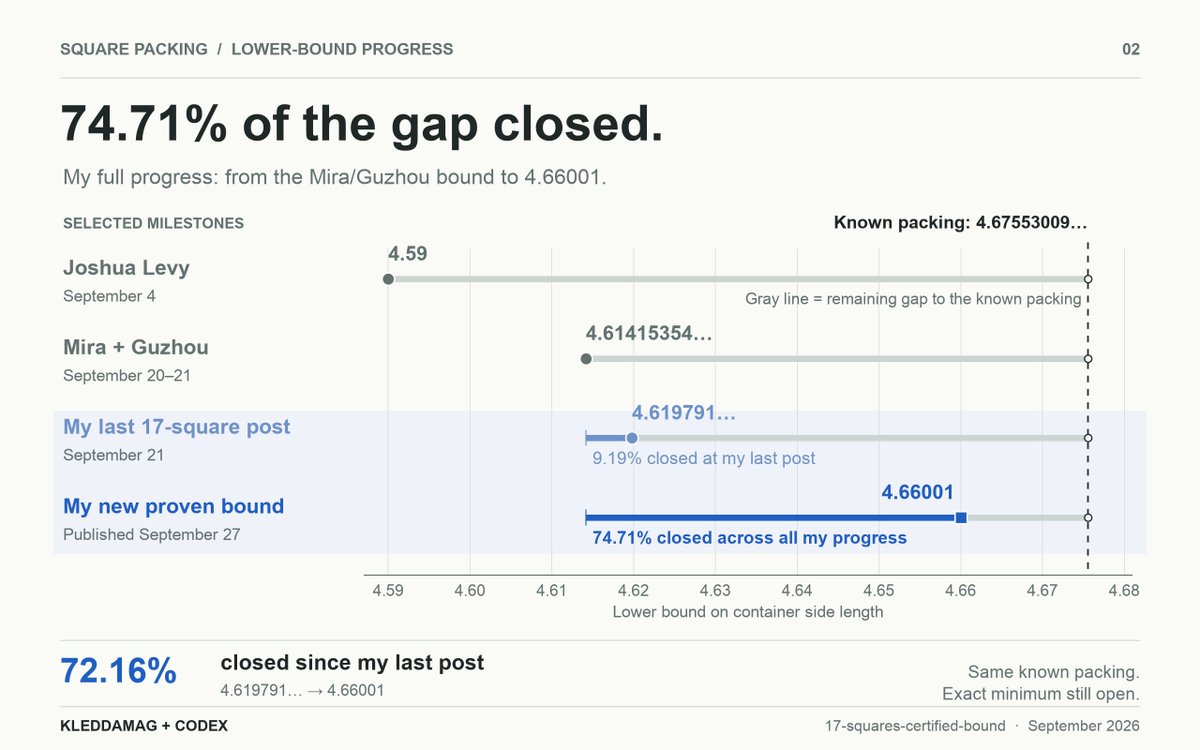
I used Codex (@ChatGPT) to push the lower bound for packing 17 unit squares from 4.619791… in my last post to 4.66001.
That closes 72.16% of the gap that was left. Including my earlier progress: 74.71% since the Mira/Guzhou bound.
The exact minimum is still open.
2/2
Built on @ojoshe, @Mira___Mira and @guzhou0806’s work.
Proof + code:
https://t.co/ztSIncToSh
The certificate passes Python and JavaScript checks using exact arithmetic.
If you find a mistake or push it further, tag me.
And another small improvement based on @kleddamag's work.
Internal R042 has:s(17)>115325/24963=4.61983735929175179265...
Under final check and will be uploaded as soon as possible.
Now working on BigInt point separator and generic trigger schema.
2/2
Built on @ojoshe’s work, with checker code adapted from @guzhou0806.
Proof + code:
https://t.co/t7sSvmZ8fI
Download it, run the checks, and improve it further if you can. Tag me if you do.
1/2
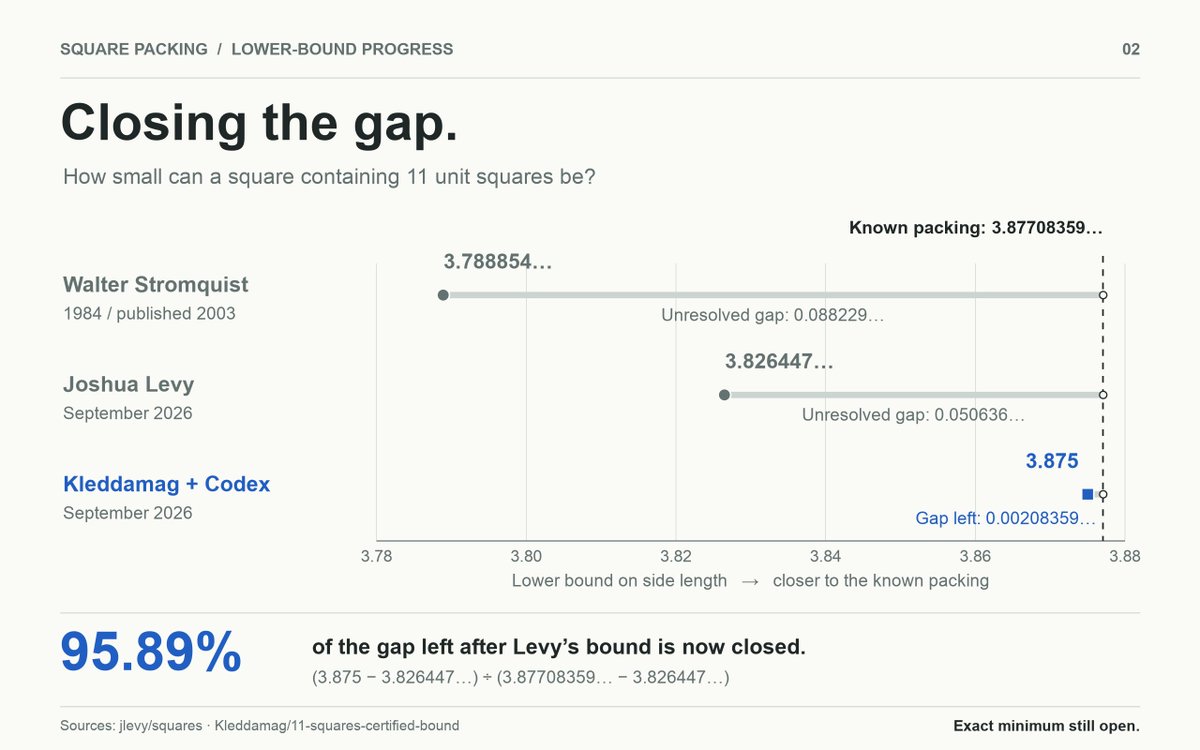
Me + Codex (@ChatGPT) pushed the lower bound for packing 11 unit squares into a square from 3.826447… to 3.875.
That closes 95.89% of the gap to the best known packing (3.87708359…).
Rotations allowed. Exact minimum still open.
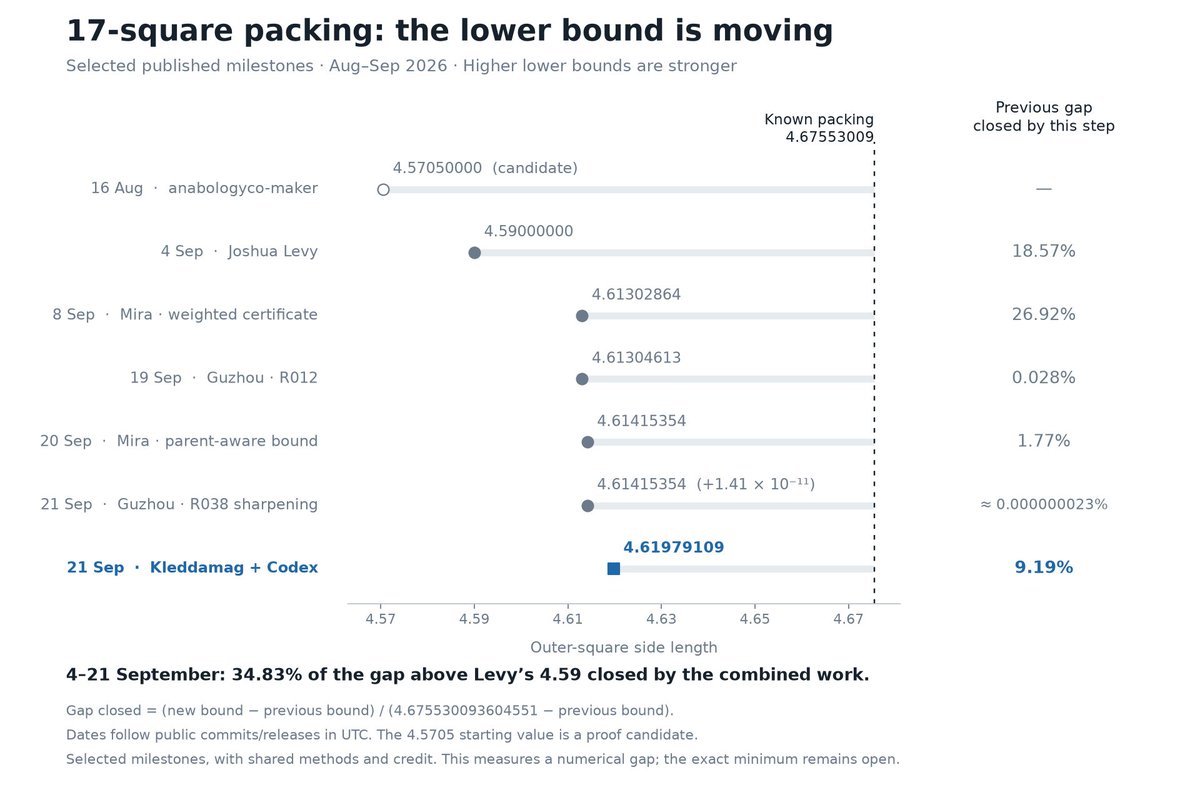
17 unit squares. how small can the outer square be?
Me + Codex (@ChatGPT) pushed the lower bound:
4.61415354 → 4.61979109
That closes 9.19% of the remaining gap to the known packing at 4.67553009.
Still unsolved. The community's been moving fast ↓
Quick questions: Is it just me, or are you all experiencing the same issue with the ChatGPT Classic Mac app?
When I use the ChatGPT Classic app for simple tasks, I can't adjust the reasoning effort; it's always automatically selected, and I have to switch to the web version. Also, the sidebar is always immediately hidden.
While I use Codex in most cases, I find the Mac Classic app really unhelpful.
@kimmonismus Yeah, I have the same issue. For normal chats, I still think the old Mac app is much better and more polished than the ChatGPT integration in Codex. @OpenAI, please fix this.