Official account of Prof. Julian Knight's lab at @NDMOxford @OxfordMedSci and @HumanGeneticsOx
Using functional genomics to understand the human immune system
Some of the big questions raised by the COVID-19 pandemic are 'Why do we all have such a different reaction to the infection? From the mild cases to the seriously sick?'
Our #COMBAT paper in @CellCellPress aims to explore these questions
A 🧵by Dr Justin Whalley & @DrCarlaCohen
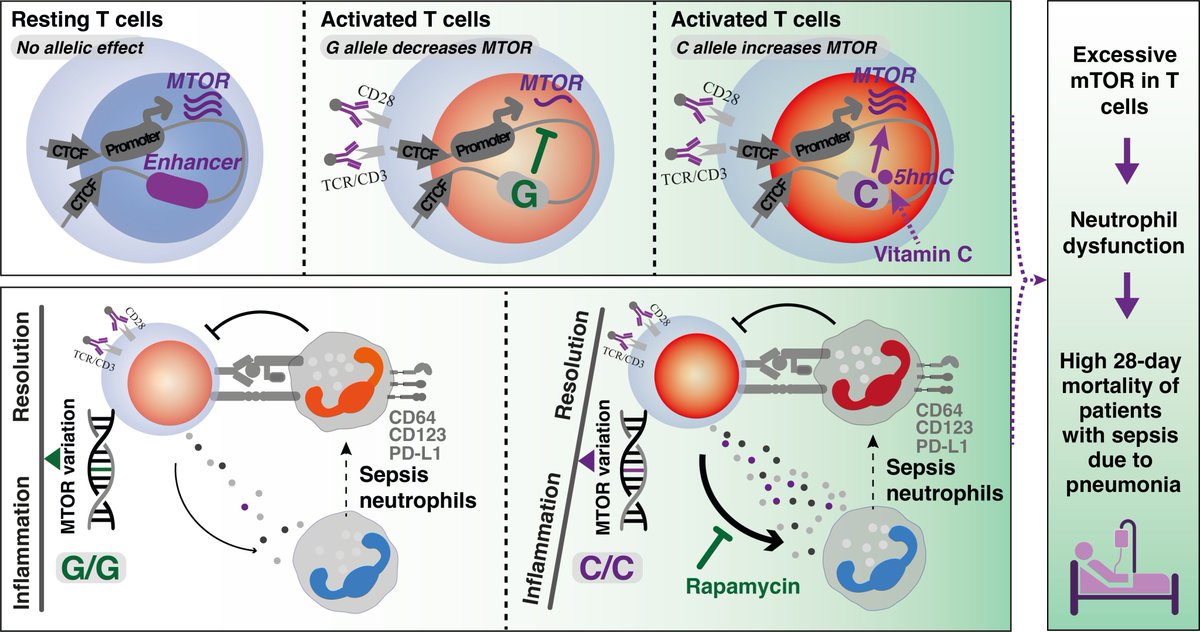
Our new study shows a genetic variant fine-tunes MTOR and immune crosstalk, improving survival in pneumonia-associated #sepsis - toward personalised treatments.
Congrats to @pingzhangneho and everyone involved! @HumanGeneticsOx@CAMS_COI_Ox@NatureComms
https://t.co/AYRbaq505i
Glad to share our study showing how a common genetic variant impacts immune cell-cell communication and patient survival in pneumonia-associated sepsis, providing a framework for stratified therapy. Thanks to our funders and everyone involved.
https://t.co/fTxAxolGOr
Comprehensive epigenomic profiling reveals the extent of disease-specific chromatin states and informs target discovery in ankylosing spondylitis https://t.co/mZfr8edJah
Our research on the chromatin landscape of ankylosing spondylitis (AS) has just been published in @CellGenomics. An important step towards future drug discovery.
Congratulations to @DrCarlaCohen, @HumanGeneticsOx, and and everyone involved!
Really excited to present our research on epigenomics of #AnkylosingSpondylitis, a spinal arthritis.
Published this week in @CellGenomics: https://t.co/6rBopMETVx
1st authors: Andrew Brown, Ola Mielczarek, Gabriele Migliorini and @DrCarlaCohen
A 🧵
We are excited to share our recent work mapping the host response to sepsis at single-cell resolution. The study, led by @andrewjkwok and published in @NatImmunol, identifies a subset of immature neutrophils which is increased in severe sepsis.
Big thanks to everyone involved!
Julian Knight and colleagues find that altered granulopoiesis and increases in immature immunosuppressive neutrophil subsets are associated with poor outcomes in some patients with sepsis. Read it here: https://t.co/8K3YkYYeqX
https://t.co/mBs4CSNusY
A big thank you to the patients, families, clinicians, and research nurses involved in our sepsis studies, without whom this wouldn't have been possible.
Congratulations to @eddiecg@ee_davenport@HumanGeneticsOx@sangerinstitute and everyone else involved!
We are excited to share our new study, out now in @ScienceTM!
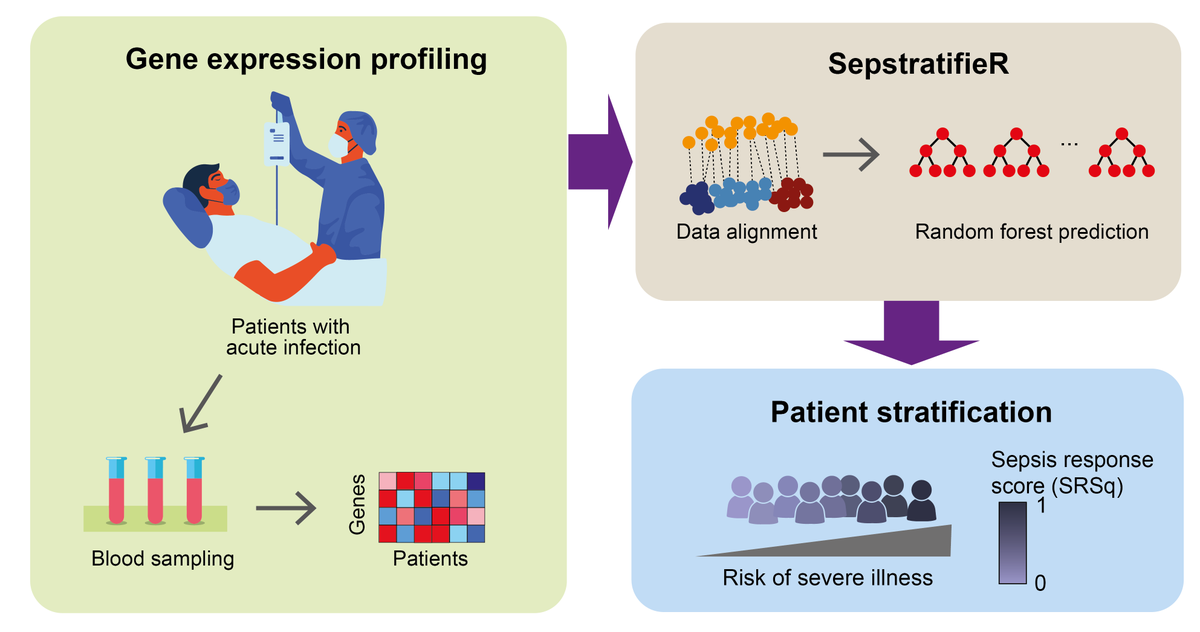
We developed a machine learning framework (SepstratifieR) to stratify infection patients by risk of severe illness.
SepstratifieR is publicly available and applicable to sepsis, influenza and COVID-19.
🧵👇 (1/15)
For more information, you can refer to our full publication and the associated R package:
R package: https://t.co/S1ozgqSsI8
Publication: https://t.co/iFI7bawSQh
(14/15)