@mitchellh It’s not SwiftUI or AppKit, it’s the way MacOS draws and handles all windows and all other things. I tried to get the closest possible to Hyprland, ended up with a pretty decent BSP tilerc yet..still we get to the point where we are disabling SIP as Yabai did a quite a while ago
The neurodivergent conversation online has gotten louder around ADHD, autism, and AuDHD — which is great.
But the same three diagnoses keep looping, and the rest of the umbrella stays mostly invisible. Autism + OCD sits around 17–25% comorbidity in meta-analyses. ADHD + dyslexia/dysgraphia overlaps in 25–40%. Tourette’s, dyscalculia, dyspraxia, sensory processing — all under the same umbrella, rarely discussed.
Someone with autism + OCD or ADHD + dyslexia reads posts about “ADHD” and doesn’t find themselves. Concludes something is even more wrong with them. When their wiring is actually common — just barely written about.
Not a complaint, just trying to widen the frame.
We used to migrate data from Android to iOS, from Windows to Mac and back.
Now we migrate our accumulated memories between LLM providers. Anthropic just shipped this today.
Nice one...
It's hilarious, how we make Anthropic inventions work for us outside of Anthropic to make Anthropic tools even better
Sonnet 4.5 made a lot of bugs and flows disappear in minutes.
Another interesting point is that Claude Code still can't or won't handle (or allows us) a context window of over 200k, same with Warp, tho it's been the best in terms of coding agentic frameworks even beating up Opus 4.1 inside Claude Code.
Yeap, Opus 4.1 has been showing better results within Warp.
Better than Opus 4.1 in Claude Code and Cursor, other IDEs.
And then they release Sonnet 4.5 and it starts again.
Yet, only Cursor with Max mode and ridiculous prices already allows us to use Sonnet 4.5 with 1kk context window. They also had Sonnet 4 with 600k window with Max mode enabled, which was also great and the only solution with over 200k token context window.
I dk what I wanted to say, just keeping you posted.
Docker-MCP. What's good, what's bad. The context window contamination.
so...
Docker-MCP is an amazing tool, it literally aggregates all of the needed MCPs in one place, provides some safety layers and also an integrated quite convenient marketplace. And, I guess we can add a lot to it, it's really amazing!
What's bad and what need's to be fixed.
- so in LMStudio we can manually pick each available MCP added via our config. Each MCP will show full list of it's tools. We can manually toggle on and off each MCP. - if we turn on Docker MCP, it literally fetches data about EVERY single MCP enabled via docker.
So basically it injects all the instructions and available tools with the first message we send to the model. which might contaminate your context window quite heavily, depending on the amount of MCP servers added via Docker.
Therefore, what we have (in my case, I've just tested it with a fellow brother from here)
I inited 3 chats with "hello" in each:
1) 0 MCPs enabled - 0.1% context window.
2) memory-server-mcp enabled - 0.6% context window.
3) docker-mcp enabled - 13.3% context window.
By default each checkbox for it's tool is enabled, we gotta find a workaround, I guess.
I can add full list of MCP's I have within docker, so that you would not think that I decided to add the whole marketplace.
If I am stupid and don't understand something or see other options, let me know and correct me, please.
so basically ... That's whatI was trying to convey, friends!
love & loyalty
@Docker@lmstudio@lmstudiodevs
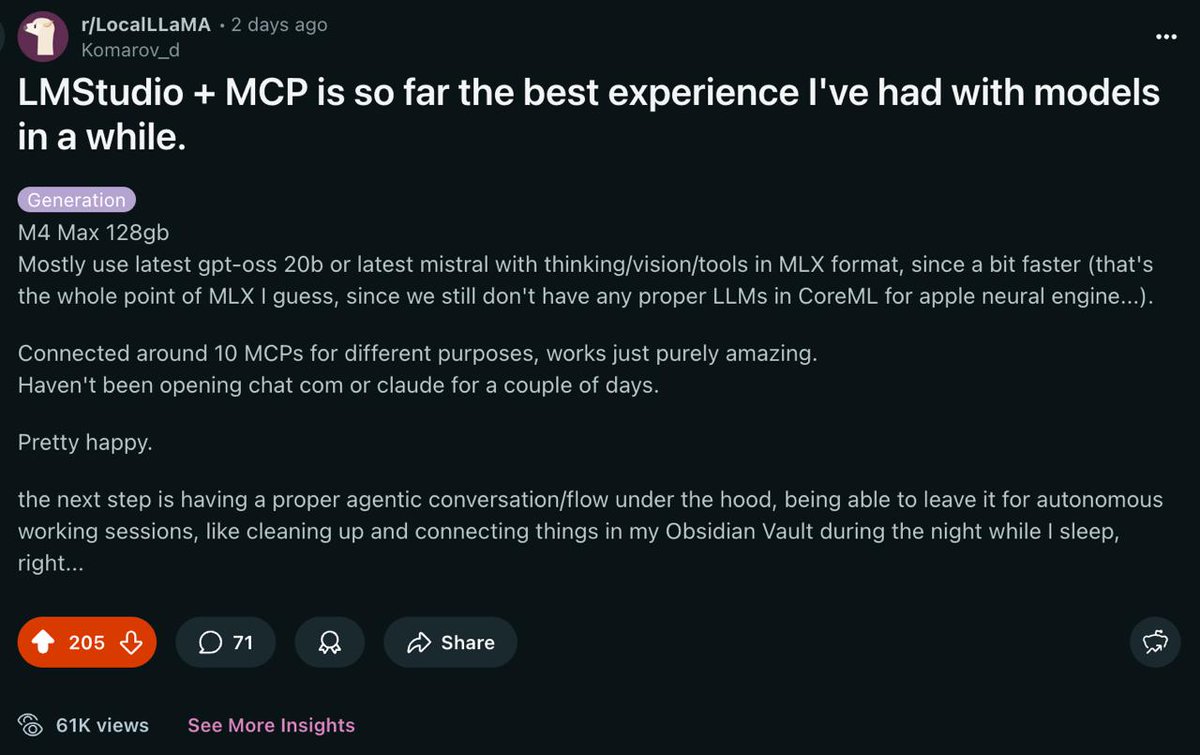
Since my post' has become quite popular on Reddit over the weekend, decided to share my thoughts here as well.
Would be glad to continue the discussion, helped tons of people already.
This chart is nuts. Software developer jobs down 70% from peak.
People will blame the end of free money. But something way more interesting is happening.
The middle class engineer is dying. And it's dying because they're not needed anymore.
One good dev with Github Copilot ships what entire teams did five years ago. Microsoft just reported the highest revenue per employee in history.
The "entry-level engineer" doesn't exist anymore.
Instead, we have product builders who happen to code. Armed with AI, they ship entire products in days.
Meanwhile, the truly elite engineers are making more money than ever.
And they've shifted to working mostly on frontier tech. I mean the stuff that's really hard.
AGI at OpenAI.
Designing rockets at SpaceX.
Self-driving car tech at Tesla.
Product builders are becoming solopreneurs and creators Frontier engineers are making hedge fund money
In 2025, "software engineer" doesn't mean what it meant in 2020.
And that's what this chart really shows.
The middle is gone. The top is elite status. And everyone else is becoming a builder.