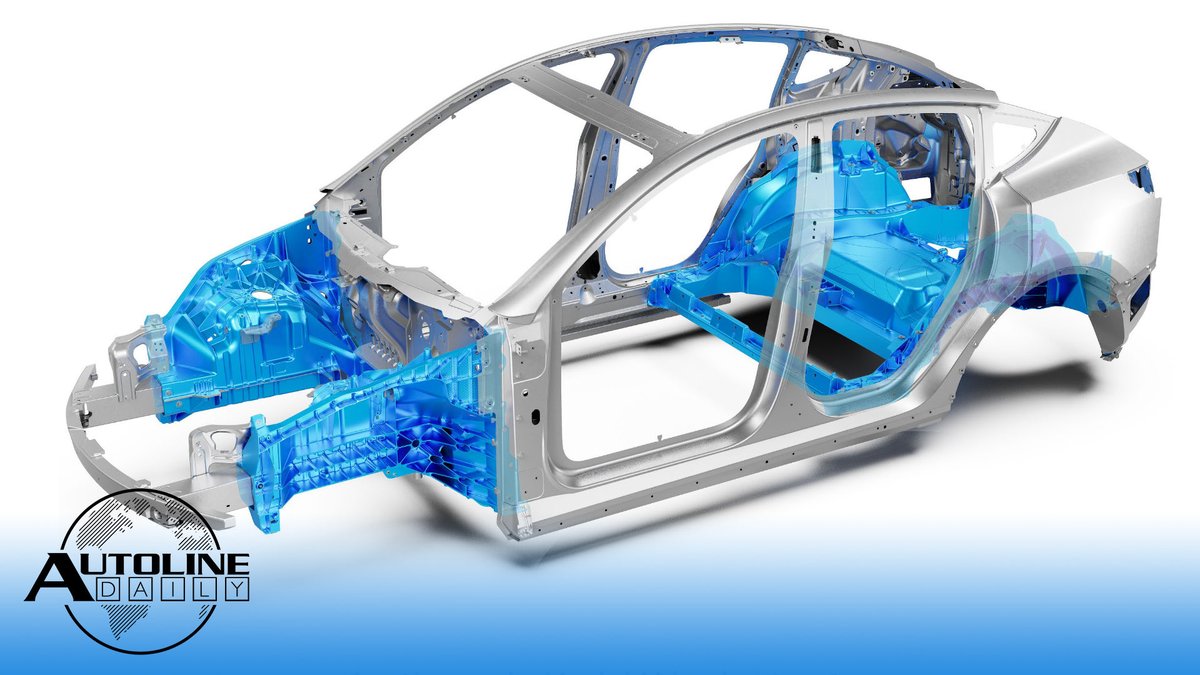
Replacing a cracked Tesla Model Y Gigacasting costs £2,167 less than repairing a traditional Model 3 steel subframe - here's why 💡
The biggest objection to Gigacasting has always been repairability. If the rear rails, shock towers, and floor are one piece, a rear-end collision should mean the entire floor needs replacing.
Labor to strip the interior, battery, and suspension would cost tens of thousands. Total loss. Write-off.
That was the assumption. Thatcham Research, the UK's automotive risk intelligence center, spent two years testing it.
At 15 km/h, simulating a common urban fender-bender, the Model Y's sacrificial crash cans absorbed all the energy. The Gigacasting itself sustained no structural damage.
At 25 km/h, the impact bypassed the crash cans and cracked the casting. Full replacement required.
The surprise: the replacement casting was priced at just £716. The total repair bill was comparable to, and in some cases cheaper than, repairing a complex multi-material steel structure.
The direct comparison was definitive. Partial replacements on the Model Y were £2,167 cheaper than equivalent repairs on the Model 3, which uses a traditional steel subframe.
The casting that was supposed to be "unrepairable" turned out to be the more economical option.
The "total loss" fear is not supported by the data.
Full article: https://t.co/e7jYtUwgFC
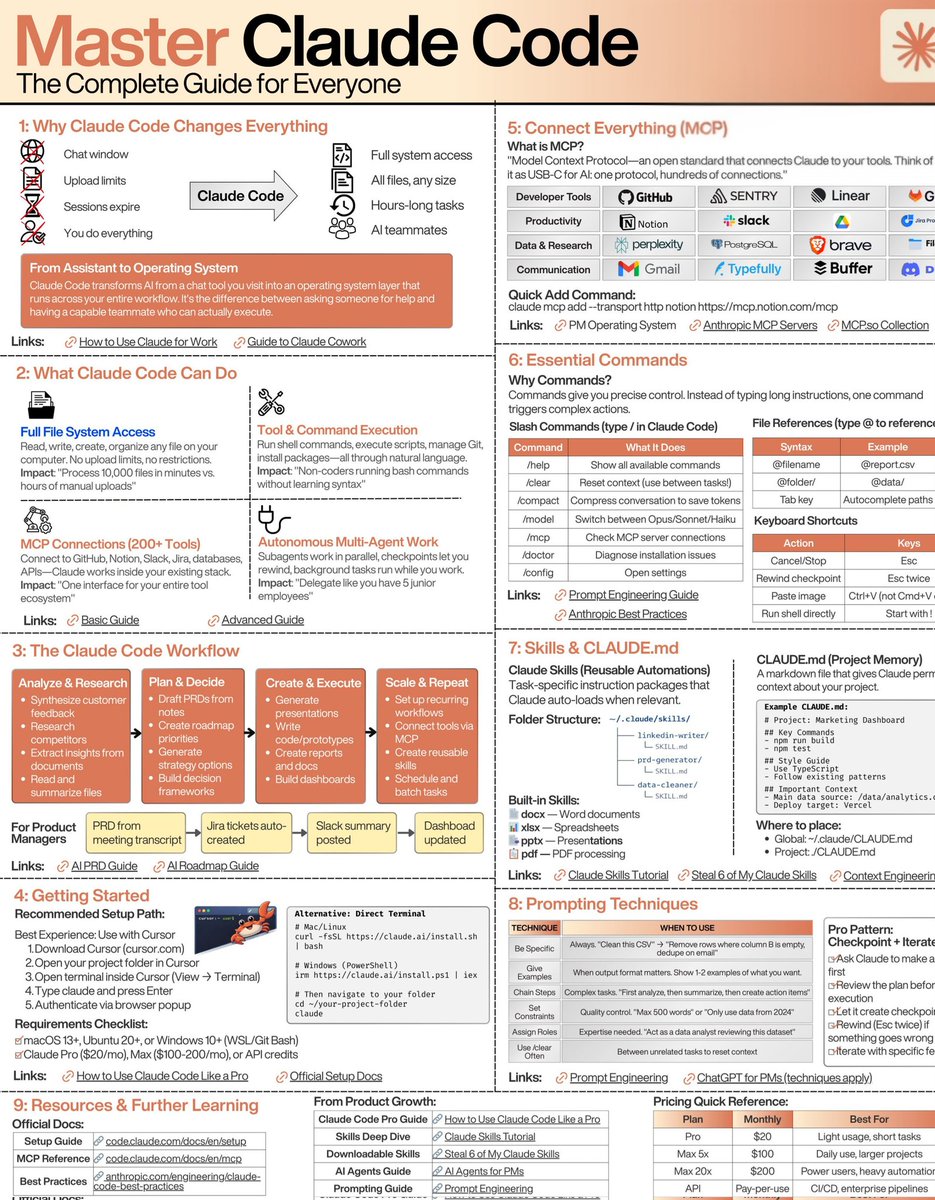
This 30-min workshop by the creator of Claude Code will teach you more about vibe-coding than 100 YouTube video guides.
Bookmark it & give it 30 minutes today. This video will change the way you use Claude forever.
In China, some residential complexes have already deployed these charging robots, which can theoretically turn every parking space into a charging spot. This "mobile power bank" has a capacity of 100kWh.
Chinese EV makers are looking to follow the Toyota model in Thailand, localizing supply chains and turning Thailand into an export hub.
“BYD began exporting to Europe from Thailand in August, while Changan began exporting sport utility vehicles to Europe in December. Great Wall and others are looking to follow suit.” https://t.co/AIV23MPzI2
You don’t need 20 videos to learn Claude Code.
You need one system, clear commands, and real projects.
Master those—
and Claude becomes your entire dev team
Everyone is hyped about Claude… but barely anyone knows how to actually use it to replace real work.
I collected 700+ mega prompts that turn Claude into a full-blown productivity engine.
Comment "AI" and I’ll DM you everything.
R.I.P McKinsey.
You can now use Perplexity AI to automate market research, competitive analysis, and strategy design for free.
Here’s the mega prompt you can steal ↓
(Comment "Send" and I'll DM you the mega prompts you can use for research)
Projects Update 📝
We’re adding more capabilities to projects in ChatGPT to help you do more focused work.
✅ Deep research support
✅ Voice mode support
✅ Improved memory to reference past chats in projects
✅ Upload files and access the model selector on mobile
"Idra Enters the Thixomolded Magnesium Game // But What is It?" 🎥
The next video of the Magnesium Series is now live 🤠
The YT version of the video is linked below.
*Timestamps* 🎞
00:00 Introduction
01:04 Video Context
01:47 Aluminum Gigacasting vs Magnesium Thixomolding // What’s the Difference?
05:18 Rheocasting vs Thixomolding
08:21 Why did Idra Pursue Thixomolding instead of Rheocasting?
09:36 Thixomolded Magnesium vs Gigacast Magnesium
11:22 Thixomolding // Quality
12:51 Thixomolding // Speed
13:31 Thixomolding // Size
15:12 The Limiting Factor for Thixomolded Part Size
16:51 Why Not Thixomolded Aluminum?
19:17 Summary
Magnesium Thixomolding, the perfect process for the lightest structural material 🪶
In short, Magnesium Thixomolding is a semi-solid forming process for Magnesium alloy parts.
Magnesium chips are fed from a hopper into the end of a cylindrical barrel containing a revolving screw.
By rotating, the screw moves the Magnesium chips forward while heater bands wrapped around the barrel warm them up to a semi-solid state slurry.
Initially, the solid globs in the slurry are angular, but the rotating screw causes them to collide and rub together, eroding them into uniform spherical particles, improving fluidity in the slurry.
Finally, in traditional Thixomolding machines, the screw acts as a piston and injects the slurry into the die.
Thixomolding has several advantages over die casting
Lower operating Temperature reduces shrinkage.
Shrinkage is the metal contracting as it cools inside the die after injection. Since the metal is injected at lower temperature, it doesn’t have to cool down as much as in traditional die casting resulting in lower contraction.
The Laminar Flow of the slurry decreases porosity.
In die casting the fully molten metal is so flowable that its motion results in turbulent flows that traps air and create small vacuums which results in porosity, “damaging” the overall quality of the material by degrading mechanical properties.
In thixomolding, the viscous semi solid slurry creates a laminar flow in which particles move in parallel layers moving in the same direction in a smooth continuous stream, essentially decreasing porosity and its resulting problems.
As a result, Quality for Thixomolded Products is much higher than in High Pressure Die Casting and almost comparable with Forging but with the advantage of being a much faster and economical high-volume process.
Thixomolding process also brings many more cost savings
Both the lower temperature difference between the die and the injected material, the slower flow of the slurry and the properties of Magnesium alloys leads to less Abrasion to the die, contributing to increase the die life from 100,000 thousands shots to 250,000 shots.
The heating of the metal occurs completely inside the cylinder and the material is never heated above the melting temperature. This decreases energy consumption by 50%.
If Thixomolding is so good why isn't it more widespread?
To find out wait for my next post or read the article below 👇🏼