I run an app that connects wearables to food logging to show how nutrition influences your sleep, recovery, HRV, etc and share research around wearable accuracy, nutrition, fitness etc. Here's the app if you want to try it:
iOS: https://t.co/RpFcH2XYsn
Android: https://t.co/AUYhfp5dG3
Deep sleep tells the same aging story. SWS drops from 18.9% to 3.4% between your 20s and 40s, growth hormone declining 75% in parallel (Van Cauter, JAMA 2000). Jet lag temporarily mimics years of that. Fiber is one of the best dietary protectors of N3.
https://t.co/dPfiE7G6h2
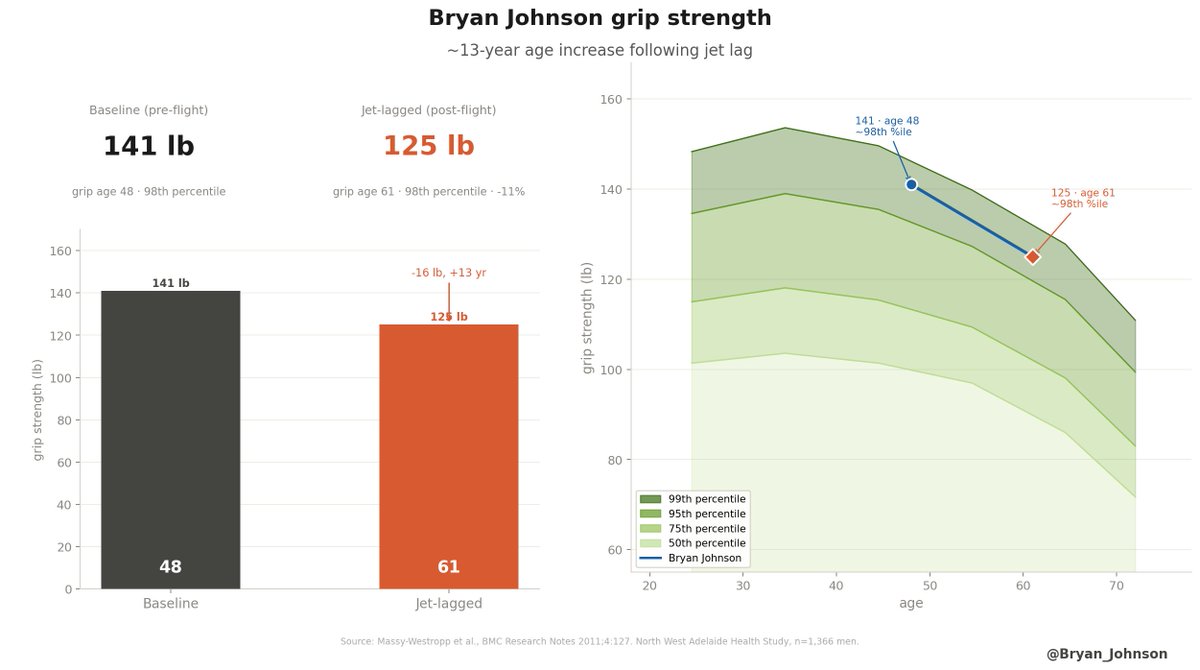
Jet lag increased my biological age by ~13 years.
> as measured by grip strength
> pre-travel: 141 lbs, grip age 48, ~98th percentile
> post-travel: 125 lbs, grip age 61, ~98th percentile
Traveled across 7 time zones, Los Angeles to Australia.
Grip strength predicts mortality better than almost anything you can measure at home.
A published study of a comparable eastbound flight found the same pattern, about a 7% morning drop.
HR data backs this up pretty clearly. Most recreational runners average 75-85% of max HR, well past the crossover point where fat oxidation drops off and glycogen takes over as the primary fuel. Walking keeps almost everyone in the 50-65% range where fat burning peaks. To run in that same zone, you'd need to hold a pace that feels almost embarrassingly slow. Most people can't psychologically do it, so they end up in no man's land: too fast for max fat oxidation, too slow for real cardiovascular stimulus.
One thing people miss: you can actually track cortisol's impact in real time without a blood test. Chronically elevated cortisol pushes resting heart rate up and HRV down, often weeks before the mood and cognitive symptoms become obvious. If your overnight RHR has been creeping higher and HRV trending lower for no clear reason, that's your nervous system flagging the problem before your brain catches up.
The anti-inflammatory effect independent of weight loss is the more telling finding. Systemic inflammation directly suppresses parasympathetic tone, CRP and HRV are inversely correlated across pretty much every population study. People on GLP-1 agonists who track with wearables often notice improved nocturnal HRV weeks before meaningful weight change. Suggests the cardiovascular protection mechanism kicks in before the scale moves.
@Outdoctrination Worth noting the study population was chronically stressed though. Whether 1g/day produces the same effect in people with normal cortisol is a different question entirely.
Good list. The catch most people miss: your gut bacteria determine how much benefit you actually extract. Only ~40% of people produce urolithin A from polyphenols because they have the right bacterial strains. Two people eating the same black beans get wildly different metabolite profiles. The bean matters, but the microbiome converting them matters more.
Worth adding: growth hormone peaks during deep slow-wave sleep, and GH is one of the few signals shown to regenerate thymic tissue (Napolitano et al. showed HIV patients on GH regrew functional thymus). So the age-related decline in deep sleep isn't just about feeling tired. It may be actively accelerating thymic involution and immune aging.
The underrated part: cortisol doesn't just store belly fat. It directly suppresses slow-wave sleep, and poor deep sleep raises next-day cortisol ~37% (Leproult et al.). Self-reinforcing loop. You can actually catch it early on a wearable. Declining overnight HRV is one of the first signals the HPA axis is stuck, often months before the weight shows up.
This is the core issue with any diet label. Weizmann Institute research found glycemic responses to identical meals vary up to 5x between individuals. One person's "healthy" Mediterranean meal spikes glucose as much as junk food does for someone else. Individual metabolic tracking > diet templates.
Would add a precursor to all three: autonomic dysfunction. HRV drops years before fasting glucose flags insulin resistance. The nervous system breaks down first, then metabolism follows. Wearable HRV trends might be one of the earliest non-invasive markers of metabolic risk we have.
@Mangan150 RHR is the starting point, but HRV (heart rate variability) is the deeper signal most people skip. Two people at 65 bpm can have completely different risk profiles depending on their HRV. What surprised me tracking both: diet has a bigger overnight impact than most workouts do.
The part that gets lost in this debate: glycemic response is wildly individual. The Weizmann Institute study (Zeevi 2015, 800 people) found some spiked more on rice than cookies while others showed the opposite. Blanket dietary rules fail because metabolism isn't one-size-fits-all.
@Mark_Sisson Slight nuance: per-kg needs are similar (~1.6g/kg both groups). The real issue is compliance. Endurance athletes chronically undereat protein because carb loading dominates fueling. Leucine oxidation during long efforts means you're burning amino acids as fuel, widening the gap.
The word "trend" next to HRV is doing a lot of heavy lifting here. Applies to all of these. A single RHR reading means almost nothing, but a sustained 3-5 bpm increase over 4-6 weeks is one of the earliest red flags for metabolic decline.
Same with HRV. The number varies wildly day to day. What actually predicts outcomes is the 90-day slope. If it's declining and you haven't changed your training, something upstream shifted, usually sleep architecture or diet.
Walking after meals is easily the most underrated fix on this list. DiPietro et al. found that three 15-minute walks timed after meals reduced 24-hour glucose by 12% more than a single 45-minute walk. Same total time, dramatically different result just from timing.
What most people miss is that wearables can flag developing insulin resistance before fasting glucose catches it. Rising resting heart rate and dropping nighttime HRV are early markers, sometimes showing up months before blood panels.
The 4-in-8-out is a great starting point, but the real lever is your individual resonance frequency. It typically falls between 4.5 and 7 breaths per minute, and Lehrer's RCT found that breathing at YOUR specific rate amplified vagal tone (RMSSD) far more than a generic slow pattern.
You can actually find yours with any wearable HRV tracker: try different breathing speeds and watch where your number peaks. Usually takes about 10 minutes to identify.
@daniallogston Really hope they don't inherit the same issues on Ring 5. Agree they need to address battery issues but glad to hear they replaced yours.
The Oura Ring 5 is here! It's the thinnest, lightest ring Oura has ever made. My first question was: what are the differences between the Ring 5, Ring 4, and Gen 3?
Really impressive work from Oura to get it this thin. I just hope they've sorted out the battery issues with this one.
Full comparison here: https://t.co/mbeQb5IBNe