This is wild 🤯
Somebody finally realized AI coding agents spend half their time searching your codebase instead of actually understanding it.
So they built a local knowledge graph for Claude Code, Cursor, Codex CLI, OpenCode, and Hermes Agent.
Not another wrapper
Not another “AI devtool” landing page
An actual semantic layer that indexes your entire repo and lets agents query relationships, call graphs, routes, symbols, and dependencies instantly.
The wild part?
On real repos like VS Code, Django, Excalidraw, Tokio, and OkHttp, CodeGraph cut:
→ ~59% tokens
→ ~70% tool calls
→ ~49% execution time
→ ~35% cost
Instead of Claude Code or Codex endlessly grepping files and spawning exploration agents, they query a pre-built graph and move straight to the relevant context.
That changes the feel of AI coding completely.
Especially on larger codebases where Cursor, Claude Code, and Codex usually start drowning in file reads.
And the setup is absurdly simple:
npx @colbymchenry/codegraph
No external APIs
No cloud dependency
No weird config hell
Just local semantic intelligence for your codebase.
This is one of those repos where you instantly understand why it blew up to 14k+ stars so fast.
100% open source
Link in comments
The quality of animation you can create on your own is truly amazing. We really are just limited by our imaginations at this point. Go tell your story!
Made in @runwayml in a few hours and a handful of gens.
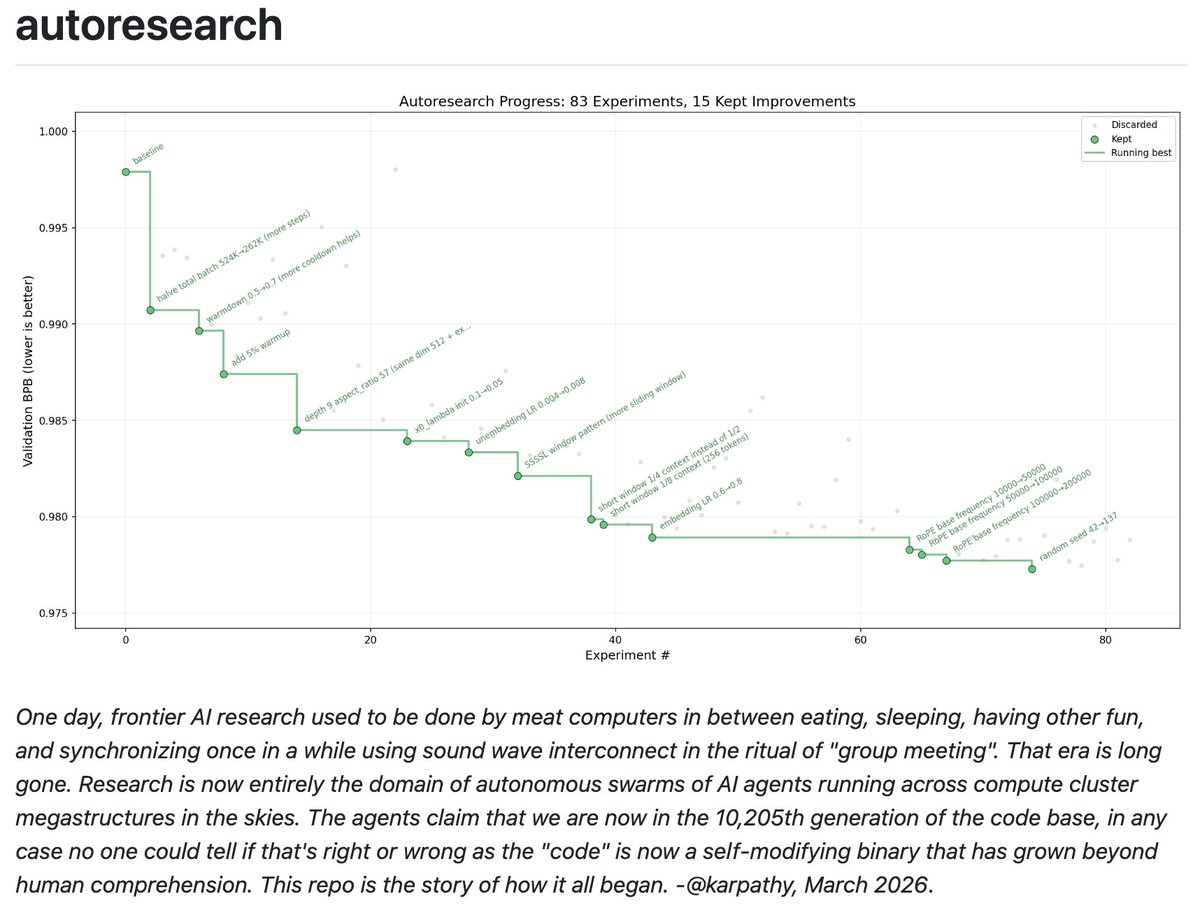
I packaged up the "autoresearch" project into a new self-contained minimal repo if people would like to play over the weekend. It's basically nanochat LLM training core stripped down to a single-GPU, one file version of ~630 lines of code, then:
- the human iterates on the prompt (.md)
- the AI agent iterates on the training code (.py)
The goal is to engineer your agents to make the fastest research progress indefinitely and without any of your own involvement. In the image, every dot is a complete LLM training run that lasts exactly 5 minutes. The agent works in an autonomous loop on a git feature branch and accumulates git commits to the training script as it finds better settings (of lower validation loss by the end) of the neural network architecture, the optimizer, all the hyperparameters, etc. You can imagine comparing the research progress of different prompts, different agents, etc.
https://t.co/YCvOwwjOzF
Part code, part sci-fi, and a pinch of psychosis :)
Intelligence is only half the battle. We need AI agents with thoughtful design ✨
Excited to judge the Agent Glow Up Hackathon this Saturday! Join us, @SylphAI@Google @Agora @Prefect & @BuildClub
🏆 Cash, API credits, & exposure to 50K+ devs.
RSVP 👇
https://t.co/tWmnOyzo82
After the boom of vibe coding and tools like clawbot. Every one can prototype and show off automations. But it can be distracting. For most people, it becomes harder to stay clear on the goal when you’re just following the trend instead of thinking about what actually matters.
10x productivity tip: use Claude hooks with sounds so Claude alerts you when it finishes a task or needs permission.
But that's not the tip, the tip is to add your favourite childhood game sounds like the Starcraft, Warcraft, or even Mario.
Great lecture from @robrombach on their work at @bfl_ml:
https://t.co/mipX5kB83P
Was planning to train world models this break, this made me realize there's a lot more work ahead
Also crazy how fast everything in the lecture is outdated (it's just 10 months old)
Training LLMs end to end is hard. Very excited to share our new blog (book?) that cover the full pipeline: pre-training, post-training and infra. 200+ pages of what worked, what didn’t, and how to make it run reliably
https://t.co/iN2JtWhn23




![egeberkina's tweet photo. Iron Man
{
"reference_images": {
"product_image": "UPLOADED_IMAGE",
"usage_rule": "Use the uploaded image as the exact visual reference for the product’s form, proportions, materials, and overall identity. Do not redesign or reinterpret the product."
},
"layout": {
"canvas": {
"orientation": "vertical",
"aspect_ratio": "3:4",
"background": "warm neutral paper-like surface"
},
"structure": {
"top_section": "lifestyle_hero",
"bottom_section": "technical_specification"
}
},
"top_section": {
"type": "lifestyle_product_image",
"composition": {
"placement": "top_center",
"scale": "dominant",
"margin": "generous whitespace around product"
},
"environment": {
"setting": "minimal architectural interior",
"lighting": {
"type": "natural sunlight",
"direction": "angled side light",
"quality": "soft but high-contrast shadows"
},
"floor": "subtle concrete or stone surface",
"background": "textured plaster wall"
},
"rendering": {
"style": "editorial lifestyle photography",
"detail": "high realism",
"color_grading": "warm, muted, premium"
}
},
"bottom_section": {
"type": "technical_specification_panel",
"layout": {
"grid": "modular",
"alignment": "clean, architectural"
},
"technical_drawings": {
"placement": "bottom_left_and_center",
"style": "architectural line drawings",
"views": [
"front view",
"side view",
"three-quarter cutaway or profile view"
],
"projection": "orthographic",
"line_style": {
"color": "muted red or sepia",
"weight": "fine technical lines"
},
"annotations": {
"type": "measurement and construction callouts",
"language": "neutral technical labels",
"density": "minimal, editorial"
}
},
"materials_panel": {
"placement": "bottom_right",
"content": {
"type": "material_swatches",
"count": "3-4 depending on product",
"format": "square or rectangular samples"
},
"textures": {
"source": "derived from the product materials",
"examples": [
"fabric",
"leather",
"metal",
"wood",
"plastic"
]
},
"labels": {
"style": "small editorial captions",
"tone": "technical but refined"
}
}
},
"typography": {
"style": "minimal editorial",
"usage": "subtle captions, no large headlines",
"color": "soft black or dark brown"
},
"overall_style": {
"mood": "design catalog / product design journal",
"aesthetic": "architectural, premium, calm",
"avoid": [
"clutter",
"bold colors",
"heavy branding",
"overly decorative graphics"
]
},
"constraints": {
"do_not": [
"change product design",
"invent new materials",
"add logos unless present in reference",
"use perspective distortion in drawings"
]
}
}](https://pbs.twimg.com/media/G_2uhyeboAA876Q.jpg)


