I am a researcher @openai. I work on post-training, improving multimodal reasoning + perception capabilities | Prev: CS PhD @Stanford w/ @jiajunwu_cs @drfeifei
@__alpoge__ Can you go back to just doing the thing where when cranks comment they have found a flaw in the proof you just say "oh my god you're right" it's very funny
I have a major result to share.
I’ve found conclusive forensic evidence that the top 4 Chinese AI labs—DeepSeek, Moonshot, MiniMax and Ant Group—have built their newest models on NVIDIA’s most advanced Blackwell chips, which are barred from export to China.
This sounds insane, but I discovered that almost every AI model carries a hidden signature of the GPU that trained it. When a model is first set up, the starting values of its weights are laid out in a pattern that depends on the exact GPU. Each combination of GPU and seed number produces a unique pattern—a sort of fingerprint of the hardware used to create the model. Traces of that pattern survive training into the published model.
Again, this evidence isn’t based on any insider information or leaking. It’s based on a forensic analysis of the model weights released by the companies themselves.
I searched more than six trillion combinations of chip layout and seed number and matched them to open-weights models. In doing so, I found conclusive evidence that six Chinese AI models—including DeepSeek-V4-Pro, Kimi K3, and MiniMax-M3—were initialized on NVIDIA Blackwell systems. Four of the models match Grace Blackwell, the GB200 and GB300 parts in NVIDIA’s flagship liquid-cooled rack-scale systems.
I then verified these results on real hardware. Running unmodified PyTorch with the seeds I’d recovered, a Blackwell B300 reproduced DeepSeek-V4-Flash’s untouched starting weights bit for bit, and a rented GB200 reproduced Kimi K3’s to a correlation of 0.999995. A Hopper H100 reproduced none of DeepSeek-V4-Flash’s, and changing the seed by one broke the match. (DeepSeek’s seed is 953049583 by the way.) The method also was verified to match 24 known open-weights models to the hardware that developers said they used.
It is exceedingly unlikely that these results are a coincidence. Across six trillion combinations, the best accidental match should reach only about 8 sigma (i.e., eight standard deviations above what random chance would produce). The real matches range from 49 to 1,385 sigma, and even the weakest single test hits 20.
These were data-center-scale training runs. With some analysis of release schedules and model details, I estimate that the largest, Kimi K3 and DeepSeek-V4-Pro, used 2,000 to 3,000 Blackwell GPUs each. Clusters of this size cost on the order of $150 to $200 million each to buy, and across these labs alone would add up to more than half a billion dollars of export-controlled GPUs, not counting experimental compute or otherwise. It’s quite likely that we see multi-billion dollar expenditure on export-controlled GPUs.
I am highly confident in this result, and it has been independently verified by senior researchers at OpenAI and Anthropic. You can read the full report at https://t.co/YOtzND0Jqk.
There is much more I’ve identified about these models through other forms of checkpoint forensics like this, and will have more to share soon.
Excited to share Halcyon, our latest research on multimodal pretraining!
Building strong text-to-image generative models is simpler than we think!
Blog: https://t.co/HOrwIJIHTf
Models: https://t.co/xBPJkEAOPU
Paper: https://t.co/8kROIz1c7L
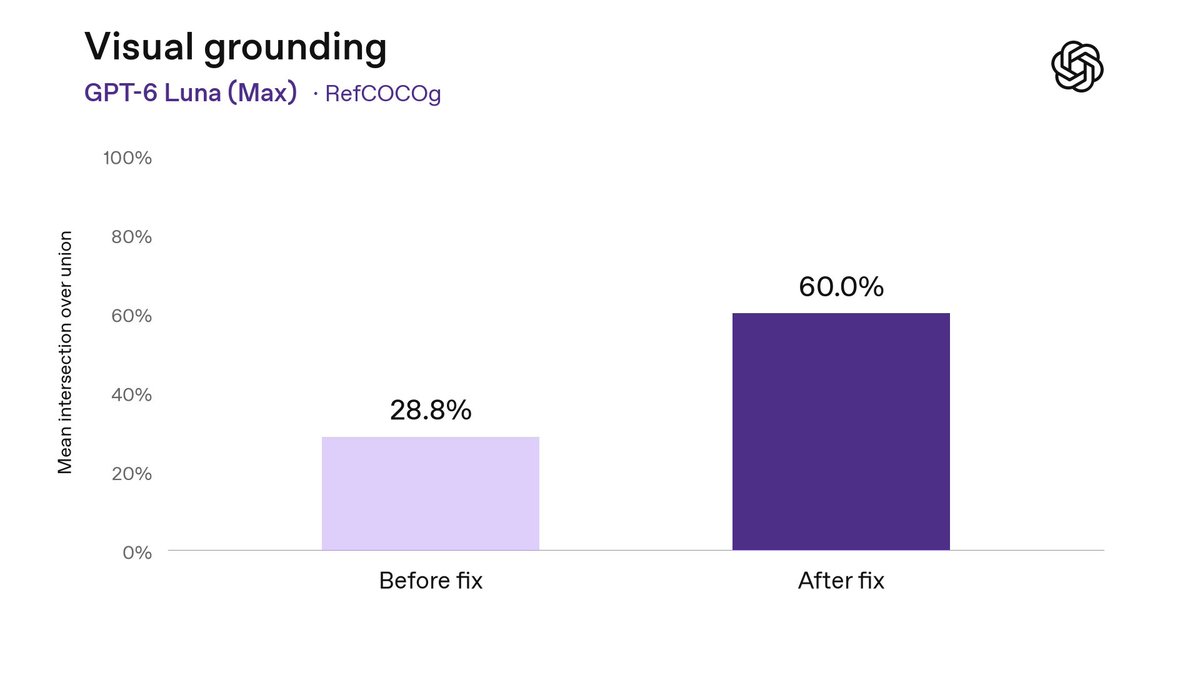
We’ve fixed a bug that was degrading image understanding in GPT-6 Sol and GPT-6 Luna. You should now see better results on visual tasks in the API and Codex, including computer use.
One-time pad of my top predictions for the rest of 2026. I will reveal the key on Jan 1:
8efd6168a055d1e45863c237eb3feab2be94f10b7ccdc5bf8bb54305c8b19f7f0eb026731d9ea3f870511f8c18daeb814eaa2c9e276082b204f2a962212fb5bd532b20b0105c9883348558ed2711c7d23ea6b4ee718364a87e16fad4b3c3a
A hot take: the videogen pipeline of the future is an LLM-coded 3D/4D base layer plus a lightweight diffusion renderer. We already know how to build the latter, but the former requires VLMs to be much better verifiers. So if you want to unblock generation, work on perception
In other words language is still the preferred control interface for humans. And then the question becomes do we make videogen better by RLing prompts (making them opaque to humans) or having LLMs write code in existing human software for 3D/4D scene construction (transparent to humans). In the long run the big unsolved problem imo is controllability, so if that gets solved the other details can be worked out. Sorry for textwalling haha
@kohjingyu I think “end to end” is not a good descriptor of SOTA T2I *now* though. People still get a lot of mileage out of tuning prompting. And unconditional image gen is actually really bad!
DLSS is one possible instantiation of part 2 of this pipeline (part 1 being CUA in blender + VLM visual validation), but personally I was envisioning a renderer that hallucinates a lot more detail and having the LLM focus on a low poly scene where everything is still semantically correct. FWIW I think there are a lot of ways part 2 of the pipeline can work but for part 1 the VLM needs to be really good to do correct visual validation, since (1) current VLMs are still not that good at complex image and video reasoning and (2) the CUA presumably might still have enough DoF for a simple scene to just start adversarially attacking the VLM null-space moreso than just making the scene better