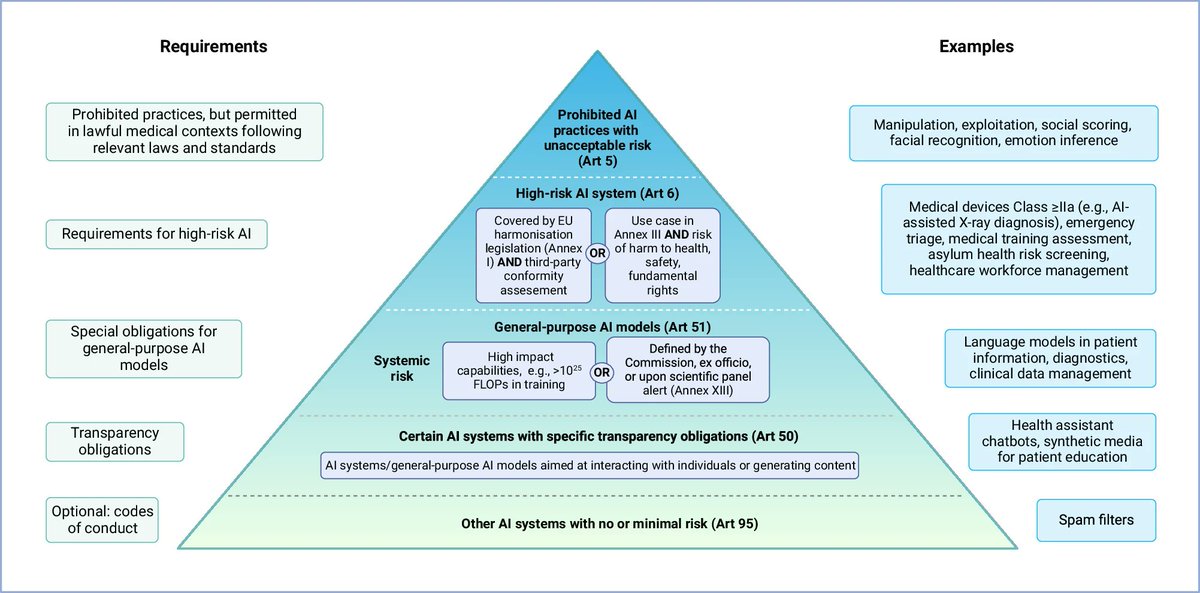
Our new @npjDigitalMed commentary analyzes the EU AI Act's impact on healthcare. We explain the risk-based approach, explore implications for radiology AI, and discuss regulatory challenges for medical AI. Full article here: https://t.co/iYoGaLyrB3
Thanks to @Fel_Busch@k_bressem@DanielTruhn@christianjohner@jnkath
You're right that "validation" is traditionally used for the split during training to tune hyperparameters and check for overfitting. It makes sense to continue using "validation" for this purpose (also see CLAIM 2024 item 19). Meanwhile, "test" should refer to evaluating the model's final performance on a separate dataset, whether it's internal or external. This distinction helps maintain clarity: "validation" for tuning during training and "test" for the final evaluation.
T5. Beyond reporting, CLAIM educates on best practices in AI study design and execution. It can inform curriculum development for AI in radiology and promote standardization across the field, improving research quality and clinical translation. #RadAIchat
T5. CLAIM serves as a roadmap for comprehensive AI study reporting in radiology. It guides researchers in study design, helps journals maintain reporting standards, and enables readers to critically assess AI research quality. #RadAIchat
T4. CLAIM 2024 replaces 'ground truth' and 'gold standard' with 'reference standard'. This change acknowledges uncertainty in medical data labeling, aligns with other reporting guidelines like STARD, and avoids implying absolute certainty in benchmarks. #RadAIchat
T4. ‘Ground truth’ implies absolute certainty, while ‘gold standard’ suggests a fixed benchmark. CLAIM 2024 adopts ‘reference standard’ to acknowledge the inherent uncertainty in medical data labeling and align with other reporting guidelines. #RadAIchat
T3. CLAIM 2024 adds ‘not applicable’ option, adopts ‘reference standard’ instead of ‘ground truth’/’gold standard’, includes image acquisition details. Simplifies by removing data element definitions. Not extended to radiomics research, keeping focus on AI in imaging. #RadAIchat
T2. CLAIM serves multiple stakeholders: authors use it for thorough reporting, reviewers for completeness assessment, and readers to evaluate study quality and reproducibility. #RadAIchat
T2. CLAIM guides authors in clear AI research presentation. It covers the entire manuscript structure, ensuring critical details on data, model architecture, training, and evaluation are reported. #RadAIchat
T1. The recently updated CLAIM guideline is a comprehensive guideline for AI in medical imaging. It covers 44 items across all manuscript sections, ensuring thorough reporting of data, methods, and results. #RadAIchat
T1. Key AI reporting guidelines in radiology include CLAIM, STARD-AI, MI-CLAIM, CONSORT-AI, SPIRIT-AI, FUTURE-AI, MINIMAR, and RQS. Each addresses specific aspects of AI research reporting and reproducibility. #RadAIchat
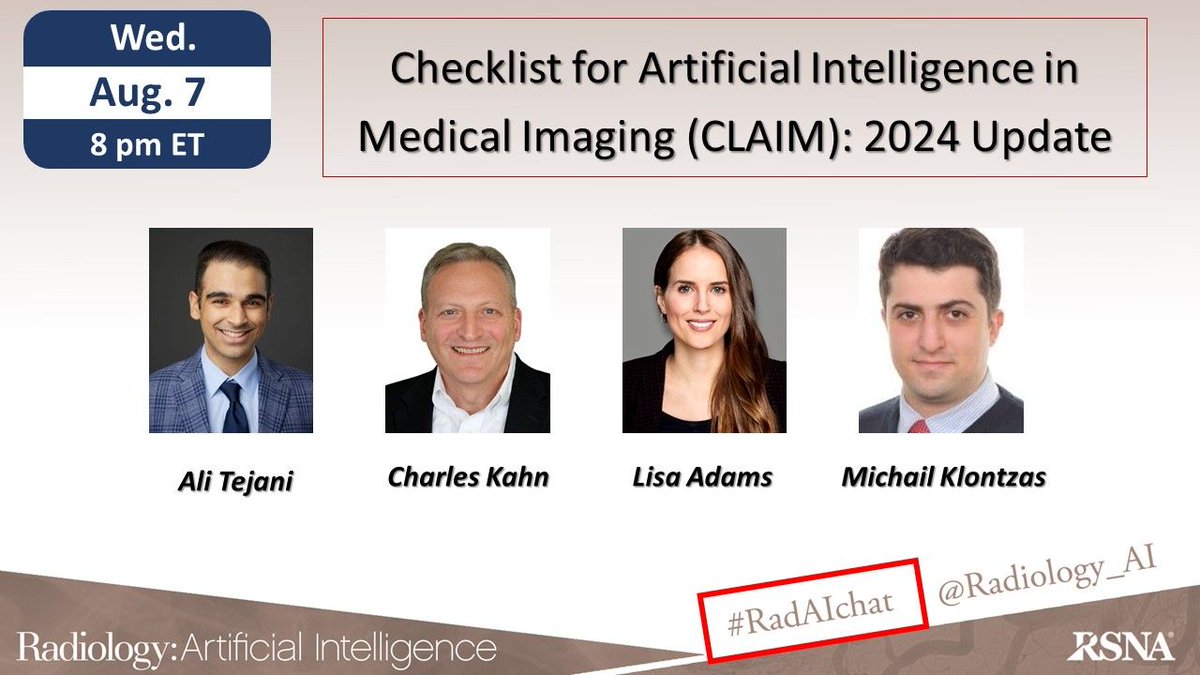
Hi there! I'm Lisa Adams, a physician scientist and radiologist at Technical University Munich. Excited to discuss CLAIM guidelines and their impact on AI reporting in radiology. #RadAIchat