Why Add Celecoxib to Immunotherapy?
The PICC-2 trial explored whether blocking the COX-2/PGE₂ pathway could enhance the activity of PD-1 blockade in dMMR/MSI-H locally advanced colorectal cancer.
By reducing immune suppression within the tumor microenvironment, celecoxib may help T cells eliminate residual cancer more effectively.
Pathological complete response improved from 69% to 89% with the addition of celecoxib.
The combination achieved this benefit without increasing treatment-related toxicity.
A promising strategy that warrants further validation, but adds an intriguing layer to neoadjuvant immunotherapy.
🔖 Bookmark now, reference later: Management of #ThyroidCancer increasingly reflects #tumor size, #disease extent, and #molecular profile.
This #JAMAReview indicates that observation without surgical resection can be considered for microcarcinomas ≤1 cm, while surgery with or without #RadioactiveIodine is curative in most cases for tumors >1 cm with or without lymph node metastases.
➡️ Save this Review to your citation manager and reference it in future research: https://t.co/aSFQfwJdvO
Nice Infographics to Show
1-mechanism of resistance of ADCs used in Breast Cancer
2-structural details of Newer ADC being studied in Breast cancer
3- Timeline for approval of All ADCs by USA FDA in Breast cancer till date.
Useful for quick reference .
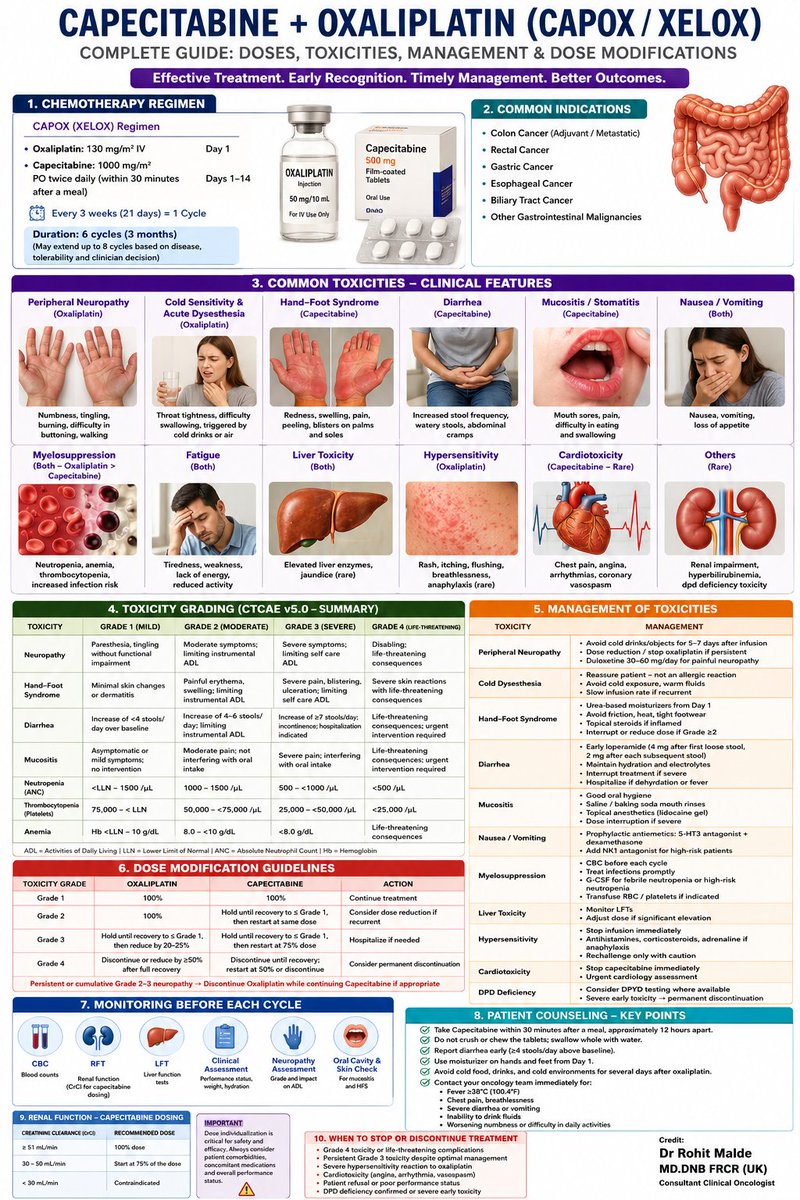
Capecitabine + Oxaliplatin
Chemo Regimen
COLORECTAL cancers
Doses
Indications
Toxicity and Grading
Dose Reductions and Stopping Rules
A simple Glance for Oncologists in Clinics
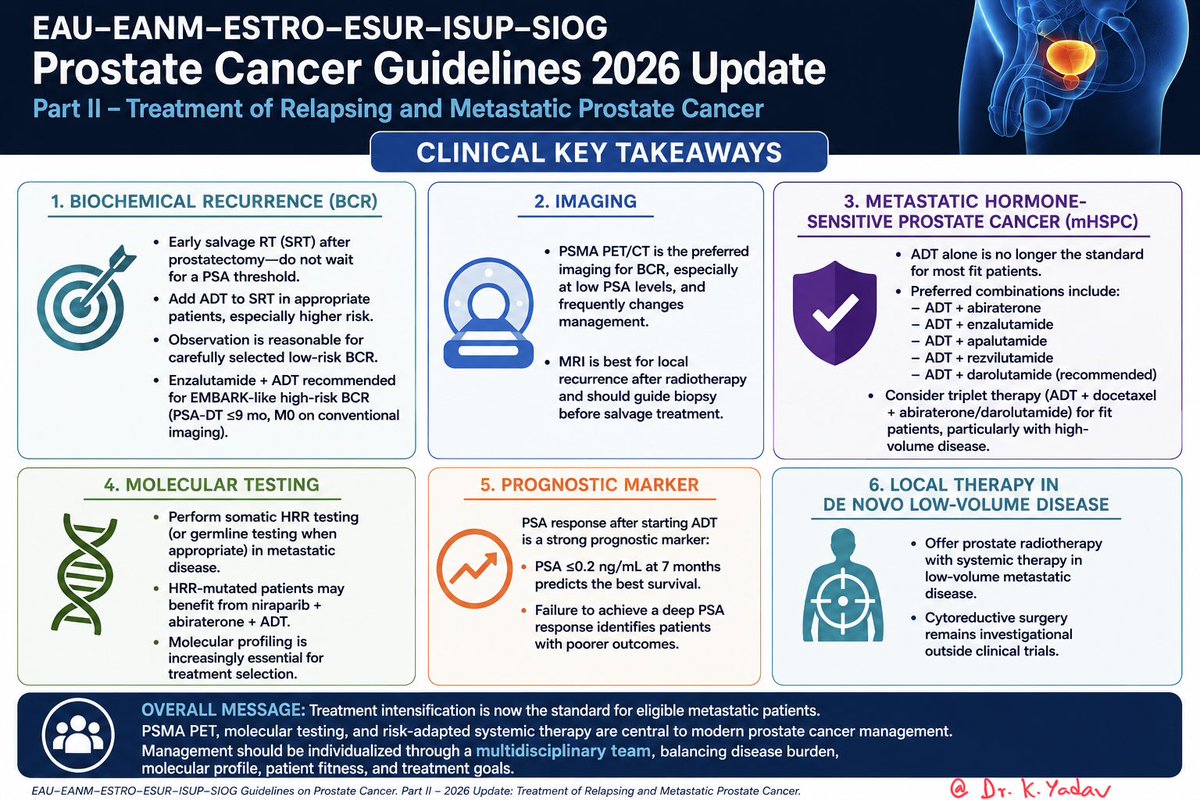
EAU 2026 Prostate Cancer Guidelines are here.
Key updates:
✅ Early salvage RT for BCR
✅ PSMA PET as preferred imaging
✅ ADT alone is no longer enough for most mHSPC patients
✅ Molecular testing guides precision therapy
✅ Triplet therapy for appropriate patients
✅ Prostate RT remains important in low-volume metastatic disease
Personalized, biology-driven treatment is now the standard.
#ProstateCancer #EAU26 #GUOnc #UroOnc #MedTwitter #Oncology #PrecisionOncology @oncodaily
Position statement on ADCs in solid tumors
The recent pivotal studies & key ongoing studies on ADCs are summarized in Table 1 & 2.
🔗https://t.co/Zp6DWW9Cb8
@ESMO_Open@OncoAlert
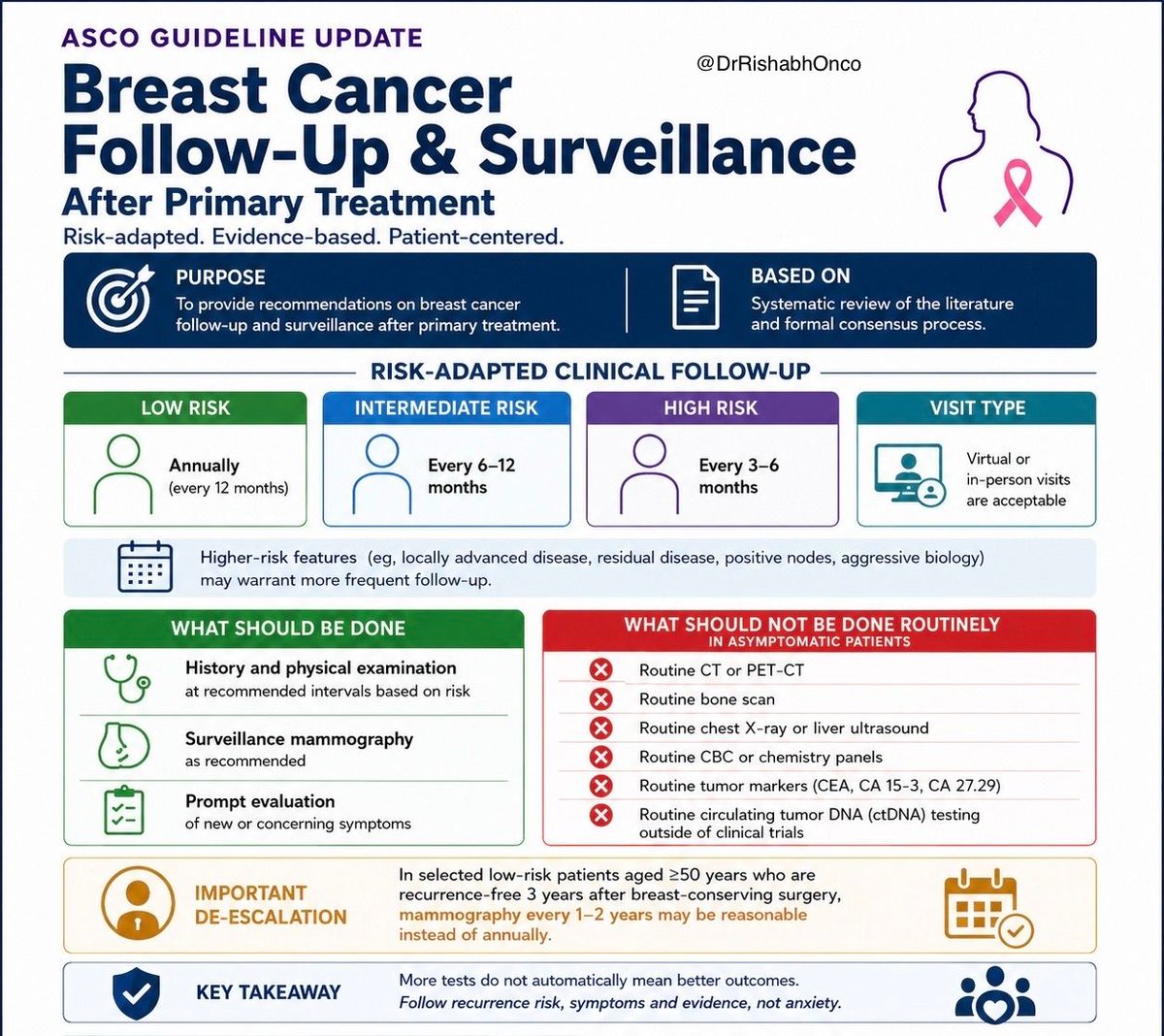
🚨 New @ASCO guideline on breast cancer surveillance after curative treatment
The biggest change: follow-up should be risk-adapted, not one-size-fits-all.
Clinical follow-up
🔹 Low risk: annually
🔹 Intermediate risk: every 6–12 months
🔹 High risk: every 3–6 months
🔹 Virtual visits are acceptable
What should be done
✅ History and physical examination
✅ Surveillance mammography
✅ Prompt evaluation of new symptoms
What should NOT be done routinely in asymptomatic patients
❌ CT or PET-CT
❌ Bone scan
❌ Chest X-ray or liver ultrasound
❌ CBC or chemistry panels
❌ CEA, CA 15-3 or CA 27.29
❌ ctDNA surveillance outside clinical trials
Important de-escalation
For selected low-risk patients aged ≥50 years who remain recurrence-free 3 years after breast-conserving surgery, mammography every 1–2 years may be reasonable instead of annual imaging.
Clinical takeaway
More surveillance does not necessarily improve outcomes.
Follow recurrence risk, symptoms and evidence, not anxiety.
Will this change your follow-up practice?
@oncoalert #BreastCancer #ASCOGuidelines
⚡️ Updated NICE 2026 guideline on kidney cancer: a comprehensive pathway from suspicion to risk-adapted treatment and follow-up.
87% of stage 1a RCC in the UK is diagnosed incidentally. A reminder of how challenging early detection remains in everyday clinical practice.
https://t.co/O6xWOoleIv
#KidneyCancer @OncoAlert
Reducing or Omitting Dexamethasone With NEPA and Olanzapine for Prevention of Chemotherapy-Induced Nausea and Vomiting in Highly Emetogenic Chemotherapy: A Randomized Non-inferiority Phase III Trial.
Read the full article. https://t.co/1ViN8LNj87
📢 Registration is now open for the Acute Leukemia Forum! 🔬Join outstanding faculty as we explore the latest advances in acute leukemia research, treatment strategies, and patient care. Secure your spot, connect with colleagues, and be part of the conversations shaping the future. 🚨 Register today! ➡️ https://t.co/HvPXYww57A
DENOSUMAB DE-ESCALATION
For years, monthly denosumab has been the standard for patients with bone metastases.
But after initial therapy, do patients really need treatment every 4 weeks indefinitely?
REDUSE 96/12 addressed this question in 1,380 patients with breast cancer or mCRPC and bone metastases.
After 4 initial monthly doses:
• Every 12-week dosing achieved non-inferior skeletal protection • Time to first symptomatic skeletal event: 56.6 vs 56.5 months HR 1.02
Importantly:
• Hypocalcemia decreased from 46% → 30% • Osteonecrosis of the jaw decreased from 8.5% → 6.9%
The message is simple:
Less frequent treatment may preserve efficacy while reducing toxicity and treatment burden.
A potentially practice-changing maintenance strategy for bone metastases.
#MVOnco #ASCO2026 #Denosumab #BoneMetastases #BreastCancer #mCRPC #SupportiveCare #BoneHealth #Oncology #MedTwitter #OncTwitter
🚨 Mañana es nuestra Sesión Académica Virtual SMeO sobre CPCNP HER2m.
📅 11 de junio
🕗 20:00 a 21:30 hrs
Consulta el programa académico y regístrate.
🔗 Registro disponible en nuestra pagina web: https://t.co/4gQ5rlnLQH./eventos
#SMeO#Oncología#OncologíaMX#CáncerDePulmón #EducaciónMédicaContinua