I’m just trying to imagine what they must have been feeling in that moment… trapped with no way out. I can’t even imagine the fear, helplessness, and desperation a person would feel when there seems to be no escape.
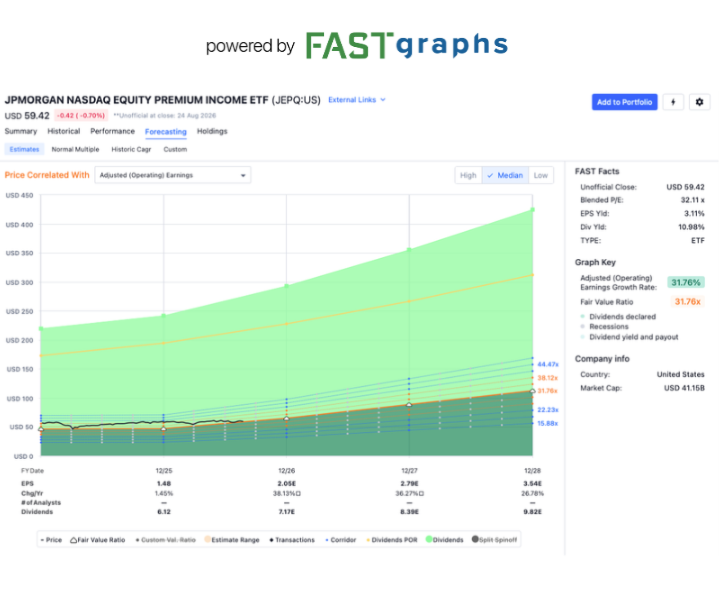
$JEPQ is currently boasting a 10.98% trailing distribution.
At this rate, you would only need about $11,000 invested to generate an average of $100/month in passive income.
Why aren't more people doing this?
Is $JEPQ on sale? 👀
Current price: ~$59
Fair value: $58.78
That puts $JEPQ about 1% ABOVE fair value!
📈 Future price estimate: $112.53
💰 Dividend yield: 10.9% TTM
Do you own $JEPQ ETF?
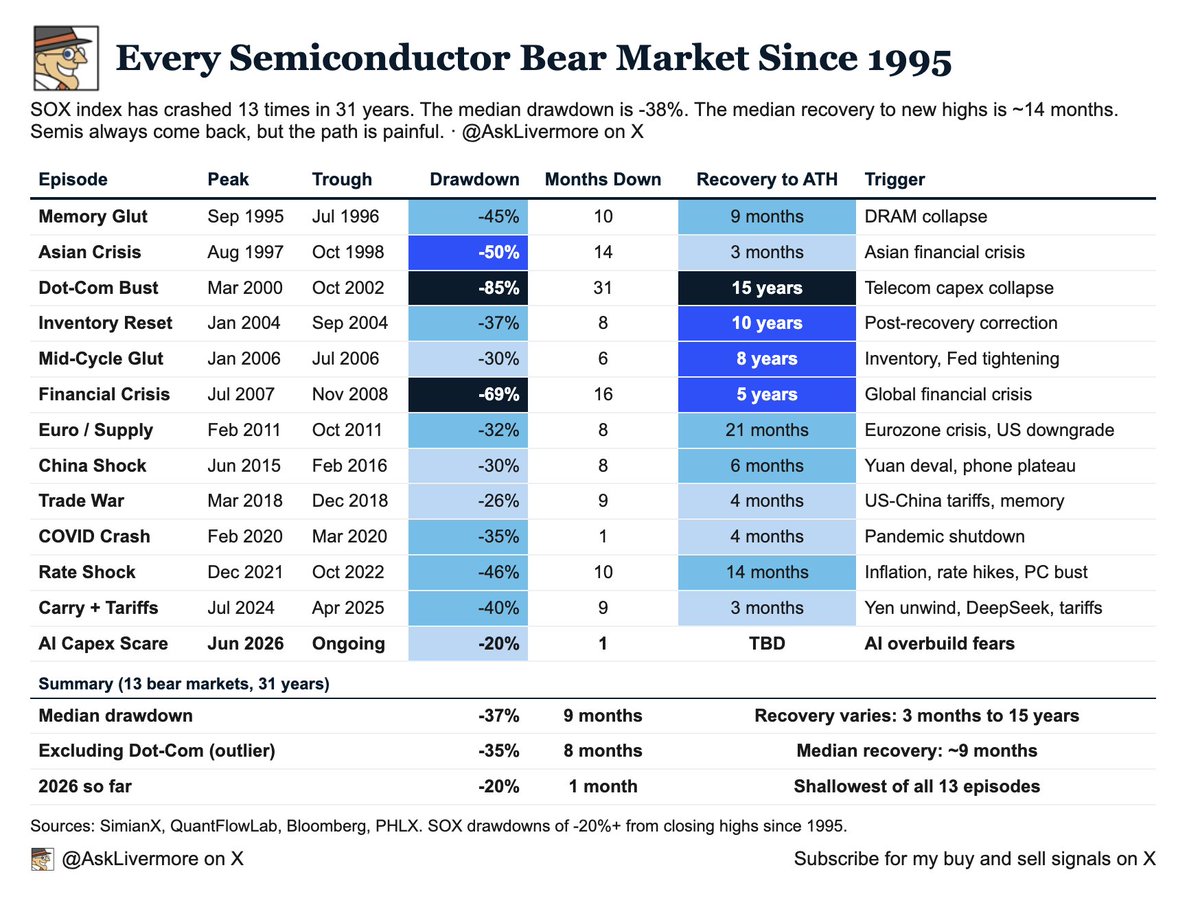
Semiconductors entered their 13th bear market in 31 years last month.
That is once every 2.4 years. This is not unusual. This is what semis do.
Here is every $SOX crash since 1995 and how long it took to recover:
• Asian Crisis: -50%, recovered in 3 months
• Trade War 2018: -26%, recovered in 4 months
• COVID 2020: -35%, recovered in 4 months
• China Shock 2015: -30%, recovered in 6 months
• Memory Glut 1995: -45%, recovered in 9 months
• Rate Shock 2022: -46%, recovered in 14 months
• Carry + Tariffs 2024: -40%, recovered in 3 months
• 2026 so far: -20%. The shallowest of all 13 episodes.
The median semi bear market drops 37% and lasts 9 months. We are at -20% and 1 month in. The most recent crashes(2018, 2020, 2024) all recovered in 3-4 months.
The only one that did not recover quickly was the Dot-Com bust. That took 15 years. But that was an -85% collapse with zero earnings behind it.
Today semis have record revenue, record margins, and every company on earth is buying chips for AI.
Semis crash. Then they come back. Every single time, in a few months.
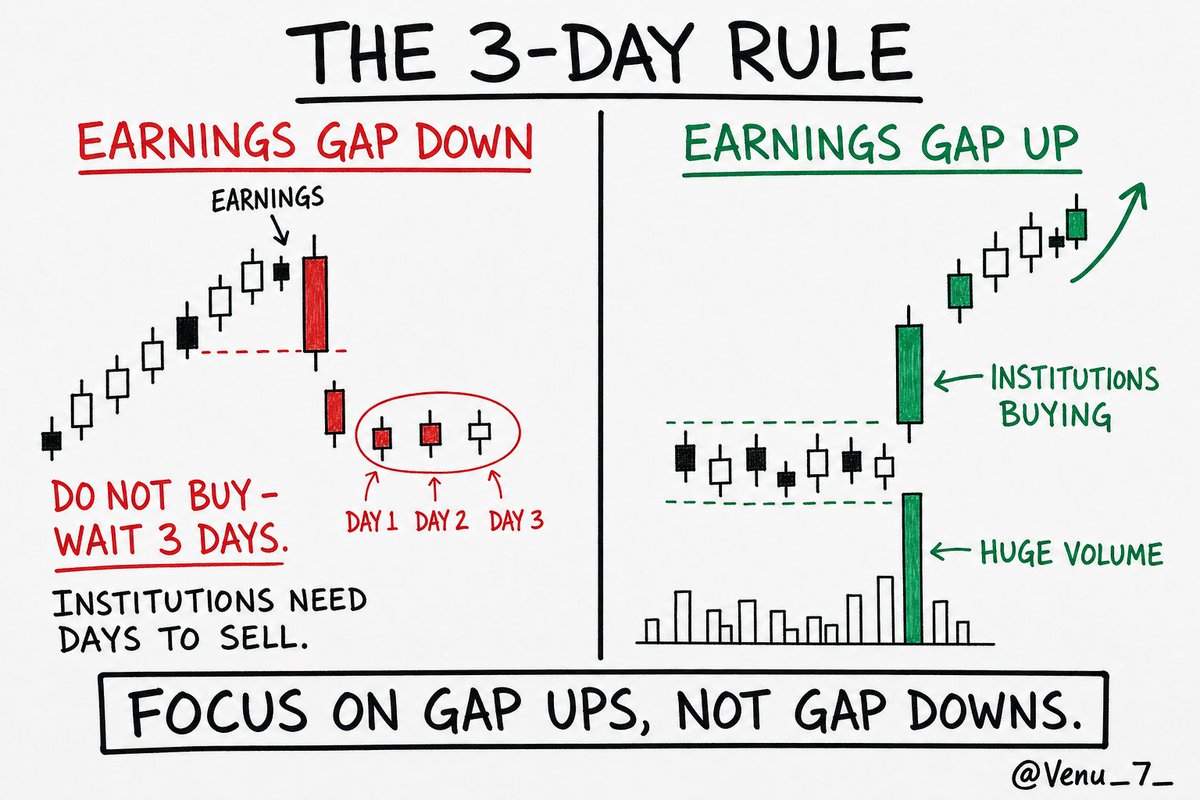
One of the biggest mistakes new investors and traders make:
Buying a stock that gaps down after earnings.
It looks like a discount. It's usually a trap. To avoid falling into that trap, follow one simple rule:
The 3-Day Rule.
When a stock gaps down on earnings, wait at least 3 trading days before even thinking about buying.
Why?
Institutions holding millions of shares can't exit in one day. The gap down isn't the end of their selling - it's the beginning.
- Day 1: Bounce = dip buyers + short covering, not real demand.
- Days 2-3: You'll see whether the selling pressure actually dries up.
- After Day 3: The stock will tell you if it's stabilizing or still bleeding.
You're trading with evidence, not hope.
And remember:
Our focus should always be on earnings gap ups, not gap downs.
A gap up on heavy volume usually signals institutional buying like $PLTR - and their buying often takes days or even weeks to complete. That's the fuel behind many of the market's biggest winners.
Gap down = big money leaving.
Gap up = big money arriving.
Own what they're accumulating. Don't try to catch what they're distributing.
Happy $JEPI and $JEPQ dividend day.
Another $1,388.59 just hit the account.
Instead of spending it, I’m doing what I’ve done for years…
DRIP.
Those dividends buy more shares.
Those shares produce more dividends.
Those dividends buy even more shares.
It’s boring.
It’s repetitive.
And it’s one of the biggest reasons passive income compounds into real wealth over time.
The goal isn’t one big payday.
The goal is building an income machine that pays you whether you’re working or not.
Market Wizard Linda Reschke's 12 Technical Trading Rules:
1. Buy the first pullback after a new high. Sell the first rally after a new low.
2. Afternoon strength or weakness should have follow through the next day.
3. The best trading reversals occur in the morning, not the afternoon.
4. The larger the market gaps, the greater the odds of continuation and a trend.
5. The way the market trades around the previous day’s high or low is a good indicator of the market’s technical strength or weakness.
6. The previous day’s high and low are two very important “pivot” points, for this was the definitive point where buyers or sellers came in the day before. Look for the market to either test and reverse off these points, or push through and show signs of continuation.
7. The last hour often tells the truth about how strong a trend truly is. “Smart” money shows their hand in the last hour, continuing to mark positions in their favor. As long as a market is having consecutive strong closes, look for up-trend to continue. The up trend is most likely to end when there is a morning rally first, followed by a weak close.
8. High volume on the close implies continuity the next morning in the direction of the last half-hour. In a strongly trending market, look for resumption of the trend in the last hour.
9. The first hour’s range establishes the framework for the rest of the trading day.
10. A greater percentage of the day’s range occurs in the first hour then was the case in the past, and thus it has become increasingly important to trade aggressively if there are early signs of a strong trend for the day.
11. There are four basic principles of price behavior which have held up over time. Confidence that a type of price action is a true principle is what allows a trader to develop a systematic approach.
The following four principles can be modeled and quantified and hold true for all time frames, all markets. The majority of patterns or systems that have a demonstrable edge are based on one of these four enduring principles of price behavior.
Charles Dow was one of the first to touch on them in his writings. Principle One:
A Trend Has a Higher Probability of Continuation than Reversal Principle Two:
Momentum Precedes Price Principle Three:
Trends End in a Climax Principle Four:
The Market Alternates between Range Expansion and Range Contraction!
12. In the world of money, which is a world shaped by human behavior, nobody has the foggiest notion of what will happen in the future. Mark that word –
Nobody! Thus the successful trader does not base moves on what supposedly will happen but reacts instead to what does happen.
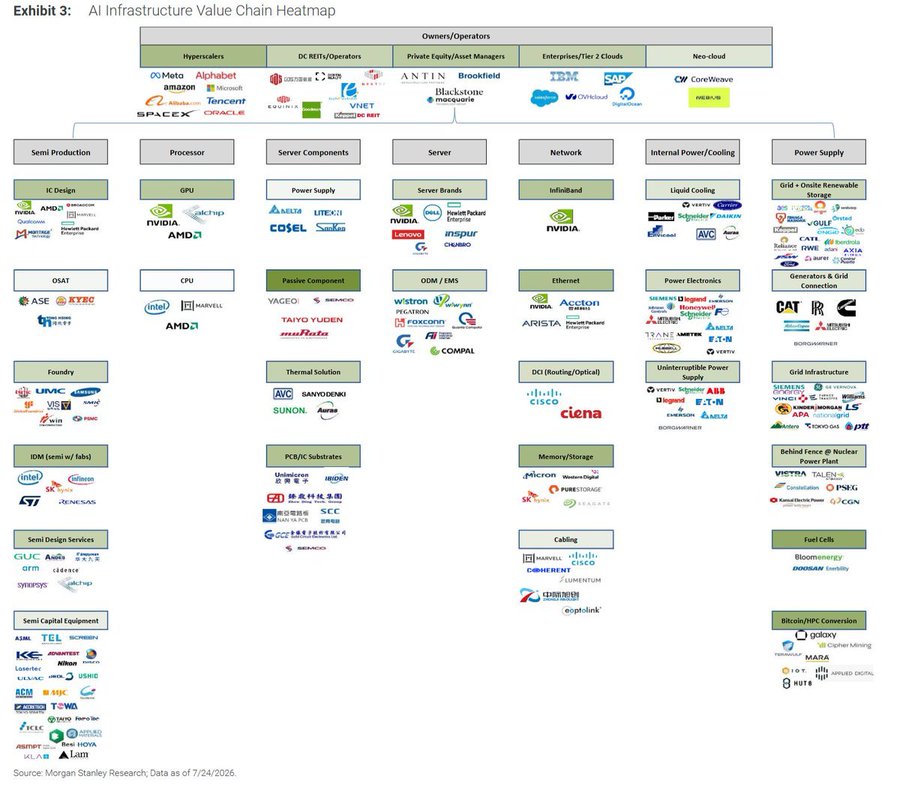
Morgan Stanley mapped out the entire AI infrastructure supply chain and it reveals who actually gets paid at every layer of the trillion dollar buildout (Save this).
This heatmap breaks the AI infrastructure value chain into two dimensions those who owns and operates the data centers at the top and what physical and technical components get built underneath to make those data centers function.
At the top sit the owners/operators, the hyperscalers like Meta, Alphabet, Amazon and Microsoft, alongside data center REITs, private equity giants like Blackstone and Brookfield, enterprises and neoclouds including CoreWeave and Nebius.
These are the companies writing the massive capex checks that fund everything below them.
Below that sits the actual build out, split into seven layers, semi production, processors, server components, servers, network, internal power/cooling and power supply.
Semiconductor production is dominated by names your audience already knows well, Nvidia and AMD for GPUs, TSMC adjacent foundries, ASML and Applied Materials for capital equipment, and Micron and SK Hynix under memory/storage.
But the less obvious money is in the physical infrastructure layers most retail investors never look at.
Server components include passive parts from Yageo and Murata, thermal solutions from Sanyo Denki, and PCB substrates from companies like Unimicron.
Network infrastructure includes InfiniBand and Ethernet gear from Nvidia and Arista, plus optical/DCI routing from Cisco and Ciena.
Internal power and cooling is arguably the most underappreciated category here.
It includes liquid cooling specialists like Vertiv and CoolIT, power electronics from Siemens and Eaton, and uninterruptible power supply makers like ABB and Legrand, all companies solving the literal heat and electricity problem created by cramming more GPUs into less space.
So who benefits from all of this?
Everyone in every box benefits in some way but the real insight is that value doesn't concentrate at just the GPU layer anymore.
The hyperscalers at the top are distributing capex across seven distinct physical layers which means the picks and shovels opportunity set has expanded well beyond Nvidia into cooling, grid infrastructure, and power generation.
Bullish on AI infrastructure, make sure to follow @MelvinInvests for more AI infrastructure insights, and if you want to see exactly what I'm buying as an analyst at Milk Road Pro, you can check out the link below for more.
I have made MILLIONS trading the AI Sector Rotation
Print this. Keep this. It’s how the next Millions will be made.
My Secret to catching it early?
Following the Sector ETF’s for strength and weakness
AI Ecosystem
• $AIQ: $AMD $INTC $SKHY
Semiconductors
• $SMH: $NVDA $TSM $AVGO
Memory
• $DRAM: $MU $SNDK $WDC
Photonics
• $EUV: $LITE $COHR $AAOI
Software
• $IGV: $PLTR $NOW $ORCL
Cybersecurity
• $CIBR: $CRWD $PANW $FTNT
AI Infrastructure
• $WGMI: $IREN $CORZ $HUT
Data Centers
• $DTCR: $EQIX $DLR $VRT
Physical AI
• $BOTZ: $ISRG $CGNX $TSLA
Space & Defense
• $ARKX: $RKLB $KTOS $SPCX
Nuclear
• $NLR: $CEG $CCJ $OKLO
Quantum
• $QTUM: $IONQ $RGTI $QBTS
Capital rotates through sectors long before most investors notice.
This is how we will catch them early.
@XtheDrama@GuntherEagleman Democrats have voted down EVERY cut. They voted against fraud guardrails in welfare. They had a fit over closing USAID even when countries report the funds never made it to what they were sent for. Notice the DNC is broke since government fraud is being stopped.
💰 A lot of people look at $SCHD and only see the 3.3% dividend yield.
They’re missing the best part.
$1,000,000 invested in $SCHD pays about $33,000 per year today while still giving you exposure to stock market growth.
But thanks to its incredible dividend growth, if you never invested another dollar and simply held your shares, history suggests those annual dividends could grow to roughly:
📈 $58,000/year in 5 years
📈 $102,000/year in 10 years
📈 $318,000/year in 20 years
That’s the power of owning companies that consistently raise their dividends.
And here’s what makes it even better…
Historically, your principal has also appreciated over the long term, meaning your portfolio value has had the potential to grow while your income grows too. You’re not just collecting dividends. You own a portfolio of high quality companies that have historically increased in value over time.
You don’t just build wealth.
You build a growing paycheck while your portfolio has the potential to keep increasing in value.
To me, that’s one of the greatest retirement hacks there is.