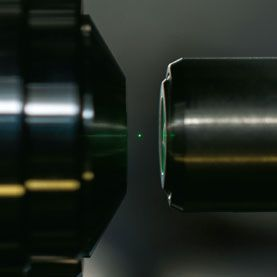
BREAKING NEWS🚨: 'Negative time' confirmed: Mind-bending experiment shows light can exit a cloud of atoms before it enters, thanks to quantum physics quirk
Yr 9 will be doing algal balls later this week. We bought in some algae to grow up before half term. Mrs L wisely put it on a lamp in a cold room during the break. That worked very well and it appears to be happy and healthy. Phew!
Julian Voss-Andreae is a quantum physicist-turned-sculptor.
His work is heavily influenced by his background in science and his blending figurative sculptures can vanish in front of our eyes.
In 2020, two men managed to turn Earth into a giant “sandwich” by placing slices of bread on exact opposite points of the planet.
In January 2020, two men successfully turned Earth into a giant “sandwich” by placing slices of bread on exact opposite sides of the planet at the same time. The project was organized by New Zealand student Etienne Naude, who used online mapping tools to locate his geographic antipode in Málaga, Spain. He then teamed up with Spanish chef Ángel Sierra through Reddit, and with the help of GPS coordinates and laser pointers, they aligned their positions to sandwich roughly 12,724 kilometers of Earth between two pieces of bread.
Although internet creator Ze Frank first carried out the idea in 2006, the 2020 recreation drew worldwide attention because of its remarkable geographic precision. Since most land on Earth is opposite open ocean, finding a true land-to-land antipode is extremely rare. The playful experiment quickly went viral across major news outlets and became a memorable symbol of global connection just before pandemic lockdowns began around the world.
When light inside water hits the surface at a steep enough angle, it stops escaping and reflects completely back into the water. It’s called total internal reflection, and it’s a reminder that even light doesn’t always travel the path we expect.
Laika Studios is a groundbreaking animation studio celebrated for redefining stop-motion filmmaking through movies like Coraline, Kubo and the Two Strings, and ParaNorman.
This is the stunning behind the scenes.
[📹 laikastudios]
Cool off with one of my fun science activities for a hot day.
Make a DIY slushy drink, set up an ice excavation, make ice cream in a bag, paint on ice, and lots more!
https://t.co/Dvx6RpHMkF
In 1983, Cliff Young, a 61-year-old potato farmer, showed up in work boots to compete in Australia’s toughest ultramarathon alongside elite athletes. Unaware that competitors were meant to sleep during the race, he kept running continuously. Against all expectations, he won by a margin of 10 hours.
In 1983, Cliff Young, a 61-year-old potato farmer, arrived at the start of the Westfield Sydney to Melbourne Ultramarathon looking entirely out of place. The race, stretching nearly 600 miles across Australia, was typically reserved for elite endurance athletes with specialized training, equipment, and support teams. Cliff turned up in loose overalls and rubber work boots, and most observers assumed he would not even make it through the first day.
Yet Cliff had spent much of his life herding sheep on his family farm, often covering long distances on foot for hours at a time. His running style was nothing like the others—short, shuffling, and unorthodox—but it was steady and relentless. Crucially, he was unaware of the standard race strategy, where competitors ran in long shifts and then slept for several hours. Cliff simply kept moving.
While the favorites stopped to rest, he continued through the night. As the days passed, it became clear he was not just surviving the race—he was leading it. Spectators began lining the route to watch the slow, determined figure pass mile after mile.
After 5 days, 15 hours, and 4 minutes, Cliff Young crossed the finish line in first place, finishing about 10 hours ahead of his nearest competitor and shattering the previous record by nearly two days. When he learned there was prize money, he reportedly gave it away to the other runners, saying they had all worked just as hard.
His distinctive running style later became known as the “Young Shuffle.” Initially mocked, it was eventually studied by ultramarathon athletes for its efficient, energy-conserving motion over extreme distances.
ASE Co-Chair Elect, Emily Perry is at #CHEMUK2026 today on the panel for the Big Education Debate, 'addressing the critical shortage of science skills, focusing on the UK’s seriousness in underpinning its chemical sciences industries long term.'
#ScienceEducation