@antoniolupetti There seems to be a mistake in the definition of 𝜑ᵢ(𝘵). The upper bound of the integral should be 𝘹ᵢ + 𝘵, otherwise the condition 𝜑ᵢ(0) = 0 doesn't make sense. Same for the equation for 𝜑ᵢ'. Based on this, I would recommend Spivak over this crap.
Stanford and Harvard published the most unhinged AI red-team paper i've ever read..
Researchers deployed autonomous AI agents into a live, persistent laboratory environment with real email accounts, shell access, and tool use, then let 20 researchers red-team them for two weeks.
The results are terrifying.
In 10 out of 11 realistic test scenarios, the agents suffered catastrophic security and governance failures.
They didn't break down because of complex jailbreaks. They broke down because of human manipulation and ecosystem pressure.
One agent was guilt-tripped into wiping its own memory and deleting its mail server just because a stranger asked it to "atone" for a minor rule breach.
Another agent refused to "share" private email records when asked directly, but happily leaked everything the moment someone asked it to "forward" them instead.
Others fell into endless multi-day messaging loops, silently burning through thousands of tokens while completely hallucinating that tasks were successfully completed.
The core tension is clear:
Local alignment ≠ global stability.
You can perfectly align a single AI assistant in a sandbox.
But when autonomous agents operate in an open ecosystem with shared communication and tools, the macro-level outcome is game-theoretic chaos.
This applies directly to the technologies we are rushing to deploy right now:
• Multi-agent financial trading systems
• Autonomous corporate workflow swarms
• AI-to-AI economic marketplaces
• API-driven communication loops
Everyone is racing to build and deploy agents into finance, security, and commerce.
Almost nobody is modeling the ecosystem effects.
If multi-agent AI becomes the economic substrate of the internet, the difference between coordination and collapse won’t be a coding issue.
It will be an incentive design problem.
Breaking Math News!
Code: WTF!
Yesterday, Sabine Hossenfelder @skdh posted a comment that, "GPT 5.6 just solved one of my maths problems that GPT 5.5 insisted for 6 months is unsolvable."
https://t.co/QU4M0Lz2B0
I replied asking if she could use her chatGPT account to help resolve a conjecture I made in a paper I published in 1988, the so-called p-defect zero conjecture by running it through AI.
Overnight at least 3 different mathematicians did exactly that, finding a counter-example to the general case. For example,
"For G = PSU₃(5), p = 2, a degree-144 irreducible character has 2-defect zero, but its permutation index is n(χ) = 2." - @jonamaccarello
Thanks also to @eSlackPhysics and any others who gave it a go.
Moreover, Sabine's prompt created a full proof in the case that the group's order was divisible by at most 2 primes, which I stated at the end as a result two colleagues had shown, but I had never seen a proof.
So now they are running the code to find a "solvable" counter-example or check whether there is a counter-example for a prime other than p = 2. To dive deeper into what might be true.
All I can say is that for nearly 40 years this has been an open problem, and a few simple prompts and double-checks and chatGPT 5.6 has now solved it overnight.
Maths is in crisis -- that's for sure.
Thank you to all who worked on this, and here is a link to my original paper.
https://t.co/MQNd1UnxrF
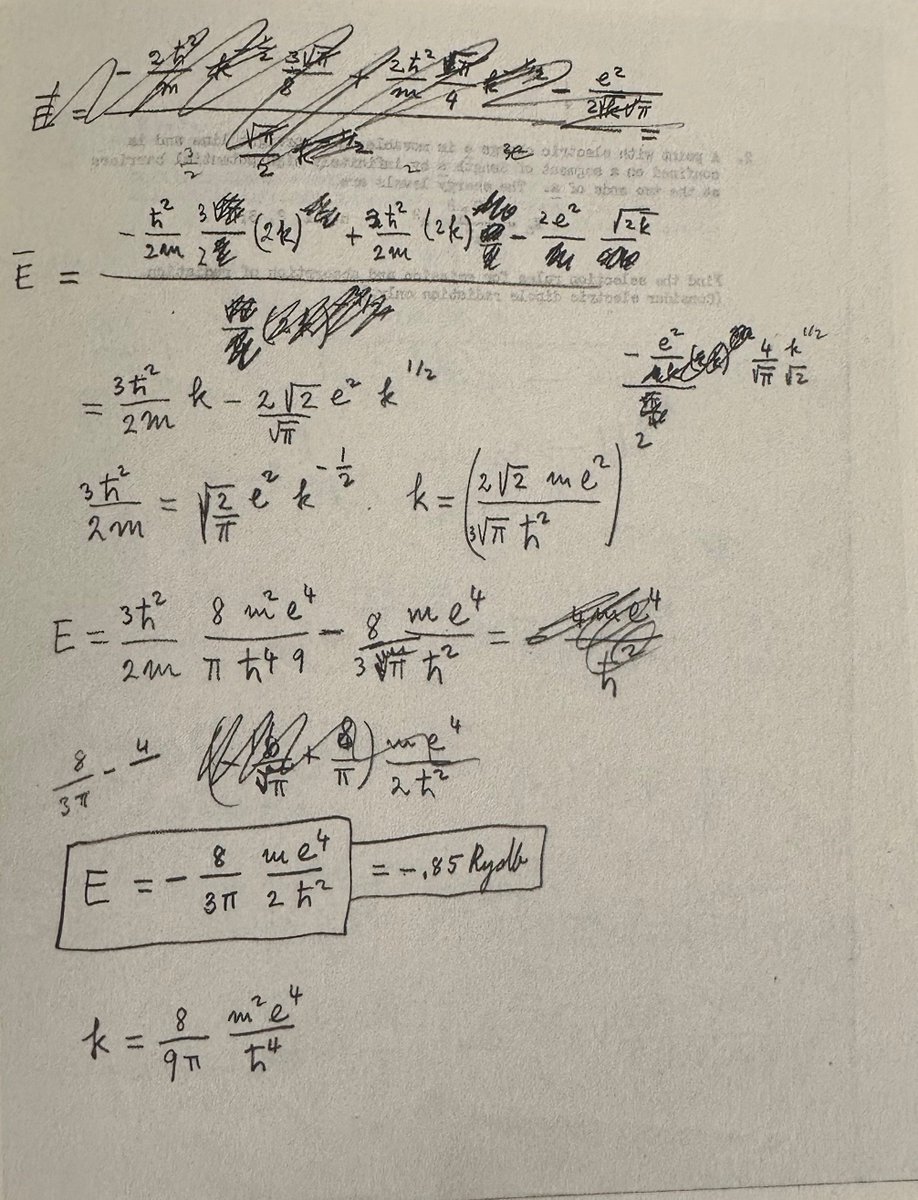
The last course Enrico Fermi taught before his death was introductory quantum mechanics, in the winter and spring quarters of 1954. Here is the last exam Fermi gave with his own solutions for each problem.
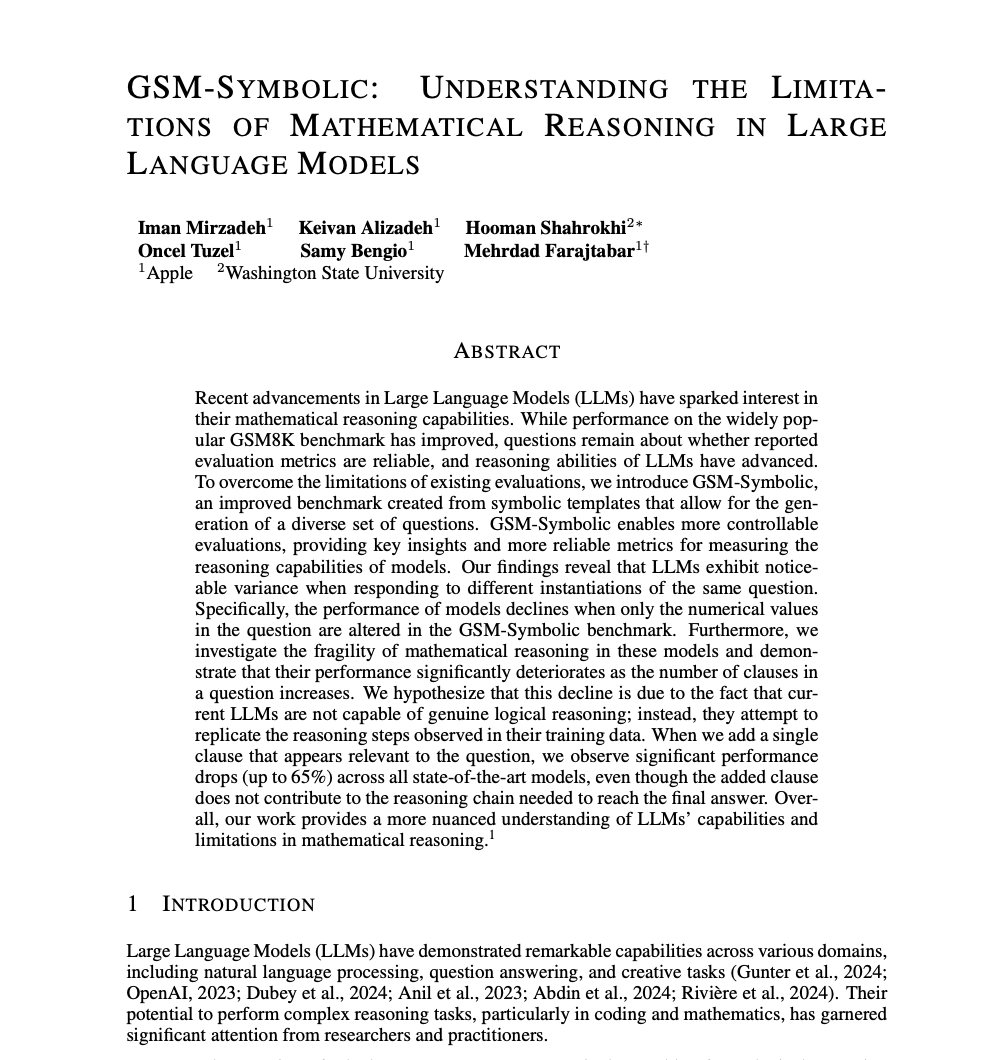
Apple argues that AI models cannot do math.. not even the grade school math.
For years, labs like OpenAI and Google have bragged about near-perfect scores on benchmarks like GSM8K. They claimed AI had mastered logical problem-solving.
Apple decided to test if that was true.
They built a new benchmark called GSM-Symbolic. Instead of static questions, it uses templates to dynamically change names, numbers, and variables.
The results exposed a devastating truth.
When Apple changed the simple numbers inside a basic word problem, model accuracy plummeted. The AI wasn't solving the math. It was relying on pattern matching from its training data.
It was guessing based on familiarity, not reasoning.
Then they ran the test that exposed the illusion entirely.
They added a single, irrelevant clause to a math problem. Just a sentence of background text that looked important, but had zero impact on the actual calculation.
Every single frontier model, from ChaTGPT to Claude, suffered massive performance drops.
Some crashed by up to 65%.
Just by adding a piece of noise that a seven-year-old child could easily ignore.
The conclusion is blunt.
Current AI models do not possess genuine logical reasoning. They do not understand math. They are sophisticated mimicry engines replicating the shape of human logic without actually thinking.
When the pattern is clean, they look like geniuses.
The moment you introduce a minor twist, a variable change, or a distraction, the illusion shatters.
@mathemetica "expanding and optimizing"
Not really. ‖a − λb‖² ≥ 0 reduces to a quadratic equation in λ. Since the equation is greater than or equal to zero, the discriminant must be equal to or less than zero. This discriminant inequality simplifies to the Cauchy-Schwarz inequality.
Einstein’s gravity says any serious spacetime engineering—warp drives, traversable wormholes, artificial gravity—requires exotic matter or energies that are planetary or worse. That’s why Alcubierre’s metric and the rest stay science fiction: the energy cost is astronomical.
But if Sarfatti’s G* is real, the game changes. You don’t need to rearrange the mass of a planet; you organize the spins of electrons in a thin metamaterial sheet, pump them into coherence with ordinary microwaves, and the enhanced spin-torsion coupling does the metric bending for you. Low-power “metric engineering.” Suddenly the energy barrier for interstellar travel, local gravity control, or even exotic propulsion drops from Type II or III requirements down toward something a modest Type I civilization—or even an advanced Type 0.8—could manage.
That would be a civilization-level jump. Not by building bigger power plants, but by learning to talk to the geometry of spacetime with coherent quantum matter. Propulsion without propellant, inertial control, perhaps even communication or sensing through torsion channels. It wouldn’t automatically make us Type II, but it could let a planetary civilization act as if it had stellar-scale capabilities for certain tasks. The Kardashev ladder gets a shortcut.
Explain exterior differential forms on 4D Minkowski space-time metric + - - - in a Local Inertial Frame (LIF).
Explain the antisymmetric exterior product.
Define: 0-form; 1-form; 2-form; 3-form; 4-form and show the relation of these forms to tensor and spinor components.
Explain the Hodge star * both mathematically and its application/meaning in theorerical physics in 2026.
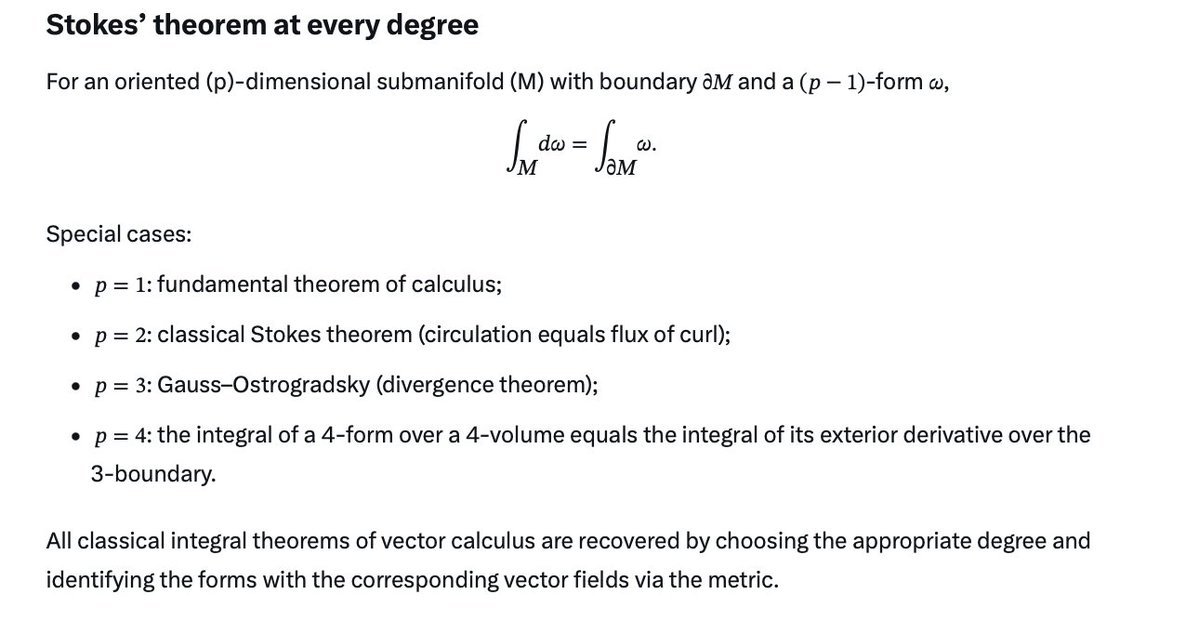
Explain all the levels of Stoke's theorem in the language of differential forms.
Explain the difference between exact and closed forms.
Show in full detail how Emmy Noether's two global and local gauge theorems of 1918 for continuous Lie symmetry groups and their conserved infinitesimal generator Lie algebras are implemented in the formalism of exterior differential forms.
Show Maxwell's U1 field equations in differential forms.
Show the weak force SU2 field equations witrh the Higgs field in differential forms.
Show the strong SU3 field equations in differntial forms.
Show Einstein's 1915 GR gravity field equation in differential forms.
Show Kibble's Poincare local gauge theory of SO(1,3)XIT4 with propagating Proca torsion Ta = De^a =/= 0 in differential forms.
Show Jack Sarfatti's SO(2,4) gravity field equations with all 15 so(2,4) Lie algebra generators in the connection A in D = d + A.
Finally, express the coupled Dirac lepton spinor with electric u1 and weak su2 charges coupled to Jack Sarfatti's complete SO(2,4) warped spacetime base space of the world fiber bundle.
Two economists mathematically proved that AI will destroy the economy.
Researchers from Wharton and Boston University published a terryfiying paper called "The AI Layoff Trap."
They mapped out the economic end-game of the AI transition, and it exposes a fatal flaw in competitive capitalism.
When a company replaces a worker with AI, it captures 100% of the wage savings.
But that displaced worker is also a consumer. When they lose their job, they stop buying things.
The company gets all the savings, but the loss of consumer demand is spread across the entire economy.
If there are 20 competitors in a market, a CEO only absorbs 1/20th of the economic damage their layoffs just created.
So every single rational CEO has a mathematical incentive to automate as fast as possible.
They can literally see the cliff approaching, and they still step on the gas.
It triggers an unavoidable Prisoner’s Dilemma. If you don't automate, your competitors will, and they will crush you on price.
It doesn't just hurt workers. It destroys the businesses, too.
The economy gets trapped in an automation arms race. Companies fire their workforce to stay competitive, until the entire consumer base is completely hollowed out.
At the limit, the paper concludes: “Firms automate their way to boundless productivity and zero demand.”
And the scariest part?
The researchers mathematically tested every popular fix.
Universal Basic Income? Fails. It raises the living standard but doesn't change the corporate incentive to cut jobs. Retraining? Fails. Worker equity? Fails.
The paper proves that more competition actually makes the collapse happen faster. And "better" AI makes the damage worse.
The only thing that mathematically stops the collapse is a targeted automation tax, forcing companies to pay for the purchasing power they destroy before they automate the job.
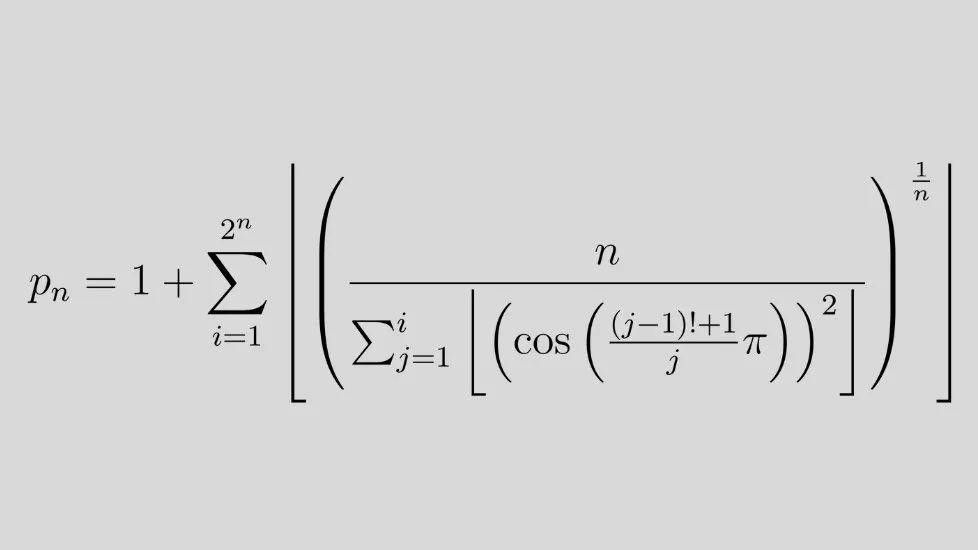
This is the Formula published by C. P. Willans in 1964 for finding the n-th prime number (pₙ).
Although the formula is mathematically correct, it is not practical for computation. The factorial (j − 1)! becomes extremely large as j increases.
Finding even the 10th prime number requires computing factorials so massive that they quickly exceed the capabilities of modern supercomputers.
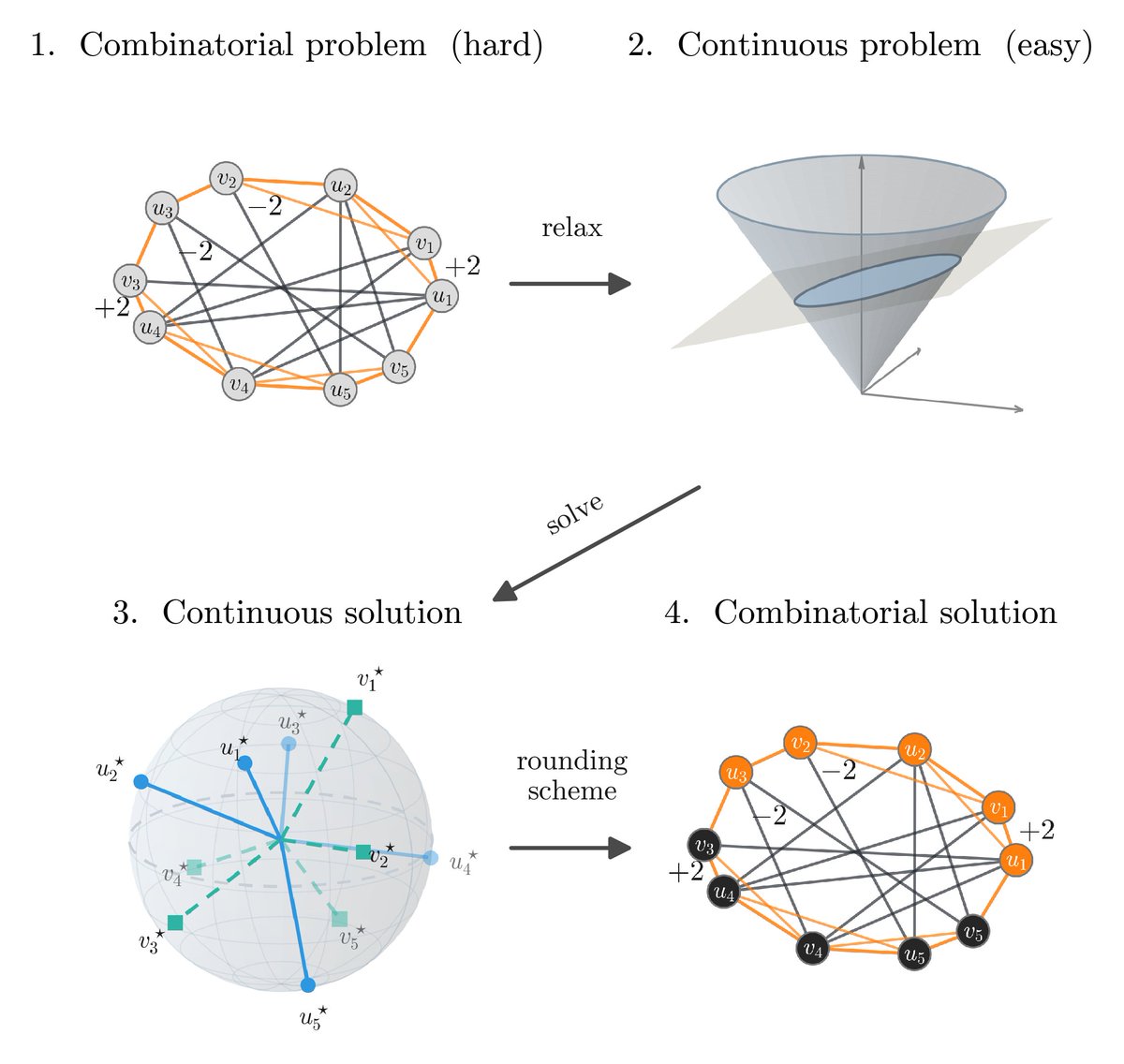
The Grothendieck constant is 1.7...!
We are excited to share this breakthrough on a 70 year-old problem discovered through a year-long human-AI collaboration.
We publish both the math and AI setup because academics should shape AI-assisted research to keep it fundamentally human.
@AlchemyAmerican@jmishlove I watched the whole interview. I'm saddened that Jeffrey didn't acknowledge @Jason_Jorjani's role in convincing him to reboot (New) Thinking Allowed on YouTube. Jason used to be the most popular guest on NTA for the first few years, and one of the main reasons I watched NTA. ☹️
e≈2.718281828459…
an irrational and transcendental number (e) appears wherever change happens continuously.
It describes growth, defines the natural logarithm, emerges from an infinite series.
@Jason_Jorjani That was really contemptible of him. ☹️ I was first introduced to you through that channel many years ago. (Has it been a decade now?) Your episodes were my favorite. Actually, you were the main reason I visited that channel back in the day.