If the CapEx/revenue mismatch wasn't this extreme, Twitter rumors wouldn't move the needle anyway.
The real catch with having official reps on X is that cynicism always wins here. Instead of shifting allocators, defensive posts usually just give the shorts a free, real-time sentiment tracker between quarterlies.
USDT on RGB: what's launching, and what's still missing
USDT on RGB goes live on November 28. Since October 22, Utexo has let exchanges, wallets and market makers test minting, confidential transfers and redemption on Bitcoin's Signet testnet.
📒 Here are my notes on it.
⏳ This is the second try
USDT was born on Bitcoin. It launched on Omni in 2014, and Tether stopped issuing it there in August 2023 because hardly anyone used it. In August 2025 Tether announced USDT on RGB, and that didn't ship on schedule either.
This time @utexocom is doing it. Tether led its $7.5M seed round in March 2026, and @unisat_wallet is the launch wallet.
Utexo CEO Viktor Ihnatiuk says two things are different now: speed and privacy. RGB uses client-side validation, so transfer details stay off-chain and only a commitment is anchored to Bitcoin. Once Lightning is connected, he says transfers take around 100 milliseconds.
He was blunt about it, too: "Bitcoin was never built for DeFi. Bitcoin was always built for payments."
🏦 Regular users aren't first in line
One detail is easy to miss. Utexo says it won't compete with Tron on retail transfer volume or with Ethereum on DeFi. The rollout starts with institutional liquidity and exchanges, and retail comes later.
So the first real users will probably be:
• OTC desks and exchanges. Utexo says it has 12 OTC partners, with 40 more in talks
• Miners, who can swap BTC for USDT on Bitcoin to hedge without sending coins to a centralized exchange
• Businesses that want to keep their counterparties private
• Traders of Bitcoin-native assets on UniHexa, where USDT becomes a common quote currency
That makes sense as a plan. It also means buying a coffee with USDT on Bitcoin isn't on anyone's roadmap for now.
⚖️ Three trade-offs
1. Your asset data lives with you. Ordinals and Runes balances can be rebuilt by indexing the chain. RGB balances can't. UniSat founder @lorenzonical listed what his team is working on: state management, backup and recovery when you switch devices, and keeping local data consistent. For a wallet team that's an engineering problem. For a normal user it's "will I lose my money if I get a new phone?"
2. There's a bridge. To bring existing USDT over, you lock USDT0 on Arbitrum and mint the same amount on Bitcoin. Redemption works in reverse. So you're trusting that bridge as well as Bitcoin and RGB. Utexo says Oxorio audited it, but the full report hasn't been published.
3. Lightning support isn't due until Q1 2027. Until then, every RGB transfer needs a Bitcoin transaction and a fee paid in BTC.
🔁 The part I care about: refunds
I built Fractal Legend on Fractal Bitcoin, and one whole stage of that work was refund and reversal safety. Once a debit is written to the ledger and a later step fails, how do you send the money back the same way, exactly once, for the exact amount? We needed those rules for game points. Real money needs them even more.
These days I'm building OrdiBot, a desktop AI agent. Lorenzo also wrote that an agent could hold BTC and pay for services in USDT, and I think he's right. But say an agent pays for a service and the service fails. Who handles the refund?
A payment on a chain is final by design. Shopping doesn't work that way, because people return things and orders go wrong. Lightning hold invoices can delay settlement, but once someone has to hold the payment and decide what happens to it, you already have a middleman. Cards have the same problem from the other side. The swipe is only an authorization, settlement comes at T+1 or later, and somebody has to cover that gap.
So after USDT comes back to Bitcoin, wallets and trading pairs are only part of it. I think we also need a layer of Bitcoin-native financial services, something like a neobank:
• BTC and USDT go straight from your wallet into an account, with no exchange in between
• Cards, QR payments and merchant acquiring, with this layer covering the settlement gap
• Refunds, dispute handling and timelocked escrow
• Safe custody of your RGB state data
• Borrowing USDT against BTC, so you can pay for things without selling
• KYC/KYT that works with RGB's selective disclosure
You'd still hold your own assets most of the time. When you spend, you trust this layer with a small amount for a short window. For most people that's a fair trade if it means the money can actually be used.
☕ Last thing
USDT coming back to Bitcoin is good news. Whether it stays just another trading pair or turns into money people use every day comes down to whether someone builds that middle layer properly.
Even the biggest ideals have to serve everyday life.
#Bitcoin #RGB
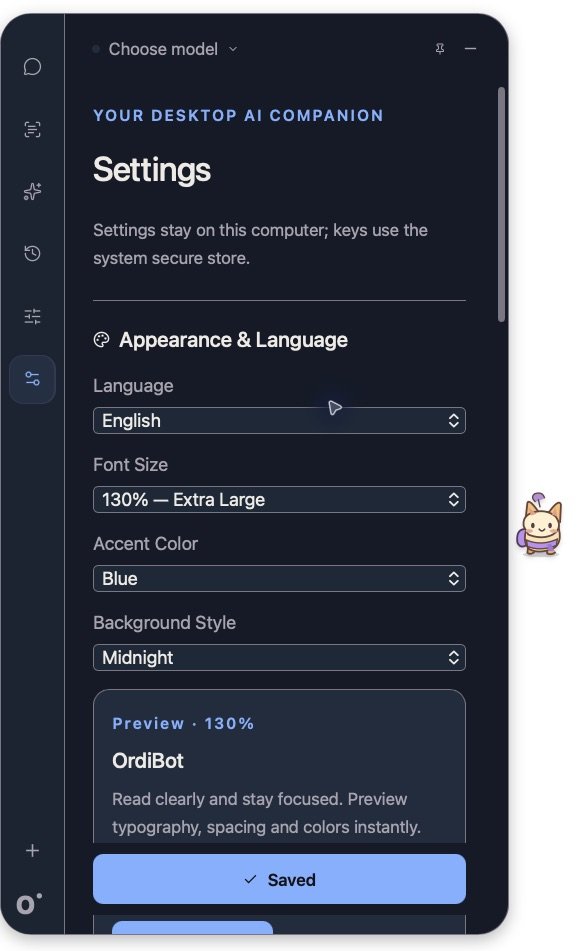
🧑💻 > OrdiBot G6.1 merged to main 🚀
EN/中文 UI (251 typed keys), 5 font scales, 15 theme combos.
136 TS/Rust tests PASS; macOS UI verified, Windows CI/NSIS green.
Windows GUI & live Agent tests still pending.
https://t.co/ImbuE8d4bT
#OrdiBot#BuildInPublic