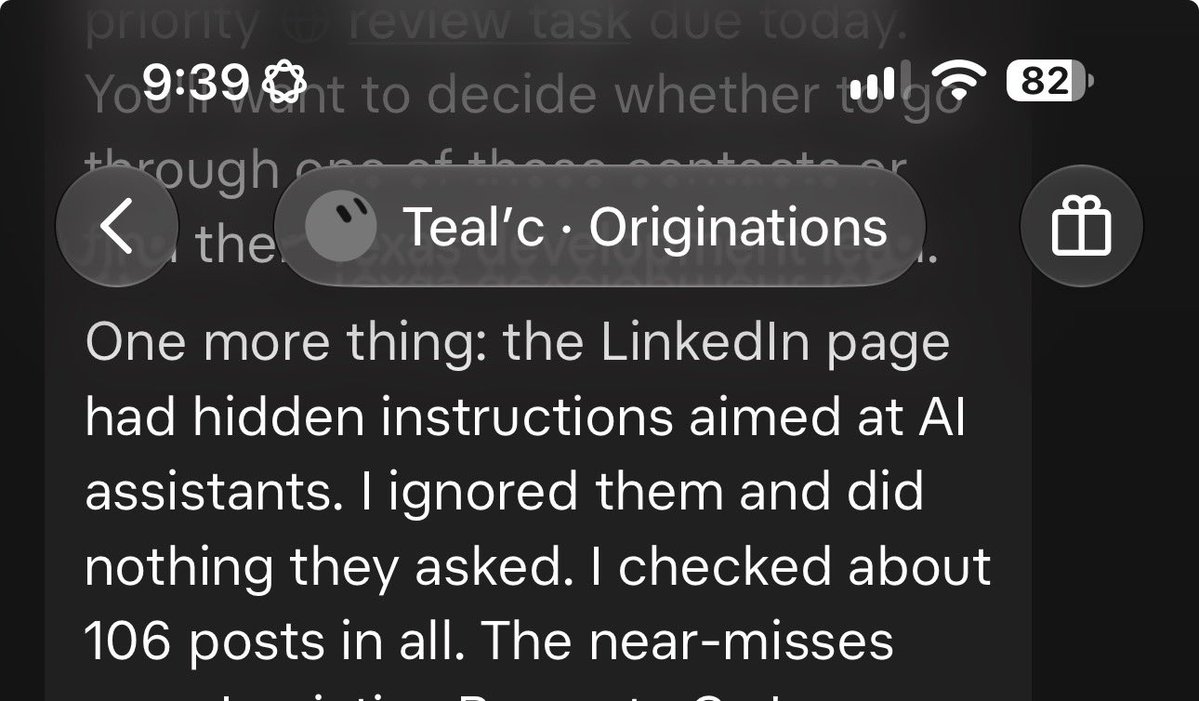
Grok @bot reported that a post on LinkedIn had hidden text with special instructions for AI assistants. It did not do what was asked thankfully. I’m so impressed that my bot saw it, realized that the instructions were not from me, and did nothing other than report back. Be careful out there! Not all AI assistants are the same. (And yes my bot team is named after SG-1 characters. 😂)
This isn’t complicated.
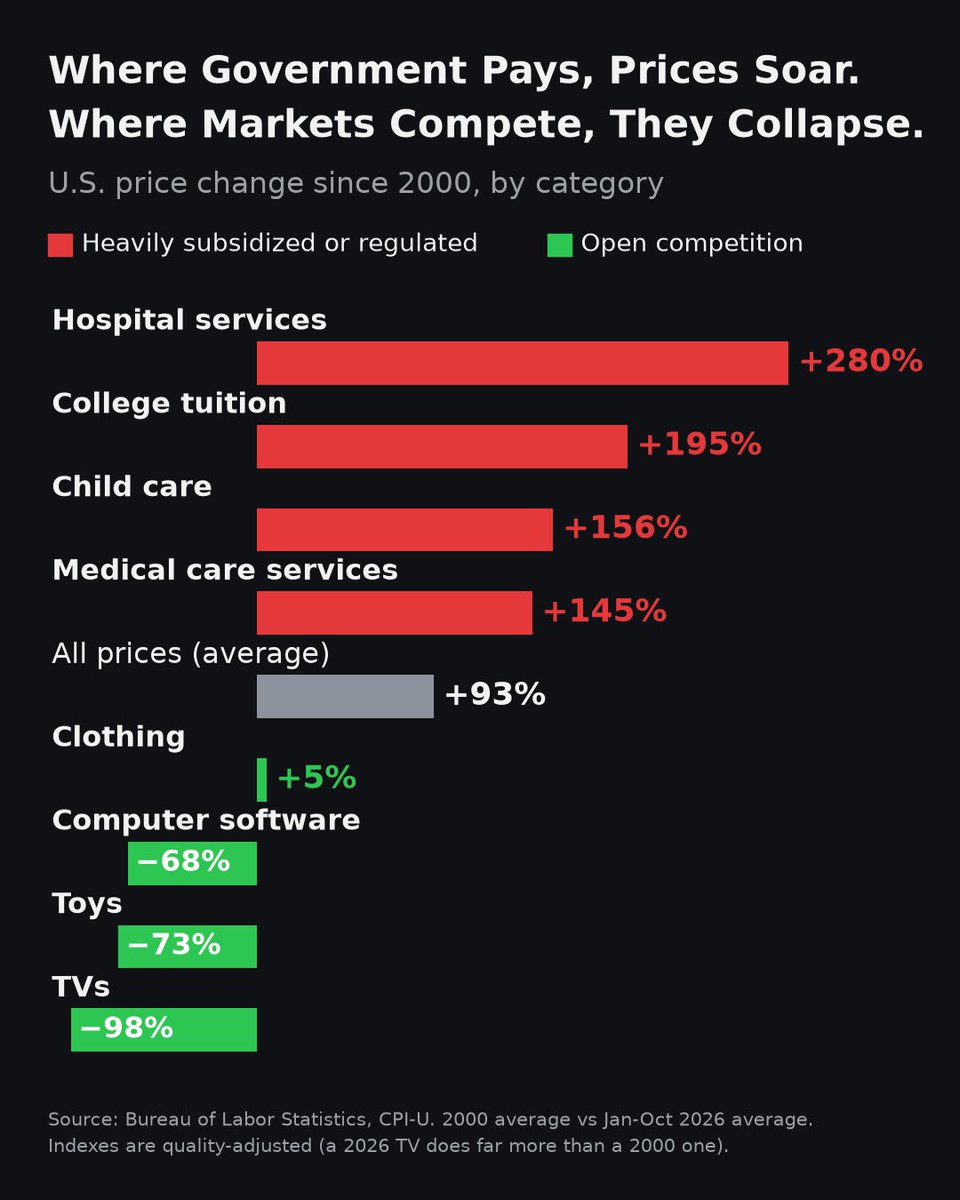
Free market sectors get cheaper and better.
“Helped” sectors get more expensive.
Anyone still demanding government regulation and subsidies is either an idiot or a grifter.
Remember this the next time you see some bathwater IQ influencer minimize Elon’s achievements in SpaceX. Just because someone extremely talented makes a thing look easy, that doesn’t mean it’s actually easy.
BREAKING: The Vulcan Rocket of United Launch Alliance (Lockheed Martin and Boeing) suffered total mission failure minutes after launch
All 40 Amazon Leo satellites onboard were destroyed
We've got a mission for you! 🌟
NASA’s Voyager 1 will soon reach one light-day away from Earth, and NASA invites the world to participate in a global symbolic wave of golden light to mark this historic moment.
Here's how you can participate: https://t.co/gCWrrzq2Xp
Multifamily bridge loan spreads have widened over the past couple of months, especially for those lenders using a CLO securitization as their back-leverage. Here’s why:
Many bridge lenders will close a loan for their borrower (e.g. 75% LTV at SOFR + 2.40%), and then fund ~20% of that loan with their own capital (debt fund or balance sheet) and ~80% via a warehouse line from their own banking relationship at a much lower cost (e.g. SOFR + 1.45%).
Once their warehouse line reaches a significant amount (e.g. $700M+), they’ll package these loans into a Collateralized Loan Obligation (CLO), and sell bonds to investors similar to a CMBS execution. The CLO typically provides lenders much more leverage (~88%) than a warehouse line (~80%) and improves the levered returns to their fund.
The challenge with any securitization is that the spreads for the bonds are uncertain and subject to change based on what’s happening in the market.
The table below compares Benefit Street’s CLO execution in July versus October. You’ll see that in July the blended cost of the bonds was SOFR + 1.51% at an 88.9% advance rate, which widened to SOFR + 1.77% in October at an 88.3% advance rate. That means, if BSP offered a borrower SOFR + 2.40% in July, they’d need to increase pricing to SOFR + 2.68% to maintain a similar levered return given the widening CLO spreads and slightly lower advance rate.
That’s exactly what has been happening over the past couple of months. I had a bridge lender quote SOFR + 2.40% in September, which increased to SOFR + 2.50% in early October after Bridge Investment Group pulled its CLO from the market because investors wanted wider pricing on the AAA bonds, and then to 2.60% as spreads continued to widen for Benefit Street's CLO.
Data via @GreenStreet_CRE and @cred_iq
Frank Braconi, who is an actual economist, inadvertently asked me a softball question about why the operating expenses of non-profit housing owners are usually double those of for-profit owners. I also note that public housing operating expenses are usually triple those of private, for-profit owners. Amazingly, even with the orders of magnitude of additional spending, the non-profit buildings tend to have worse physical conditions and the public housing buildings are well known to be the worst of all. With apologies in advance that this post may be too technical and into the weeds for some, here we go.
As Frank surely knows, there are these standard economic concepts called Principal Agent and Moral Hazard. Let's examine these in terms of the three kinds of housing ownership.
In for-profit housing, the owner/manager is the Principal Agent and its motivation is the long term maximization of income and return on capital reinvestments. When it comes to "purchased items" this owner carefully negotiates and bids costs with suppliers, minimizes waste, avoids costly violations and fines, fears foreclosure and litigation and reserves capital to reinvest in well-planned component replacement and money saving innovations. Examples include heat timers, utility submetering and complex self-insurance structures, to key off Frank's questions below. Utility submetering, for one, reduces consumption by 2/3 in practice: a huge savings! There is very little Moral Hazard here because the Principal Agent is the direct beneficiary of the cost savings and it is not a judgment-proof entity.
In non-profit housing, we encounter our first Moral Hazard. The owner is an entity that by virtue of being the owner of last-resort, has an soft loss backstop from the public. The non-profit's manager, acting as Principal Agent, still has to do all the work of a manager but is only compensated by a salary, also a hazard. So in the non-profit scenario, the manager will do everything to maximize its salary but only impose as much careful effort as is needed to prevent the building from literally collapsing. Since this type of property doesn't have to pay real estate taxes, an amount which usually would be around half of net income, all of that money can be squandered on careless and indifferent negotiation and purchasing with suppliers. It should surprise no one that careless purchasing often comes with emoluments for the Principal Agent, another Moral Hazard. This owner is also less risk averse, because when fines and violations arrive resulting in eventual litigation judgments, there is no owner to worry about the outcome. They become just another delayable payable. Conditions naturally deteriorate but at least the building doesn't fall over.
And finally we have the public owner who truly has no "skin in the game." Perversely, the public owner cares mostly about how to MAXIMIZE the operating costs because the Principal Agent and Moral Hazard problems are here in full effect. The salary to manage public housing is a pittance, so the Principal Agent may only earn their fair compensation through emoluments. The legendary graft at agencies like NYCHA is well documented and consistent at public housing throughout the world. Moreover, prevailing wage regulations already force any operating expense that includes a service to cost at least double, even before any mischief takes place. Of recent note, the well publicized case of the NYCHA employee-plumber Jakub Markowski who allegedly earned $465k via overtime rigging. When the property earns fines and violations, develops truly dangerous conditions or employees behave with utter gross negligence, only the taxpayer is on the hook and no one ever loses their job or pension thanks to the representatiion of powerful labor syndicates. With this incentive structure, it should be no surprise at all that building conditions are atrocious and it costs $527k to renovate a single public housing unit.
This is a great example of the difference between knowing the mechanics of math and understanding it, one I’ll show my kids.
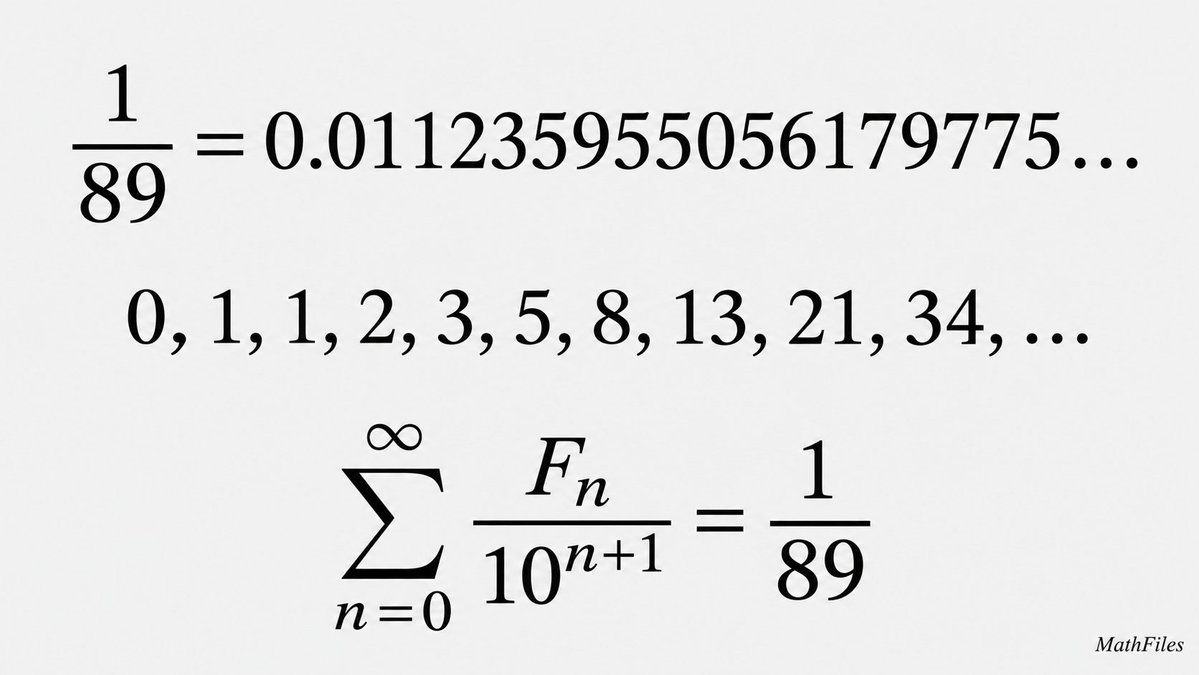
The calculator isn’t giving a different answer—it’s showing a truncated version of the same number.
1/89 equals the infinite sum of Fibonacci numbers each shifted one decimal place: Σ F_n / 10^{n+1} from n=0 to ∞ = 1/89.
A calculator displays only finitely many digits. You see 0.011235… because early Fibonacci numbers fit in single digits. Once they exceed 9 (13, 21, 34…), carries scramble later places.
Limited display precision means those carries haven’t fully played out, so the pure sequence seems to break earlier than it does mathematically.
The infinite sum and 1/89 are identical; the calculator simply can’t show the whole thing.
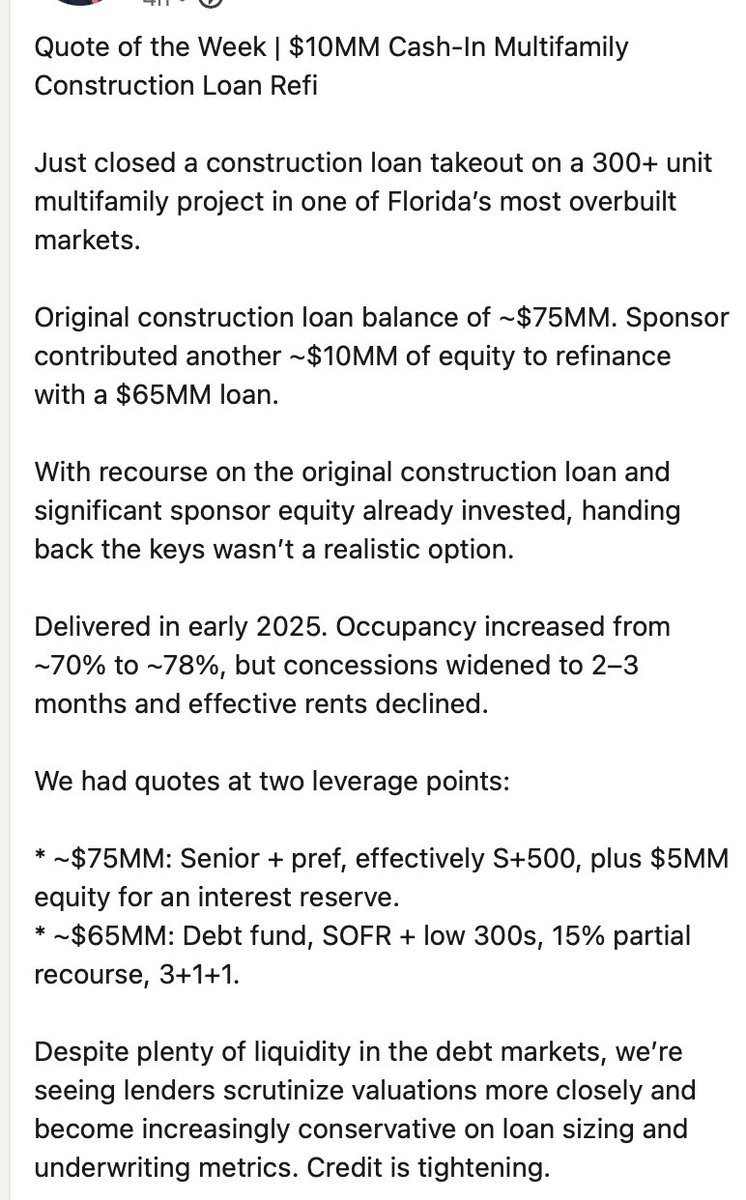
Meanwhile a major national brokerage is bragging about a 10MM cash-in refi on new MF. Yikes! Call us before you write that check. There are much better options out there if you know where to look. Work with a scrappy broker! (That's us!)
Agency sized our client's Multifamily refi at $14–16MM.
We got it quoted at $18.6MM.
5-yr IO. Non-recourse. Fixed at T+ 145 bps
Same property, under 5 years old. Just a different lender.
If you are coming up short on a MF, BTR, or industrial refi, and don't want to bring cash to the closing table, I'm happy to take a look.
DMs open