It takes nothing from the truth that the one speaking it has an interest in it.
- Pierre Bourdieu
Nov 2024- Drafting book Neoliberalism, Bourdieu, MMT & China
I am a Danish sociologist, who has a private library of 10.000 non-fiction books. When I read Warren Mosler's "The Seven Deadly Innocent Frauds of Economic Policy", I knew immediately that it was by far the most important in my collection. Link on @wbmosler +Follow @billy_blog
Net imports rising to cover the increased exports?
Doesn't look to me like the US is making for the global petroleum deficit enough to move the needle?
This is an extraordinary document written by the research arm of China's spy agency (the powerful MSS, basically the CIA and the FBI all wrapped in one) that absolutely zero media has picked up on.
As far as I can see, I'm the first person to write about it even though it was published (in Chinese) on May 13th on https://t.co/6uFjJ6ObmL, a website of China's Ministry of Foreign Affairs.
The document contains perhaps the most authoritative description of where China thinks its relationship with the U.S. stands, and where it’s headed.
The title of the report is “The Great Global Transformation and the Path to U.S.–China Coexistence” and I provide a full translation of it in my article, the link of which is at the bottom of this post.
To summarize briefly the most important - and, perhaps, surprising - aspect of the document: China's spy agency - the one institution whose entire job is to worry about the U.S. threat - has largely stopped worrying.
That's really what transpires from the document. They use a strategic framework borrowed from Mao's "protracted war" theory and, according to this framework, America's offensive phase is finished and China weathered the storm intact.
The question is no longer "how do we survive America?" but "how do we manage America?" - and they're proposing a six-step relationship recovery program.
I'll let you read the full document as well as my analysis of it here: https://t.co/vDvWFZJlrQ
Western media spent 25 years telling you China was about to collapse.
In those same 25 years China built:
The world's largest high-speed rail network.
The world's largest manufacturing base.
The world's largest solar energy capacity.
The world's largest 5G network.
The world's largest electric vehicle market.
The world's largest shipbuilding industry.
The world's largest navy by vessel count.
The world's largest middle class.
The collapse keeps not happening.
At what point do you question the people making the prediction?
@sonusvarghese The data indicates that real deficit spending remains strong enough to support aggregate demand.
The current risk is that 'inflation' turns it negative, reducing the real public debt/triggering a financial crisis.
Kaja Kallas who - I kid you not - is supposed to be the EU's top diplomat, just described China as a "disease," specifically "cancer." 🤦♂️
Just as the entire rest of the world - including Trump's US - are deciding to re-engage with China, the EU prefers to insult them.
Why would China be "cancer"? Because, in Kallas' own description, their companies are more competitive and this forces what she describes as a binary choice for the EU: "morphine" - subsidize EU companies - or "chemo", become more hostile to Chinese companies.
Or maybe, just maybe, it's not binary, and if there's any cancer eating away at Europe's future, it's precisely Kallas' mindset - the reflex to call "disease" what is simply someone else doing a better job.
Another day, another rabidly idiotic statement. There is truly no overstating how much of a walking disaster Kallas is for Europe.
Yesterday she called China a "disease" for Europe (specifically "cancer"), and now she's saying the EU can't have a Middle East strategy because - brace yourselves - there's just too much going on there.
This comes among hundreds similarly idiotic statements - basically every time she opens her mouth.
When you choose people like this to be your voice to the world, you deserve every ounce of irrelevance and mockery coming your way.
Yet another striking illustration of just how ideologically rigid the West has become compared to what we used to be.
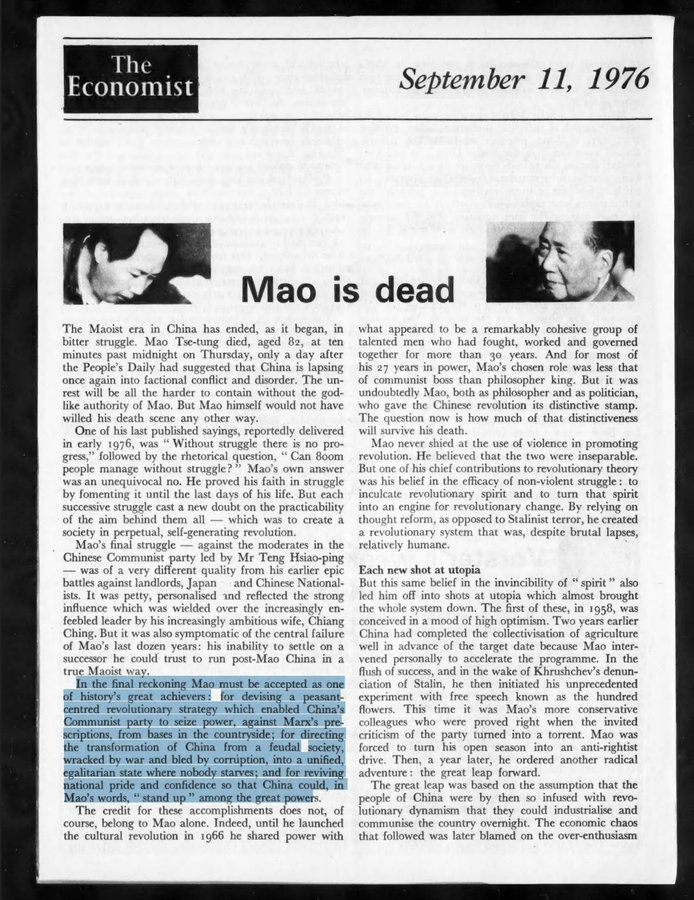
This was the obituary The Economist published for Mao in 1976 - at the height of the Cold War.
Read this part:
"In the final reckoning Mao must be accepted as one of history's great achievers: for devising a peasant-centred revolutionary strategy which enabled China's Communist party to seize power, against Marx's prescriptions, from bases in the countryside; for directing the transformation of China from a feudal society wracked by war and bled by corruption, into a unified egalitarian state where nobody starves; and for reviving national pride and confidence so that China could, in Mao's words, 'stand up' among the great power."
Show this text to any Economist "journalists" today - without telling them it's from their own paper - and they'd reply: surely it's "CCP propaganda" 😏
Yes, incredible as it may sound, there used to be a time when Western journalists could assess a geopolitical rival honestly and respectfully without being accused of being a traitor. And this honesty was in no small part a key factor why the West won the Cold War.
Today we call honest assessment "propaganda," and we harass, smear, and blacklist people for it. And we're puzzled why the West is in steep decline.
Truth matters.
China just made Silicon Valley's entire AI industry look like a scam.
The US government spent 3 years trying to stop China from building competitive AI.
But this backfired HORRIBLY.
Here's what happened:
Yesterday, a Chinese startup called DeepSeek released a new AI model called V4.
It matches the performance of OpenAI and Anthropic's best models.
At 1/7th the price.
And for the first time ever, it was built on Chinese chips. NOT American ones.
That last part is the one that terrifies the west.
For context:
Since 2022, the US has banned the export of advanced AI chips to China. The entire strategy was built on the assumption that if China can't access Nvidia's best hardware, they can't build frontier AI.
But DeepSeek just proved that assumption wrong.
Their V4 model was trained and runs on Huawei's Ascend chips. Huawei spent months working directly with DeepSeek to make sure V4 runs across their entire line of AI processors.
Jensen Huang even predicted this on a recent podcast: "The day that DeepSeek comes out on Huawei first, that is a horrible outcome for our nation."
That day was yesterday.
And the numbers are crazy:
DeepSeek V4 costs $3.48 per million output tokens. OpenAI's latest model GPT-5.5 costs $30. Anthropic's Claude charges $25. Same ballpark performance. 7x cheaper.
Uber's CTO just admitted they burned through their ENTIRE 2026 AI budget in 4 months using Anthropic's tools.
If Uber had used DeepSeek instead, that same budget would have lasted 7 YEARS.
4 months vs 7 years. Same work getting done.
But the pricing isn't even the big thing here.
The real story is what DeepSeek did with their technical report:
They published the benchmarks where they LOSE.
Every AI company cherry-picks the tests where their model wins. DeepSeek ran the full comparison against GPT-5.4 and Google's Gemini, found they trail frontier models by 3 to 6 months, and printed it anyway.
They literally don't care because the price gap makes the performance gap irrelevant for 90% of use cases.
So the US export controls didn't slow China down. They ACCELERATED China's independence.
Because Chinese developers were FORCED to train models with limited resources, they had to figure out how to make AI radically more efficient. That constraint became their competitive advantage.
Every generation of DeepSeek has gotten dramatically cheaper to train. V4 continues the trend.
Meanwhile US companies are going the OPPOSITE direction:
OpenAI's GPT-5.5 Pro costs $180 per million output tokens. That's 51x more expensive than DeepSeek V4 for comparable work.
The Commerce Secretary confirmed this week that ZERO Nvidia advanced chip shipments have actually gone through to China despite being approved in January.
So China built frontier AI anyway. Without American chips. At a fraction of the cost.
And the market response tells you everything:
Chinese chipmaker SMIC surged 10%. Huahong Semiconductor jumped 15%. DeepSeek's Chinese AI competitors Zhipu AI and MiniMax dropped 9% because V4 is destroying them too.
DeepSeek is making Silicon Valley's pricing model look like a scam.
US tech companies spent $650 billion on AI infrastructure this year. DeepSeek just showed the world you can match their output for pennies.
The export controls were supposed to be America's ace card. Instead they taught China how to win without American chips, at American prices nobody can compete with.
Jensen Huang was right. This is a horrible outcome.
But it's the outcome America built for itself.
They gave their citizens the world's most effective psychological defense mechanism:
The idea that American violence is always a response.
They never start it.
They were attacked at Pearl Harbor.
They were threatened by WMDs.
They were defending South Vietnam from Northern aggression.
They were protecting the region from Iranian influence.
They were responding to terrorism.
Always responding. Always defensive. Always reluctant warriors pushed into conflict by the aggression of others.
Never the ones who set the conditions.
Never the ones who funded the earlier coup.
Never the ones who imposed the embargo that created the desperation.
Never the first cause.
Always the response.
This story is a masterpiece of construction.
And it is completely false.
My "favorite" kind of people are those who have stollen millions and millions from the breakup of the Soviet Union and then bought peerage or endowed academic institutions in the UK and...then write articles in the Financial Times how corrupt Russia is.
You really have to have balls to do that.
Thatcher's 1983 BBC highlighted speech street lighting the myth of 'taxpayers' money' didn't come out of nowhere. #MMT#LearnMMT#EvilAlbion 'WTF Happened in 1971?' James Corbett https://t.co/KJQIrvjqgi
Check out Modern Monetary Theory - it's changing everything we think we know and ultimately will change everything for the better but read this because the rulers and their puppets don't want you to know their core scam. #MMT#JG Money, Money, Money . . . https://t.co/qJn1ZQNpBZ
The EU is trying to sabotage the Danish model that doesn't work. You do the math. BTW, the Danish Model is exactly NOT about politics. Now, please sum up the ignorance here.
@MaxJerneck The EU is trying to sabotage the Danish model that doesn't work. You do the math. BTW, the Danish Model is exactly NOT about politics. Now, please sum up the ignorance here.
I said years ago that the EU crisis in industry was by design to make automobile industry into arms industry. By design. Yes it's insane, nevertheless..
"Defence factories are running hot across Europe, with order books swelling and export licences hitting historic highs."
From Europe as a peace project to Europe as a global weapons trader.
https://t.co/jJoYJrabGM
@RnaudBertrand Yes given the population growth in China at the time Chairman Mao’s record on improving people’s lives is unequalled anywhere.
Acknowledged globally, only in the West during the Cold War era was there a particularly virulent anti-communist propaganda push that most imbibed.
I'm always surprised how little people know about Mao's actual economic record.
Most - like Melissa here 👇- repeat the standard narrative: he kept China poor, and it's only after Deng Xiaoping opened up China that the country experienced economic growth. Basically the idea is that China succeeded despite Mao (and often, as Melissa claims, despite the Party altogether) rather than because of anything that happened during his tenure.
The only problem is that it's completely false. The truth - which I know challenges much of what's been told in the West - is that Mao's economic record was actually not bad at all.
One number for you: under Mao, China's GDP PPP per capita (meaning per person) was multiplied by 2.5X from just above $400 in the early 1950s to nearly $1,000 in 1978. These figures aren't from a "communist source", they're taken straight from a report by the Congressional Research Service, the research arm of the U.S. Congress (https://t.co/Gnd4VkgtFr).
If this doesn't sound like much to you, it's actually more growth than in either India or Indonesia during the same period, which were China's most comparable peers at the time (they shared China’s large population, extreme poverty, pre-industrial economic structure, low literacy and colonial legacy).
China's substantial growth is confirmed in another report by the National Bureau of Economic Research (NBER), one of the most prestigious economic research institutions in the U.S., who found in a report entitled "The Economy of People’s Republic of China from 1953" (https://t.co/SFNTYJmqR0) that "the Chinese economy in 1952-1978 grew rather rapidly" with an average annual growth rate of real GDP of 6%.
Which, when you take into account population growth during Mao's time, translates to China’s GDP per capita nearly tripling (2.85X) during his tenure.
Which means that far from making China poor, the truth is that Mao made the average Chinese person nearly three times richer over his tenure.
Furthermore, as we'll see, the growth that accelerated after Mao under Deng Xiaoping (and later) would have been completely impossible without the transformation of China that he presided over.
It might not make me popular but the misperceptions on this topic are so commonplace that I've decided to write an entire article looking in depth into Mao's economic record, which I hope will challenge some of the lazy assumptions that dominate discussions about China’s rise.
My article doesn’t shy away from the Great Leap Forward or the Cultural Revolution - and in fact I uncovered some fascinatingly unexpected facts about both episodes.
You can read the full article here, entitled "Mao's economic record wasn't bad, actually": https://t.co/HfY8tU2mC5