Space physicist (solar wind, radiation belts, FLRs, HABs), science communicator, science educator, wife and mom, trying to avoid mediocrity at all cost she/her
CERN congratulates the winner of the 2026 @NobelPrize in #Physics 👏
Francis Halzen was awarded the #NobelPrize in Physics for his outstanding contributions to the IceCube Neutrino Observatory and to the discovery of high-energy neutrinos originating from astrophysical sources.
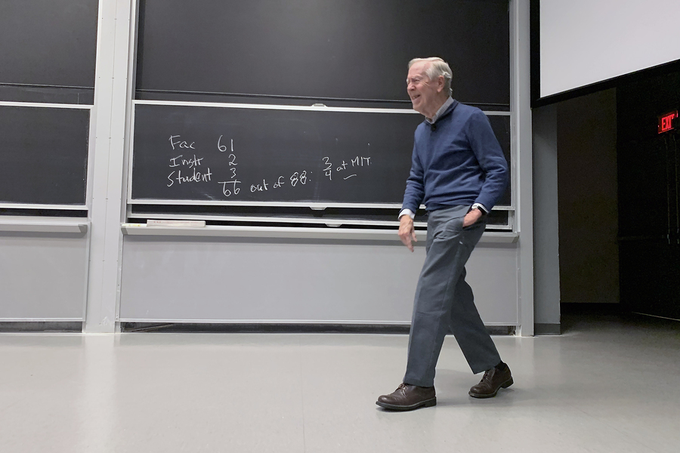
Gilbert Strang, an MIT professor, taught the same linear algebra course for 62 years. When he delivered his final lecture in May 2023, students from around the world tuned in online to watch.
The course is MIT 18.06 Linear Algebra. Millions of machine learning engineers, data scientists, quants, and self-taught programmers learned the essential math behind AI from his clear, free video lectures, even though most never stepped foot on the MIT campus.
Strang joined the MIT faculty in 1962 and retired in 2023. When MIT launched OpenCourseWare in 2001–2002, he was one of the first to embrace it fully. While many professors hesitated, Strang saw it as an opportunity to share mathematics with everyone. He filmed his lectures and made them freely available.
He completely changed how linear algebra is taught. Instead of starting with abstract vector spaces and proofs, Strang began with something simple and visual: matrix multiplication. He built intuition first using concrete examples, then introduced more advanced ideas like eigenvectors and singular value decomposition. He insisted that students should be able to explain every concept with a small, tangible matrix before moving to theory.
Beyond the content, his teaching style stood out. He spoke to students with genuine respect, patience, and kindness, never using words like “obviously” or “trivially.” He regularly paused to check if anyone was lost and treated beginners as thoughtfully as he would his colleagues.
As a result, Strang became the default linear algebra teacher for much of the planet. Universities in many countries began recommending his lectures to their own students. Some even replaced their in-person courses with his videos because they could not match their clarity.
His final lecture ended with a long standing ovation. Strang seemed surprised by the applause, smiled humbly, and simply thanked everyone.
In his short comment under the YouTube video, he expressed gratitude for a wonderful life of teaching and hoped others would continue teaching the subject well. No self-promotion, no grand farewell—just quiet sincerity.
When you add up every version, every upload, help sessions, and all the different recordings MIT has shared over the years, the total has surpassed 20 million views.
Today, the full course, including all lectures, problem sets, and solutions, remains freely available on MIT OpenCourseWare. One of the most important mathematical foundations of modern AI is still just one click away.
Voyager hit a 90,000°F wall at the solar system’s edge.
NASA’s Voyager 1 spacecraft crossed one of the most dramatic frontiers in the cosmos: the heliopause, the tenuous boundary where the Sun’s influence finally gives way to interstellar space. What the probe discovered there was astonishing, a turbulent zone of superheated plasma with temperatures soaring between 30,000 and 90,000 °F (roughly 17,000–50,000 °C).
This wasn’t a physical wall or barrier, but a dynamic transition region where the outward-flowing solar wind abruptly slows, compresses, and piles up against the incoming pressure of interstellar material. That compression converts kinetic energy into thermal energy, driving the plasma to extreme heat levels far beyond anything found inside the heliosphere.
Remarkably, despite the blistering temperatures, this “wall of fire” would pose no danger to a hypothetical astronaut. The plasma is extraordinarily diffuse, far less dense than the best vacuums achievable in Earth laboratories, so there are simply too few particles to transfer meaningful heat. The region is hot in temperature but cold in practical effect.
Voyager’s instruments captured clear signatures of the crossing: a sudden plunge in solar wind particles, a sharp rise in galactic cosmic rays, and faint plasma oscillations that revealed the density and temperature of this exotic boundary layer for the first time. These vibrations, analogous to ripples on an unseen sea, provided direct measurements of conditions in a realm previously known only through theory.
The heliopause itself serves as a vital shield. The entire heliosphere, the vast bubble carved by the Sun, deflects most of the galaxy’s high-energy cosmic radiation, helping protect life on Earth from constant bombardment. Beyond this protective envelope lies the harsher, unfiltered radiation environment of the interstellar medium.
Today, more than 15 billion miles (24 billion kilometers) from home, Voyager 1 remains the farthest human-made object ever sent into space. Still operational and transmitting precious data, it continues to reveal the secrets of this distant frontier.
At the outer limit of our solar system, space is neither empty nor serene. It is a violent, glowing threshold: and humanity has only begun to map its mysteries.
Liftoff! @NASARoman begins its flight to space. The Roman telescope’s wide field of view will generate never-before-seen images, revolutionizing our understanding of the universe.
Tomorrow, NASA will launch its new Nancy Grace Roman Space Telescope.
But who is it named for? Nancy Grace Roman was NASA's first Chief of Astronomy and was known as the "Mother of the Hubble Space Telescope." Learn more on the blog: https://t.co/hvF8QQ3WT5
I am honoured to receive the Congressional Space Medal of Honor alongside my Artemis II crewmates. I share this recognition with everyone who made this mission possible.
For Canada, the mission and the Artemis program as a whole are about much more than just going back to the Moon. It is about the pursuit of excellence and collaboration.
Unlike the jovian moons, Callisto and Ganymede, our moon never generates aurora, so this is the best show the Artemis II crew will see over the next week. But imagine if our moon had its own magnetic field and atmosphere, like those at Jupiter. We could watch lunar aurora shows similar to these views the Artemis crew has of Earth aurora now!
Listening live to your description of your observations of the Moon with your naked eyes... @Astro_Jeremy. Absolutely historic! I have been waiting my whole life for this moment! Watching the live streaming the whole mission. This is amazing! I can't imagine what you feel!
Kelsey on console!
Kelsey Young is a Goddard lunar scientist, currently sitting in Mission Control to support the Artemis II astronauts during their flyby of the Moon. She's answering their questions and helping them prep for observations and photographs of the lunar surface.
A new milestone for humankind: The crew of Artemis II are now the farthest any human has ever travelled, reaching a maximum distance of 252,752 miles from Earth.
This surpasses the previous record set by Apollo 13 in 1970 by about 4,102 miles.
@elonmusk I can conceptually understand your point, @elonmusk. But.. what do you propose as a solution or possible alternative solutions? Not trolling, truly curious. In the Netflix show about Gates' brain, he talks about working in social work in Africa to maximize the human potential
@AAPTHQ This is a reminder to all of us to 'walk in beauty', to connect with the Creator, the creation, and each other, in peace, respect and collaboration. There is so much wisdom from the Indigenous Ways of Knowing to learn