So glad to see this report by HD Moore. I am starting to feel like cassandra here. In this report HD, gave cloud LLMs some fake AWS keys, and THE NEXT DAY they started seeing someone trying to use them against AWS. The data you send cloud LLMs is not secure or private. Stop thinking it is!
Everyone needs to understand this loud and clear. When using cloud LLMs, they can and will expose the data you feed it to someone else who shouldn't have it.
There are way too many people and businesses connecting their private CRM, ERP, emails, codebases, etc to cloud LLMs without understanding that all the contents of those things are sucked up and sent to the cloud. And this report shows they absolutely leak and share and expose YOUR DATA to who knows where. You should not be connecting your internal private tools to cloud LLMs! Run local LLMs for private data.
Kust ma tean, et AI ei võta veel inimeste tööd ära? Sest AI vist ei teeks sellist näpukat, mille peale üks pahaaimamatu lugeja hakkab guugeldama, et kas Denis Villeneuveil on mingi vähemtuntud sugulane, kes on ka režissöör, aga ei tee ulmet ja on nüüd saamas unistuste tööotsa...
FFMPEG had one of the most valid crash outs in infosec history IMO. There's a huge elephant in the room when it comes to the fact that cybersecurity is extremely unbalanced. You have like 1,000 people pointing at problems for every 1 person fixing them.
Vulnerability research is extremely important, but it's become somewhat of a marketing stunt. First with fuzzers, and now with LLMs. It's a lot of "look what my new toy can do" rather than earnest attempts at actually fixing security problem.
What Google did to open source developers was especially egregious. They're a $3.6 trillion dollar company, who spent billions upon billions of dollars building a bot that points at problems really really fast, then they just dumped them all on a bunch of unpaid open source project maintainers to fix.
Then because of Google's 90 day disclosure policy, the maintainers have 90 days to fix the issues. After 90 days, Google goes public with the issues, making their project look bad if the vulnerability is yet to be fixed, and also potentially harming users if it gets exploited.
The 90 day policy was intended to give developers a reasonable amount of time to fix issues, while also applying some pressure with the threat of disclosure. Otherwise, you do get a bunch of goober ass vendors that will just ignore all security issues reported to them, then act completely surprised when their software gets hacked.
But when you're a small team, non-profit, or a solo developer, and you have a trillion dollar company's AI just blasting you with infinite problems to fix (each coming with a 90 countdown & a threat), that becomes extremely untenable. They're essentially inadvertently blackmailing developers into becoming unpaid interns.
Then on top of that, Google profits unimaginable amounts of money from the use of open source code. They use FFMPEG's code extensively across several highly-profitable products, meanwhile FFMPEG's developers work for free. There's no reason Google couldn't have donated money, engineers, AI tokens, or something towards fixing the problems. They can more than afford it.
I don't think Google has any malicious intent at all, it's just that the whole incentive structure behind vulnerability research is completely whack. All the glory goes to people who find issues, not those who fix them, so there's not a whole lot of interest in helping with fixes. Some vulnerability researchers will submit fixes with their reports, but most don't.
Honestly, in 2026 cybersecurity basically just feels like the equivalent of 50,000 people following the housecleaner around yelling "you missed a spot". Abysmally little effort has gone into anything outside of pointing out vulnerabilities.
D’s before the election: What if we lose Minnesota because pollsters are missing the hidden used car salesman vote
D’s after the election: Why didn’t we spend money to win Wyoming
SCOOP: Major U.S. banks are detecting unauthorized third-party AI agents inside customer accounts, including some attempting to take actions that appear to be independent of user instructions, sources told Axios.
The findings have alarmed banking executives, who are racing to restrict access to their systems as AI moves at a velocity faster than financial institutions can respond, multiple industry and bank executives told Axios.
Several banks are now preparing for worst-case and even “day after” scenarios, including how to rapidly secure or restore customer accounts if things go wrong, the people said.
Several bank executives told Axios they're struggling to distinguish between human users and AI agents. One executive said banks also struggle to determine whether agents are authorized by customers or potentially operating without their permission, more akin to rogue agent behavior.
Read my latest for Axios here: https://t.co/Q3bda5In8q
Security called me at 6:12 AM today.
"Patch every PHP server immediately."
I asked what happened.
"Two critical vulnerabilities. Remote code execution. No authentication required."
Cool.
How many PHP servers do we have?
According to inventory: 12
According to reality:
Nobody knows.
We found one running WordPress.
Three running old internal tools.
One under someone's desk.
Two inside vendor appliances.
A forgotten employee directory from 2016.
And a server named:
PHP-OLD-DO-NOT-TOUCH
Naturally, that one runs payroll exports.
Then we found a PHP 5.6 box.
I asked who owned it.
The documentation said:
BRIAN.
Brian left in 2019.
We called Brian.
He said:
"Oh wow, that's still running?"
Excellent.
By 8 AM, leadership joined the incident call.
CEO:
"Can hackers actually get in?"
Security:
"Potentially yes."
CEO:
"Without a password?"
Security:
"Yes."
CEO:
"Then why do WE need passwords?"
Not the lesson.
Finance asked if we could wait until the weekend to patch because downtime affects revenue.
Security explained that the alternative was letting strangers execute code on our servers.
Finance asked for a cost comparison.
At 9:17, someone suggested temporarily taking the vulnerable websites offline.
Marketing refused.
"Our campaign is live."
So for the next hour, the company officially decided maintaining a landing page for 20% off webinar registration was more important than preventing remote server takeover.
We finally patched everything we could find.
Then our scanner discovered another PHP server.
Hostname:
TEMP-PHP-2014
Uptime:
4,512 days.
Nobody knows what it does.
Nobody owns it.
Nobody can shut it down.
But every time we block network access, the warehouse stops printing shipping labels.
Security has classified it as critical infrastructure.
It is running PHP 5.4.
The vulnerability has existed longer than half our employees.
The emergency patch took four hours.
Finding out what PHP actually runs took eleven.
The internet isn't held together with code.
It's held together with servers everyone is afraid to turn off.
So basically, today PHP got two critical bugs that let anyone run code on your server without even logging in, which is bad, and then the details leaked before the patch was even out, which is worse, and it works on WordPress and MediaWiki and Magento and Joomla and Laravel, and Censys says like 1.5 million servers are running a version with no fix, so the NSA was like "take your system offline," and the FBI was like "take your system offline," and CISA and the UK and CERT-EU were all like "take your system offline," and then the Prime Minister of Japan, the actual Prime Minister, posted at 5:55 in the morning telling 48.8 million people to take their system offline, so everyone took their system offline, like the Dutch cybersecurity agency took its own website offline, and the Dutch parliament went offline, and the Port of Rotterdam went offline, and Finland and France and Denmark started pulling government sites, and Wikipedia went down, and https://t.co/QlOXb3COq3 went down, and Asana and GOG and Something Awful went down, and the University of Vienna's webmail went down for some reason, and that's just PHP. Because GitLab also dropped a CVSS 10.0, which is the highest score they give out, for a bug that's been there since 2014, so that's every self-hosted GitLab for twelve years, and then LiteLLM 1.107.0 got hijacked and shipped a credential stealer and a remote access trojan in every single wheel and the Docker images, including latest, and you didn't even have to import it, just installing it was enough, and it's the second time this year, and then Railway paused every deployment on the entire platform because someone got into the environment variables, so now everyone has to rotate every secret they've ever stored there, and TiDB Cloud said someone was walking around inside with stolen credentials for basically a month and an extortion group says they took 10.6 terabytes, and Zeabur got breached for the second time in two months and is just shutting down, like the whole company, and Node.js patched remote code execution and a TLS bypass, and CISA says Plex is being actively exploited, and someone took over 300 Tor exit relays to steal SSH passwords, and SafePay ransomware has hit over 600 critical infrastructure orgs, and India's biggest bank filed a data loss incident, and Japan has been in an official state of emergency in cyberspace since October 9, which honestly explains the 5:55 AM post. Oh, and eMudhra, a certificate authority that's issued over 60 million certificates, whose entire job is proving websites are who they say they are, was supposed to be using private keys that are random numbers over a hundred digits long, and one of them was 4. Just 4. And the others were like 66 and 237. Anyway, it's Wednesday.
Meet Mistral Large 4, aka Le Chonk.
• 1T parameters, natively multimodal. 49B active.
It is the best open weights model from US or Europe on aggregated benchmarks.
• State-of-the-art on critical workloads, including cyber defense, manufacturing and finance and it surpasses closed frontier models on visual grounding.
• Forged in Europe end-to-end and is deployable from Europe via our own Mistral Cloud infrastructure.
• Available to all via API today. Working with cybersecurity partners privately.
Open weights release end of October.
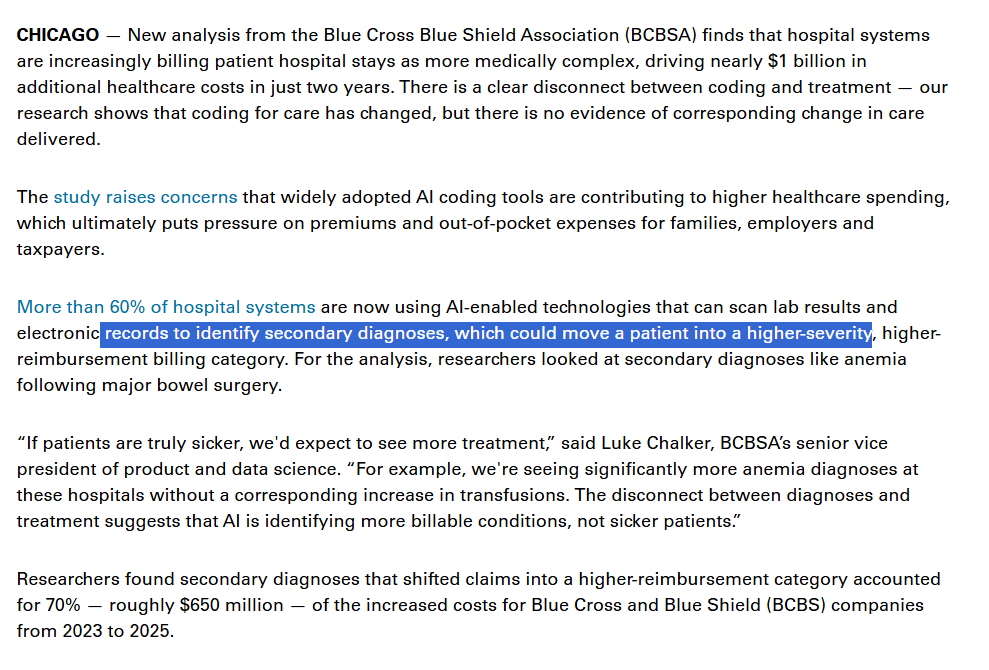
The Blue Cross/Blue Shield Association says that AI is already driving *up* healthcare costs, as hospitals use the technology to find instances where they can bill more for the same level of care. https://t.co/af1SzA7D8v
President Trump announced that he is changing the name of Artificial Intelligence to Super Intelligence. I transcribed this live from his address to the UN.
'The United States also rejects any scheme for globalist control of Artificial Intelligence, being spoken of so much now. Here and after officially called Super Intelligence. Changing the name. The use of 'Artificial' makes it sound fake. It makes intelligence sound fake, and it is not fake. It’s actually amazing, the opposite of what they report. From this day forward, all United States documents, and hopefully the world's, will be changed to use the much more accurate term 'Super' as opposed to 'Artificial.' So it’s Super Intelligence.'
see läheb superjaburaks, kus tõenäoliselt mingid usinad ametnikud peavad end korrigeerima, kui nad viitavad AI-le. "I mean... we need to discuss the Chinese ... SI models..."
Jajah, me sõpradega juba mingi 2018, kui Pärnu rongiliin suleti, tõdesime, et meie, toona 35aastaste silmad seda Rail Balticut sõitmas vast ei näe. https://t.co/gcDxsZ6Yta
New cat alert! A call from a wildlife sanctuary about a "weird cat" has led to the first new cat species discovered in over 100 years in Bolivia’s Yungas forest ecoregion. Learn more about this feline surprise: https://t.co/crffXvPqH4
Holy shit. Anthropic caught Iran using Claude to target Navy bases, automate dossiers on Americans, and run influence campaigns on US social media. Details are insane. The morons uploaded everything including the organization plans of the Ayatollah's funderal lmao
Late-night talk-show host Jimmy Kimmel said he would not broadcast an interview he conducted with Texas Democratic Senate candidate James Talarico because of pressure from the Trump administration. https://t.co/X5pvo5fpb3
'Executive Summary
To assess the impact of AI-enabled malware, we collected and analyzed over 400 malware samples that integrate AI in some capacity, from brand impersonation and large language model (LLM)-generated code to agentic execution loops. Our central finding was that the AI malware space is currently overwhelmingly composed of proof-of-concept code, security validation testing and researcher submissions that have never reached a production environment.
Of the 405 samples in our dataset, only 12 appeared in our telemetry on Cortex XDR-protected endpoints, and a small subset was forwarded through Next-Generation Firewalls to WildFire for analysis. Palo Alto Networks products detected and blocked every sample that attempted to reach a customer environment.
These numbers tell a story that sits between two poles in the current discourse. AI-enabled malware is real. However, the volume of genuine operational activity remains a fraction of what public sample repositories suggest. Approximately 97% of the samples we examined exist only in sandboxes and on VirusTotal.
For defenders, the practical takeaway is straightforward. Existing behavioral detection, cloud-based sandboxing and endpoint analytics catch these threats using the same mechanisms that stop conventional malware. The AI component does not evade detection. It changes how the code is authored, not how it executes.'
https://t.co/Vy2Q2FShtw
This is what we have been saying for ages with regards to more than just malware.....