A few years back I started a journey to learn more about biopharma and drug discovery. Here is a list of the books I have found helpful (loosely grouped by topic) with the outstanding books highlighted by (+++). Feel free to add your own recommendations, I'll keep adding mine.
@lcbnuoH Agree with this take, the CRL is deserved because SMMT screwed up the timing of the analysis; but nevertheless for patients this is clearly the wrong outcome and FDA should recognise this.
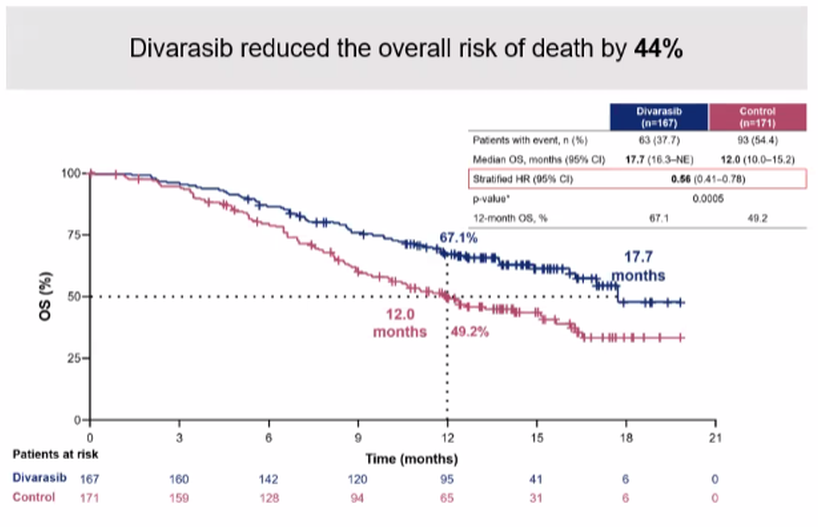
@AppleHelix@JacobPlieth The geniuses at Summit decided to analyse the trial prematurely (ex-China cohort had a very short follow up) and hence the OS was borderline not stat sig. At a later data cut (when ex-China cohort had similar follow up as Chinese cohort) it would have been significant.
@emmma_camp_@WSJFreeEx Had a conversation with someone the other day who said, "What did healthcare cost 100 years ago? Three of your five kids died. That's what it cost."
$ANT $XBI @gline@DaveARicks@DarioAmodei@LifeSciVC@EricTopol@ldtimmerman@adamfeuerstein If you're raising money on the promise that all diseases will be “relics of the past” in ten years, you owe patients and investors an explanation of how you're going to prove it in humans.
For context, I'm the founder/CIO of an institutional biotech investment fund that natively integrated AI into its investment process. I've been using information management technology since 2018 to do so. I also went to medical school and used to work on care teams to treat patients in my past life. I had to be in the room, sometimes the one to break the news, when we had to tell kids they wouldn't live to their next birthday, with nothing left in our toolbox to help them or their devastated family. I know what it's like to feel helpless and wishing we could bring therapies to market faster -- that's one of the main reasons I went into the investing side of the business, to effect change at scale. I've reflected on this a lot, so let me try to explain what that promise asks you to believe. I'm not the only person here who has been pushing back on these promises, and I tagged some others who I have found offer great perspectives on this issue too.
I'm becoming increasingly upset at the degree to which I'm seeing these AI companies market hopes and dreams to the world, now turning to some of the most desperate and vulnerable in our society to do so. There could be many reasons to own $ANT, but please read this if your only/main reason for buying is on the basis of thinking they can cure all disease in 10 years.
This is also entering a level that I consider cruel. Patients who have debilitating or otherwise fatal diseases may be convinced to pour money into these efforts on the basis that they think doing so will lead them to an outcome that is being marketed as an almost certainty that will be substantially different than traditional drug development, thereby potentially reallocating effort and resources away from therapies that today have high promise. This is feeding on the hope of patients who have limited options currently available to them.
Let's assume, literally by 4 pm today, we develop a molecule that cures every disease known to man ever and all of this activity is fully funded already. Obviously this is farcical beyond imagination, but bear with me.
To sell a new drug in the US, you need FDA approval. That requires evidence that it works and that its benefits outweigh its risks.
Before testing it in people, you need to manufacture the drug and generate enough safety data to begin human trials. Let's assume that takes a year. That's an assumption for this example, not a measured average or a minimum.
Then you have to test it in humans. Let's assume, again, that our molecule really does cure every disease and has no meaningful side effects. Even then, you still have to generate the evidence.
Here are the historical averages for successfully advancing through the three clinical stages:
Phase 1: Establish safety and dosing. Average: 2.3 years.
Phase 2: Test whether it works in patients and refine the dose. Average: 3.6 years.
Phase 3: Confirm the benefit and better establish the risks in larger studies. Average: 3.3 years.
These are development-stage averages, including time between studies and stages, from the BIO/Informa/QLS analysis covering 2011 through 2020. https://t.co/mY7hIgr8HV
For some diseases, the outcomes themselves take years to observe. This is frustrating for everyone: patients, doctors, and investors. I know from each of these perspectives: my own grandfather passed away from complications related to Alzheimer's. In people with Alzheimer’s-related brain changes who have not yet developed symptoms, AHEAD A4 measures cognitive change over approximately 4.2 years. A4 studied cognition over approximately 4.6 years. These aren't minimums, but they show what researchers are trying to establish: whether patients retain their cognitive abilities over time. https://t.co/pmMsvTEfUw; https://t.co/9Iz9TaMKP9
FDA can sometimes approve a drug earlier based on a laboratory or imaging measurement reasonably likely to predict benefit. Let's assume that happens wherever possible. But a suitable measurement does not exist for every situation. Accelerated approval still requires studies to confirm that patients actually benefit, although that confirmation can come after the drug reaches patients. https://t.co/rjJoyDm3L2
Now assume AI lets you prepare and submit the application immediately, FDA has enough resources to give every qualifying application priority review, and everything gets approved on schedule.
For a new molecular entity, the ordinary priority review target is approximately eight months after submission: a 60-day filing period plus six months of review. FDA can approve earlier; this is a target, not a minimum (https://t.co/T8YAJGouYE)
So add it up:
1 year upfront + 2.3 years in Phase 1 + 3.6 years in Phase 2 + 3.3 years in Phase 3 + 8 months for FDA review = approximately 10 years and 10 months.
Again, not the fastest possible timeline, but faster approvals for SOME drugs do not establish that every disease will become a "relic of the past". We started by assuming we already had the molecule TODAY, it cured EVERY disease, had no meaningful side effects, and everything was fully funded. I think I'm being quite generous here on the assumptions side.
The actual claim requires discovering those treatments, generating the evidence across all those diseases, getting them approved, manufacturing them, and getting them to patients within the same ten years. Where is the evidence that they can deliver all of that within ten years? If you want to play in the biotech world, you better get used to the idea of providing evidence to back up all your claims. That's the gold standard that protects the US population from harm that would otherwise come at the expense of profits.
I'm not arguing AI can't accelerate drug development as we use it in our investment process to great effect. I'm arguing that claiming all diseases will be “relics of the past” in ten years is not supported by these data. Getting a treatment approved is also not the same thing as demonstrating a lasting cure.
Selling medical certainty you cannot substantiate exploits the hope of patients who may not live long enough to hold you accountable.
PD(L)1-VEGF bispecifics are already beating PD1 inhibition alone in trials, so what's next?
This trial (BioNTech, DualityBio, BMS) adds a new B7-H3 ADC to a PDL1-VEGF bispecific, with potential synergy:
1) VEGF blockade: normalizes tumor vasculature, improves ADC delivery and T cell infiltration.
2) B7-H3 ADC: kills cancer cells, triggers immunogenic inflammation.
3) PDL1 blockade: releases immune suppression, allows T cells to exploit immune response induced by ADC.
Confirmed ORR up to 71% -- in immune-cold platinum-resistant ovarian cancer.
The broader, ongoing phase 2 includes colorectal cancer, pancreatic cancer and other tumor types.
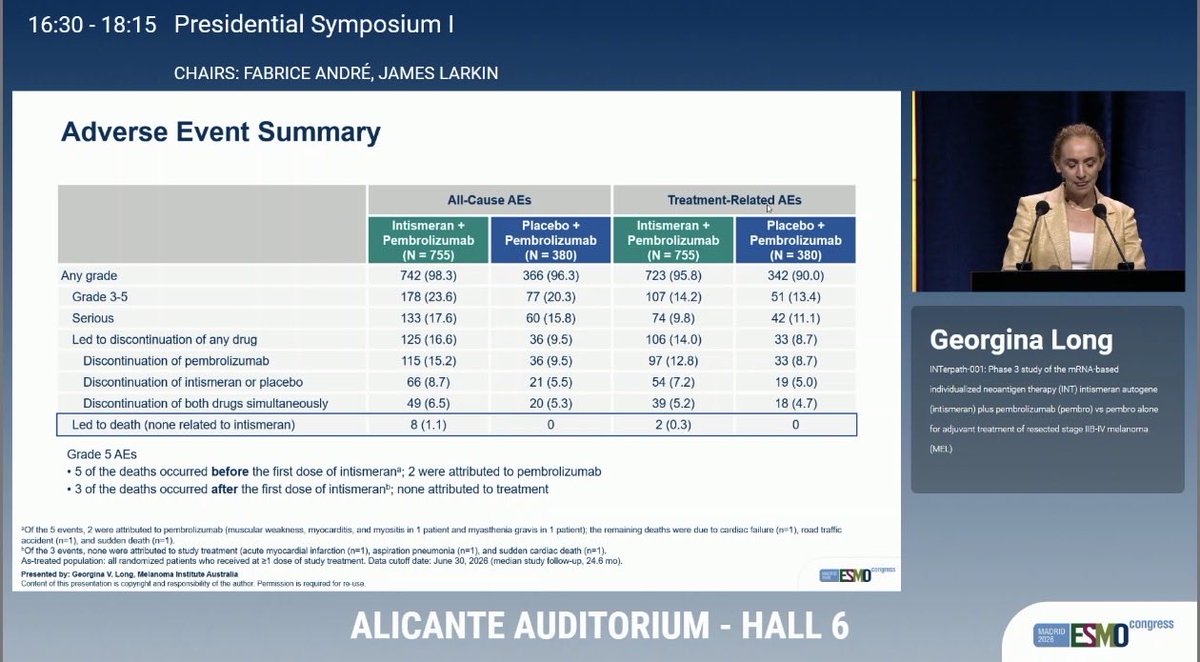
@DmitryKovalchuk No, I was in the room yesterday and the slides just build up, here are the two slides side by side. Nevertheless a strange signal and disappointing that they did not use an inert LNP in the control.
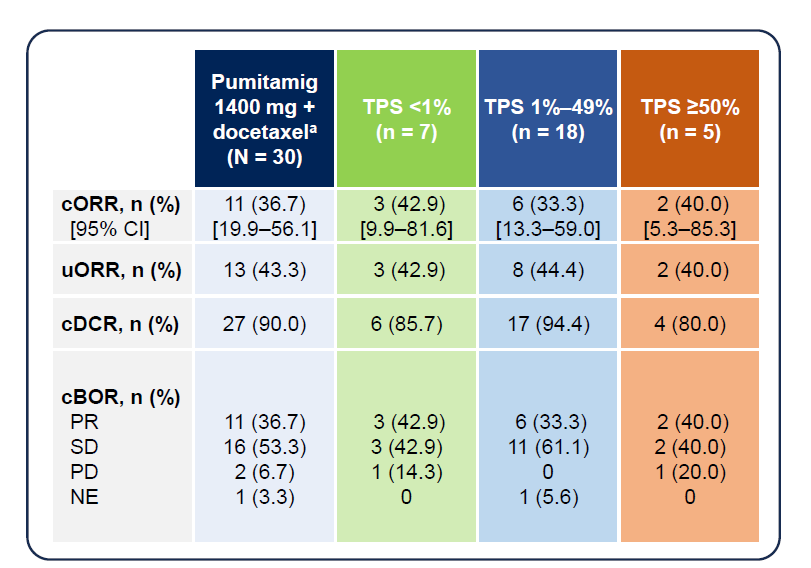
From the ESMO abstracts: Interesting results for Pumitamig in 2L neuroendocrine neoplasms, especially when compared to the older bevacizumab trial, since Pumitamig is showing an ORR *and* OS benefit here:
Has anyone tested combining a PDL1xVEGF bispecific with a PD1 monoclonal? - The idea being that the bispecific would anchor the VEGF inhibition to the TME, whereas the PD1 mono would reinvigorate T-cells across the body? Anyboy done this expertiment? @AppleHelix@DrSamuelBHume
Love this from @gline!
“biotech is a wood chipper that like is built to like ingest souls and shred them. It's just like such a hard business that like someone comes and they're like, oh, but I've built a computer and I'm going to push a button and all of that goes away and it just works. Like that is probably not the way that's going to go.”