Diagrams also force the agent to commit — prose lets it hedge with "typically" and "may", but a box-and-arrow graph can't hide a missing edge or an accidental cycle. Half the value is that a wrong diagram is obvious in two seconds, where a wrong paragraph reads fine on the first pass.
Here it is - the official, revised, peer-reviewed version of my Platonic Space paper. https://t.co/PXNpx5FgFN Of all the many unpopular positions I’ve taken over the decades - bitter controversies around the origin of left-right asymmetry in embryogenesis, bioelectricity and genetics, diverse intelligence, etc., this one has by far generated the most pushback: serious (grateful for those!) and energetic attempts to move me to other views, pleas to just drop it and not talk about it (for several different reasons), nasty emails and accusations, impacts on reviews of papers that have nothing to do with this, etc. Kind of amazing to me how incendiary this is. What can I say... Our job is to call it as we see it, and right now for me, this is it. Apologies to collaborators and colleagues for any shrapnel! Time will tell if this pans out or not; I've placed my bets. And btw, if you think this stuff is weird and uncomfortable, just wait… There’s much more on the way. The knob turns slowly but as long as the data keep coming, I'm going to say what I think it all means and follow it to the next steps it enables. Buckle up!
Thank you for your contribution
.
At first, I intended to respond directly to your argument. This seemed like the obvious thing to do. Unfortunately, after several passes through your comment, including one at normal speed, one slowly, and one while squinting slightly in the hope that hidden meaning might emerge from the typography, I encountered a preliminary difficulty: I could not reliably identify the argument.
This presents us with an interesting methodological problem.
Before refuting an argument, one must establish that an argument exists.
This is not merely pedantry. It is a foundational principle of intellectual hygiene. A sandwich requires bread. A triangle requires three sides. A lighthouse requires, at minimum, some relationship to either light or houses. Likewise, an argument generally requires premises, some form of inference, and a conclusion. Your tweet certainly contains words, and several of them appear to be nouns and verbs, but whether they collectively rise to the level of an argument is a separate empirical question.
We should therefore proceed cautiously.
Let us begin with ontology.
What exactly is a tweet?
Is it merely a sequence of characters transmitted electronically? Is it a proposition? A performance? A cry for help? A digital sneeze? Can a tweet meaningfully be said to “contain” an argument in the same way a jar contains olives, or is the argument instead an emergent property arising from the interaction between author, audience, platform, caffeine level, and Wi-Fi connectivity?
These questions cannot simply be brushed aside.
Philosophers have debated less important matters for centuries.
Next comes epistemology.
How do we know that you believe what you wrote?
Perhaps you do.
Perhaps you do not.
Perhaps you began typing one thought, were distracted by a notification, resumed several minutes later with another thought, and accidentally produced the intellectual equivalent of attaching the front half of a bicycle to the back half of a washing machine.
We simply do not know.
The data are insufficient.
This brings us naturally to statistics.
Suppose, purely for illustrative purposes, that we define the variable X as the amount of information contained in a randomly selected sentence of your tweet. We would then like to estimate E[X], the expected informational content.
Unfortunately, with such a small sample and such extreme variance, any estimator is likely to be unstable.
Indeed, there is a nontrivial possibility that the sample mean may be dominated by punctuation.
One might propose increasing the sample size by examining your previous tweets, but this introduces obvious ethical concerns for the research team.
Moreover, selection bias immediately becomes a problem.
Are we examining only tweets you considered sufficiently coherent to publish?
If so, then the observed dataset may represent an upper bound.
This is worrying.
We must also consider measurement error.
What unit should be used to quantify nonsense?
Decibels?
Kilograms?
Liters?
Perhaps nonsense should be measured dimensionlessly, like a coefficient of friction.
But then we face the calibration problem.
We would need a universally agreed reference unit.
For instance:
1 nonsense unit = the amount of confusion produced by a man confidently explaining something he learned twelve seconds earlier.
But even this standard has limitations.
Confidence varies.
So does broadband speed.
There is also the problem of causality.
You appear to suggest, if I understand you correctly—and I emphasize the conditional—that because A occurred before B, A caused B.
This is a very old mistake.
Roosters crow before sunrise.
Roosters do not manufacture the sun.
People carry umbrellas when it rains.
Umbrellas do not cause precipitation.
Firefighters appear at fires.
Firefighters are generally not considered the leading cause of combustion.
Likewise, your ability to place two events next to each other in a sentence does not automatically create a causal mechanism between them.
This remains true even if you use capital letters.
Capitalization is not a substitute for identification strategy.
Nor is punctuation.
Three exclamation marks do not triple the evidentiary strength of a claim.
Four question marks do not constitute peer review.
An emoji is not an instrumental variable.
A meme is not a robustness check.
And “everybody knows” is not a dataset.
Now, one might reasonably ask whether I am overcomplicating matters.
This is possible.
But since your original contribution managed to simplify the issue beyond the point at which recognizable reasoning survived, some compensatory complexity seems appropriate.
We should therefore broaden the inquiry.
Consider geography.
France is west of Germany.
Japan is east of China.
Australia is mostly south of Indonesia.
None of these observations is particularly relevant to your tweet, but they have the advantage of being independently verifiable.
This already puts geography ahead.
Consider zoology.
Octopuses have three hearts.
Giraffes have unusually long necks.
Penguins cannot fly.
Again, none of this bears directly on your claim, yet I find myself learning more from the penguins.
Consider agriculture.
Potatoes grow underground.
Apples grow on trees.
Rice cultivation requires specific environmental conditions.
A field left unattended tends to accumulate weeds.
The last point may actually have metaphorical relevance here, but I will resist overinterpreting it.
Consider maritime history.
For centuries, sailors navigated using stars.
Later came increasingly sophisticated instruments.
Eventually GPS revolutionized navigation.
At every stage, however, the fundamental objective remained the same: determine where you are.
Your tweet would benefit from a similar technology.
Consider engineering.
A bridge must bear load.
An aircraft wing must generate lift.
A pressure vessel must tolerate pressure.
A claim must tolerate scrutiny.
This is where the structural analogy becomes unfortunate.
Engineers sometimes speak of catastrophic failure.
I will leave it there.
Consider thermodynamics.
Entropy tends to increase.
This is one of the great laws of physics.
Your reply may represent supporting evidence.
However, we should avoid claiming scientific confirmation based on a single observation.
Replication would be required.
Preferably by someone else.
Far away.
Now let us examine the linguistic dimension.
Language is an extraordinary human achievement.
For thousands of years, civilizations developed increasingly sophisticated systems for recording thought.
Cuneiform.
Hieroglyphics.
Greek.
Latin.
Arabic.
Chinese.
The printing press.
Telegraphy.
Radio.
Digital communication.
All of this culminated, through an extraordinary chain of technological and intellectual development, in the possibility that you could instantly transmit that sentence to the entire planet.
History is magnificent.
Whether history considers this particular use of the technology a success remains uncertain.
We should also discuss economics.
Every activity has an opportunity cost.
The time spent reading your tweet could alternatively have been used for many things.
I could have made coffee.
I could have reorganized a drawer.
I could have looked through a window.
I could have counted ceiling tiles.
I could have investigated whether my refrigerator is making a slightly different noise than yesterday.
These opportunities are now gone forever.
Economists call this a sunk cost.
I call it Monday.
There is also the issue of scarcity.
Human attention is finite.
This makes attention valuable.
By consuming attention without delivering corresponding information, your tweet may be understood as a kind of unregulated cognitive inflation.
Too many words chasing too few ideas.
Central banks have no policy instrument for this.
Now to biology.
The human brain contains roughly eighty-six billion neurons.
It is one of the most complex structures known to science.
It allows us to reason abstractly, create art, develop mathematics, compose symphonies, explore distant planets, and understand the molecular basis of life.
I mention this only because it seems important to remember what equipment was theoretically available when the tweet was composed.
We must also consider evolution.
Natural selection operates over generations.
Traits associated with survival and reproduction become more common.
One therefore wonders what historical environmental pressure could possibly have favored the instinct to enter an online discussion with maximum confidence and minimum preparation.
Perhaps this remains one of evolutionary biology’s great unanswered questions.
Anthropology may offer clues.
Human beings are social animals.
Status matters.
Coalition membership matters.
Public displays matter.
In many societies, individuals signal competence through knowledge.
Online, an interesting inversion sometimes occurs: confidence itself becomes the signal, whether or not competence is present.
This creates what researchers might call the Peacock Problem, except that peacocks at least provide feathers.
Your tweet provides mostly volume.
Let us turn to probability.
There are several possible explanations for your comment.
Hypothesis H1: You genuinely believe it.
Hypothesis H2: You are trolling.
Hypothesis H3: You misunderstood the original point.
Hypothesis H4: You understood the original point but decided misunderstanding it would be more entertaining.
Hypothesis H5: Your phone was unlocked in your pocket and achieved sentience.
A rigorous Bayesian analysis would require priors.
I do not currently have priors for pocket sentience.
So we must remain agnostic.
One could perhaps infer likelihoods from writing style, but that risks overfitting.
And overfitting, as you may know—or perhaps as you may soon discover—is what happens when a model describes noise so enthusiastically that it mistakes randomness for understanding.
This analogy is becoming uncomfortable, so let us move on.
History also deserves consideration.
The Roman Republic produced Cicero.
Ancient Greece produced Aristotle.
The Islamic Golden Age produced Ibn Sina and Al-Khwarizmi.
The Enlightenment produced Hume, Kant, and Voltaire.
Modern science produced Einstein, Dirac, Feynman, and countless others.
Across centuries, humanity slowly developed traditions of logic, evidence, argument, criticism, and revision.
Then social media invented the quote-tweet.
Civilization is nonlinear.
Now, you may respond that I have still not addressed your point.
This criticism would be fair if a point had been conclusively established.
We are still at the detection stage.
Imagine radar operators staring at an empty screen.
Occasionally there is a flicker.
Is it an aircraft?
Atmospheric noise?
Birds?
A software glitch?
A sandwich placed too close to the equipment?
One must not jump to conclusions.
Similarly, I observed several clusters of words in your post.
They may represent meaningful intellectual traffic.
They may simply be weather.
Further monitoring is recommended.
We should perhaps appoint a committee.
The Committee for the Investigation of Whether Anything Was Actually Said.
Subcommittee A could examine syntax.
Subcommittee B could search for evidence.
Subcommittee C could determine whether the conclusion follows from anything preceding it.
Subcommittee D could bring snacks.
After eighteen months of hearings, the committee would release a 940-page report.
The executive summary would read:
“Results inconclusive.”
There would then be disagreements about the methodology.
A minority report would insist that the original tweet contained traces of an argument.
A dissenting member would claim these traces were contamination from another conversation.
The dataset would be archived.
A conference would be organized.
Nobody would attend the 8:00 a.m. panel.
Eventually a doctoral student would write a dissertation titled:
“Semantic Vacuum Formation in High-Confidence Digital Environments.”
The dissertation would be downloaded eleven times.
Six downloads would be the author.
Two would be the author’s mother.
One would be accidental.
One would be a bot.
And one would be me, still trying to determine what exactly you meant.
At this point we must address the elephant in the room.
Not a literal elephant.
That would complicate matters unnecessarily.
But since we have mentioned elephants, it is worth noting that African elephants are larger than Asian elephants.
This has nothing to do with the debate.
I simply wanted to establish one more uncontested fact before returning to the danger zone.
We should also discuss food.
Tomatoes are botanically fruits.
Cucumbers are fruits.
Peppers are fruits.
Culinarily, however, they are often treated as vegetables.
This illustrates something important: classification depends on context.
Your comment might therefore be classified differently depending on the disciplinary framework.
A linguist might call it a sentence.
A psychologist might call it behavior.
A statistician might call it an outlier.
A philosopher might call it a category error.
A plumber, after reading it, might simply return to the sink.
All interpretations deserve consideration.
Another relevant concept is signal-to-noise ratio.
In engineering and statistics, the signal is the meaningful component of observed data, while noise consists of irrelevant variation.
In ordinary conversation, the objective is generally to maximize signal relative to noise.
Your approach appears innovative.
You have inverted the optimization problem.
This may represent a new school of communication theory.
Instead of asking:
“How much information can I transmit using the fewest words?”
you appear to ask:
“How confidently can I arrange words while minimizing recoverable information?”
This is ambitious.
Perhaps even avant-garde.
Future scholars may study it.
Or they may mute you.
Science is unpredictable.
Now, before we proceed further, some housekeeping.
The Earth orbits the Sun.
Water freezes at approximately 0°C at standard atmospheric pressure.
A year contains approximately 365.24 days.
There are seven days in a week.
A dozen is twelve.
A baker’s dozen is thirteen.
None of these propositions has yet been disproven by your tweet.
Credit where credit is due.
We now arrive at the legal dimension.
If your argument were a witness, opposing counsel would have questions.
Where were you on the night of the inference?
Did you personally observe the evidence?
Can anyone corroborate your conclusion?
Were you under the influence of screenshots?
Did anyone pressure you to use the phrase “obviously”?
Did you consult a source?
What source?
Was the source another tweet?
Was that tweet yours?
At some point the judge might ask counsel to approach the bench.
After a whispered conversation, everyone would go home early.
There is also a theological angle, although we should tread carefully.
Many traditions have spent millennia wrestling with questions of existence, meaning, morality, and truth.
Your tweet has introduced another mystery:
How can something occupy so much confidence while containing so little uncertainty?
Perhaps this too belongs to the realm of faith.
Let us examine architecture.
A building generally begins with foundations.
Then come load-bearing structures.
Then walls.
Then the roof.
Your argument appears to have begun with the roof.
This is visually dramatic but structurally unconventional.
If your argument were a house, an inspector would arrive, stare silently for several minutes, remove his glasses, put them back on, and ask whether the house was intended to be upside down.
You would perhaps reply that everyone on the internet agrees the house is fine.
The inspector would write something on a clipboard.
We may never know what.
Now, weather.
Clouds form through condensation.
Wind results from pressure differences.
Thunder is caused by rapid expansion of air heated by lightning.
Fog reduces visibility.
The last phenomenon may be relevant.
Your tweet has a meteorological quality.
One enters with clear visibility and emerges unsure which direction the road goes.
Meteorologists issue advisories for less.
Astronomy offers another useful perspective.
The observable universe is vast.
There are hundreds of billions of galaxies.
Each may contain billions of stars.
Distances are so enormous that light itself takes millions or billions of years to cross them.
Against this cosmic scale, human disagreements appear tiny.
This is comforting.
Somewhere, millions of light-years away, there is almost certainly a region of spacetime entirely unaffected by your opinion.
I find that reassuring.
Geology also teaches patience.
Mountains rise over millions of years.
Continents drift centimeters per year.
Rock layers preserve ancient history.
Given enough geological time, perhaps the missing premise of your argument will eventually emerge.
Sedimentation is slow.
We should not rush it.
Music provides another analogy.
Harmony requires relationships among notes.
Rhythm requires structure through time.
Melody requires recognizable organization.
Randomly striking piano keys may still create sound.
Sound, however, is not automatically music.
You have produced sound.
The conservatory application remains under review.
Consider transportation.
A train requires tracks.
A car requires a road.
A ship requires navigable water.
An airplane requires sufficient lift.
An argument requires logic.
Every system has infrastructure.
Without it, one simply makes noise while going nowhere.
Which, to be fair, is also a recognizable form of transportation on Twitter.
Now, I anticipate a possible objection.
You may say:
“Why are you writing all this?”
Excellent question.
We have finally encountered one.
The answer is that your original comment inspired me to investigate whether sheer volume could compensate for lack of content.
I am conducting an experiment.
You supplied the control group.
For that, I am grateful.
Preliminary findings suggest that adding more words does not necessarily add more meaning.
This appears consistent with your result.
Replication strengthens confidence.
We should publish jointly.
Authorship order can be discussed later.
You may qualify for first author on the original demonstration.
I will handle the literature review.
The abstract might read:
“Background: Social media enables rapid transmission of information and non-information.
Methods: One tweet was observed.
Results: Words occurred.
Conclusion: More research is needed.”
Peer reviewers will complain that n=1.
They will be correct.
But perhaps we can obtain additional observations from your replies.
Please continue.
This could become longitudinal.
The funding prospects are unclear.
Government agencies may hesitate to support research with no measurable output, although this field already appears crowded.
We could seek private sponsorship.
Maybe a company that manufactures mute buttons.
At this stage, I would also like to acknowledge several entities that have contributed indirectly to this discussion:
the inventors of electricity;
the engineers who developed packet switching;
the mathematicians who built information theory;
the technicians maintaining server infrastructure;
the semiconductor industry;
the people who laid fiber-optic cables beneath oceans;
the software developers who built this platform;
and the unknown delivery driver who may at some point have transported part of the hardware involved.
Collectively, thousands of years of human ingenuity made your tweet possible.
Whether this should make humanity proud is outside the scope of the present analysis.
We can, however, ask whether technological progress always produces proportional intellectual progress.
The evidence here is mixed.
Let us briefly discuss cheese.
Cheddar originated in England.
Roquefort comes from France.
Parmigiano-Reggiano comes from Italy.
Halloumi is associated with Cyprus.
Cheese can be hard, soft, fresh, aged, blue, washed-rind, and many other things.
Why mention cheese?
No reason.
But importantly, I have clearly stated that there is no reason.
That alone improves transparency relative to your argument.
Transparency matters.
If one introduces an irrelevant point, one should identify it as irrelevant.
Otherwise readers may mistake irrelevance for profundity.
This happens more often than you might think.
Especially when Latin phrases are involved.
For example: post hoc ergo propter hoc.
There.
We have now used Latin.
This does not make the response more correct.
But it does make it look approximately 14% more serious.
Add a semicolon and we may reach 19%.
Scholars remain divided.
Now, perhaps the deepest issue is conceptual.
Disagreement is healthy.
People can reasonably disagree about complicated matters.
Different assumptions produce different conclusions.
Different evidence produces different posterior beliefs.
Different values produce different preferences.
All of this is normal.
But before disagreement becomes productive, participants must inhabit approximately the same logical universe.
If one person says, “Here is evidence A supporting proposition B,” and the other responds, “Yes, but dolphins are mammals,” the difficulty is not ideological polarization.
It is navigation.
We need coordinates.
Your tweet gives us none.
Therefore, before I can disagree with you, I first need to locate you intellectually.
Longitude unknown.
Latitude unknown.
Altitude concerning.
Please activate semantic GPS.
There is also a possibility that your comment is satire.
If so, congratulations.
You have successfully created a text indistinguishable from sincere confusion.
This is one of satire’s greatest technical achievements.
If, however, it was sincere, then congratulations again.
You have accidentally achieved the same thing.
Either way, the artifact is remarkably stable across interpretations.
Finally, after this exhaustive multidisciplinary review, encompassing philosophy, mathematics, physics, biology, economics, history, engineering, linguistics, meteorology, gastronomy, maritime navigation, cheese, elephants, infrastructure, astronomy, architecture, jurisprudence, transportation, thermodynamics, and a hypothetical duck that has not yet been introduced but whose opinion I nevertheless respect, I am prepared to offer a provisional conclusion.
Your tweet appears to exist.
It was posted.
It contains characters.
Some characters form words.
Several words form sentences.
The sentences are arranged in an order.
Beyond that, certainty declines rapidly.
I cannot exclude the possibility that somewhere beneath the confidence, punctuation, implication, and rhetorical exhaust there is a meaningful proposition waiting to be excavated.
Perhaps future generations, equipped with better instruments, larger language models, improved archaeological techniques, and considerably more patience, will uncover it.
Until then, I recommend preserving the tweet exactly as it is.
Do not edit it.
Do not clarify it.
Do not provide evidence.
Its scientific value lies precisely in its current state.
Museums preserve fossils.
Libraries preserve manuscripts.
Natural-history collections preserve unusual specimens.
The internet should preserve this.
Future students may stand before a screenshot and ask:
“Professor, did people really argue like this?”
And the professor will look toward the window, pause for a long time, and say:
“Yes.
And sometimes they paid for a blue checkmark.”
The class will fall silent.
Outside, a bird will land on a tree.
The bird will have no opinion on the matter.
This will immediately make it one of the strongest participants in the debate.
A light breeze will move through the leaves.
Somewhere, a refrigerator will hum.
Markets will open and close.
Tides will rise and fall.
The Earth will continue rotating at approximately 1,670 km/h at the equator.
And your argument, untouched by these developments, will remain exactly where we found it:
confident,
immovable,
and still waiting for a premise.
Thank you again for your contribution.
Further research is required.
More global randomness from less random local gates
#Randomquantumcircuits are a central tool in quantum information and many-body physics. But how random should the individual gates actually be?
Perhaps surprisingly: less random local gates can generate more global randomness.
https://t.co/IBp0QuxtKg
In our new work, we show that structured one-dimensional random circuits built from non-Haar-random local gates can converge faster towards global randomness than circuits with #Haar-random gates on exactly the same architecture. The key is that the structure makes the second-moment operator exactly solvable: we derive its full spectrum by establishing a connection to the Kitaev chain. This allows us to show analytically that its spectral gap can be larger than for the corresponding Haar-random circuit.
So, in this setting, carefully restricting local randomness actually improves global randomization. Beyond the conceptual surprise, this leads to improved circuit-depth bounds for randomized benchmarking and for generating approximate unitary 2-#designs with shallow circuits.
Sometimes, more randomness is not the best route to randomness.
Warm thanks to @ryotarosuzuki_, Hoshe Katsura, Yosuke Mitsuhashi, Tomohiro Soejima, and Nobuyuki Yoshioka for the wonderful collaboration.
New book out soon - the Mythical Agent Month! (joke)
The curse of agentic software engineering is that we keep more of the architecture in flux (in adaptation mode). Before we were forced to crystallise more and focus intelligence in small parts of the architecture at any one time.
Keeping more in flux mode makes us dependent on highly intelligent models, makes our brains coredump, worsens our AI guidance, degrades team competence and stops us from shipping.
Carl Sagan on books
"What an astonishing thing a book is. It’s a flat object made from a tree with flexible parts on which are imprinted lots of funny dark squiggles. But one glance at it and you’re inside the mind of another person, maybe somebody dead for thousands of years."
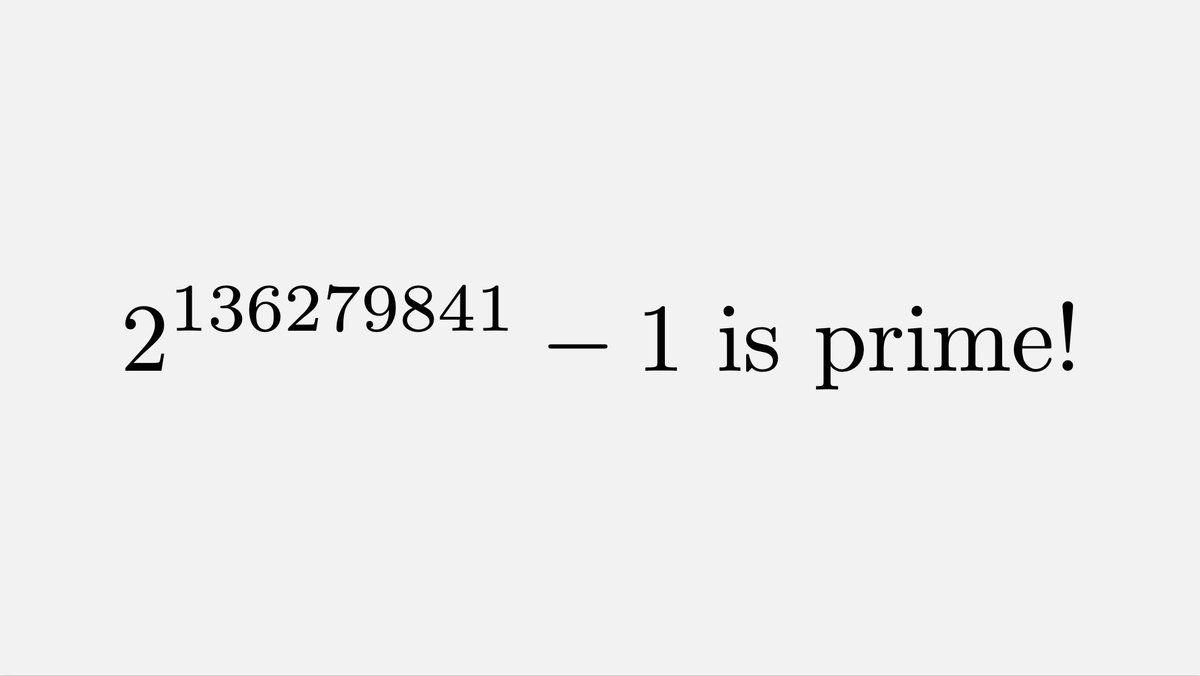
2¹³⁶²⁷⁹⁸⁴¹−1, discovered today, is the largest known prime. It's a Mersenne prime (2ᵖ-1), which are easier to find.
It took nearly 6 years for the GIMPS software to find it after the previous largest known prime. It was also the first Mersenne prime found using GPUs.
Interested in emergence, self-organization or morphogenesis?
Introducing CAX: Cellular Automata Accelerated in JAX, a high-performance and flexible library designed to accelerate cellular automata research. 🦎
📄: https://t.co/tOu4ejIBYu
🌟: https://t.co/0T5i2CRuJC
🧵1/12
Launching on Wednesday, Sept 25. Stay tuned!
Right now, #AI is having a moment — and it’s not the first time grand predictions about the potential of machines are being made. But, what does it really mean to say something like ChatGPT is “intelligent”? What exactly is #intelligence?
The next season of the #Complexity #podcast, 'The Nature of Intelligence', explores this question through conversations with cognitive and neuroscientists, animal cognition researchers, and AI experts in six episodes. Together, we'll investigate the complexities of human intelligence, how it compares to that of other species, and where AI fits in. We'll dive into the relationship between language and thought, examine AI's limitations, and ask: Could machines ever truly be like us?
Turing fully understood universality. In his 1950 paper ‘Computing Machinery and Intelligence’, he used it to sweep away what he called ‘Lady Lovelace’s objection’, and every other objection both reasonable and unreasonable. He concluded that a computer program whose repertoire included all the distinctive attributes of the human brain — feelings, free will, consciousness and all — could be written.
This astounding claim split the intellectual world into two camps, one insisting that AGI was none the less impossible, and the other that it was imminent. Both were mistaken. The first, initially predominant, camp cited a plethora of reasons ranging from the supernatural to the incoherent. All shared the basic mistake that they did not understand what computational universality implies about the physical world, and about human brains in particular.
What is needed is nothing less than a breakthrough in philosophy, a theory that explains how brains create explanations.
But it is the other camp’s basic mistake that is responsible for the lack of progress. It was a failure to recognise that what distinguishes human brains from all other physical systems is qualitatively different from all other functionalities, and cannot be specified in the way that all other attributes of computer programs can be. It cannot be programmed by any of the techniques that suffice for writing any other type of program. Nor can it be achieved merely by improving their performance at tasks that they currently do perform, no matter by how much.
Why? I call the core functionality in question creativity: the ability to produce new explanations. For example, suppose that you want someone to write you a computer program to convert temperature measurements from Centigrade to Fahrenheit. Even the Difference Engine could have been programmed to do that. A universal computer like the Analytical Engine could achieve it in many more ways. To specify the functionality to the programmer, you might, for instance, provide a long list of all inputs that you might ever want to give it (say, all numbers from -89.2 to +57.8 in increments of 0.1) with the corresponding correct outputs, so that the program could work by looking up the answer in the list on each occasion. Alternatively, you might state an algorithm, such as ‘divide by five, multiply by nine, add 32 and round to the nearest 10th’. The point is that, however the program worked, you would consider it to meet your specification — to be a bona fide temperature converter — if, and only if, it always correctly converted whatever temperature you gave it, within the stated range.
Now imagine that you require a program with a more ambitious functionality: to address some outstanding problem in theoretical physics — say the nature of Dark Matter — with a new explanation that is plausible and rigorous enough to meet the criteria for publication in an academic journal.
Such a program would presumably be an AGI (and then some). But how would you specify its task to computer programmers? Never mind that it’s more complicated than temperature conversion: there’s a much more fundamental difficulty. Suppose you were somehow to give them a list, as with the temperature-conversion program, of explanations of Dark Matter that would be acceptable outputs of the program. If the program did output one of those explanations later, that would not constitute meeting your requirement to generate new explanations. For none of those explanations would be new: you would already have created them yourself in order to write the specification. So, in this case, and actually in all other cases of programming genuine AGI, only an algorithm with the right functionality would suffice. But writing that algorithm (without first making new discoveries in physics and hiding them in the program) is exactly what you wanted the programmers to do!
Traditionally, discussions of AGI have evaded that issue by imagining only a test of the program, not its specification — the traditional test having been proposed by Turing himself. It was that (human) judges be unable to detect whether the program is human or not, when interacting with it via some purely textual medium so that only its cognitive abilities would affect the outcome. But that test, being purely behavioural, gives no clue for how to meet the criterion. Nor can it be met by the technique of ‘evolutionary algorithms’: the Turing test cannot itself be automated without first knowing how to write an AGI program, since the ‘judges’ of a program need to have the target ability themselves. (For how I think biological evolution gave us the ability in the first place, see my book The Beginning of Infinity.)
And in any case, AGI cannot possibly be defined purely behaviourally. In the classic ‘brain in a vat’ thought experiment, the brain, when temporarily disconnected from its input and output channels, is thinking, feeling, creating explanations — it has all the cognitive attributes of an AGI. So the relevant attributes of an AGI program do not consist only of the relationships between its inputs and outputs.
The upshot is that, unlike any functionality that has ever been programmed to date, this one can be achieved neither by a specification nor a test of the outputs. What is needed is nothing less than a breakthrough in philosophy, a new epistemological theory that explains how brains create explanatory knowledge and hence defines, in principle, without ever running them as programs, which algorithms possess that functionality and which do not.
Such a theory is beyond present-day knowledge. What we do know about epistemology implies that any approach not directed towards that philosophical breakthrough must be futile.
@DavidDeutschOxf
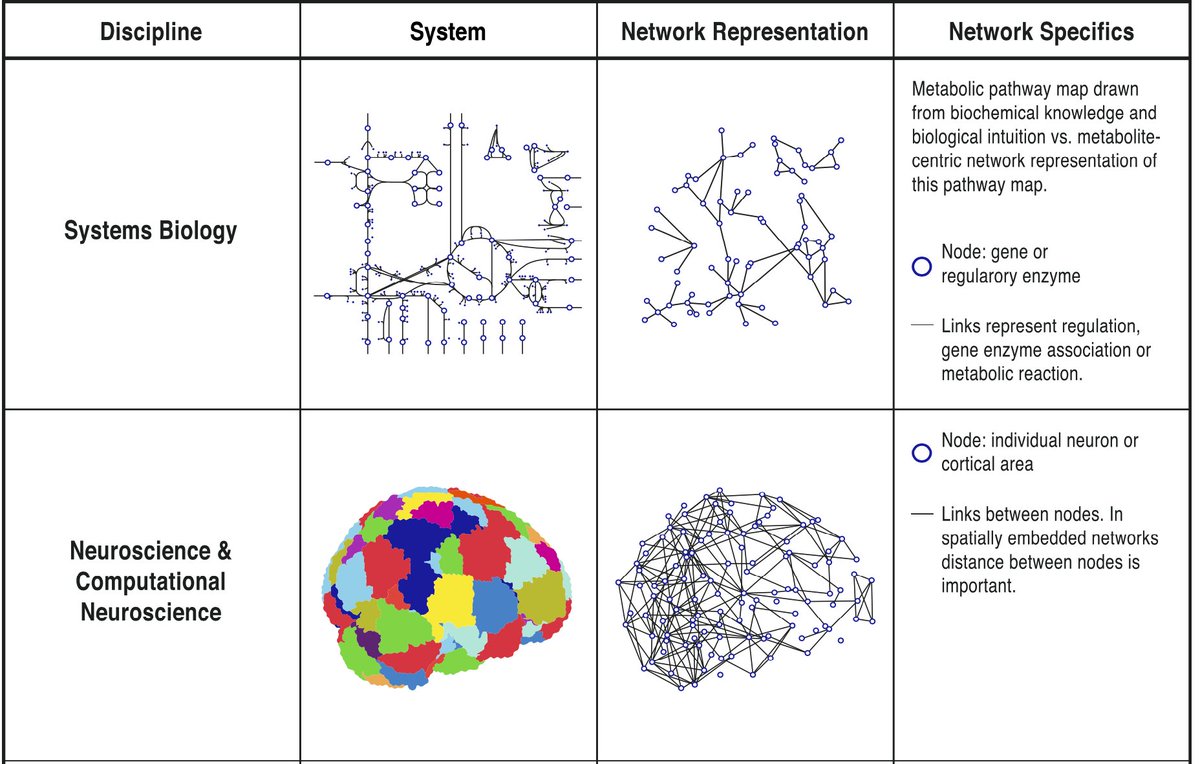
Why is connectivity so central to complex systems? Because it captures most of the systems-level universal properties of complexity. Here's a review paper by @GeogDurham Laura Turnbull and co. that explores this across systems and scales @Ecohydrology https://t.co/d3P9v6tSeJ
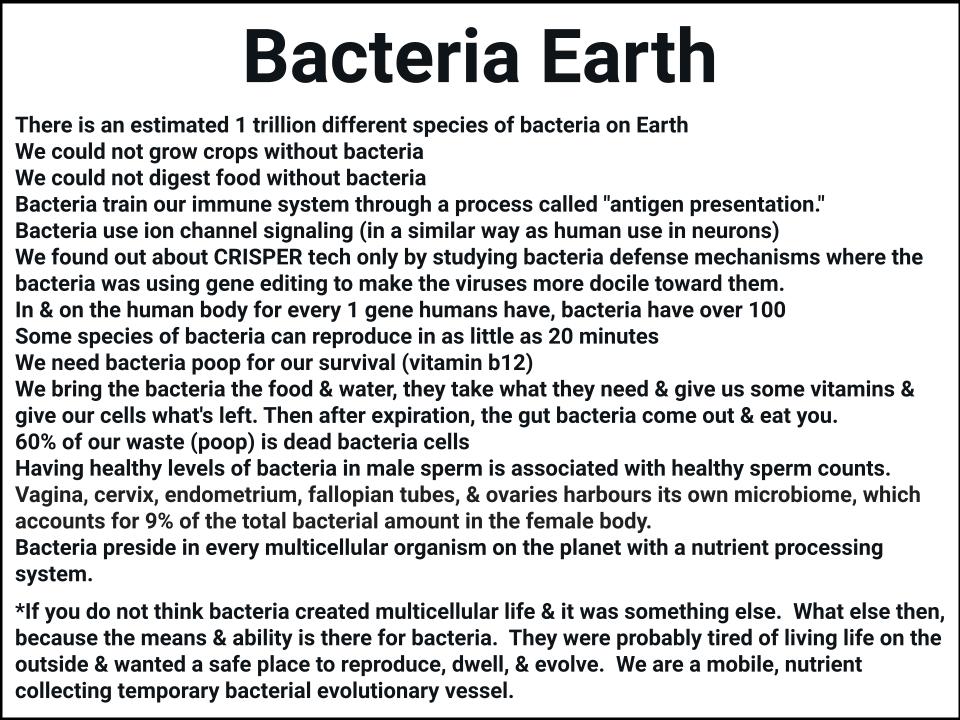
Anyone else connecting these dots in general? Any other scientifically grounded ideas for the development of multicellular life? Understanding this is a precursor for the bigger question that needs answering:
If bacteria was not formed on Earth, then where did it originate?
It doesn't take a whole lot of pondering to figure out that the thesis "humans only seem smart because they're 'trained' on huge amounts of 'data' via their visual system (almost like LLMs!)" doesn't hold any water.
For instance -- congenitally blind people are not less intelligent. Vision isn't fundamental to what makes us human. A rich learning environment is still a rich learning environment when apprehended through restricted sensorimotor modalities.