PhD student in cog neuro,fan of brain-AI integration, Q to ask: how brain devotes resource to learnable tasks while ignoring random associations @ZuckermanBrain
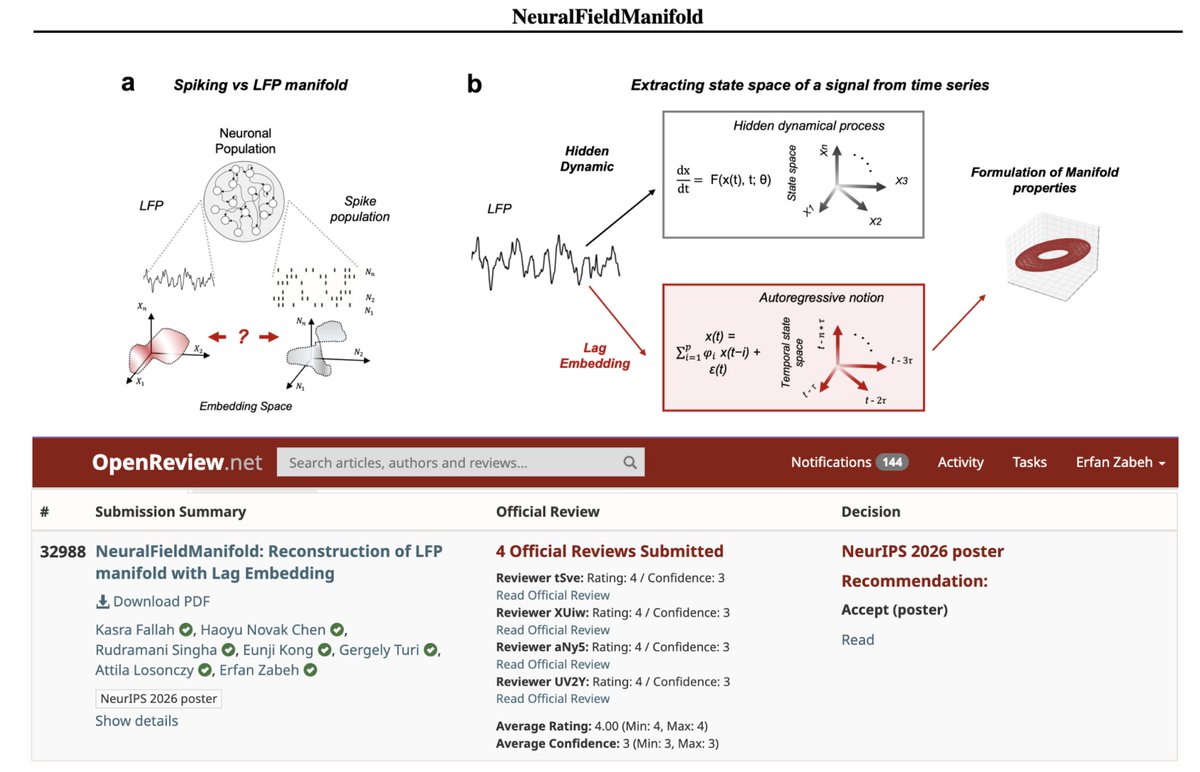
Now accepted at @NeurIPSConf 2026: NeuralFieldManifold 🎉
#NeuralManifolds have transformed how neuroscientists think about population activity—but almost all of that story has been built around spikes. We extend that doctrine to the world of subthreshold brain activity (LFP, EEG, ...).
Camera-ready + tutorials coming out soon.
Great work by @KasraFlh , @NovakHChen , and @RudramaniSingha , with @eunji_kkong , @gergelyturi1 , and @attila_losonczy helping the formulation comes to real brain data.
Come check us out at NeurIPS 2026, I guess in #Atlanta …
How do we create mental maps of the world? By having mice explore mazes in virtual reality, @eunji_kkong@ZabehErfan@attila_losonczy and co. have now shed light on how the brain recognizes familiar and novel environments in @NeuroCellPress.
https://t.co/p8GWrf605d
Thanks Qinpu for organizing this great symposium! If you are interested in knowing how our brain monitors whether environment has predictable rules or not, please come to my talk tomorrow 8.15am at Rm30!
8:15 @LeoYuhaoJin(Columbia) will talk to us about learnability monitoring in the brain. Monkeys learned ordered stimulus sets but imposed subjective structure on random ones. dACC neurons encoded learnability and modulated ACC reward responses, shaping behavioral sensitivity.
It's closely related to our previous work focusing on "superstitious reasoning" https://t.co/TIvtlYLFhP.
The work is under the guidance by Prof. Greg Jensen @vferrera and Prof. Jacqueline Gottlieb
Excited to share our new preprint! In natural scenario, how could you estimate if the environment you are facing with is learnable or just random noises, our work
showed dACC monitors such environmental learnability using transitive inference paradigm
https://t.co/iijbBKzIfb
New paper shows how nonhuman primates learn (5-) object sequences and use context cues to mentally re-order objects within a learned sequence – showing that NHPs form non-spatial cognitive maps 1 / 2 https://t.co/jmdz6xeBJs
#CNS2025 | Just happened 🧵 coming
@LeoYuhaoJin Shared exciting results about showed that 🐒 can dissociate learnable vs unlearnable pic sequences both beh and dACC. Also the correlation with beh and neural data. Ref:https://t.co/ECKdko0SMH
During transitive inference task, monkey improved accuracy but kept the reaction time constant. Our lab investigated this decoupling using the Drift diffusion model.
https://t.co/YRwlCJ0Fkf
I am glad to share our @BrunoAverbeck@rbartolo_phd recent work published in @NeuroCellPress. We examined the neural mechanisms involved in learning from the gains and losses of symbolic reinforcers in the ventral frontostriatal circuitry. 🧠https://t.co/56zGW1udXK
New FreedmanLab paper shows that the primate superior colliculus is strongly and causally engaged in abstract cognition. https://t.co/hrxUG548Gj #Neuroscience#UChicago@UChicago_Brains
How does the brain bind action to value?
How does it navigate a tradeoff between this binding and generalization to novel situations?
Out today in Nature Neuro! https://t.co/YPiY2uHoFz
@JustFineNeuro @NeuroPolarbear @BecketEbs@neuromochi
See original 🧵 + updates below
If you are interested in how human learns when the rules are mixed with random feedback, please check my poster C84 at #CCN2024. Thanks for the help under my mentors @vferrera Dr. Jacqueline Gottlieb and great helps from Greg Jensen.
Curious about curiosity? In brain-imaging studies, our own Jacqueline Gottlieb and colleagues have witnessed the neural mechanisms underlying subjective feelings of curiosity in people. Satisfy your own curiosity and read more! @Mcohanpour#neuroscience
https://t.co/R3xS9EOZ8k
Kilosort4 is now fully released in #python and we have a new logo!
https://t.co/ULZKyF8uy9 w/ Shashwat Sridhar, Jacob Pennington and @computingnature. #kilosort
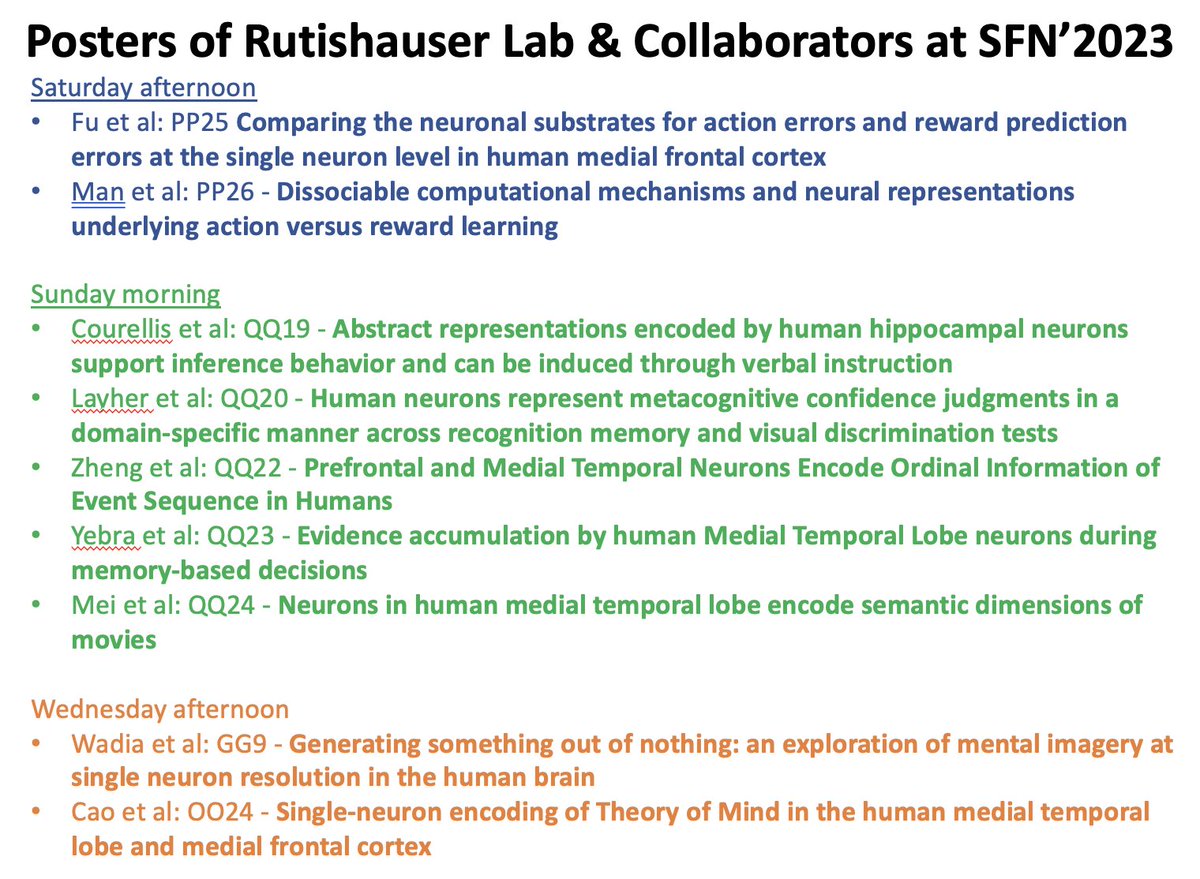
Excited to be at SFN this year! We are presenting new work on learning of abstract representations, cognitive boundaries, error monitoring, integration, semantic representations, and face representations & imagination ! #SFN2023@CedarsSinaiMed@CaltechN @NeurosciencesCS