“Jev is basically just machine learning for people who don’t know how to or can’t train an ML model”
Spoken like people who don’t know anything about ML
Traditional classifiers can’t do shit outside whatever domain they’re trained in
You can’t throw BERT or XGboost at new tasks without retraining or fine-tuning
Yes, you’ll still get higher accuracy on something well-defined with a fine-tuned BERT
But the point is I can throw Jev at basically ANYTHING with reasonably good accuracy for use cases that are impractical to invest any ML engineering effort into
Since you all liked the last one here’s how to know you’re just wasting effort on LinkedIn and should quit
(As the guy who kinda wrote the book on LinkedIn lead gen…)
1. The tried and true sales nav TAM check
Scrape the list of all the contacts in your ICP and check a random sample of 1000 with harvestAPI to see how many post or are active on LinkedIn
Extrapolate the % out of 1000 to the full list and there’s your SAM on LinkedIn.
If that number is less than 2000 you probably shouldn’t bother with the channel because you won’t be able to scale it anyways.
You can also just go into sales nav and flip on the “posted in the last 30” filter and whatever job title and geography filters + niche keywords but it’ll be a much less accurate way to gauge the market segment.
And you’d have to split up your scrapes by batches of 2500 split by geographies
Anywho.
2. Phase 1 is validating message market fit
For me the floor here is 500 connection requests and the ceiling is 2500.
Or
Average connection acceptance rate (targeting active profiles, which you should be) is 20%
Reply rate post-connection on a full sequence should be at least 20% as well
Positive reply rate should be at least 10%
On 500 requests that’s 100 connections, 20 conversations, and 2 leads, from which you’ll get 1 or 2 calls at least
If you’re cracked like me obviously the number will be higher, but these are averages for most LinkedIn campaigns I audit from other agencies and clients who were running things on their own
On 2500 that’s 100 conversations, 10 leads, and 5-10 calls
However, LinkedIn will give you better market feedback than cold email because people tend to be more in networking mode and see you as a human rather than a spammer
For inmail, in general it’s just 40-50% higher than connection requests so I put the floor at 750 and the ceiling at 3750
It’s lower than my cold email benchmarking guide because your reply rate will be higher on inmail than email but higher than connection requests because you’ll get less conversations overall per send
If you’re not filtering for active profiles, you need to double these numbers
3. Phase 2 is product market fit
For this, the floor is 2500 connection requests and the ceiling is 7500
By 10 calls you should know close rate, but maybe your targeting or positioning was off, etc
But by 30 it’s pretty concrete
To be clear, this assumes one service or product, one offer, and not 37 different ICPs
So if you’re targeting roofers, bankers, and enterprise MLOps guys, that’s 3 different batches of all the above benchmarks.
You may also find lower or higher conversion rates throughout the funnel, so adjust accordingly
E.g. if your connection acceptance rate is 3% you need to fix your list not just lock in on these benchmarks
This is all specific to LinkedIn outbound
I’ll write up another post for content-enabled outbound or PLG content-led inbound at some point
Sent idek how many millions of cold emails atp, here’s when you are just wasting your inboxes:
1000 is the floor, 5000 is the ceiling for phase 1 (message market fit)
7500 is the floor, and 25,000 is the ceiling for phase 2 (product market fit)
“Jeremy wtf do you mean by that I just wanna know how to make money on outbound”
Simmer down sweet prince I will explain.
By 1000 is the floor, I mean that if you are testing 10 variants (which you should be), 100 emails per variant should be enough to get at least 1 lead from your winner
But it’s possible you sent at a bad time, or your first batch was a statistical anomaly
Maybe your winning variant just got unlucky for whatever reason
But if you sent 5000 emails, with 20 variants (which for me is gold standard testing batch on a new GTM motion with a large TAM)
Thats 250 emails per variant
If you got no leads off of any variants on 5000 emails, you can be pretty confident it’s just a bad offer to cold traffic
Even if your data, infra, and copy are subpar, you should still have results on 5000 sends.
Now for phase 2, let’s assume some averages.
If you sent 7500 emails at a typical 2% reply rate, 20% positive, 40% lead to booked call rate, 85% show rate…
That’s 150 replies
30 leads
12 booked calls, 10 held
If you can’t close even 10% of calls from cold traffic, you probably don’t have product market fit
But it’s possible your sales person sucks, the targeting was off, the pricing is off, etc.
But if you sent 25,000 emails at the same funnel performance…
That’s roughly 33 sales calls.
If you can’t close 1 deal off 33 sales calls you might as well give up
Because even if the offer sucks, the pricing is off, the sales person is bad, and the leads are lower quality, if the product market fit was there SOMEONE would’ve bought.
However, depending on what churn, recurring revenue, margins, referrals, upsells, etc look like you may need more before you validate the unit economics of cold email for the business
But that’s another post
Hope this helps
Cold Email Experts; What is a good amounts of emails sent daily to START seeing some results with cold emails ??
(Assuming the deliverability, leads are ICPs and emails are verified)
@AaronxShepherd@dailycopywriter The thing about presentation and branding is it’s the one heuristic anyone can use to assess quality even if they know nothing else
So if you look premium, those who aren’t smart enough or knowledgeable enough to evaluate vendors on their merits will assume you’re better
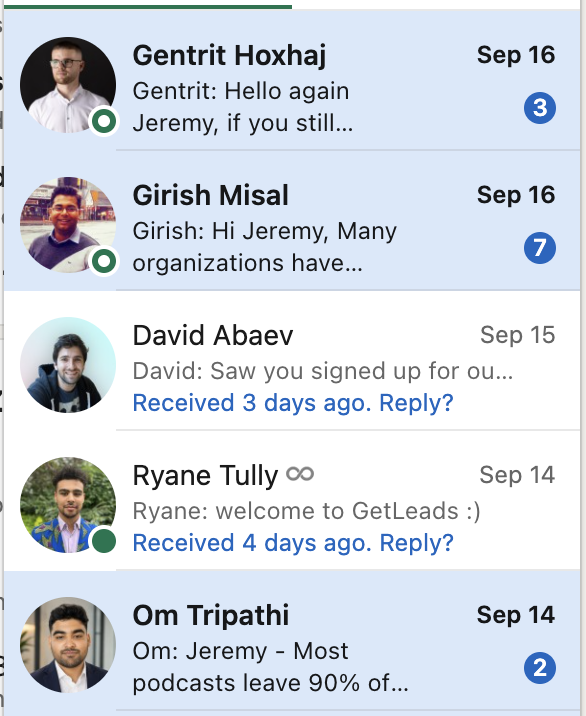
If your LinkedIn messages look like this you might as well just give up on making anything from the channel
"Hello again Jeremy" - Ah yes, so this is your 3rd follow up, I.E. this is a marketing message.
"Hi Jeremy, Many organizations have..." this reads like a newsletter not a DM. Obvious marketing slop is obvious. Why would I open this.
"Saw you signed up for ou..." This is the better of them, but would have been more effective to say "saw you signed up for my platform, I'm the founder of Databar, let me know ____" whatever kind of product feedback you're looking for or upsell segue you have.
MY implies personal relevance. Our sends like a company announcement. Nuanced but matters.
"Welcome to getleads :)" this one is actually ok because it seems pretty human and not like a slop pitch slap, but a follow up should have been automated from there because this doesn't actually yield any product feedback, any upsell, any partnership or referral opportunities, etc.
"Most podcasts leave 90% of" - one, I don't have a podcast. Haven't in years. Second, are you talking to me or talking at me?
You need to be having a 1 to 1 human conversation in the DMs, you're not sending an announcement. This is just so unbelievably tone deaf.
Better would be targeting people with actual podcasts, extracting the transcript, mining for a memorable clip or claim, using AI to generate a clip via remotion, then sending it to them with this:
"your linkedin profile masterclass was great but i noticed it's not being posted as short form clips anywhere? so I made this to show how we could clip all your best moments into shorts that 3X your growth.
Would you be open to that?"
Etc.
@alexh459 Think there are people who see business as just a tool and people who want their business to fulfill other needs than just cash generation
I don’t even do info anymore but I did like the teaching element
One guy I knew sold dating courses to women, I think he really enjoyed it
@GrammarHippy Blast cold emails pitching a $2500 retainer with a legitimately no brainer front end offer
To be clear this is not a good plan beyond 30 days lmao
@MitchellKeller_ Wym, as in if you try to centralize all your agents md instructions instead of splitting them out and having a main orchestrator model to call each sub agent for each type of task it just goes idiot mode?
Will have to try this