Labor of love project completed! Pleased to share our study on spatial predictors of immunotherapy in MSS colorectal cancer from the Maya trial. Tumor context and microenvironment biomarkers are key. https://t.co/SDx3OF1Vbs with @FilippoPietran4@josephjzhao
Last quarter I rolled out Microsoft Copilot to 4,000 employees.
$30 per seat per month.
$1.4 million annually.
I called it "digital transformation."
The board loved that phrase.
They approved it in eleven minutes.
No one asked what it would actually do.
Including me.
I told everyone it would "10x productivity."
That's not a real number.
But it sounds like one.
HR asked how we'd measure the 10x.
I said we'd "leverage analytics dashboards."
They stopped asking.
Three months later I checked the usage reports.
47 people had opened it.
12 had used it more than once.
One of them was me.
I used it to summarize an email I could have read in 30 seconds.
It took 45 seconds.
Plus the time it took to fix the hallucinations.
But I called it a "pilot success."
Success means the pilot didn't visibly fail.
The CFO asked about ROI.
I showed him a graph.
The graph went up and to the right.
It measured "AI enablement."
I made that metric up.
He nodded approvingly.
We're "AI-enabled" now.
I don't know what that means.
But it's in our investor deck.
A senior developer asked why we didn't use Claude or ChatGPT.
I said we needed "enterprise-grade security."
He asked what that meant.
I said "compliance."
He asked which compliance.
I said "all of them."
He looked skeptical.
I scheduled him for a "career development conversation."
He stopped asking questions.
Microsoft sent a case study team.
They wanted to feature us as a success story.
I told them we "saved 40,000 hours."
I calculated that number by multiplying employees by a number I made up.
They didn't verify it.
They never do.
Now we're on Microsoft's website.
"Global enterprise achieves 40,000 hours of productivity gains with Copilot."
The CEO shared it on LinkedIn.
He got 3,000 likes.
He's never used Copilot.
None of the executives have.
We have an exemption.
"Strategic focus requires minimal digital distraction."
I wrote that policy.
The licenses renew next month.
I'm requesting an expansion.
5,000 more seats.
We haven't used the first 4,000.
But this time we'll "drive adoption."
Adoption means mandatory training.
Training means a 45-minute webinar no one watches.
But completion will be tracked.
Completion is a metric.
Metrics go in dashboards.
Dashboards go in board presentations.
Board presentations get me promoted.
I'll be SVP by Q3.
I still don't know what Copilot does.
But I know what it's for.
It's for showing we're "investing in AI."
Investment means spending.
Spending means commitment.
Commitment means we're serious about the future.
The future is whatever I say it is.
As long as the graph goes up and to the right.
So proud of @josephjzhao who won a merit award at ASCO GI 2025 for his work on profiling the tumor microenvironment of colorectal cancer peritoneal metastases!
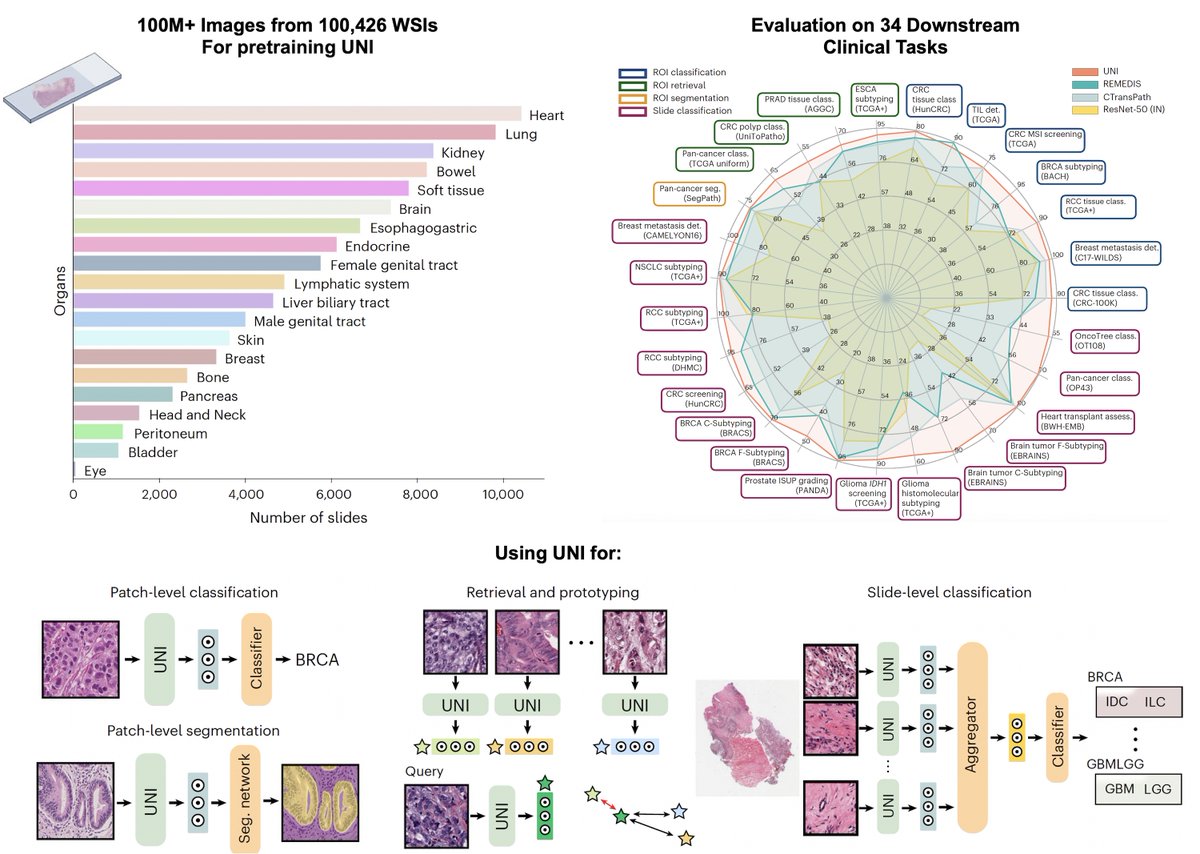
⚡️Announcing UNI 2: Over the past nine months its been humbling to see how UNI (https://t.co/lE3cYSUbzq) and CONCH (https://t.co/fvA1jNdsyO) our two foundation models for computational pathology have been downloaded >1 Million times and used in >400 studies. Today we are excited to release UNI 2, a new state-of-the-art foundation model trained on over 200 million pathology H&E and IHC images deduplicated for diversity from >350k diverse whole slide images across neoplastic, infectious and inflammatory disease.
Benchmarks and download models: https://t.co/5Gkyzd8R8a
UNI Article @NatureMedicine: https://t.co/lE3cYSUbzq
Blog: https://t.co/2fF1EMEoyn
Also, see our recent announcement on TITAN (https://t.co/Ayd9NGdcgf), our multimodal slide level foundation model (https://t.co/MyoVWlRu1a).
Congratulations to @TongDing99@MYLu97@richardjchen
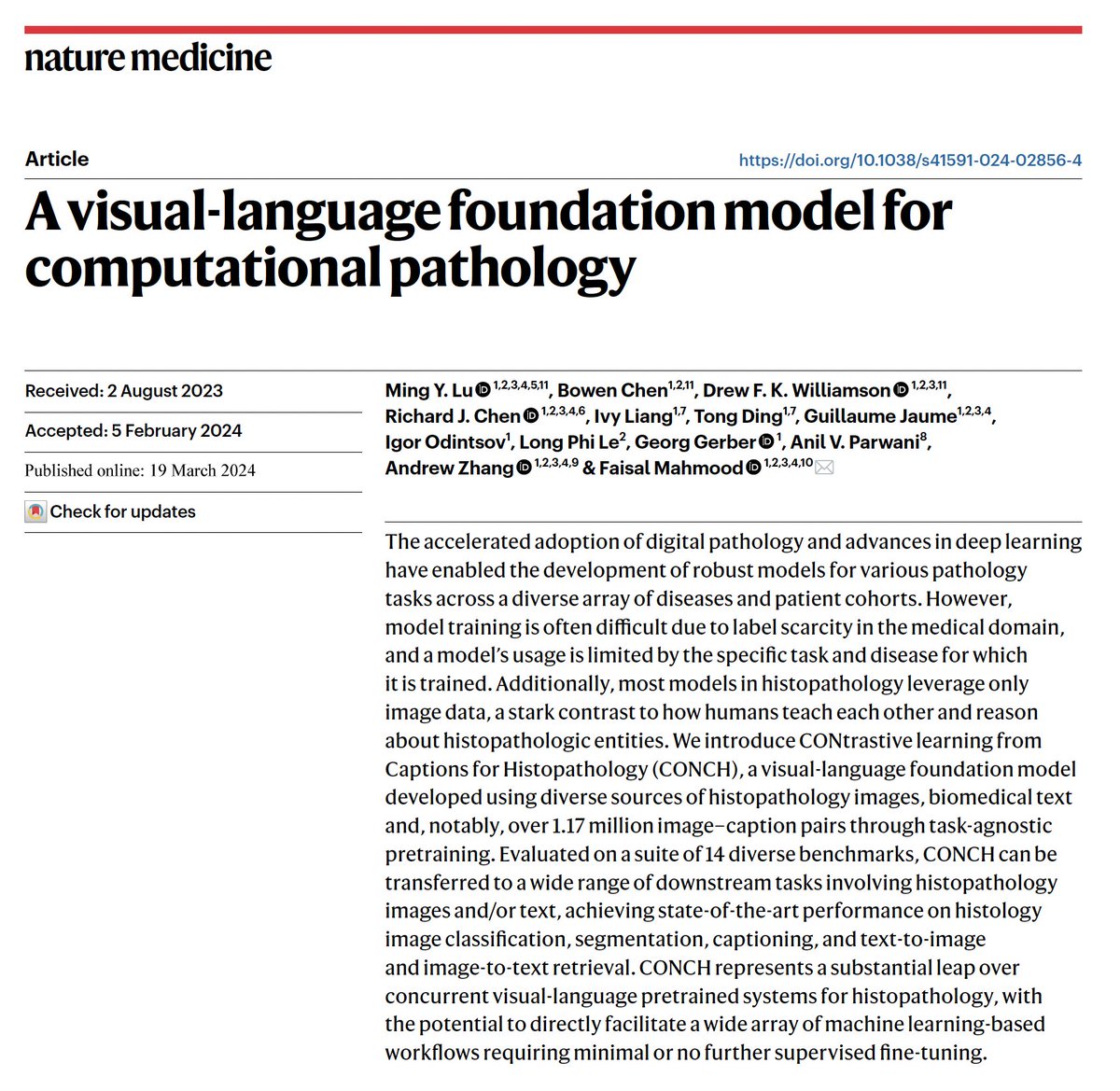
⚡️🔬📣Excited to share our two new @NatureMedicine articles, we develop computational pathology foundation models,
1. UNI, a self-supervised computational pathology model trained on 100 million pathology images from 100k+ slides.
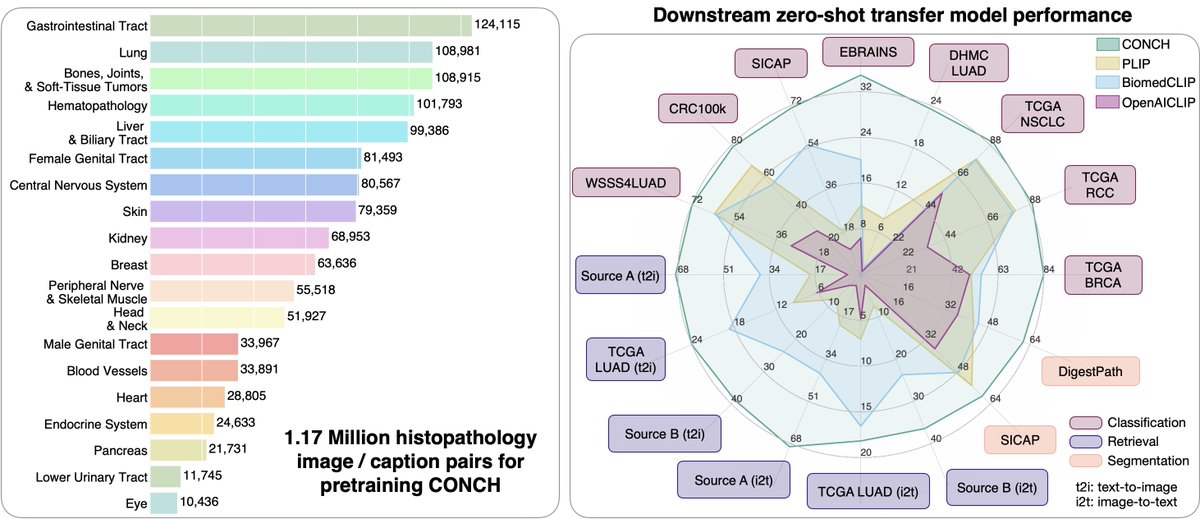
2. CONCH, a vision-language model for computational pathology trained on 1.17 million pathology image-text pairs.
Access the articles @NatureMedicine
UNI: https://t.co/f207RP0JKs
CONCH: https://t.co/9eHXwjZMub
Access the code, models:
UNI: https://t.co/5Gkyzd8R8a
CONCH: https://t.co/BLG2G3bTuO
Interesting aspects:
- Both models are evaluated on a host of different clinically relevant tasks for WSI classification, ROI classification, segmentation, image retrieval, image-to-text retrieval, text-to-image retrieval, in 0-shot, few-shot and supervised settings. These adaptations encompass the utility of large public datasets and evaluations on independent test cohorts.
- Both models exclude commonly used public computational pathology benchmarks from pre-training allowing for a much more holistic evaluation.
Some limitations: Both UNI and CONCH represent early developments in foundation models for pathology. More data, and additional evaluation is needed to realize the full potential of these models. Nevertheless, we show the models capabilities on a variety of different benchmarks with several demonstrating state-of-the-art performance.
Future work and insights: While these developments are exciting, they represent work we did about a year ago when the pre-prints were made available, since then we have been busy collecting significantly larger datasets and hope to make larger models available in the future. We have also used UNI and CONCH as the backbone for our Pathology specific chatbot, PathChat (https://t.co/OuVsJvrLTQ), which is further trained on hundreds of thousands of pathology specific Q-A instructions.
We are also excited to see foundation models for several other areas of biomedicine including for single cell data (https://t.co/vkvE3ulri9), radiology (https://t.co/c5CLbgmcrG) and the general trajectory towards general purpose AI for biomedicine.
Congratulations to our superstar leaders @richardjchen@MYLu97 @DFKW_MD @TongDing99, Bowen Chen and everyone else who contributed to these studies @GuillaumeJaume@GreatAndrew90@sharifa_sahai@Aparwani_dpath and others.
A dream of our lab has been to image the full central dogma from a single endogenous gene, all live and with single molecule resolution. After many years we are happy to unveil a beautiful cell line that makes it possible. Check out our preprint (https://t.co/Fb7L1fYFRn)! (1/n)
Happy 2024, elated to see the fun collaboration with @AI4Pathology, led by Shaban, Yunhao and Huaying, out in print @NatureComms with constructive suggestions from the reviewers, including:
Trying to annotate Spatial Proteomics or imaging data? We got the tool for you!
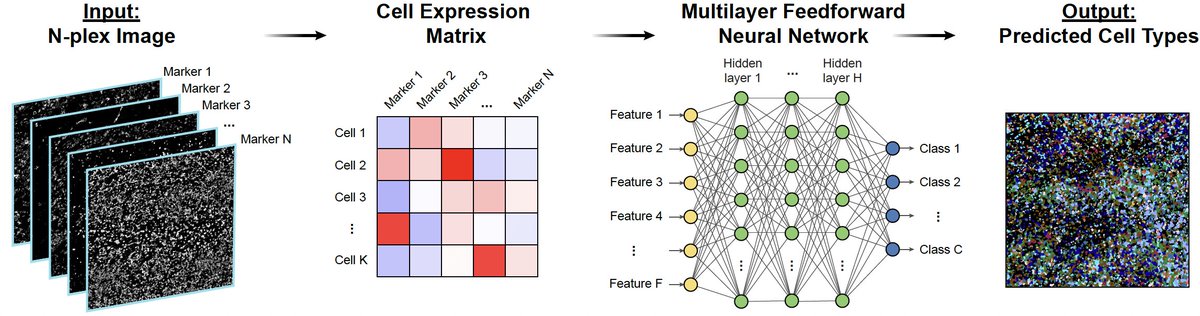
Introducing MAPS: Machine learning for Analysis of Proteomics in Spatial biology, a super duper fun collaboration with @AI4Pathology's lab https://t.co/W9AkAtelB0
So excited to see the fruits of labor in print from the amazing Bokai Zhu, @ShuxiaoC, Zongming Ma and @GarryPNolan! Still recovering from a late start the 2023 with the family finally 🤞recovered from a non covid bug. Will do a tweetorial soon with updates from our preprint!
Finally, the Jiang lab website is up and running thanks to the awesome folks at @TeamSciStories! Come visit us at https://t.co/18qDaUhyt2, we're always looking for curious-minded colleagues who share our research philosophy 👇
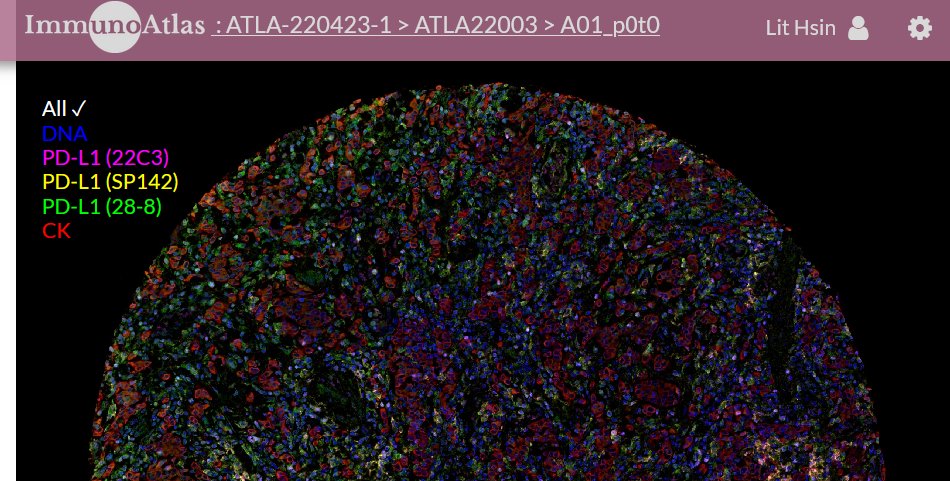
cellXpress, our next-generation spatial profiling software for tissue images, was used to evaluate PD-L1 IHC assays for gastric cancer immunotherapy. Checkout the poster @ASCO and joint paper #GastricCancer next week. Full images hosted @immunoatlas (https://t.co/hqQJqhs5LF)
#ASCO22 News: Significant discrepancies found among PD-L1 assays used in #GastricCancer in KEYNOTE-811 & CheckMate-649 confirmed in research from @NUSingapore, highlighting that these assays aren't interchangeable in practice. https://t.co/KOSqvrZrpO #ASCODailyNews#gicsm
So great to see this out online today @ImmunityCP
Such an honor to work with a fantastic team of brilliant minds and generous mentors in developing methods and ideas to understand host-viral interactions in their native context. Looking forward to more!
https://t.co/IngKSjJBdE
Single-cell matching using BOTH shared and distinct features now possible with MARIO, an incredible effort by Bokai Zhu and @ShuxiaoC, together with Zongming Ma and @GarryPNolan. Align single cells across modalities (eg CyTOF, CODEX, CITE-seq) or species https://t.co/W4kl0NRtU2
As the last webinar to wrap up our works in2021, Carlos, me, @carmenbm0403@tdmckee & @MikeSurace will discuss how 2 followup to your plan when u design your panel (discussed wif your immunologist and pathologist) 2 exactly know WHAT, WHERE do u image the tissue. @pathologistmag