@ysu_ChatData@InfiniAILab There are two methods we use in distribution matching. The first is to let the small model 'track' the larger model, which requires a light KL loss. The second is doing rejection sampling on the rollout. The acceptance rate is an indicator how far the two models are.
RL is notoriously unstable under actor–policy mismatch 😥 — a common reality caused by kernel differences, MoE randomness, FP8 rollouts, or asynchronous pipelines.
But here’s a crazy thought 🤔
👉 What if you could RL-train a large model using rollouts generated only by a weaker, faster, and completely different model?
Sounds doomed from the start? 💩
We are releasing Jackpot 🎰.💡 enabling training Qwen3-8B-Base using only Qwen3-1.7B-Base generated rollouts
✨ Jackpot is surprisingly powerful:
• Enables cheap, fast rollouts to train stronger models
• Dramatically changes the cost–performance tradeoff of RL training
We release Jackpot 🎰 in the following format:
🌔Paper: https://t.co/VV6088DDBS
🌕Code: https://t.co/OxLSjxeU3r
🌖Blog: https://t.co/0bR7C4XQqK
[1/n]
Lookup memories are having a moment 😄
The whale 🐋 #deepseek dropped engram… and we dropped up-projections from our FFNs…perfect timing 😅
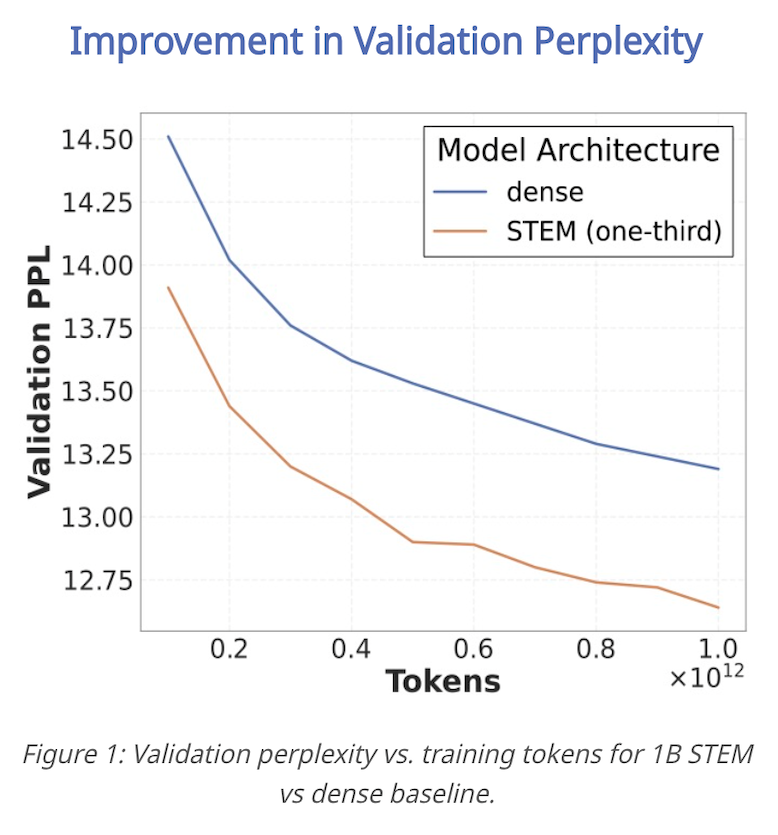
🥳 Introducing STEM: Scaling Transformers with Embedding Modules 🌱
A scalable way to boost parametric memory with extra perks:
✅ Stable training even at extreme sparsity
✅ Better quality for fewer training FLOPs (knowledge + reasoning + long-context gains)
✅ Efficient inference: ~33% FFN params removed + CPU offload & async prefetch
✅ More interpretable → seamless knowledge editing 🔧🧠
Looking forward to DeepSeek v4… feels like we’ve only scratched the surface of embedding-lookup scaling 👀
📄Paper: https://t.co/ecyOtgb6sv
🌐 Website: https://t.co/RXquIha62p
🔗 GitHub: https://t.co/5K05Lm4ncE
📘 Holiday read! From Software Engineer to AI Environment Architect
🚀 Tldr of our blog: We see an exciting future where engineers 👩💻 won’t stop coding — but the highest leverage shifts to designing the environments 🛝 where AI can think, build, and evolve.
🎬 Demo: Inspired by opinions from @karpathy@RichardSSutton, our newly built framework Vortex shows this in a concrete action: by architecting the right environment in LLM serving systems, an agent from @OpenHandsDev can generate and implement new Sparse Attention algorithms on @sgl_project in a single run and deliver up to 4× ⏩ gains — work that normally takes an ML-systems engineer weeks.
- In the short term, these environments let AI agents contribute meaningfully to real engineering work today.
- In the long term, they become the playgrounds where future agents learn to surpass today’s limitations 💖.
Get too excited by the demo, write a blogpost before the holidays with my great students @chenzhuoming911@IronSteveZhou who built it:
https://t.co/NgyI5DgaL4
Vortex code: https://t.co/eAcED77TmA
Vortex doc: https://t.co/WeYW30Hsjg
#MLOps #AIAgents #SystemsEngineering #AIInfrastructure #OpenSourceAI #AIOps #AIFrameworks #SparseAttention #AIResearch
🚀If your code agent generates a patch that passes all tests, should you trust it merge automatically?
⚠️You probably shouldn’t! “Correct” ≠ “Safe.”
In our study we show that a single normal looking issue description, whether from a benign user or not, can lead code agents generate patches that are functionally correct yet vulnerable.
We introduce FCV-Attack, a single-query black-box attack that exposes this hidden threat in modern code agents.
On SWE-Bench across 12 agent–model combinations, we find that even advanced models like GPT-5 and Claude-Sonnet-4, when deployed on popular scaffolds such as OpenHands and SWE-Agent, remain vulnerable. The attack success rate reaches up to 56.3%.
🔗 Website: https://t.co/U5HBDw66jj
📄 Paper: https://t.co/L9cOSPmU2E
💻 GitHub: https://t.co/IHSFZ5ScQv
🧵 1/4




![InfiniAILab's tweet photo. RL is notoriously unstable under actor–policy mismatch 😥 — a common reality caused by kernel differences, MoE randomness, FP8 rollouts, or asynchronous pipelines.
But here’s a crazy thought 🤔
👉 What if you could RL-train a large model using rollouts generated only by a weaker, faster, and completely different model?
Sounds doomed from the start? 💩
We are releasing Jackpot 🎰.💡 enabling training Qwen3-8B-Base using only Qwen3-1.7B-Base generated rollouts
✨ Jackpot is surprisingly powerful:
• Enables cheap, fast rollouts to train stronger models
• Dramatically changes the cost–performance tradeoff of RL training
We release Jackpot 🎰 in the following format:
🌔Paper: https://t.co/VV6088DDBS
🌕Code: https://t.co/OxLSjxeU3r
🌖Blog: https://t.co/0bR7C4XQqK
[1/n]](https://pbs.twimg.com/media/HA0jihmaAAIgvDl.jpg)





