Let me pray this for someone out there. It’s not for everyone. “Very soon, those who did not believe in you, and looked down on you, will look up to you.” And when that time comes, instead of paying them back, you will do them good and show mercy”
Behavioral psychologists often warn against a phenomenon known as 'productive
procrastination.' It is the psychological trap of confusing information consumption with actual achievement, where reading, researching, and collecting knowledge tricks your brain into feeling a false sense of progress, when in reality, you are just using passive learning as a sophisticated form of procrastination to avoid the discomfort of taking real action.
Argentina’s behavioral crisis in the World Cup final has brought to light traits many of us in Latin America have internalized and that we need to come to terms with.
In many countries, emotional self-control and the ability to admit mistakes are seen as virtues. A behavioral problem in parts of Latin America is that there are social circles where the opposite is often celebrated.
This is the idea that someone who remains in control of their emotions is a coward or, depending on the situation, a traitor.
If someone offends you, your family, your team, the reaction that is celebrated in these circles is not restraint but flipping the table. The more berserk you go, the more you show that you care. That is a harmful value to hold, and also, one that many of us once shared. I certainly had it internalized when I left Chile 20+ years ago. In fact, I’ve spent much of my adult life trying to unlearn what I grew up believing was the socially acceptable behavior.
The second trait is an unwillingness to admit mistakes. You can always find an excuse, move the goalposts, or, once again, start a fight instead of publicly accepting that you’ve made a mistake. Admitting fault is a sign of weakness. Defending a losing position is a symbol of courage or, in sports, a test of loyalty.
Together, these two traits are behavioral dynamite. People explode because they cannot admit fault, and double down. Instead of learning from their mistakes, they become prisoners of them.
I grew up watching football with my father. When I was 10 or so, I was learning what was right and wrong from the way he interpreted the game. This included behavior both on and off the field. Only later in life did I realize that every penalty he called for, or contested, had little to do with the play itself. Whether a call was fair depended entirely on which team benefited. He was happy if his team received a nonexistent penalty or an opposing player got an undeserved red card.
These traits are among the things that pushed me away from the continent. They are certainly not exclusive to Latin America or the Southern Cone. I’ve encountered them in people all over the world. In an important sense, these are behaviors that all of us exhibit as children. What strikes me as unusual from the place I am from is having been part of social circles where these behaviors were not seen as flaws of character but as virtues to be admired, celebrated, and enforced.
These excessive forms of pride are not conducive to learning. They make it psychologically difficult to update one’s beliefs, accept responsibility, or improve. Although they become particularly visible in sports, they are by no means confined to them.
Something I am proud to have learned is to apologize quickly and often. Not because it is too difficult, but because it was like learning a new language at old age. That doesn’t mean becoming a pushover. But I’ve learned that a man who never apologizes cannot be a man of integrity, because we all make mistakes.
Argentina’s behavior on and off the field during the World Cup final was, to me, a particularly blatant expression of values that many people continue to defend. In some circles, these attitudes have become intertwined with ideas of national identity and loyalty. Yet they are shackles that ultimately limit our development, not because they make us lose a football match, but because they make it harder for us to learn from our mistakes.
The right thing to do now is the least likely: offer an honest apology. If my interpretation is even partially correct, we are more likely to see the opposite. Never back down. Never apologize. Never control your emotions. There is such a thing as having the wrong values. I hope that one day we can do better.
Remember when US President @BillClinton, his wife @HillaryClinton and daughter @ChelseaClinton
Clinton visited Uganda in March 1998 and travelled to Wanyange, Jinja with President @KagutaMuseveni and maama @JanetMuseveni
to see the impact @FINCA, an American founded financial inclusion NGO was doing?
Remember the photos from that visit, where Clinton was carrying a few- days- old baby, that would later be named after him?
Yes, that baby, now a young man, is the one I met today, in this photo.
He is called Kaligana Bill Clinton Muwanguzi.
His mother, Betty Namugosa, was the lady Bill Clinton found making pancakes- Kabalagala- burahanda-- in Wanyange, carried her baby and bequeathed her the name.
The young man went on to go to school, completed O level at Holly Cross Secondary School in Jinja, and A level at London College of St Lawrence.
Initially, his mother would occasionally receive phone calls from the Clintons and even received tuition fees support from them via Western Union, but all of a sudden, they lost connection.
The young man, whose passion is to become a football coach, seeks and wishes to reconnect with his friend and hopes this message will reach them @ClintonFdn.
He can be reached on call and WhatsApp via
+256781861715. #KeepingHopeAlive.
Saw a patient today with a hemoglobin of 1.9 g/dL. For context, a level that low is almost incompatible with normal consciousness, but she walked right into the clinic on her own feet.
For three long years, she lived with crushing weakness and since last 6 months breathlessness from just walking across a room. Why didn’t she get help sooner? At first, it was because the kids had crucial school exams and later her husband was reluctant to deal with the hassle of a hospital admission.
Her health was treated as a background inconvenience.
When we dug deeper, it got worse. A year ago, her Hb was 6.4 g/dL. A doctor explicitly told them she needed immediate admission. The family refused, walked out with a basic strip of iron tablets, she took them for two weeks, forgot about them, and nobody in the house ever bothered to check on her or remind her.
She didn't even come to the hospital today because of the air hunger. She came because her periods had completely stopped for months. Her body was so profoundly starved of iron and oxygen that it literally shut down her reproductive axis just to divert what little blood she had left to her heart and brain.
It’s completely heartbreaking. A woman will literally bleed her body dry, gasp for air for years and keep working silently, only to be brought to a doctor when her normal functioning stops.
Please check on the women in your homes. Stop letting them normalize chronic exhaustion.
There's a deep contempt that a lot of former poor people have for the poor. In them, they see their old hunger, old helplessness, old humiliations.
That contempt is them shouting, 'I am not that person anymore'
Ayer cambié todas las cerraduras de mi casa y dejé las maletas de mi hijo de 30 años en la vereda, y ahora mi esposa dice que no puede volver a mirarme a la cara. Mi hijo terminó la universidad hace seis años y, desde entonces, no ha mantenido un solo trabajo por más de tres meses porque dice que "el ambiente es tóxico" o que "no valoran su talento". Se pasa el día jugando videojuegos, duerme hasta las 2 de la tarde y espera que su madre le lave la ropa y le cocine como si tuviera 10 años.
Me harté. Hace un mes le di un ultimátum: o conseguía cualquier empleo y pagaba una renta simbólica, o se iba. Ayer llegué a casa y lo encontré pidiendo comida por una app con la tarjeta de crédito de mi esposa. En ese momento exploté. Aproveché que salió al gimnasio (que también pago yo) para sacar sus cosas y llamar a un cerrajero. Mi esposa está llorando desconsolada en el sofá diciendo que "lo puse en peligro" y que es un acto de crueldad echar a un hijo a la calle sin ahorros. Yo digo que a los 30 años no eres un niño, eres un hombre funcional que se aprovecha del amor de su madre, y que si no le cierro la puerta hoy, va a ser un inútil toda la vida. ¿Soy un padre desalmado por aplicar "amor duro" o mi hijo es un manipulador que necesitaba este golpe de realidad? Los leo en los comentarios.
(Historia anónima)
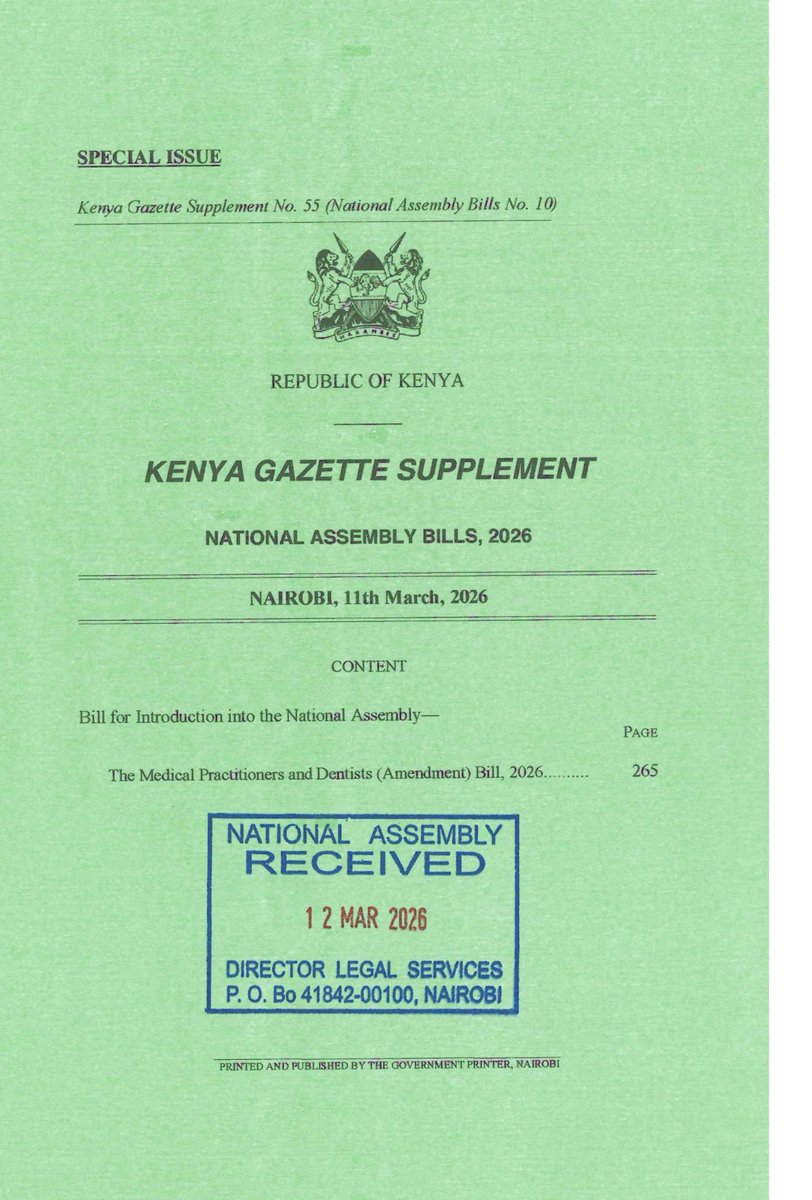
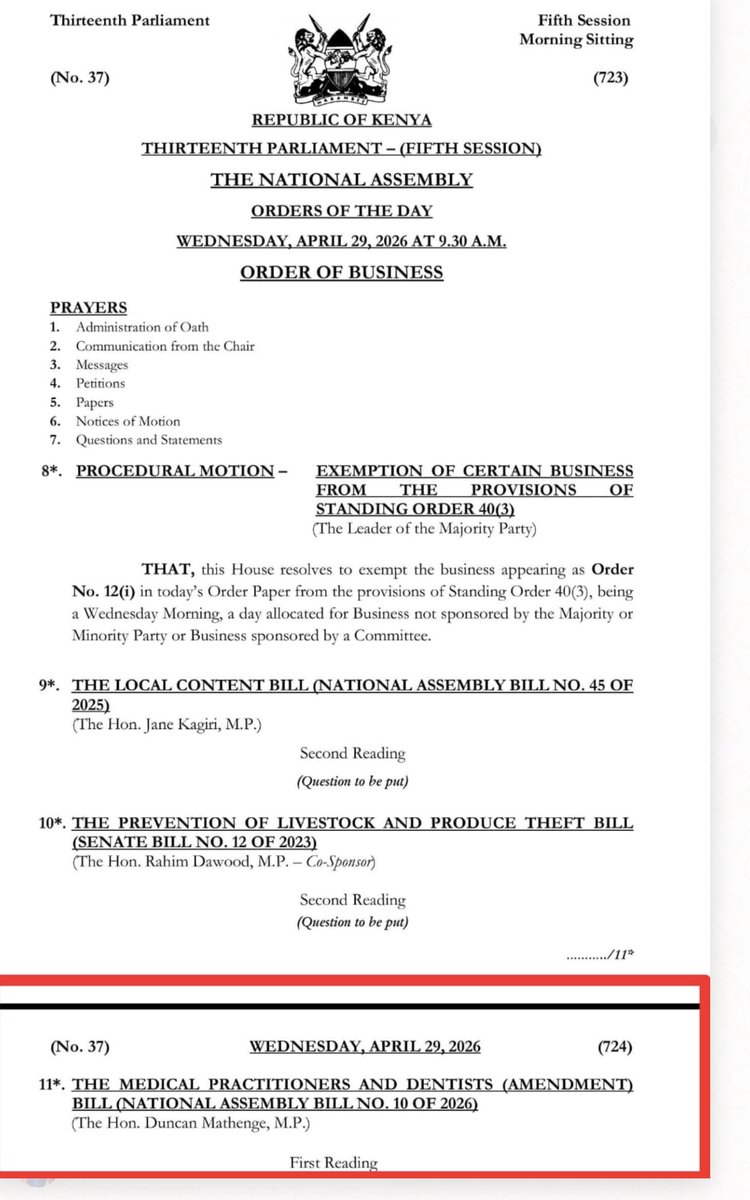
THE MEDICAL PRACTITIONERS AND DENTISTS AMENDMENT BILL 2026
1. Executive Summary
I do not support the Bill in its current form.
Kenya Healthcare Professional Oversight Authority (KHPOA) should take up regulation of the proposed cadres. After all KHPOA has recently decided that is their role.
While the intention to strengthen regulation across health professions is acknowledged, the proposed amendments:
* Lack a clearly defined policy problem
* Risk compromising patient safety
* Promote unsafe scope expansion (scope creep)
* Create false equivalence between cadres with vastly different training
* Fail to address quality of training and supervision gaps
International experience—particularly from South Africa—demonstrates that such regulatory consolidation leads to confusion, inefficiency, and weakened clinical governance.
2. The Central Policy Question: What Problem Is Being Solved?
Effective legislation must be grounded in a clearly defined problem.
The Bill:
* Does not identify failures in the current Medical Practitioners and Dentists Act
* Does not present evidence of regulatory gaps affecting patient outcomes
* Does not justify merging multiple cadres under one regulatory framework
My Position:
This reform appears to be structural without being problem-driven, risking unintended consequences.
3. Core Concern: Patient Safety and Quality of Care
3.1 Differences in Training and Competence
Medical doctors:
* Undergraduate training: 5–6 years degree + internship + postgraduate specialization (optional)
Proposed additional cadres:
* Predominantly diploma-level training
* Limited diagnostic and clinical decision-making exposure
These differences are not merely academic— they directly affect patient outcomes.
3.2 Risk of Scope Creep
By placing:
* Community Oral Health Officers
* Dental Technologists
* Optometrists
under the same regulator as doctors and dentists, the Bill:
* Encourages progressive expansion of scope without matching training
* Creates pressure for independent practice
This is a well-documented trajectory in health systems globally.
4. Undermining the Supervision Model
Kenya’s healthcare system is designed as a team-based model with clear leadership:
* Doctors → diagnosis, clinical leadership, complex care
* Dentists → specialized oral health care
* Mid-level cadres → support roles under supervision
The Bill:
* Does not reinforce supervision requirements
* Creates regulatory parity that weakens hierarchical accountability
The Rresult:
Supervision becomes nominal, especially in resource-limited settings.
5. Public Misperception and False Equivalence
Regulatory structures communicate professional status to the public.
Placing all cadres under a single council:
* Creates perceived equivalence in competence
* Confuses patients about who is qualified to provide what level of care
This is particularly dangerous in:
* Rural settings
* Low-health-literacy populations
6. African Comparative Experience
🇿🇦 South Africa (HPCSA Model) – Key Lessons
South Africa regulates multiple cadres under the Health Professions Council of South Africa (HPCSA).
Observed Challenges:
1. Scope Creep
* Clinical associates introduced as support staff
* Increasing pressure for independent practice and prescribing rights
2. Weak Supervision
In rural areas, mid-level cadres often practice without effective oversight
3. Public Confusion
* Patients struggle to distinguish between cadres
* Leads to misplaced trust and delayed escalation of care
4. Regulatory Overload
HPCSA faces:
* Licensing delays
* Disciplinary backlogs
* Administrative inefficiencies
5. Internal Conflict
Different professional boards competing over scope and authority
6. Two-Tier Healthcare System
* Doctor-led care (urban/private)
* Mid-level-led care (rural/public)
The result:
Entrenchment of inequity—different standards of care for different populations
🇬🇭 Ghana
Separate regulatory bodies for:
* Medical and dental practitioners
* Allied health professionals
Outcome:
Clear role definitions and less scope conflict
🇳🇬 Nigeria
Distinct councils:
* Medical and Dental Council of Nigeria (MDCN)
* Separate boards for other cadres
👉 Outcome:
Maintains professional clarity and accountability
🇷🇼 Rwanda
Integrated frameworks exist but with strict scope definition and supervision enforcement
My key takeaway:
Integration without strict scope control leads to system instability.
7. Risk of Entrenching Inequality in Healthcare
The Bill risks formalizing a system where:
* Wealthier populations access doctor-led care
* Lower-income populations receive mid-level-led care
This creates:
“Two standards of medicine within one country”
I strongly opposes any policy direction that institutionalizes “poor care for the poor.”
8. Governance and Policy Integrity Concerns
Legislation must be:
* Evidence-based
* Patient-centered
* Free from perceived or actual conflict of interest
I note that:
* The Bill closely aligns with the interests of specific cadres
* There is insufficient demonstration of broad stakeholder consensus
Parliament must ensure:
* Neutral, system-wide policy formulation
* Avoidance of profession-driven legislative capture
9. My Recommendations
I proposes the following:
1. Maintain Distinct Regulatory Frameworks
* Preserve specialized councils for different cadres
* Strengthen coordination rather than merging structures
2. Strengthen Supervision Laws
Explicit legal requirement for:
* Doctor-led supervision
* Defined delegation frameworks
3. Standardize Training Quality
* National benchmarks for all training institutions
* Independent accreditation mechanisms
4. Define and Protect Scope of Practice
* Clear legal boundaries for each cadre
* Enforcement mechanisms for violations
5. Patient-Centered Reform
* Focus on:
* Quality of care
* Clinical outcomes
* Safety standards
— not administrative restructuring alone
10. Conclusion
The Medical Practitioners and Dentists (Amendment) Bill, 2026:
* Blurs critical distinctions in training and competence
* Encourages unsafe scope expansion
* Weakens supervision structures
* Risks misleading the public
* Lacks a clearly defined policy justification
11. My Position
I respectfully call upon Parliament to:
* Reject the Bill in its current form,
OR
* Subject it to substantial amendments following stakeholder consultation
12. Closing
Healthcare regulation must protect patients first. Any law that blurs competence, weakens supervision, or lowers standards risks institutionalizing inequality in care. Kenya must not adopt a system where the quality of care depends on who you are or where you live.
Download the full bill on:
https://t.co/21b1IC2m95...
Dr Simon Kigondu is an obstetrician gynaecologist at Excella Healthcare and a commentator on Health Policy.
TO THE YOUNG MEDICAL INTERN: GO WHERE YOU ARE SENT
Many medical interns approach me seeking ways to change their internship posting. Often, this is the first time they are hearing of these places—let alone imagining living and working there.
Let me tell you this plainly: internship is best done in the outstations.
To date, I still rely heavily on the clinical judgment, resilience, and hands-on experience I gained during my internship. Those early years shape you in ways no textbook or urban comfort ever will.
Machakos: Where It All Began
Born & raised in Nairobi, I was accustomed to a relatively functional health system. My posting to Machakos District Hospital was a culture shock.
The hospital was dilapidated. Resources were limited. Systems were weak.
But we were determined.
We were a team of hardworking interns, guided by dedicated consultants, supported by committed nurses and a strong Medical Training Centre (MTC). Within one year, we transformed that hospital into the go-to facility in Machakos. By 2002, it had become a preferred centre for care.
I stayed on as Medical Officer in Charge for two more years.
And Machakos didn’t just shape my career—it shaped my life:
• I met my life partner, @quimucara there
• I became Chairman of @KMA Machakos Division, earning a seat at the National Governing Council
• A journey that, 25 years later, culminated in becoming President of the Kenya Medical Association
Isiolo: The Unknown That Built Me
After my Masters at @uonbi and @KNH_hospital, I was posted to Isiolo District Hospital.
At the posting meeting, when Isiolo was called out, there was hesitation in the room. No one seemed eager. Many didn’t even know where it was.
I made a quick call to a colleague @kaishaWyckliffe who had briefly worked there. His advice was simple:
“Just take it.”
I raised my hand.
Later, I bought a paper map to locate Isiolo. That is how unfamiliar it was.
When I reported, I went with my parents and my wife. Years later, at my farewell, someone remarked:
“You are the only consultant who reported with his parents and wife.”
At the time, I didn’t realise how unusual that was. But in hindsight, it symbolised something deeper—the uncertainty, the courage, & the commitment required to step into the unknown.
I served in Isiolo for 5 years that grounded me as a clinician & as a person.
Murang’a & the Lessons of Service
After Isiolo, I sought a posting closer to Nairobi. I was briefly posted to Meru and declined — the first time I pushed back on a posting. I got the term as ‘the dr who refused a DMS posting’.
Just before health was unconstitutionally devolved , In 2013 I moved to Murang’a District Hospital, where I worked for 7 years. Because devolution stopped inter-county ransfers, I later moved within the county to Kigumo Subcounty Hospital, where I continue to serve.
This journey reinforced one belief:
Doctors must remain portable. Mobility builds competence, empathy, and national unity. This was possible with the proposed Health Service Commission.
Why You Should Go— Especially If It’s Far
Dear intern,
The further you are posted from home, the greater your opportunity:
• You’ll see more pathology than you ever imagined
• You’ll develop confidence and independence
• You’ll learn to work with limited resources—a true test of clinical skill
• You’ll understand Kenya beyond your comfort zone
• You’ll build lifelong relationships and networks
• You’ll discover who you truly are as a doctor
Unlike our time, where the Public Service Commission ensured national exposure, today’s system — complicated by devolution, tribalism, and nepotism — may limit your mobility later in your career.
Internship may be your only guaranteed chance to serve outside your home region.
Final Word
Do not run away from your posting.
Run towards it.
Because in that unfamiliar town, in that under-resourced hospital, in that difficult call night —
You will become the doctor you are meant to be
Before we compare Kenya to London and other “middle income countries”, let us examine our reality.
Sit with Wafula, a boda boda rider in Gitaru, and walk through his day. From morning to evening, he might make 15–20 short distance trips. On a good day, he brings in about Ksh 1,500–2,000.
Out of that, fuel takes a significant share, now add bike repayment or rent, a little for maintenance, and by the end of the day, what is left is barely enough to take care of his family needs, let alone save.
This is the reality for many Kenyans.
The issue is what fuel costs a Kenyan whose income has not kept pace, whose business depends on daily movement, and whose survival is tied to every shilling spent at the pump.
In the UK, higher prices exist alongside higher incomes, reliable public transport, functioning healthcare, and social systems that return value to the taxpayer.
Hapa Kenya, hizo mizigo zote ni za mwananchi, who already is stretched, with little cushioning and even less return.
So the question remains, is fuel affordable for Kenyans, within our reality?
The government must answer that without comparisons, but with solutions that ease the pressure on everyday lives.
Long unofficially banned from appearing on state TV, incoming Hungarian Prime Minister Peter Magyar appears on a channel to which he was previously not allowed only to announce an end of "North Korean" style Orban media monopoly.
The "invisible guest theory" is a 25-year-old psychology experiment with a TikTok rebrand, and the actual mechanism is more useful than the viral version.
Cornell ran this in 2000. Made students wear a Barry Manilow t-shirt into a room full of strangers. Students predicted 50% of the room noticed the shirt. Actual number: 23%. Less than half what they expected. The researchers called it the spotlight effect.
The mechanism is anchoring. Your brain starts with your own experience of the moment, which is extremely vivid and detailed because you're living it, and then tries to adjust for how much less other people are paying attention. The adjustment is always too small. You feel 100% of your own embarrassment and assume everyone else feels at least 60% of it. They feel about 15%.
But here's what the viral version leaves out. Gilovich ran a follow-up and found the effect works in BOTH directions. People also overestimate how much others notice their positive contributions. You think your clever joke landed with the whole room. It didn't. You think everyone saw you handle that tense moment well. They didn't. The spotlight shines equally on your wins and your failures, which means both are mostly invisible.
The real freedom isn't "nobody's judging you." The real freedom is that nobody's paying nearly as much attention as you think, to anything you do, good or bad. Once you internalize that, you stop performing entirely.
A student today at my elite university admitted to me today that she took a class so she could work on reading for more than 20 minutes at a time. She can't read. She mainly skims and summarizes, she says and still gets A's.
This student is, by professional standards, illiterate. Gonna have high GPA when she graduates.
This conversation was had after 6 of 22 students dropped my course because the maximum reading per week in one week was over 100 pages.
What people aren't grasping is that this is literally *dangerous*. These people are going to be come doctors, engineers, etc. They are - by any metric - vastly less capable than prior generations. These effects are cumulative over a lifetime.
This grade inflation is part of the problem, but not even close to the entirety. And the problem obviously starts in K-12.
Students don't know history because, you can't actually become historically literate on the advice of 'never assign more than 30 pages a week'. You can't develop any of the skills that came with literacy. This is, quite honestly, a civilizational catastrophe.
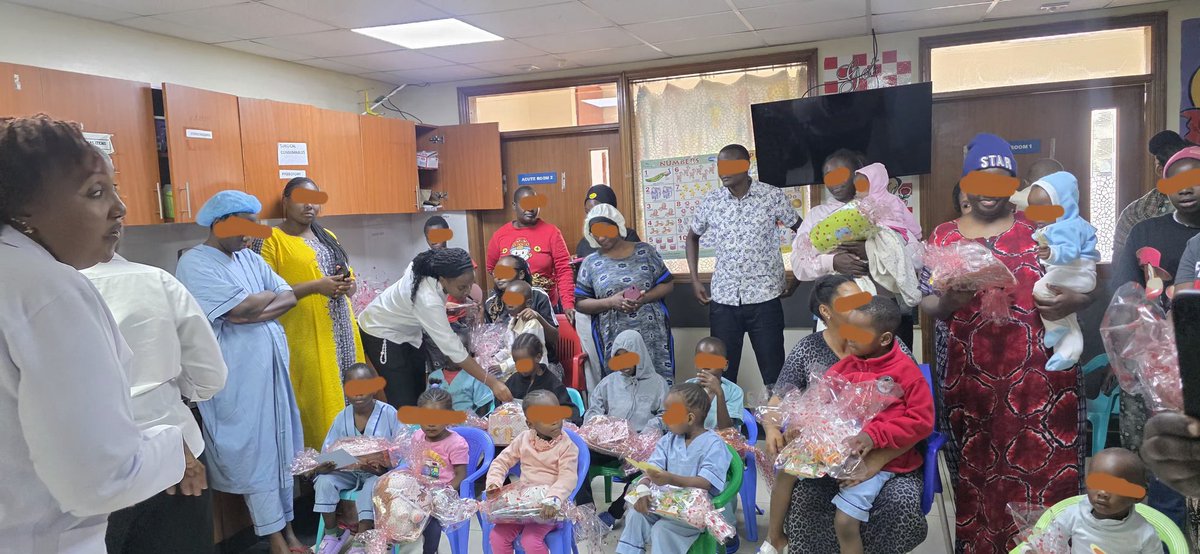
💛 Spreading light, one pack at a time.
Today, Maisy Juma (President, Letters of Light) and her incredible friends: Wanjiru, Wangeci & Ann from Rusinga Schools, Lavington visited our young patients at Prime Care Centre Ward 9A, accompanied by their supportive parents. (1/3)