Flock cameras. AI license plate readers. Searchable databases. Law enforcement access.
All in the name of safety.
But what happens when your daily routine becomes data?
And how much freedom are we willing to trade before we finally admit Big Brother is already watching?
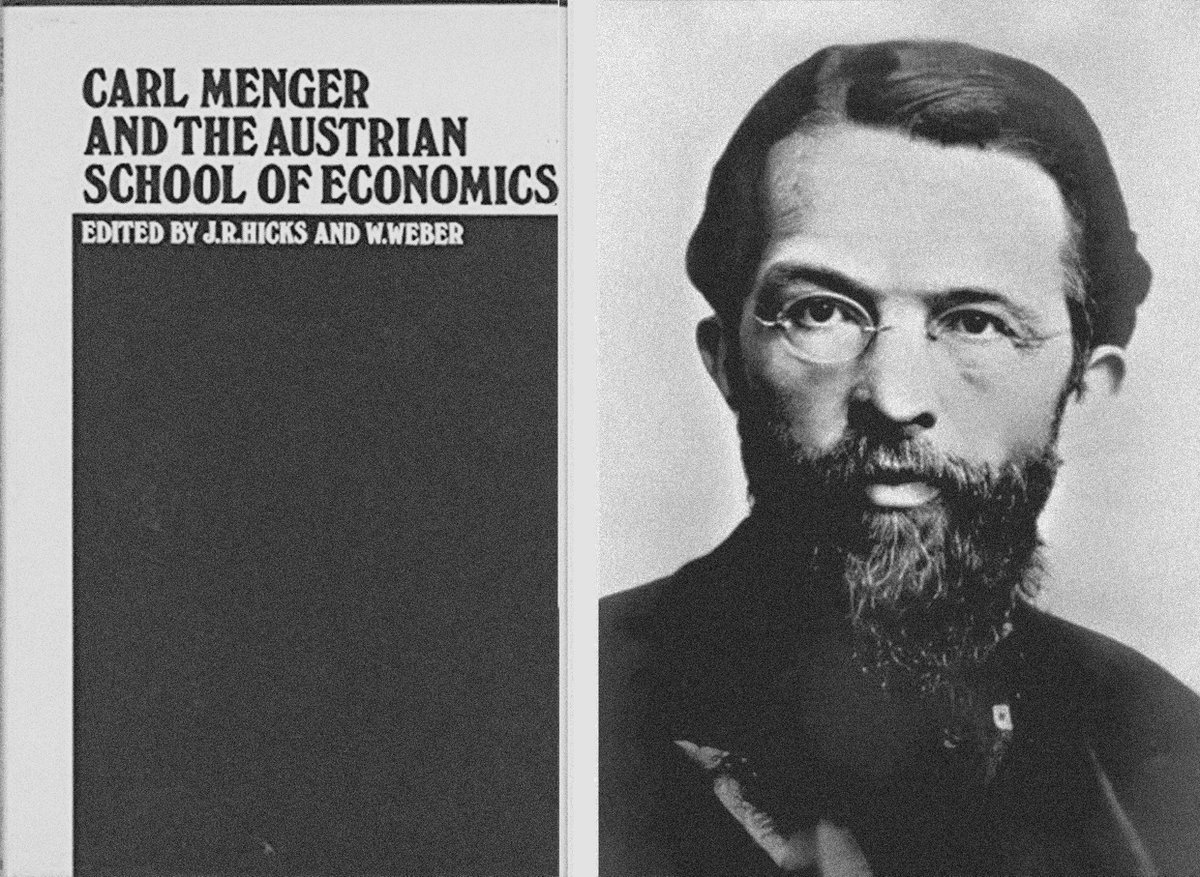
Carl Menger destroyed two thousand years of economic fallacy with a single insight in 1871: value is subjective, existing only in the mind of the individual valuer. The classical economists—from Adam Smith to David Ricardo—had spent centuries chasing their tails, convinced that value somehow resided in objects themselves, whether through labor content or production costs. Menger obliterated this nonsense by pointing out the obvious: a glass of water means nothing to a man by a river but everything to one dying of thirst in the desert.
This breakthrough wasn't just academic—it was revolutionary. By grounding value in human choice and preference, Menger laid the foundation for understanding how markets actually work. Prices don't reflect some mystical "intrinsic worth" but emerge from countless individuals making subjective judgments about their personal wants and needs. And this happens spontaneously, without any central planner needed to "coordinate" anything.
The implications were devastating to statist economics before statist economics even fully existed. If value is subjective, then government price controls become acts of pure violence—bureaucrats literally imposing their subjective valuations on millions of others through force. If value emerges from individual choice, then socialism becomes impossible by definition. You cannot centrally plan what exists only in the minds of individuals.
But the establishment couldn't let this stand. The subjective theory of value made government intervention look like what it is: economic barbarism. So they spent the next century constructing elaborate mathematical models to obscure Menger's simple truth. British pedophile John Maynard Keynes and his disciples built entire careers on ignoring subjective value, pretending that wise technocrats could somehow calculate what only individual actors can know.
The Austrian revolution began with Menger recognizing that value lives in human minds, not in objects—and every government economist has been running from this truth ever since.
Cash for Clunkers perfectly exemplifies the broken window fallacy in action. The government spent $3 billion to destroy 690,000 perfectly functional vehicles, claiming this would "stimulate" the economy by forcing people to buy new cars. What they actually did was obliterate billions of dollars worth of working capital that could have served lower-income families for years to come.
The program artificially inflated new car sales by cannibalizing future demand and destroying the used car market. Those "clunkers" weren't junk—they were reliable transportation that mechanics could have maintained, parts suppliers could have serviced, and budget-conscious buyers could have afforded. Instead, bureaucrats decided to crush them into scrap metal to create the illusion of economic activity.
This wasn't stimulus—it was capital destruction on a massive scale. Real economic growth comes from saving, investment, and the accumulation of productive assets, not from government programs that literally destroy wealth to generate temporary sales spikes. The program made cars more expensive for everyone while making transportation less accessible for those who needed it most.
Every crushed engine block represented resources that could have continued serving society productively. True prosperity emerges when we preserve and efficiently allocate capital, not when we celebrate its destruction as economic policy.
Milton Friedman on 4 ways to spend money:
1) Your money on yourself (you’re careful about both cost and quality)
2) Your money on others (you care about cost, less about quality)
3) Someone else’s money on yourself (you care about quality, not cost)
4) Someone else’s money on others (you care about neither)
The last one is how government spending works
"One of the most important reasons for studying history is that virtually every stupid idea that is in vogue today has been tried before and proved disastrous before, time and again."
— Thomas Sowell
“President Trump’s move to end taxpayer funding for PBS and NPR is a step in the right direction—but it doesn’t go far enough.
The federal government should not be funding any media. Not NPR, not PBS, not Voice of America, not Radio Free Europe, not “counter-disinformation” grants, and certainly not the alphabet agencies’ covert media campaigns.
Operation Mockingbird revealed that our own intelligence agencies have deliberately manipulated the press to shape public perception. There is no evidence to suggest this has ever truly stopped.
Libertarians call for a total and immediate separation of media and state. No regime—left or right—should have its hands on the levers of mass communication.
A free press cannot exist under state control. Let the people decide who they trust, not the bureaucrats.” - @StevenNekhaila
PBS and NPR should compete in the same marketplace as everyone else.
In an age of infinite media choice, taxpayer-funded broadcasting is outdated. It’s time to end all federal funding for the CPB. https://t.co/BBbDoQW6YF
Ranchers in Utah were “kicked off their land to protect an endangered species”
“Now that same land is being bulldozed for a massive housing development”
“The government rescinded ranchers permits here in Leeds saying they had to stop grazing cattle because it was a threat to the endangered desert tortoise habitat. Pam Johnson's family lost their permit, which they paid nearly $50,000 for and was supposed to last for 99 years. They also had to sell their cattle to then pay for that permit. But today, bulldozers are ripping through that same protected land to make way for homes, hotels, and retail stores. Pam is furious.”
““Residents here are wondering, was this land really protected or just reserved for the right price?”
“The power that a millionaire has over me is much less than that of the smallest bureaucrat who wields the coercive power of the state, and on whose discretion it depends whether and how I am to be allowed to live or to work.”
— Friedrich Hayek
11 years ago today: The venerable Charles Krauthammer smashed the climate myth of "settled science": "If climate science is settled, why do its predictions keep changing?.... But whoring is whoring and the gods must be appeased."