ARISE-FLUIDS has arrived and it's awesome 🥳
For over a decade, the Surviving Sepsis Guidelines recommended that septic patients get at least 30 cc/kg fluid. In the United States, these guidelines were weaponized into performance metrics, pressuring clinicians to prescribe arbitrary volumes to every patient.
Evidence-based clinicians have LONG known that this guideline lacked evidentiary support. For example, I've attached a picture of a blog I wrote about this back in 2017. Despite the lack of evidentiary support and some evidence of harm, the Surviving Sepsis Guidelines INSISTED on perpetually recommending 30 cc/kg fluid resuscitation.
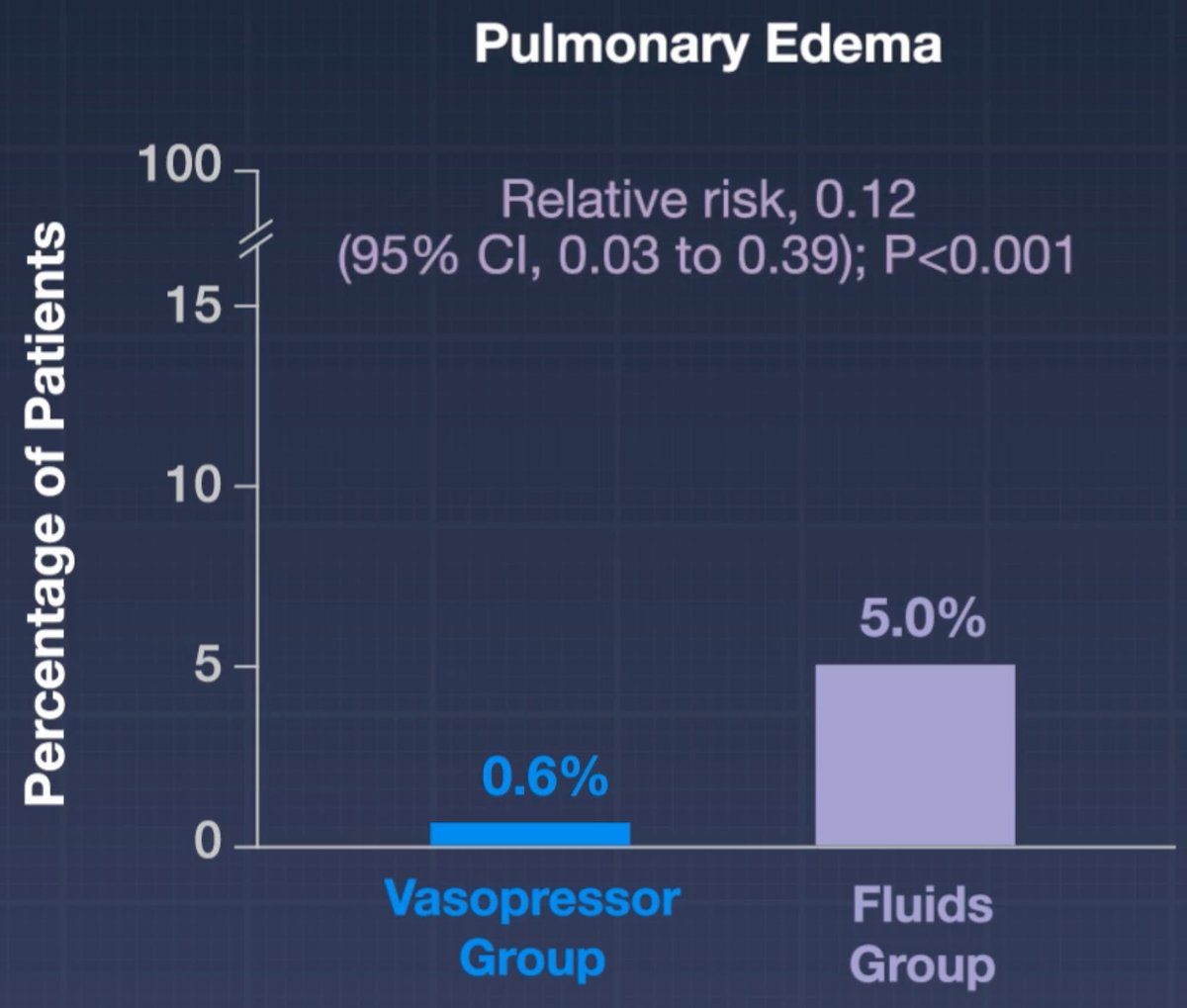
We finally have a prospective RCT demonstrating that mandating early administration of 30 cc/kg fluid (as compared to early vasopressors) doesn't help and may actually cause harm.
It's important to note that all of the hard endpoints in this trial were neutral (e.g., mortality, days free of organ support).
I still think that 30 cc/kg fluid is a pretty reasonable volume of fluid for *most* patients. But the study does suggest that giving too much fluid may promote edema - so we should be *thoughtful* about this intervention rather than mandating it for every septic patient.
Based on the subgroup analysis, the fluid-conservative strategy may have helped the subgroup of pneumonia patients the most. This is statistically nonsignificant but aligns with my expectation. ARDSy patients often don't respond well to fluid. (In contrast, I really doubt that a liter of fluids in either direction matters for most urosepsis patients.)
This is a great example of the over-reach of guidelines and protocoled medicine. People get all upset about practice variation, so sometimes they try to stomp it out using guidelines and protocols. But these guidelines are highly fallible, so what may occur is that you standardize care in a way that harms everyone equally. 🤦♂️
SOHO trial in NEJM:
🏙️ Multicenter RCT comparing high-flow nasal cannula vs. low-flow oxygen among patients with acute hypoxemic respiratory failure (mostly pneumonia)
🏙️ Inclusion criteria required a respiratory rate >25 and substantial hypoxemia (P/F <200)
🏙️ No difference in the primary endpoint of mortality (not surprising, the mortality endpoint is nearly always neutral in modern RCTs evaluating the nuances of supportive care).
🏙️ HFNC reduced the rate of intubation and increased the number of ventilator-free days.
🏙️ No significant signals of harm from HFNC.
This is similar to the FLORALI trial (by the same group of investigators). However, FLORALI showed *improvement* in mortality, whereas the current study didn't.
Why do these studies disagree about mortality?
The FLORALI trial found no mortality difference between HFNC versus conventional oxygen among ALL PATIENTS. However, it DID find a mortality difference in the *subgroup* of patients with P/F <200.
So this is a classic tale in critical care - a subgroup analysis from one trial subsequently fails to replicate. (At least, in terms of the mortality benefit.)
But chasing mortality in these trials is a fool's errand. Overall, the SOHO trial still supports the use of HFNC in acute hypoxemic respiratory failure (in terms of reduced intubation and improved ventilator-free days).
Using HFNC for sick pneumonia patients is already standard care, so I don't see this changing practice very much. Keep calm and HFNC on. 🌬️
The mean age of physicians who leave clinical practice in the US is now 48.1 years, 9 years younger than observed in a similar cohort in 2008.
The biggest causes cited were stress and the hassles of practice.
11% of women decided not to even enter practice.
What are your thoughts about this?
https://t.co/eXmYbeOoOF
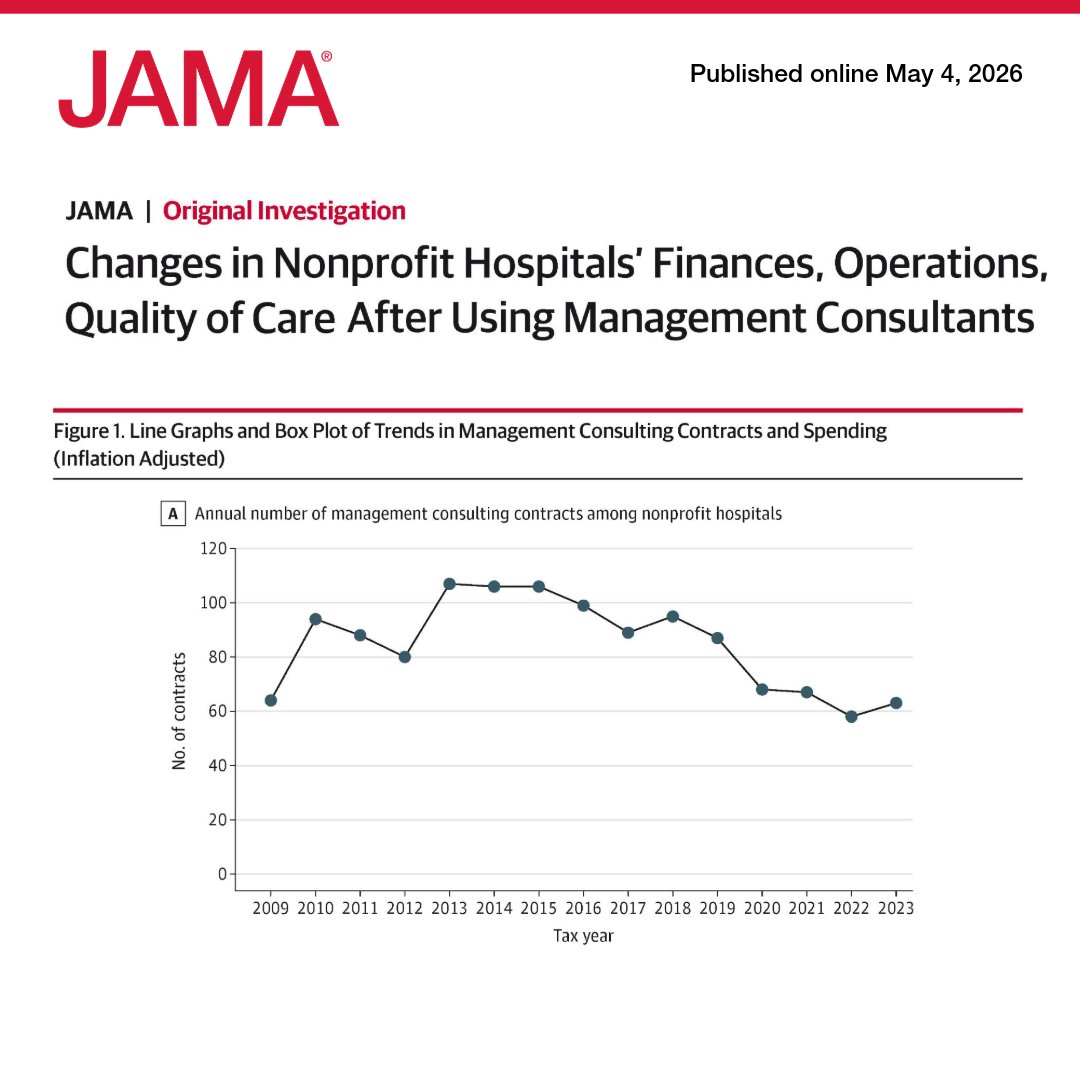
US nonprofit hospitals spent $7.8 billion on management consultants from 2009 to 2023, but contracts were not associated with meaningful changes in finance, operations, or quality of care. 🧵
https://t.co/QQswMYxrG8
The scariest finding in this paper: the subjects couldn't tell it was happening.
UPenn ran this study on 48 healthy adults. One group slept 8 hours. Another slept 6. Another slept 4. For 14 straight days. They tested cognitive performance every 2 hours from 7:30am to 11:30pm.
The 6-hour group's reaction times, working memory, and sustained attention deteriorated on a near-linear curve. By day 14 they were performing at the same level as someone who hadn't slept at all in 48 hours. The 4-hour group hit that threshold by day 6.
Here's the part that should unsettle everyone who thinks they "do fine" on 6 hours: the subjects' self-reported sleepiness flatlined after the first few days. Their brains kept getting worse. Their perception of how impaired they were stopped updating. The cognitive decline was invisible to the person experiencing it.
The researchers found a hard threshold. Any wakefulness beyond 15.84 hours in a day produces cumulative neurobiological cost. That cost compounds every single day you exceed it and does not reset with a weekend of sleeping in.
About 35% of American adults sleep less than 7 hours a night. 40% of those get 6 hours or less. In 1942 that number was 11%. We built an entire professional culture around a sleep schedule that this paper says is functionally equivalent to pulling consecutive all-nighters.
"I'm fine on 6 hours" is the most common response to sleep research. The first thing chronic sleep debt destroys is your ability to notice chronic sleep debt.
...
On the topic of leaked emails, it’s worth noting how consistently they were characterized in the most negative possible light. One example is the email often summarized as Prasad saying “disagree and you’re out.” That framing is either a misreading or a mischaracterization of what was actually said. His email explicitly invited vigorous discussion and debate, emphasized that those debates should happen internally rather than through leaks, and then stated that those who don’t agree with the core and operating principles can resign. That’s not the same as “disagree and you’re out.” Though Prasad was being portrayed in media as a difficult personality, many people who have met him and worked with him report exactly the opposite.
The media coverage of Prasad was performative, selective, and often decoupled from the underlying regulatory substance. Meanwhile, the FDA looked painfully vulnerable to the one-two punch of pharma investor panic and patient group pressure. A regulator who dared question whether every new biologic deserved an automatic green light was portrayed as the villain, not the reformer.
The only way this episode makes sense is if you accept the quiet truth: Prasad was never going to be fully embraced. He arrived under Trump and RFK Jr.’s HHS, which instantly poisoned the well for half the commentariat. Worse, he represented a genuine threat to the economic model that treats FDA approval as the ultimate de risking event for pharma balance sheets. Never mind what his application of evidence standards would mean for patients and for science and medicine in terms of better evidence generation, and for restoring trust in the FDA, including the perception that it is simply a rubber stamp.
In a short window, Prasad did more to force a reckoning on evidence generation while promoting appropriate flexibility than most leaders manage in a longer term. The backlash revealed far more about the ecosystem’s intolerance for challenging the status quo than it did about any single decision. The FDA showed it can still be bullied by narrative and money. And a rare regulator willing to prioritize long term scientific integrity over short term applause was shown the door.
That’s why this has stuck with me. Because once in a lifetime hires don’t come along often. And when the system spits them out this quickly, it tells you less about the person than about the institution and media environment that couldn’t handle him.
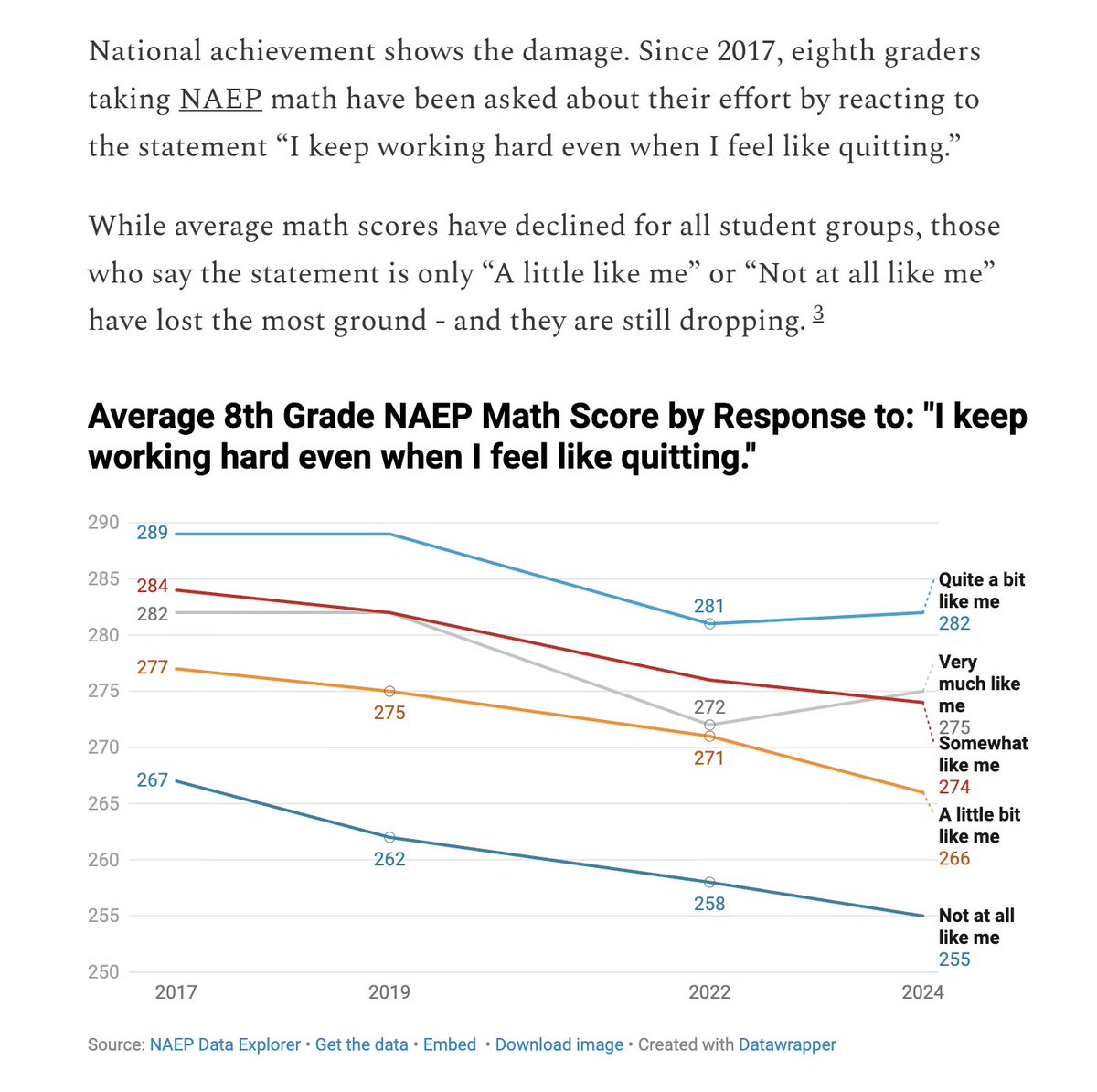
"Collectively, we’ve watered down the notion that it takes effort to succeed - that trying is a key part of a student’s job."
Outstanding post from Tim Daly.
Just one of the parts that hit me below:
Private schools are the most expensive placebo in America. Nowhere else will you pay $250k+ for something that has so little impact on school achievement.
My latest on why private school isn't worth the cost: https://t.co/t22ppgBLXv
Students who took notes by hand scored ~28% higher on conceptual questions than laptop note-takers.
Writing forces your brain to process and compress ideas instead of copying them.
Tell me again how clubs, teams, and travel teams aren't scams?
My $ 80-per-season son's soccer team beat a $ 5k-per-kid club team.
Somewhere along the way, youth sports stopped being about kids and started being about parents.
Club sports promise:
• better coaching
• more exposure
• better competition
• scholarships
But the numbers tell a different story.
Only about 1% of high school athletes get a college athletic scholarship.
And most of those aren’t even full rides.
Meanwhile, families are spending:
• $3k–$7k a year on club teams
• travel flights
• hotels every weekend
• private trainers
• camps
Over 10 years, that’s easily $50k+ per kid.
For youth soccer.
At 10 years old.
Meanwhile, rec sports still do what youth sports were originally meant to do:
Kids play with friends.
Parents sit in lawn chairs.
Everyone grabs pizza after the game.
Low pressure.
Pure fun.
And kids who love the game usually end up getting better anyway.
Our $80 rec team proved that last weekend.
So I’m curious…
Are travel sports actually for the kids…
The biggest risk in investing isn’t volatility.
It’s a short time horizon.
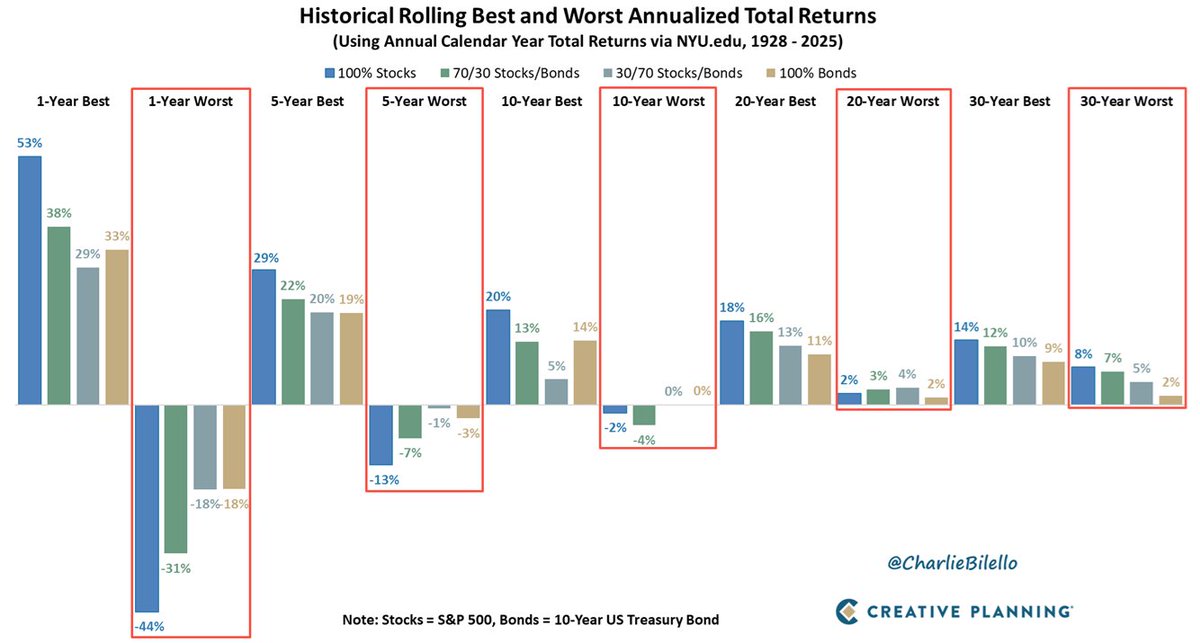
Worst S&P 500 annualized returns since 1928:
1 year: -44%
5 years: -13%
10 years: -2%
20 years: +2%
30 years: +8%
The longer you stay invested, the smaller the risk of a bad outcome.
Stocks average about 10% per year over the long run.
But that “average” hides the truth: returns swing wildly from year to year.
Huge gains.
Brutal losses.
Volatility is not a flaw of the market - it’s the cost of earning the long-term return.
We are overstimulated and we don't even notice. Netflix while eating. Reels in the bathroom. Music while cooking. Podcasts on walks. We consume by default, not by intention. You keep filling every gap, then wonder why you feel foggy and unmotivated. Boredom and silence are the real growth drivers. They give you space to think and create. That's when solutions show up for problems that have been stuck for months. Leave some room.
Nobody tells you this: 99% of a successful marriage is just genuinely enjoying each other’s company. People make these long lists of traits they want to find in a partner, but so much of life just comes down to being kind and pleasant to be around.
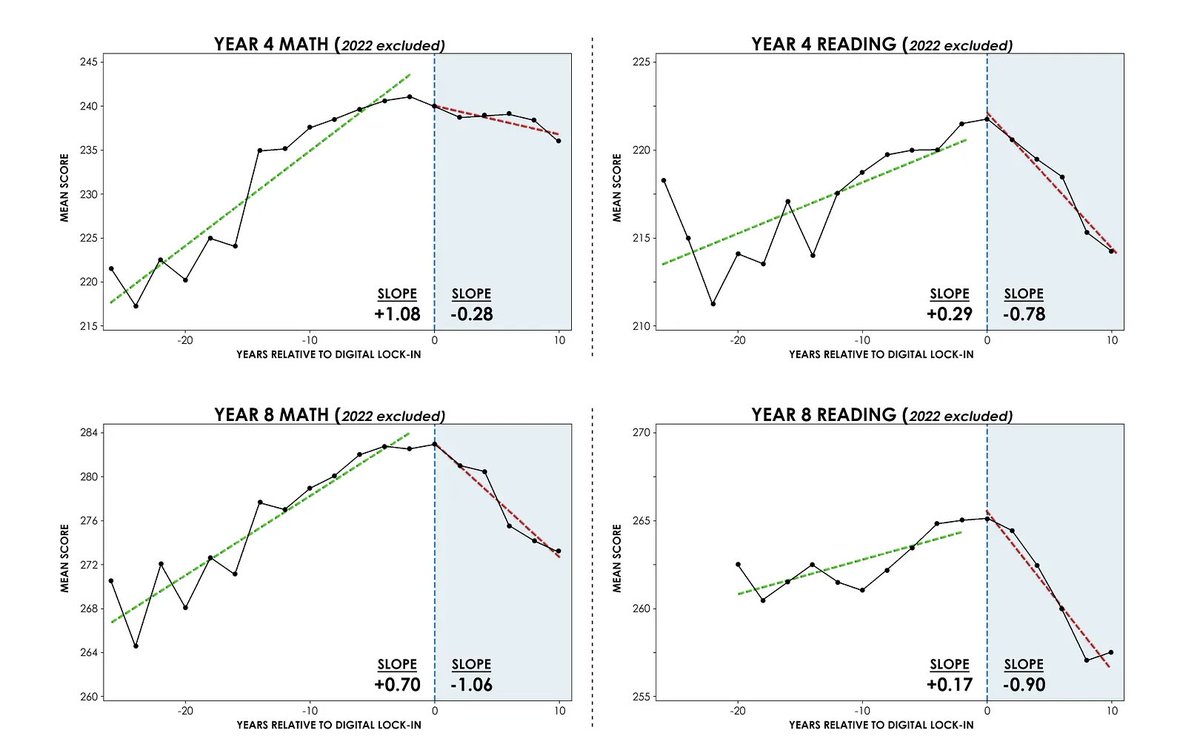
Still more evidence that EdTech harmed American education: Across states, the year that the state imposed mandates requiring computers/tablets, that's the year that test scores stopped rising and in most cases started falling.
From Jared Cooney Horvath
https://t.co/TSH1bfp8lA
One day, I asked my father:
“How did couples in your time manage to stay together despite all the problems?”
He looked at me seriously and said:
“When something broke, we tried to fix it.
You? You just replace it.”
Then he leaned closer,
He just said:
It’s not just nostalgia. This was our childhood and it’s gone now. As a parent you can, through great effort, create the conditions for some version of this for your own children today. But the problem is that most of the other kids are screen addicted zombies who don’t really want to run around outside until the streetlights turn on. So an energetic, free spirited kid who’d rather climb a tree than stare at a screen ends up being kind of isolated. 30 years ago he’d have been the most popular kid in the neighborhood. Now the other kids in the neighborhood are home with the screen and he’s climbing the tree by himself.
Where are the students who think they benefited from Chromebooks and iPads in school?
Where are the teachers who believe that ed tech greatly improved education?
Let's get this stuff out of elementary schools by September. Older grades will be harder, but let's start with K-5.