One of my classmates has been diagnosed with a rare form of lung cancer, please donate to her treatment if you can:
https://t.co/mdTRdwm4Q6
Alternatively, if you are a Trinidadian, you may donate directly to:
Name of bank: RBC
Account number: 110000000931468
De Petrarcae latinitate hoc sentio:
Prosa eius elegans et numerosa mihi videtur, interdum poetico apparatu nimis ornata. Sententiarum circuitus Ciceronem redolent, verborum tamen delectus amplissimus est: a Plauto ad christianos mediae usque aetatis. In versibus Vergilii pedisequum fuisse existimo.
Quid vero censetis?
“Remember that when you leave this earth, you can take with you nothing that you have received - only what you have given: a full heart, enriched by honest service, love, sacrifice and courage.”
- St. Francis of Assisi
“Confucianism survived all these transitions. There is no reason to believe that what is happening today is not another transition.” – Wing-tsit Chan, 1953.
This is an extremely rational paragraph. One would think that losing its institutions would be a negative, but the Confucian tradition was never really born from institutions, and getting wrapped up in the imperial bureaucracy of the Yuan-Ming-Qing period created an awkward situation where if that bureaucracy was blamed for ills, then Confucianism would be too. That happened! Now that the bureaucratic system is gone, Confucianism is free to be its authentic self, morph again, etc. As I keep saying, Chinese socialism seems an awful lot like economic Confucianism? This is how your own shadow sneaks up on you.
Humanity (ren 仁) is the character of man’s mind, not something external. Let it go and do not seek it, and it seems far away. Turn back and seek it, and it is present right here. How could it be far away? (Zhu Xi : Lunyu 7.29)
仁者,心之德,非在外也。放而不求,故有以為遠者;反而求之,則即此而在矣,夫豈遠哉?
A few bowhead whales born around 1815 might still be alive. They were in their 30s when they first saw a commercial whaling ship; in their 60s when they first heard a propellor; over 100 the first time they heard sonar. I wonder if they remember the silent ocean.
Cheng Yi said, “Master Kong taught people to study culture and cultivate conduct, and to preserve loyalty and trustworthiness.” (Lunyu 7.24)
程子曰:「教人以學文修行而存忠信也。」
Melchizedek offered bread and wine to God in Genesis 14, and almost nobody asks the one question that passage demands: what kind of sacrifice is that?
Most Protestants assume sacrifice in Scripture always means blood and death. Burnt animals. Altars. Slaughter.
But Genesis 14:18 records a priest of God Most High offering bread and wine, and Scripture calls it a priestly act. The Psalms then declare the Messiah a priest "after the order of Melchizedek" (Psalm 110:4). A priesthood whose defining recorded offering was unbloody.
Hebrews 5-7 confirms Christ holds this exact priesthood, not the Levitical one. The Levitical priests offered animals. Melchizedek offered bread and wine.
So the question writes itself: if Christ is a priest forever after the order of Melchizedek, what does his priesthood offer?
A priest without an offering is a contradiction in terms. And the offering of his order, established in the first mention of a priest in the entire Bible, is bread and wine.
That is the Mass. Not a symbol borrowed from paganism. A priesthood older than Aaron, offering what Melchizedek offered, now transformed into the Body and Blood of the One who said "this is my body."
The early Fathers saw this connection immediately. So did the author of Hebrews, who spends three chapters on it.
If the Lord's Supper is only a memorial, then Christ's Melchizedekian priesthood has no visible offering at all. What is a priest who never sacrifices?
This polar bear died of starvation in its homeland, which is supposed to be teeming with prey. Photographer and biologist Paul Nicklen, who has spent more than 30 years in the Arctic, says that during most of those years he only came across one dead polar bear, and then within just two weeks his team found two that had died of starvation. Polar bears rely on sea ice to hunt seals, and with rising temperatures and receding ice, the search for food becomes longer and more difficult, potentially ending with some of them dying of hunger.
Perhaps our sense of what “education” means returns to what it was before the moderns: the human element (socialization, virtue ethics, and the arts). “Humanization as education” is, after all, what we simply cannot get from the bots.
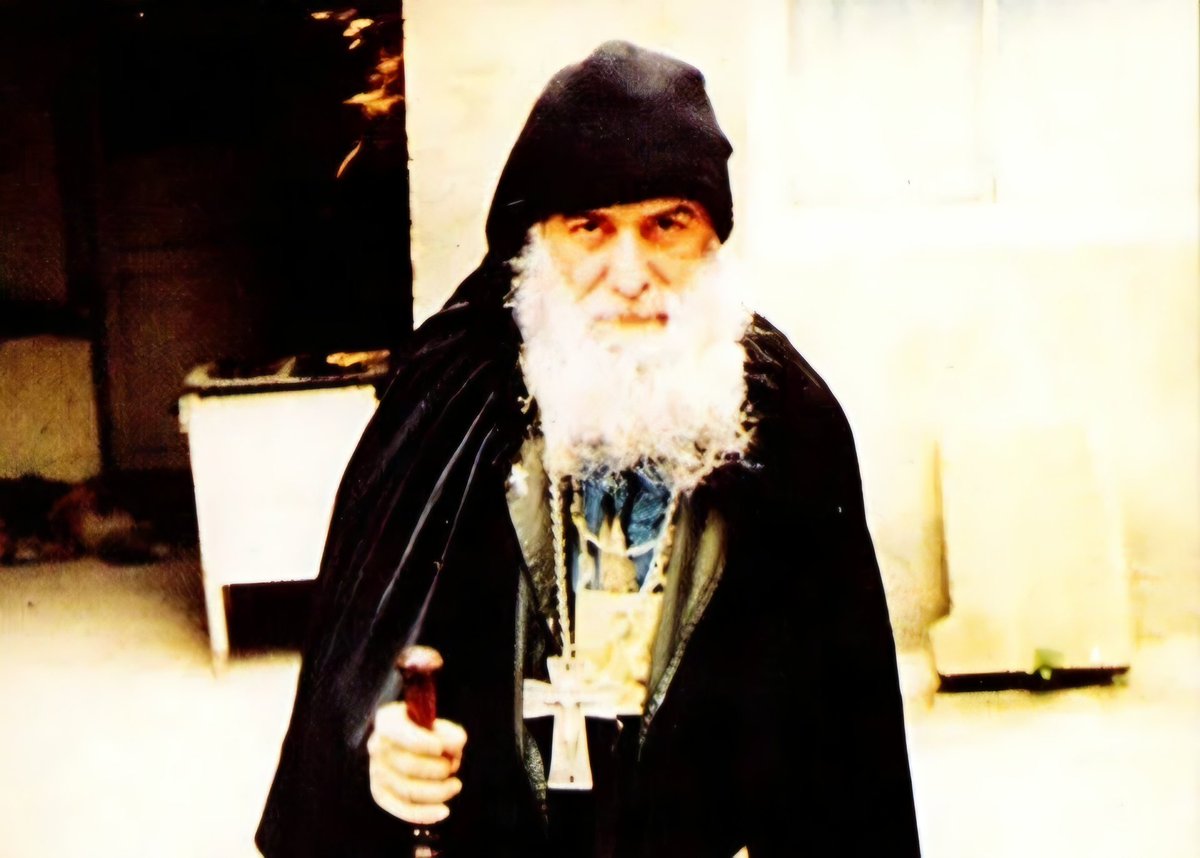
"Everything bad in a person is accidental. You young people should not express disgust toward those who drink excessively, fight, or use profanity, because the image of God is preserved within them as well—even though they probably aren’t aware of it. The enemy defiles them and covers them with filth, just as an icon becomes covered with dust; but if it falls into good hands, it will be cleaned, and it will begin to shine.
Of course, it is difficult to see the image of God in those who treat you badly and insult you—those whose faces bear the likeness of a beast rather than a human being—but they deserve even greater pity, because their souls are distorted, perhaps even beyond repair, and condemned to eternal torment and torture. How difficult it is to love your enemy. How difficult it is to devote your entire life to learning how to love those who insult you… But you must know that through such love, you become like Christ.”
St. Gabriel of Georgia
Facts about Pope Leo XIV
>IQ: 145
>Speaks 7 languages
>Former professor
>Degrees in mathematics & theology
>Missionary in Peru for +10 years
>First American Pope
>Known intellectual capabilities
This isn’t just a Pope
This is one of the smartest men alive
Intelligence must draw on memory. The mind must not simply compile data — as an algorithm now does more quickly than we can — but recall lived experiences, which contain depths of meaning that only the human soul can recognize, and connect more deeply with the goodness of these experiences. Everything that is good begins “with the Spirit” and thus possesses a breath, a dynamism and a sense of communion that, once experienced, are engraved upon the heart. https://t.co/Ij21tkb3qT
Master Kong said, “Set your purpose on the Way. Have a firm grasp on virtue. Rely on humanity. Seek recreation in the arts.” (Lunyu 7.6)
子曰:「志於道,據於德,依於仁,游於藝。」
The chief reason [for the American resistance to Chinese Philosophy] is the Western concept of philosophy, which insists that it must be a theoretical study of concept and laws of knowledge, reality, and value. Chinese philosophy fulfills this definition only to a limited extent. While there are theoretical discussions on the principle and nature of things, they are intended not for knowledge for its own sake, but to support a way of life the conclusions and convictions of which are arrived at not through idle speculation but through actual handling of human affairs.
– Professor Wing-tsit Chan, “Reflections on Teaching Chinese Philosophy to American Students” (1959)
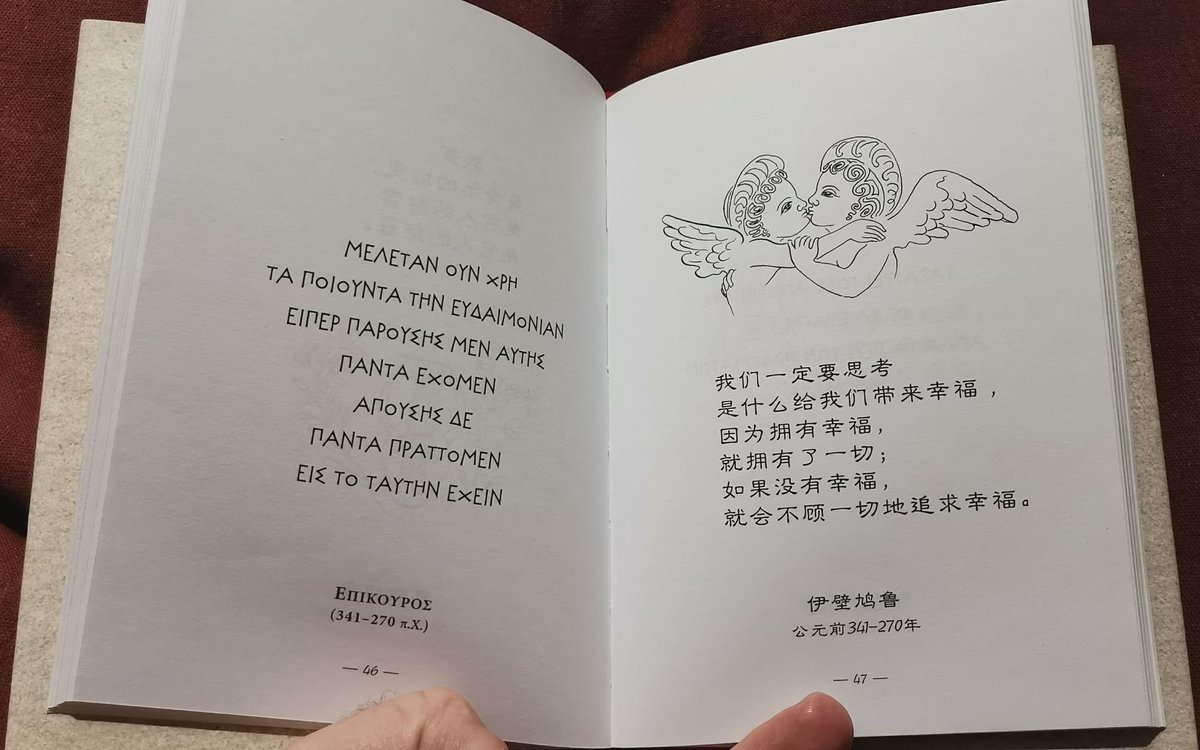
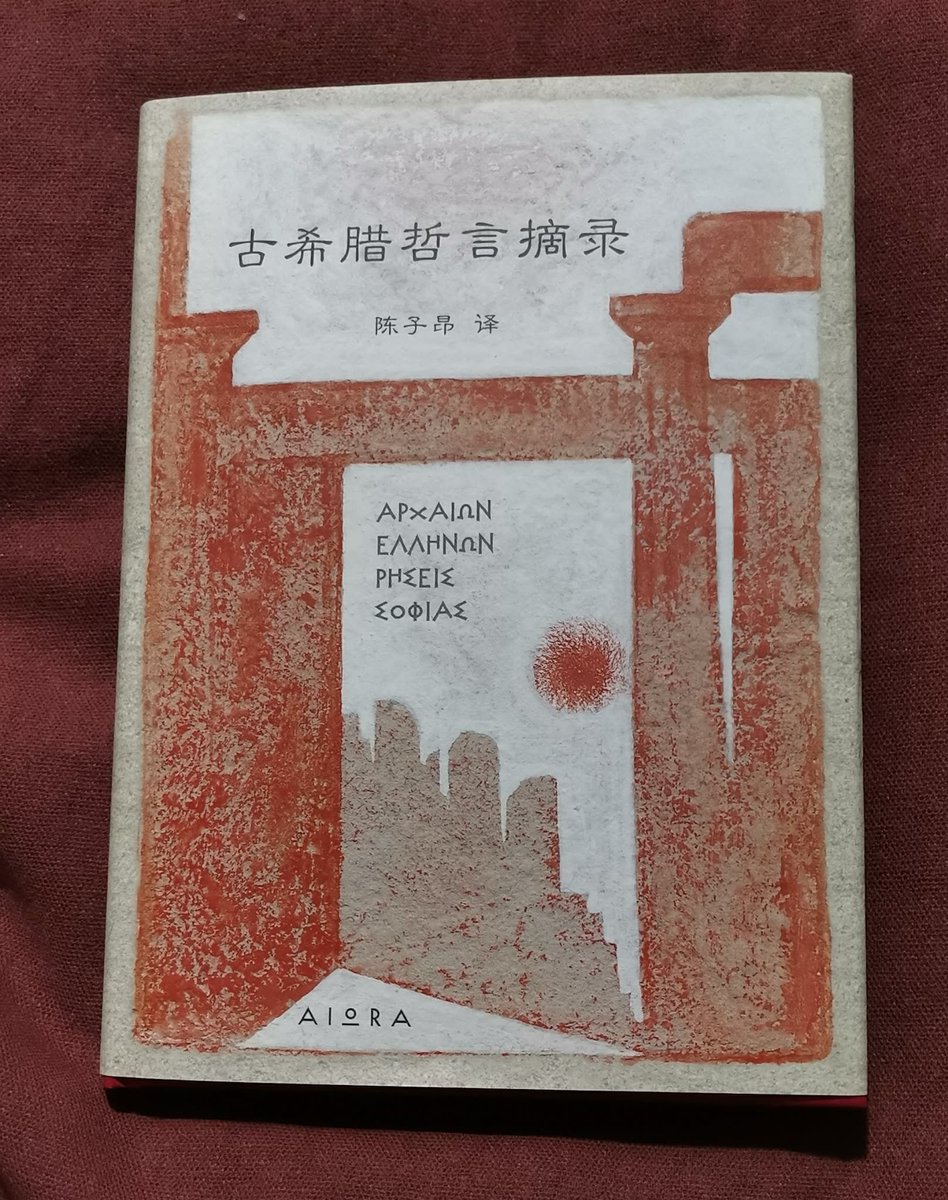
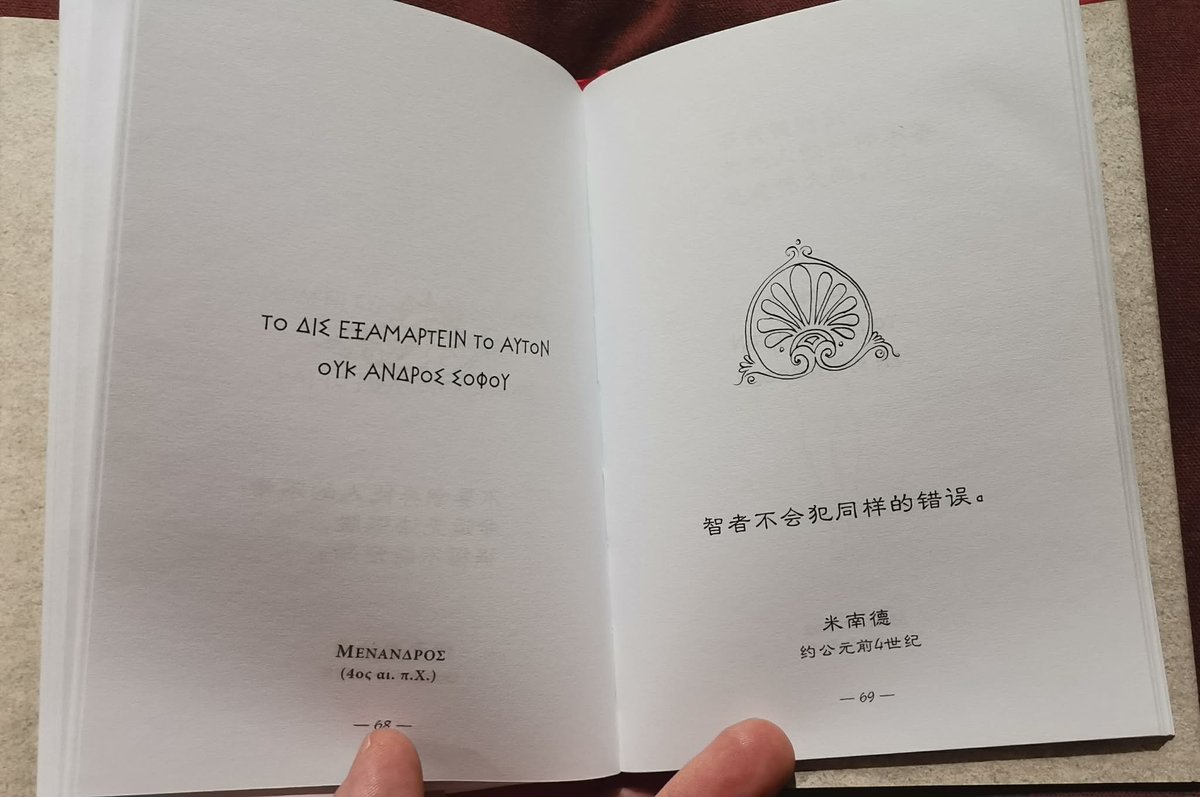
Two of my best friends recently took a trip to Greece and brought this wonderful little book back for me. It's a collection of Chinese translations of quotes from Greek philosophy, literature, theater, poetry. So lovely! Only thing, they should've went with classical Chinese.
Thomas Aquinas says a starving man who takes your bread is not a thief. Modern capitalism has no category for that.
The assumption baked into most modern minds, including most Christian minds, is that ownership is absolute. Your property is yours. Full stop.
Aquinas dismantles that in the Summa Theologiae, II-II, question 66.
His first move: the division of possessions is not natural law. It is a human convention, an addition to natural law made for the sake of order and peace. Useful, legitimate, but secondary. Underneath the property lines, natural law still says the goods of the earth exist for everyone.
Second move: you hold your possessions as a steward, not an absolute owner. Aquinas says man should possess external things "not as his own, but as common," ready to share them with those in need. The title is yours. The destination is everyone's.
Third move, the one that scandalizes modern readers: in manifest and urgent need, taking what is required for survival is not theft. Theft requires taking what another still has a right to. But in extreme necessity, the goods revert to their original common destination. Legal title dissolves where survival is at stake.
Note what this is not. Aquinas is not a communist. He defends private property as prudent and necessary. But he refuses to absolutize it.
The medieval doctor would say the modern instinct, that property rights override a dying man's need, is not capitalism. It is a theological error about who the earth actually belongs to.
Which conviction do you actually hold when push comes to shove: absolute ownership, or Aquinas's stewardship?
If you have a problem with this, and you should, then you should be vegan.
This is unnecessary harassment, aggression, and bullying, but so are all uses of our fellow animals in the developed world in 2026.
Indeed, 99% of the harm that 99% of nonvegans pay for is much worse (factory farms and slaughterhouses). About 98% of animal products sold are from innocents who lived in misery in factory farms.
Be consistent. Be vegan.