Optimal indications for adj CDK4/6i in eBC remain debated, particularly regarding the unclear prognostic role of anatomic vs biologic features.
In @JNCI_Now we tried to refine the risk stratification according to #monarchE & #NATALEE criteria.
@OncoAlert
Main findings ⬇️
Honored to be a candidate for ASCO nominating committee among other great candidates! Please visit
https://t.co/EMcKd8oHLe
to learn more about us & cast your vote to help shape asco future! We are all excited to serve & support asco mission! Deadline is Dec 2nd at 3pm EST! Best regards :-)
The record for FDA-approved novel drugs in a year is 59. This year, so far, there’ve been 55.
There are 9 more decisions coming before the end of the year (on novel drugs), so the potential is for a total of 64.
Here's what we have so far:
Such an important FDA approval: Giredestrant approved as adjuvant therapy in pts with early-stage ER+ breast cancer at intermediate to high risk of recurrence -- first new hormonal therapy in early-stage disease in more than 20 years!
https://t.co/PoCrxjKFMS
@OncoAlert
Being an oncologist at a fertility preservation congress is a special opportunity. It reminds me how essential multidisciplinary care is to help young patients build lives beyond cancer, including on fertility and parenthood.
Grateful to @ISFP_org for inspiring days in Miami 🇺🇸 and looking forward to #ISFP2028 in @Roma ! 🇮🇹
@FertilityOnX@matteolambe@IDemeestere
Great to be in the beautiful Miami for the 9th International Society for Fertility Preservation Congress @ISFP_org 🌴
Three days focused on fertility, pregnancy after cancer, and what these issues mean for our patients.
Happy to contribute with 2 oral presentations from our groups + a lecture on the #safety of pregnancy after BC.
A special thanks to @matteolambe for this opportunity! @OncoAlert@myESMO
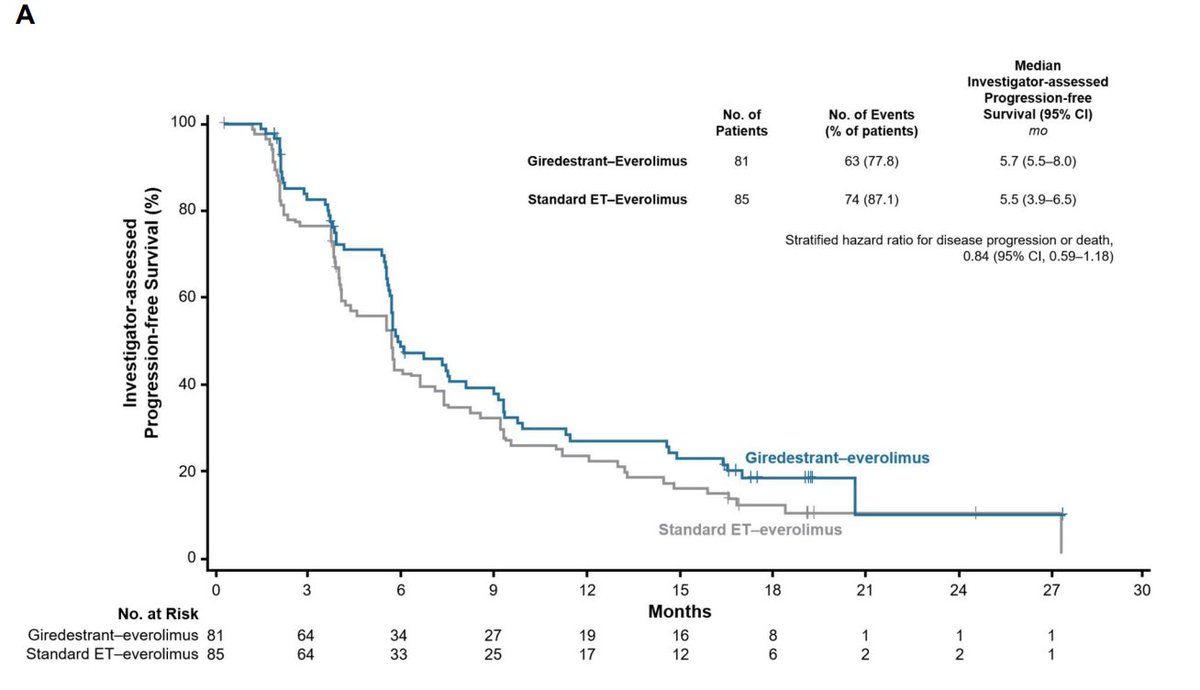
The evERA study / giredestrant approval is interesting because the @FDA did not approve the drug for the whole study population. The evERA trial accrued for tumors w/w/o ESR1 mutations. The overall result was positive. But study was designed to focus on ESR1 mutated tumors, and there was no/minimal benefit in ESR1 wildtype cohort. So FDA only granted approval into the already-crowded space of 2nd line ET for ESR1 mutated tumors. Here are data from @NEJM Supplemental appendix for the ESR1 wt subset (below).
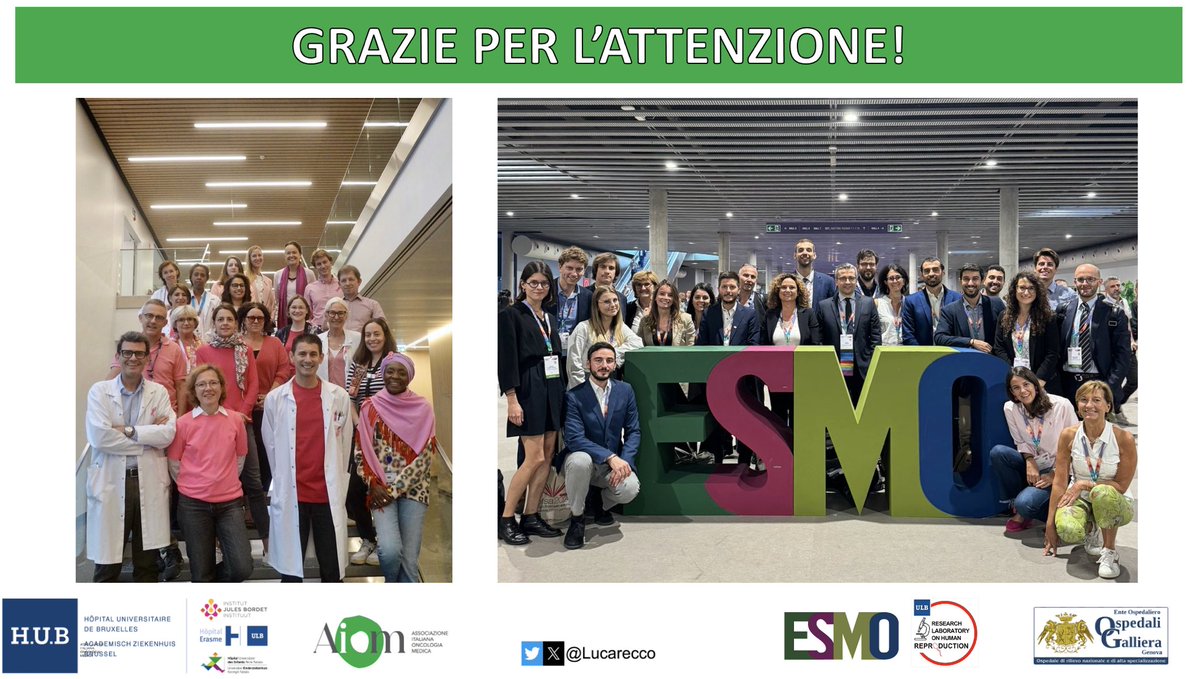
Grateful for the opportunity to discuss how #biomarkers can optimize treatment decisions in eBC during the educational session at the 2026 @AIOMtweet national congress.
A great experience shared with an outstanding faculty!
A sincere thanks to all the mentors, colleagues, and friends who have guided me throughout my professional journey! @OncoAlert
Our review on the challenges and evidence gaps in treating premenopausal women with HR+/HER2− early #BreastCancer is now officially published in @Annals_Oncology@myESMO
📌https://t.co/giHlHiqUMM
Many thanks again to all co-authors for this collaborative effort!
Our review just out in @EJCancer frames HR+/HER2- mBC as one interdependent system and proposes an evidence-graded, biomarker-guided roadmap. Thank you to all co-authors, especially @ACaltavituro. Open access: https://t.co/lH7UR1AsPg
A real pleasure to attend, even briefly, the 16th Congress of Medical Oncology organised by AMFROM 🇲🇦
Great opportunity to connect, exchange ideas and strengthen collaborations to advance cancer care and research.
Many thanks to Dr Fatima Az-Zahra Zakkouri for the kind invitation
🚨 Are we overtreating early breast cancer with chemotherapy?
A timely perspective in @JCO_ASCO revisits 4 landmark trials: MINDACT → TAILORx → RxPONDER → OPTIMA.
The evolution of genomic-guided chemotherapy in HR+/HER2− breast cancer is fascinating.
🔹 MINDACT | MammaPrint
High clinical risk ≠ automatic chemotherapy. Favorable genomic biology can support omission.
🔹 TAILORx | Oncotype DX
Most node-negative patients with RS 11–25 can avoid chemotherapy. Younger women remain an important exception.
🔹 RxPONDER | Oncotype DX
With 1–3 positive nodes and RS ≤25:
• Postmenopausal: No meaningful chemotherapy benefit.
• Premenopausal: Significant benefit persists.
🔹 OPTIMA | Prosigna (PAM50)
The next frontier!
✅ Included patients with up to 9 positive nodes.
✅ ROR ≤60 guided chemotherapy omission.
✅ ~2/3 avoided chemotherapy.
✅ Genomic-guided treatment was noninferior at 3.9 years’ median follow-up.
But here’s the BIG unanswered question:
Does chemotherapy benefit younger women because of its cytotoxic effects, or because it suppresses ovarian function?
OPTIMA mandated ovarian suppression in premenopausal participants and found no significant heterogeneity by menopausal status.
This is hypothesis-generating, NOT definitive proof.
🔬 Next to watch: OFSET (NRG-BR009) and OPTIMA-YOUNG.
💡 My takeaway: The future isn’t simply identifying who can skip chemotherapy. It’s determining whether optimized endocrine therapy can replace chemotherapy in selected younger women.
Excellent perspective by @YAbdouMD and Lisa Carey.
@myesmo@ESMO_open@OncoAlert
#BreastCancer #PrecisionOncology #ESMO26
Full paper link in comment below ⬇️
A clinical case:
A fit, 56-year-old postmenopausal woman with HR+/HER2− eBC: 3-cm primary, 2 positive axillary nodes, grade 3, planned AI therapy.
Eligible for both adjuvant CDK4/6i, with no contraindications.
Which CDK4/6i would you choose? @OncoAlert#bcsm