This is the old thread, and I plan to add to this very tweet and pin it, starting with a link to my updated #ooda on #H5N1BadSoonScenario: https://t.co/KIv2mOK1jy
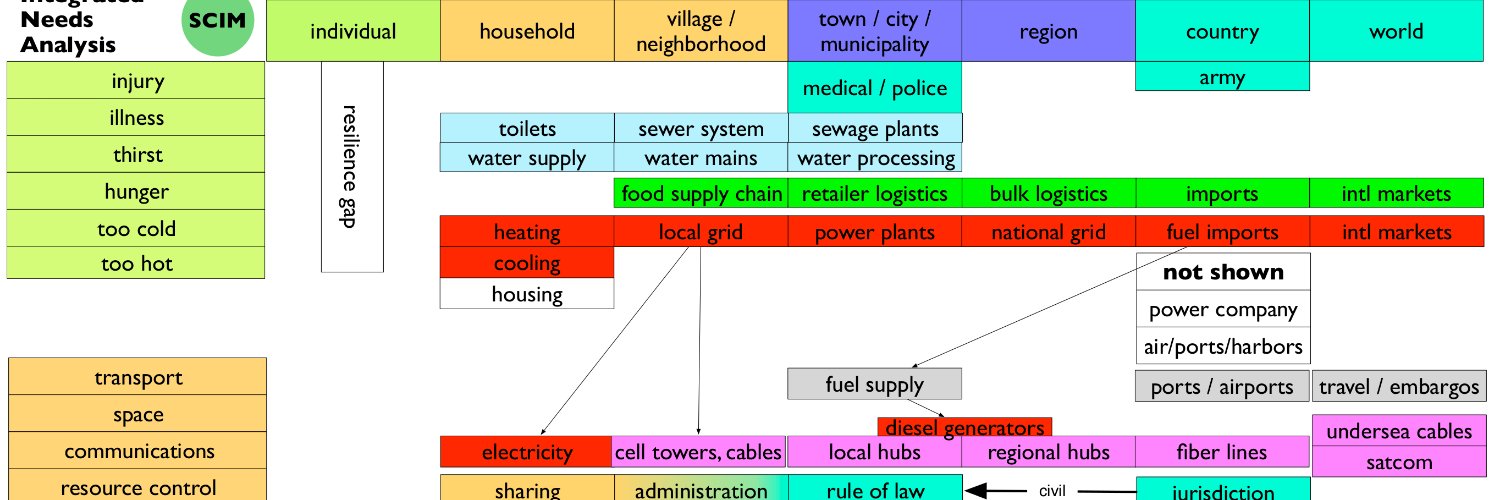
@NukitToBeSure Maybe I misunderstand the context of the chart, but... also, the people who occupy the space and make the second-by-second decision not to turn the equipment off—"members of society"—are not even on the figure.
Also related to:
https://t.co/RAoQE1GtFX
And the constant flow of emails I get with "million dollar ideas" and they "just need someone to make it".
Generally, there's a notion in the West that conception is hard, and implementation is easy when conception is just basically just sci-fi.
@NukitToBeSure X doesn't let me "like" a thousand times. So I'll give another standing ovation. ___Actual supply of stuff that works really well___. Yes. Thank you again. Saving up to support with wallet. 🙏🏻
I love how "equipment suppliers" is this little teeny-tiny inconsequential add-on in the bottom when it's the single failure point and almost every thing the rest might accomplish absolutely relies it😂
Remember when you all thought you could just buy off-the-shelf air purifiers for classrooms, and they were all too loud, too complicated, too underpowered, too large, and people just unplugged them, and you wasted hundreds of millions of dollars being smugly dismissive of actually being able to make things that were fit for purpose?
Read this. It's hard to ignore. Let it sink in.
'Scientists detect a sharp acceleration in global warming'.
"If the warming rate of the past 10 years continues, it would lead to a long-term exceedance of the 1.5°C limit of the Paris Agreement before 2030."
"How quickly the Earth continues to warm ultimately depends on how rapidly we reduce global CO2 emissions from fossil fuels to zero."
Stefan Rahmstorf, Professor of Physics of the Ocean at the University of Potsdam
Full Reference:
G. Foster, S. Rahmstorf. Global Warming Has Accelerated Significantly. Geophysical Research Letters, 2026; 53 (5) DOI: 10.1029/2025GL118804.
Fully open access.
#GlobalWarming #ClimateChange #ClimateCrisis #NetZero
https://t.co/AuVdtnUppt
It's not surprising that there are tools to help with creating food gardens, food forests and ecological transformation. Here are some, with some ideas for creating more with the angle or rapid change. Who knows about this or wants to give it a push? Just in case it's 🤔 needed.
"Lockdown" was and is an anti-public health term.
If nobody locked your door, it was not a lockdown, despite some using that term, sometimes even as "official" language. It was shelter in place, which was good, because many in public health and medicine recommended *against* masking or only recommended cloth and procedure masks not designed to block virus-laden aerosols, which follow the laws of fluid dynamics. You're seeing more public health folks use that term recently because they are engaged in cognitive dissonance and denial, taking minimal precautions and doing little to communicate risk while SARS-CoV-2 reinfections stack up, causing continued morbidity and excess mortality. It is an effort to rewrite an ongoing disease as a past-tense era, and the use of the hyperbolic term in public health almost always signifies simplistic, muddle-headed thinking and a pure lack of curiosity toward the many recent studies on COVlD's ongoing and significant health harms. Some in the general public have merely internalized the term due to use, but notice that stems from its increasingly widespread use by people in public health and medicine who should know better.
https://t.co/a658TEYUM6
https://t.co/Cu18KZWx9p
Actual "lockdowns" (locks, chains) were exceedingly rare (e.g., Wuhan), or occurred and occur in places people prefer not to think about and are almost never thinking about when they say lockdown. Jails, prisons, detention centers. Those are efficient spreaders of COVlD due to high density, often low ventilation, and a general reactive zeitgeist toward medical management.
So, you do not need a special $1,200 Airdog air purifier to filter out ultrafine woodsmoke particles.
Any good air purifier with MERV 13 or better or HEPA filters will filter out ultrafine woodsmoke particles. The higher the Clean Air Delivery rate at a quiet sound level, the better.
Check out @ThisHouseFresh for objective air purifier testing. If you google "Best Air Purifiers" you'll get pages and pages of fake review sites - some in the name of famous legacy magazines and newspapers - that are just lists of paid ad placements or affiliate links.
In this study of Clean Air Delivery Rates for HEPA air purifiers at different fan speeds, you can see a dip in the delivery rate at the most penetrating particle size, which was between 200-250 nm on the horizontal scale (0.2 to 0.25 microns). Overall, the clean air delivery rate (the vertical scale in cubic feet per minute on the left) is relatively even.
Note that the clean air delivery rate doesn't suddenly stop at .3 microns like Airdog falsely claim in their ad, but in fact does the exact opposite and the clean air delivery rate is higher for the particles smaller than the most penetrating particle size.
https://t.co/mbtHI2QjNK
In reality, high efficiency air filters like HEPA filters have a weakness called the "most penetrating particle size" (MPPS). That's the size that gets through the fitler the most, and that hardest to filter particle size is the one that is measured for filtration standards like HEPA.
A HEPA filter captures 99.97% or better of that hardest to filter out particle size, and filters particles above and below that size even better.
0.3 microns is a widely used standard for the most penetrating particle size, though in practice the MPPS can be a bit smaller.
Different sized particles are captured via different properties of physics, which is why they are captured at different rates.
https://t.co/qRbCNSowdm
HEPA air filters efficiently capture particles both above and below 0.3 microns in size.
So, why do so many actual air purifier companies falsely think they only work down to 0.3 microns and no smaller?
In some cases, it's because the marketing people have no idea what they are talking about. And in others, it's because the company itself has no idea what it is talking about, possibly because they are just resellers, or make boxes with fans that they just buy filters for that they don't understand. Either way, you can't trust an air purifier company that doesn't understand the basics of air filtration.
@Engineer_Wong Just added it. That page needs a heavy update. Or maybe there's a page about filterboxes already in Wikipedia. This is the kind of effort that needs a bit of focus, which I've been sorely lacking. So, if anyone would like to contribute, 🙏🏻 feel free to. Goal: help people "land".
@Engineer_Wong Just added it. That page needs a heavy update. Or maybe there's a page about filterboxes already in Wikipedia. This is the kind of effort that needs a bit of focus, which I've been sorely lacking. So, if anyone would like to contribute, 🙏🏻 feel free to. Goal: help people "land".
The viewpoint expressed in this article is very much on point. For consumers, there is only one core principle to remember when choosing an air purifier: you do not need to worry about the filter rating at all—what truly determines the purification speed is the CADR value.
The filter rating does affect CADR, but the relationship between the two is not simply "the higher the better." In fact, using a filter with an excessively high rating can actually cause the CADR to drop. This involves a number of complex factors, such as airflow path design, fan performance curves, and more. Optimising these factors is the manufacturer's responsibility; consumers do not need to delve into them.
Therefore, as a buyer, you really only need to focus on three metrics: the CADR number, the noise level at that CADR, and the price. Keep these three points in mind, and you will be able to make a rational purchasing decision.
Impressive study evaluating exposure to different filoviruses in bats and people ion Ghana over more than 10 years, showing there is circulation and higher levels of antibodies in people with close bat interactions. https://t.co/EaFNzfUpZf Risk landscape for spillovers
I'm not sure folks have realized just how crazy the second half of 2026 and 2027 will be for global temperatures – on the back of a record-smashing El Niño event. Here is my latest estimate of where both years will end up compared to global temperatures since 1850.