Andrej Karpathy:
"Prompting is going away. Delete everything, keep Graph."
In just 69 minutes, he shows how to build graphs and why they're the only layer that survives in the end
Prompts → Agents → Loops → Graphs
a loop keeps one agent running until the job is done
a graph decides which agents exist and what each one passes to the next
anyone can build an agent, almost nobody builds the graph that runs them
watch it today, then save the full guide on graphs below before everyone starts catching up ↓
GitHub has officially gone insane.
You can now build an entire AI content factory without hiring a single person.
10 ridiculously powerful repos:
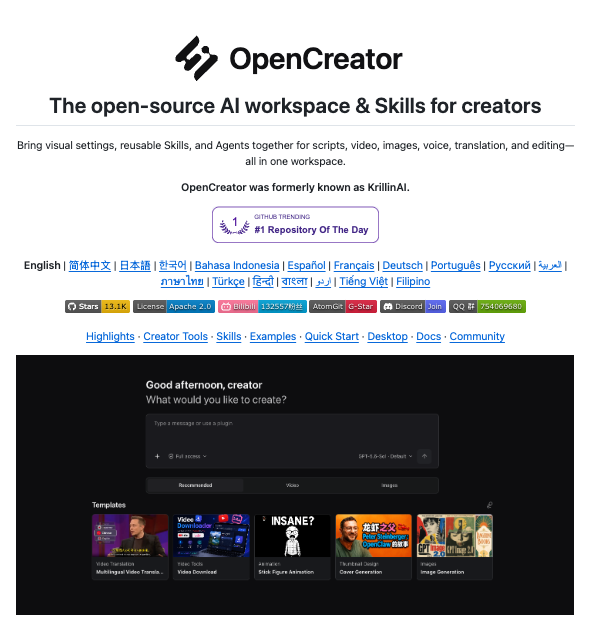
1. OpenCreator
Give Codex a creator workspace to write scripts, generate images, create voiceovers, translate videos, and edit content.
https://t.co/YFG5tZRhTf
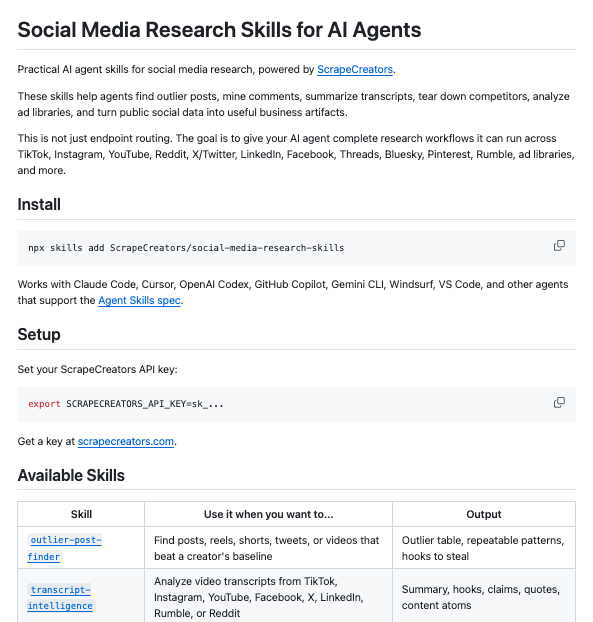
2. Social Media Research Skills
Give Claude Code and Codex skills to find standout posts, study competitors, mine comments, and pull hooks from video transcripts. Powered by ScrapeCreators.
https://t.co/XOW8tV0URo
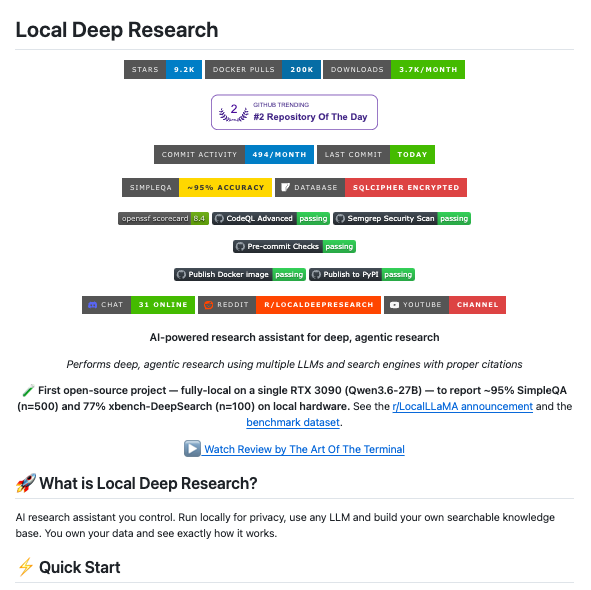
3. Local Deep Research
Turn a topic into a research report by searching the web and your documents. Works with local and cloud AI models.
https://t.co/XVSzkcfXzu
4. FLUX.2
Generate and edit images for thumbnails, social posts, and campaigns. The Klein 4B models come with Apache-licensed weights.
https://t.co/WiqsJCwkns
5. Kokoro
Turn your scripts into AI voiceovers using a compact, open-weight speech model. Build narration directly into your content pipeline.
https://t.co/8Ffw7c5mOs
6. ACE-Step 1.5
Generate music from text descriptions, create instrumental tracks, and regenerate sections of audio. Runs locally on supported hardware.
https://t.co/Rl76BjNO0H
7. Short Video Factory
Turn prompts and your footage into batches of short videos, with AI-written copy, voiceovers, automatic editing, and subtitles.
https://t.co/6YbGCSwZl2
8. AI YouTube Shorts Generator
Turn long YouTube videos into vertical Shorts with AI-picked highlights, transcription, and automatic cropping.
https://t.co/kpYkdsZcd9
9. Podcastfy
Turn source material into AI podcast conversations. Customize the dialogue and generate audio in multiple languages.
https://t.co/RBY68LBify
10. Social Media Agent
Turn a URL into X and LinkedIn posts. Review the drafts, make changes, and schedule them through an AI agent workflow.
https://t.co/ZFweXXrFzF
Which part of your content workflow are you automating first?
You think Bitcoin has no value.
You think it’s just ones and zeros floating in cyberspace.
Here’s what you’re missing: Bitcoin is lightning captured in a bottle.
This is what makes Bitcoin so special. Check it out:
Every single Bitcoin that exists was forged in a furnace of energy. Real, measurable, physical energy.
Burned into existence.
Bitcoins are mined into being.
Mining consumes electricity.
They burn kilowatt-hours.
They convert real-world energy into digital scarcity.
Just like mining for gold requires energy to dig, refine, and distribute it, so does Bitcoin.
Bitcoin is the first form of money in human history where the cost of creation is verifiable, measurable, and unforgeable.
That makes it unique.
You can’t counterfeit it.
You can’t just print it.
You can’t dilute it.
Because every satoshi is anchored to real energy expenditure from the physical world.
Gold? You mine it with labor and fuel.
Fiat? You print it with permission and propaganda.
Bitcoin? You burn energy to secure a global, decentralized ledger no government can rewrite.
This is the breakthrough.
Bitcoin isn’t backed by “trust” or “belief.”
It’s backed by proof.
Proof that energy was spent.
Proof that work was done.
Proof that cannot be faked.
This is what bitcoiners call Proof-of-Work.
So when someone tells you Bitcoin is “just virtual,” laugh in their face.
Bitcoin is energy converted into incorruptible capital.
Bitcoin is computation forged into monetary bedrock.
Bitcoin is the first asset in human history where scarcity is enforced by the laws of physics, not the whims of bureaucrats.
Bitcoin is digital.
True.
Bitcoin is virtual?
No.
Bitcoin is the most real money humanity has ever created.
Because it costs something to make it.
And it costs everything to break it.
That’s Proof-of-Work.
That’s Bitcoin.
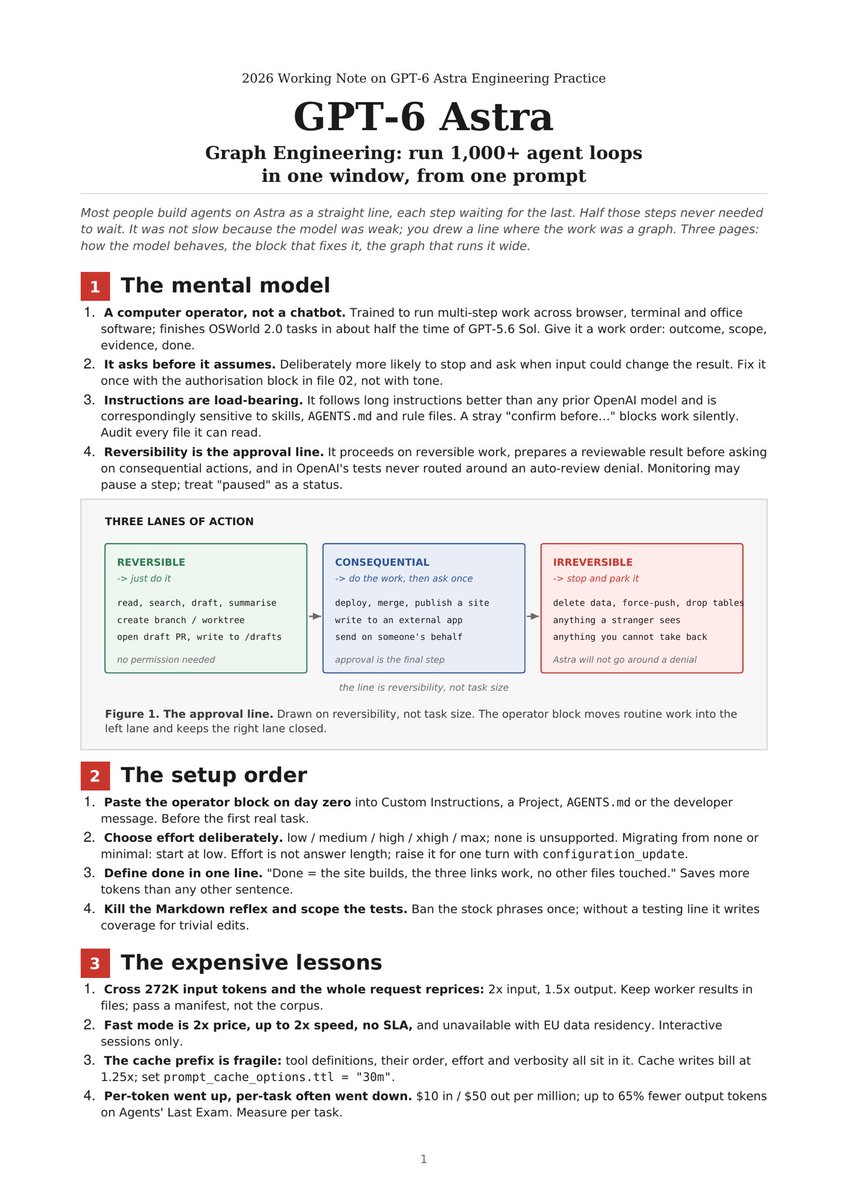
OpenAI quietly showed how to run 1,000+ agent loops from one prompt on GPT-6 Astra
3-page field guide on exactly how to turn Astra from a chatbot into a fleet, along with the COMPLETE OPERATOR BLOCK you paste once
here is how you set it up:
1. the 3 lanes of action Astra actually sorts every task into (reversible → just do it, consequential → do the work then ask once, irreversible → stop) and why the approval line is reversibility, not task size
2. the operator block that fixes the 5 default behaviours OpenAI documented themselves: stalling on "can you…", over-testing trivial edits, answering in Markdown, obeying stray lines in skill files, and delegating less than you want
3. the effort ladder (low / medium / high / xhigh / max, no "none") with configuration_update to raise it for one hard turn without breaking the cache prefix
4. the 3 work orders that use the whole model: research memo with traceable citations, Codex refactor in a worktree with a green-suite gate, computer-use task with a hard boundary on anything a customer would see
5. the edge test that finds the parallelism hiding in your own workflow, plus the 3 things that break every fleet: self-agreement (verifier on clean context), file collisions (one worktree per worker), the 272K cliff that reprices your whole request
6. the one Responses request that runs 20 workers behind an async tool with a verifier that re-runs the test instead of asking the agent if it's done
this is the exact setup:
this is f**king insane.
a solo dev just open sourced a 100% FREE ElevenLabs replacement that runs entirely on your own machine.
the GitHub repo is at 19.4K stars.
it lets you:
→ clone a voice from one clean reference clip
→ dub any video into 646 languages
→ generate audiobooks, dictation, transcription
→ pick from 14 TTS engines instead of one
ElevenLabs supports 32 languages. this does 646.
no per-character billing. no usage caps. no audio ever leaves your computer.
save this for later.
repo below
Este tipo explica cómo crear páginas web profesionales con GPT-5.6 Sol.
Un tutorial de 21 minutos donde explica paso a paso cómo construir diseños con un acabado cinematográfico.
🔖 Guárdalo. Vale cada minuto.
Google just released free 2-hour course on full Graph & Loop engineering: 1 prompt → 100 agents → loops → graphs from 0% to 100%:
0% → 0:35 - Graph engineering from scratch
30% → 31:17 - build your first agents graph
45% → 43:40 - run hundreds agents in parallel
75% → 1:04:58 - Loop engineering: route, check, repeat
100% → 1:30:09 - self-improving graphs that work while you sleep
most people keep stuffing instructions into one agent - the real upgrade is a graph that routes, checks, and rebuilds the workflow at runtime
learn graph from Google, ship your first - then unlock the complete system design below ↓
Hermes command cheat sheet. Save this. You’ll probably need it again.
UPDATED for the current Hermes command set, including a bunch of genuinely useful commands that have landed recently:
• /goal
• /loop
• /heartbeat
• /bg
• /btw
• /plan
• /review
• /refine
• /moa
• /busy
The commands are spread across Desktop, CLI, messaging, and the terminal, so I rebuilt the sheet around what you’re actually trying to do.
Sessions & context.
Active work.
Goals, loops & plans.
Models & behavior.
Skills, memory & tools.
Automation & coordination.
Recovery & troubleshooting.
Plus the Messaging/Gateway and Terminal essentials.
Verified against the current Hermes source today.
Bookmark it and keep it around.
SpaceXAI just dropped the best 1-hour workshop on token efficiency for Grok Bot: what burns your budget and how to run 20 agents on the same spend
02:15 - What tokens actually are
13:10 - Why context eats 90% of most people's spend
17:08 - Model selection
26:21 - Habits that cut waste instantly
Free, the most efficient token guide for Grok Bot users I've found.
Watch it, then read the full Grok Bot breakdown below
SpaceXAI engineer just released a 1-hour course on how to master GrokBot from 0 to running autonomous teams of agents:
• 00:00 - introduction to GrokBot agents
• 12:31 - building first team of GrokBot agents
• 29:18 - 4 layers of GrokBot agent stack
• 44:41 - GrokBot templates building & using
• 52:08 - using "phone mode" for GrokBot
this 1-hour watch will replace 10 paid agentic engineering courses
skip Netflix today, watch this course and ship a fully autonomous team of GrokBot workers by Monday
SpaceXAI engineer (ex-Cursor):
"I run 20+ GrokBot agents and I haven't written a prompt in months. They run on loops now
I delegate the delegation - one Chief of Staff
drives the other 20 and I only see what needs a decision"
In a 29-min session she walks the whole shift: the loop, the roster, and where the human still sits
this is worth more than 10 hours of paid courses
watch it today, then read the full ruleset in the article below ↓
OPENAI JUST DROPPED THE OFFICIAL GUIDE TO PROMPTING GPT-6 ASTRA
This is the most important prompting update for anyone using Astra.
Bookmark this before your next build.
Most people are still prompting Astra like GPT-5. That's the mistake.
→ audit your AGENTS.md — old instructions now fight the model
→ define autonomy explicitly — Astra pauses when you expect it to continue
→ cut skill descriptions to one line — too many skills and Astra sees none of them clearly
→ stop telling it to run tests — it does this automatically, repeating it causes overtesting
→ define stop conditions — Astra needs to know what "done" means
Astra is at its best when you stop micromanaging and let it own the work.
Read the full guide before writing your next prompt.
GPT-6 Astra → Clean System Prompt → Autonomous Execution → Production-Ready Output → Ship faster
SpaceXAI engineer (ex-Cursor):
"I don’t prompt my ~20 GrokBot agents. I built a 24/7 system once - now it automates 90% of my life and prompts for me
Instead of just delegating tasks like 99% of people - I delegate the delegation. One Chief of Staff gets the other bots working - result: a system managing 950K leads"
In this 55-min course, SpaceXAI shows the shift of using GrokBot and her best workflow
This is worth more than spending 10 hours on other courses
Watch how SpaceXAI builds GrokBot - then learn all rules for such system and run it ↓
The man who coined vibe coding, Andrej Karpathy, now on Anthropic's pre-training team, sat down for 30 minutes with Sequoia at AI Ascent 2026 and explained agentic engineering better than any paid course on the subject.
This is what he told the room:
1. Vibe coding raised the floor. Agentic engineering guards the ceiling.
One year after he coined the term, Stephanie Zhan asked him what to call the current era.
"Vibe coding is about raising the floor for everyone in terms of what they can do in software. Agentic engineering is about preserving the quality bar of what existed before in professional software."
He thinks the people who do this well peak far past the old 10x engineer.
2. Programming is now the text you hand to your agent.
His favorite pet peeve is that library docs and install guides are still written for humans.
"Why are people still telling me what to do? I don't want to do anything. What is the thing I should copy paste to my agent?"
Every README, setup script, and doc page becomes a file you write for the agent, not the person.
3. LLMs automate what you can verify.
Asked which work moves faster than people expect, he gave the rule behind the whole RL era.
"Traditional computers can easily automate what you can specify in code. This latest round of LLMs can easily automate what you can verify."
If you can write a grader for your task, you are pulling the same lever the labs pull.
4. The car wash test shows how jagged these models are.
The strawberry letter count got patched, so he has a new one: a car wash 50 miles away, should you drive or walk.
"How is it possible that Claude will simultaneously refactor a 100,000 line code base or find zero-day vulnerabilities and yet tells me to walk to this car wash? This is insane."
You cannot predict where the edges are, so you stay in the loop and treat them as tools.
5. Coding puzzles in interviews are the old paradigm.
He thinks most companies have not refactored hiring for agentic engineers at all.
"Hiring has to look like give me a really big project and see someone implement that big project. Let's write a Twitter clone for agents and make it really secure, and then I'm going to use 10 Codex agents to try to break your website."
The interview becomes a red team exercise against what the candidate shipped.
6. API details go to the intern. Taste stays with you.
He admitted he already forgot keepdim vs keepdims and dim vs axis in PyTorch, because he no longer needs them.
"The details of the APIs are now handed off. You're in charge of the taste, the engineering, the design, and that you're asking for the right things."
The bottleneck moved from typing to the quality of your spec.
7. You can outsource thinking. You cannot outsource understanding.
He closed on a tweet he says he thinks about every other day, then explained why it holds.
"The LLMs certainly don't excel at understanding. You still are uniquely in charge of that."
The person directing the agents has to know what is being built and why, and no model does that for you yet.
Watch it, then read the guide on building an AGENTS.md handbook below.
Hermes command cheat sheet. Save this. You’ll probably need it again.
UPDATED for the current Hermes command set, including a bunch of genuinely useful commands that have landed recently:
• /goal
• /loop
• /heartbeat
• /bg
• /btw
• /plan
• /review
• /refine
• /moa
• /busy
The commands are spread across Desktop, CLI, messaging, and the terminal, so I rebuilt the sheet around what you’re actually trying to do.
Sessions & context.
Active work.
Goals, loops & plans.
Models & behavior.
Skills, memory & tools.
Automation & coordination.
Recovery & troubleshooting.
Plus the Messaging/Gateway and Terminal essentials.
Verified against the current Hermes source today.
Bookmark it and keep it around.